
Moxa IoT Gateway Alternatives: 2026 Edge Computing Guide

In 2026, the “rugged tank” hardware model is no longer enough to sustain complex IIoT deployments. This article analyzes why leading engineers are shifting from Moxa’s proprietary ThingsPro ecosystem to the open, Debian-based architecture of the Robustel EG5120. We break down the “Developer Tax” associated with closed systems and demonstrate how a platform-first approach—combining Docker and Integrated Cloud Management (RCMS)—dramatically lowers Total Cost of Ownership (TCO).
What we will cover:
- Moxa = Hardware-First: Moxa has a strong reputation for rugged hardware, but their ThingsPro software ecosystem is a proprietary “black box” that can lead to vendor lock-in.
- Robustel = Platform-First: A Robustel IoT Gateway (like the EG5120) provides an open, Debian-based OS (RobustOS Pro) with Docker support. This gives developers total freedom, a key advantage for a Moxa alternative.
- Cloud Management: Robustel’s RCMS platform is a deeply integrated, from-the-ground-up fleet management solution designed for its IoT Gateway hardware, often seen as more comprehensive and scalable for device management than MXcloud.
- TCO is Key: A Robustel IoT Gateway often presents a significantly lower Total Cost of Ownership (TCO) by eliminating “developer tax” (time wasted fighting proprietary SDKs) and “ops tax” (time wasted managing a less-integrated fleet).
Looking for a Moxa IoT Gateway Alternative? A 2026 High-Value Comparison
Let’s be frank: Moxa makes a tank. For decades, they’ve built a rock-solid reputation on rugged hardware, and their UC-series is no exception. If you need a device to survive a blast furnace, we respect the Moxa legacy.
But in 2026, is a “tank” enough?
Modern IIoT projects are no longer defined by simple connectivity; they are defined by software agility. As an engineer, you aren’t just “sending data”—you are deploying containerized apps, running local ML inference, and managing massive fleets. This is where the friction of a proprietary “black box” begins. If you’ve felt the frustration of limited APIs or vendor lock-in, you are in the right place.

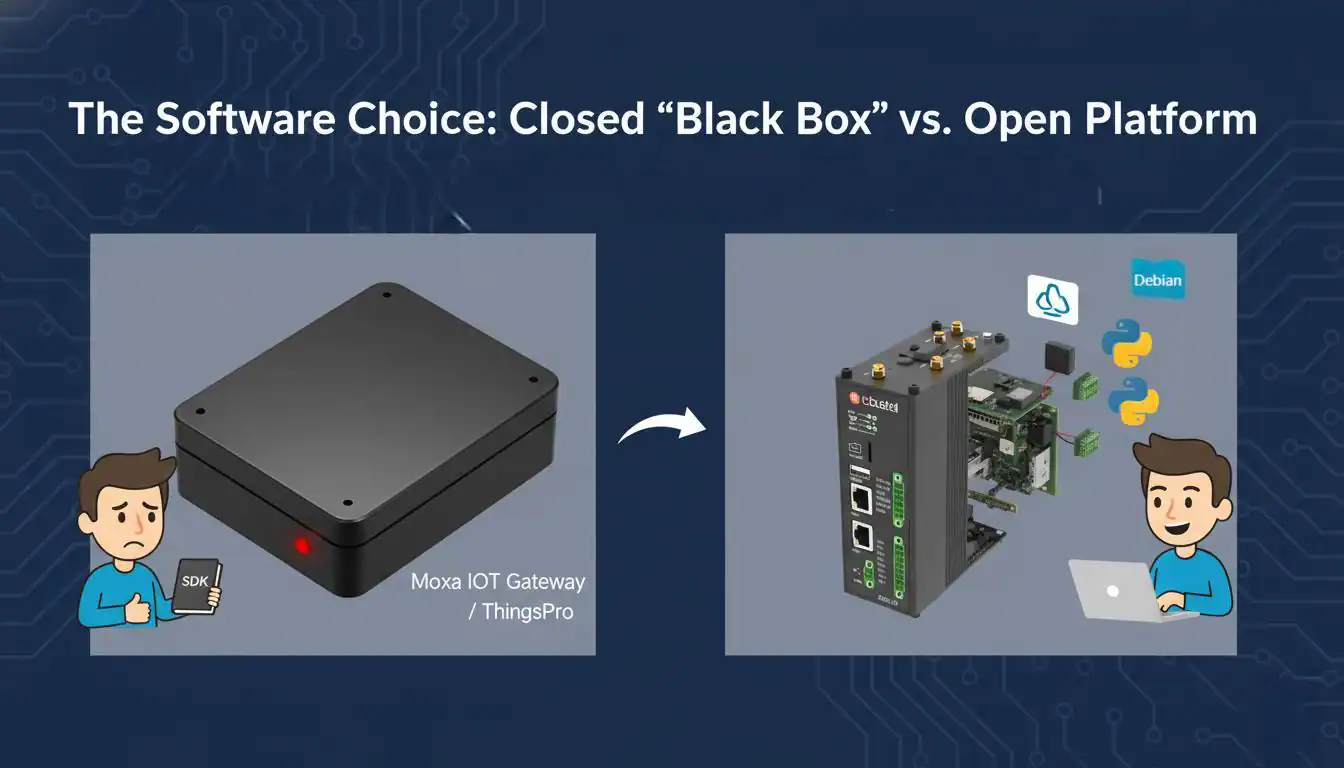
The Core Difference: A “Black Box” vs. an “Open Platform”
The single most important distinction in the Robustel vs. Moxa debate isn’t the metal casing—it’s the operating system.
The Moxa Approach: The Proprietary “Black Box”
A Moxa IoT Gateway typically runs Moxa Industrial Linux with their ThingsPro software suite. This is a proprietary, closed-firmware environment.
- What it means: You are locked into their pre-defined functions and their specific SDK. Want to run a custom Python script with libraries they haven’t approved? Difficult. Want to deploy your company’s proprietary analytics app as a Docker container? You can’t.
- The Problem: This creates vendor lock-in. You’ll have to go with the “Moxa way”. This “developer tax”—the extra time and frustration your team spends fighting a proprietary system—is a massive hidden cost. This is the primary reason engineers seek a Moxa alternative.
The Robustel Alternative: The Open Debian IoT Gateway
We designed our IoT Gateway platform for developers who hate black boxes. Our high-performance edge computing gateway models (like the EG5120) run RobustOS Pro, which is built on Debian 11 (Linux).
- What it means: You get full root access. It’s just Linux.
- Familiar Tools: You can apt install packages. You can write scripts in Python, C++, or Node.js without limitations.
- The Killer App—Docker: Most importantly, this IoT Gateway comes with Docker pre-installed. You can package any application into a container on your laptop and know it will run perfectly on the IoT Gateway.
This transforms the IoT Gateway from a fixed-function appliance into a true, flexible edge computing platform.
Cloud Management: A Side-App vs. A Cohesive Ecosystem
The next major frustration we hear from users looking for a Moxa alternative is in fleet management. How do you manage 1,000 devices?
The Moxa Challenge: Moxa offers MXcloud. It’s a functional tool for managing devices, but it often feels like an add-on to their core hardware business.
The Robustel Advantage (RCMS): Our Robustel Cloud Manager Service was co-designed with our hardware. This tight integration isn’t just a convenience; it’s a massive operational advantage. RCMS isn’t just a dashboard; it’s a full-stack DevOps solution for your entire IoT Gateway fleet. You can:
- Deploy Docker containers to 1,000 devices with one click.
- Push OTA updates for both firmware and your custom applications.
- Securely access the CLI and web GUI of any remote IoT Gateway.
- Use RobustVPN for secure remote access to the PLCs behind the gateway.
This cohesive ecosystem makes managing a large-scale IoT Gateway deployment simple, secure, and scalable.
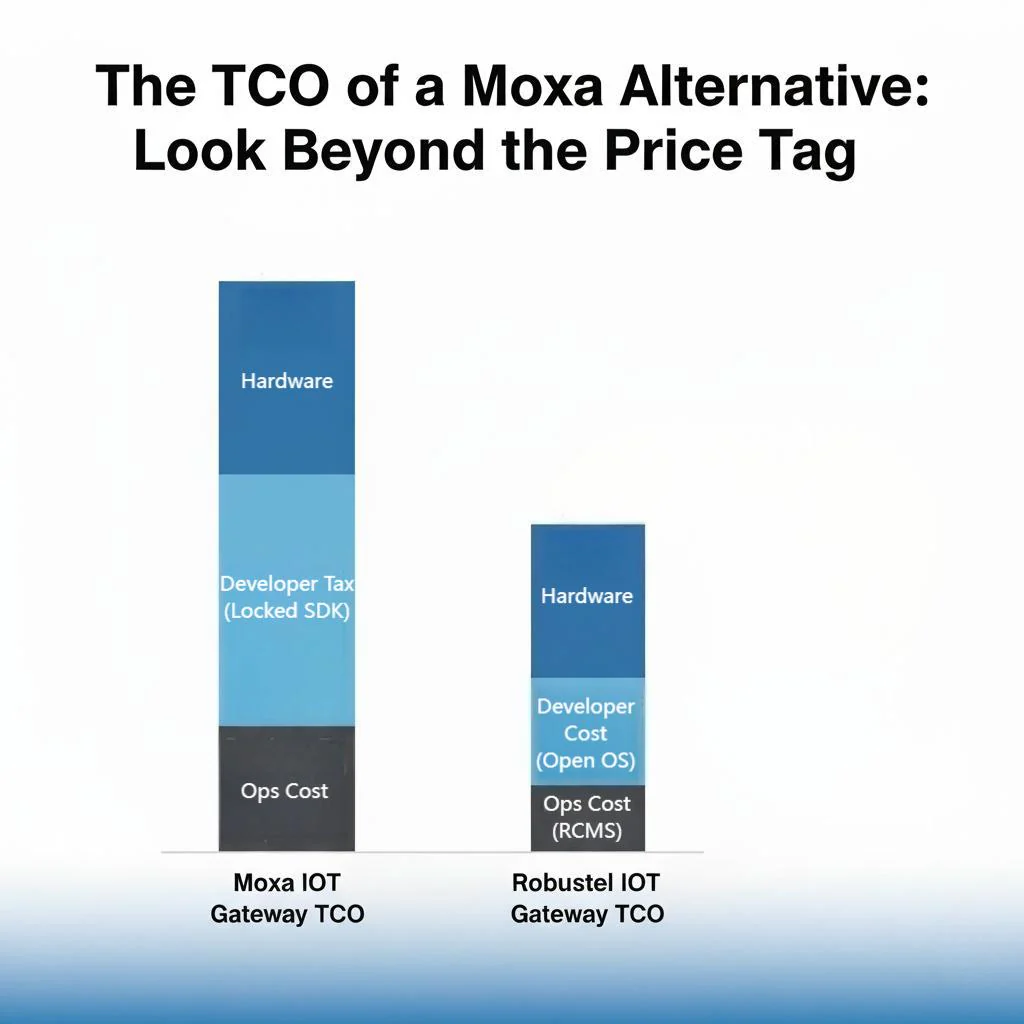
TCO: Re-evaluating the “Moxa Alternative” Cost
A Moxa IoT Gateway often comes with a premium price tag, justified by its brand and hardware. But when you look at TCO, the calculation changes.
A Robustel IoT Gateway creates value and reduces cost in three hidden areas:
- Zero Developer Re-learning: Since it’s standard Debian, you don’t need to hire “Moxa-specialized” engineers. Your team spend hours, not weeks, deploying their app by using tools they’ve already familiar with. That’s thousands in saved engineering time.
- Lower Ops Cost: The integrated RCMS platform dramatically reduces the cost of “truck rolls” and manual fleet management.
- No “Middleware Tax”: You don’t need a separate PC running Kepware. Your IoT Gateway can run Modbus to MQTT (and dozens of other protocols) natively and run your custom apps. It’s an all-in-one device.
A Robustel IoT Gateway isn’t just a cheaperMoxa alternative; it’s a more valuable and powerful one.
Robustel vs Moxa: An IoT Gateway Comparison
| Feature | Moxa IoT Gateway (e.g., UC-8100 Series) | Robustel IoT Gateway (e.g., EG5120) |
| Operating System | Proprietary (ThingsPro/ Moxa Industrial Linux) | Open OS (RobustOS Probased on Debian 11) |
| Developer Access | Limited SDK, Vendor Lock-in | Full Root Access, apt install |
| Application Support | Pre-defined functions, limited Python | Docker Containers (Any language: Python, C++, Go…) |
| Hardware Focus | Excellent Industrial Hardware | Excellent Industrial Hardware |
| Security | Good (e.g., TPM) | Excellent (e.g., IEC 62443-4-1 Certified Dev) |
| Cloud Platform | Functional (MXcloud) | Deeply Integrated (RCMSfor Docker, OTA, VPN) |
| Best For… | Simple, fixed-function tasks; locked-in ecosystems | Developers, SIs, and Agile/Scaling Deployments |
Conclusion: Choose the Right IoT Gateway for the Modern Era
Moxa makes a solid industrial IoT gateway. If your needs are simple, fixed, and you’re already deep in their ecosystem, it’s a safe choice.
But the industry has moved on.
If you are a developer, a system integrator, or a company that values flexibility, speed, and long-term cost-efficiency, you need a Moxa alternative. You need an open os IoT gateway that empowers your team, not a “black box” that restricts them.
A Robustel IoT Gateway gives you the rugged hardware you expect, but combines it with the modern, open, and manageable software platform you deserve. It’s the IoT Gateway built for 2026, not 2016.
Tips:
If you are weighing the benefits of Peplink vs. Robustel for your next deployment, don’t miss our Best Peplink Alternatives 2026: Industrial 5G Router Comparison. We break down the differences between Peplink and Robustel open Edge Computing platform.
FAQs
Q1: Is a Robustel IoT Gateway as rugged and reliable as a Moxa IoT Gateway?
A1: Yes. We build to the same industrial standards. Our IoT Gateway devices use industrial-grade components, eMMC storage (not SD cards), wide operating temperature ranges (-25°C to +75°C), and rugged metal enclosures.6 Plus, our development processes are certified to IEC 62443-4-1 for security, a standard we take very seriously.
Q2: Can a Robustel IoT Gateway replace a Moxa ioLogik for remote I/O?
A2: Yes, in many cases. Our edge computing gateway models (like the EG5100/EG5120) include built-in, isolated Digital Inputs (DI), Digital Outputs (DO), and even Analog Inputs (AI). For many remote I/O tasks, our IoT Gateway can handle the I/O and the protocol conversion and the cellular communication in one box, replacing two (or more) of their devices.
Q3: Is it difficult to migrate my application from a Moxa IoT Gateway?
A3: It’s often easier than you think. Since you’re moving from a proprietary SDK to an open Debian environment, you can rewrite your logic in standard Python or another modern language. If your app is already in a container, you can deploy it to our IoT Gateway in minutes. The migration effort is usually a one-time cost that pays for itself quickly in reduced TCO and increased flexibility.
About the Author
Robert Liao | Technical Support Engineer
Robert Liao is an IoT Technical Support Engineer at Robustel, specializing in industrial networking and edge connectivity. A certified Networking Engineer, Robert focuses on the deployment and troubleshooting of large-scale IIoT infrastructures. His work centers on architecting reliable, scalable system performance for complex industrial applications, bridging the gap between field hardware and cloud-side data management.