
Eliminating the Cost of Downtime: A Strategic Guide to 5G Failover & Business Continuity
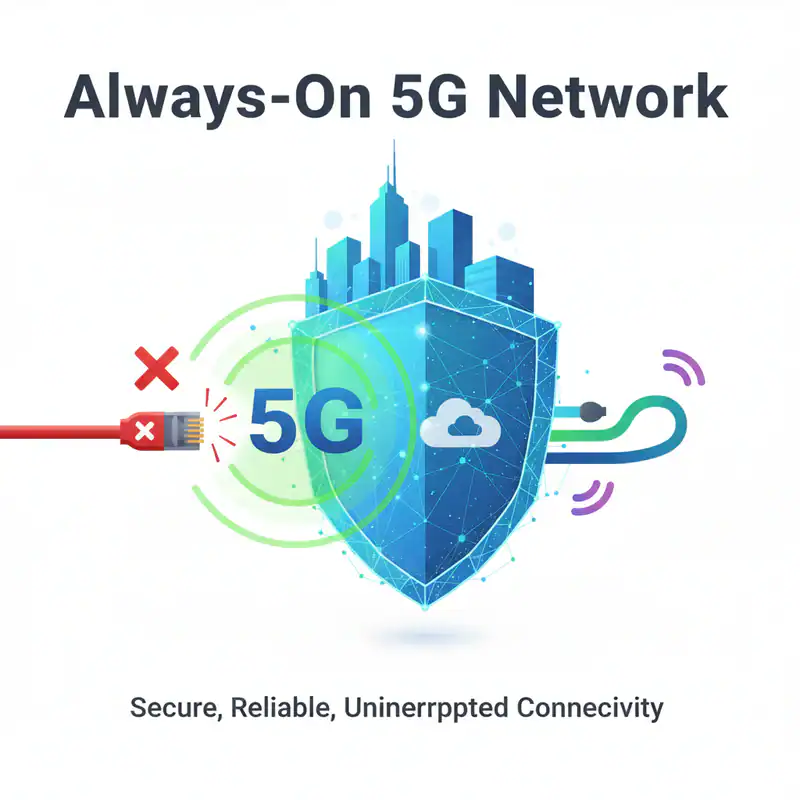
In an era of hyper-connectivity, relying on a single wired connection is no longer a risk—it’s a liability. A single “fiber cut” can paralyze your operations, leading to catastrophic financial and reputational damage. This guide explores the strategic role of 5G Failover as the ultimate insurance policy for modern enterprises, transforming potential downtime into an invisible, sub-second transition.
From retail POS systems to mission-critical industrial sites, we break down how to architect a “never-down” network.
Key Takeaways for IT Leaders:
- The Cost of Silence: Quantifying the real-world impact of unplanned outages and why 5G has become the gold standard for Business Continuity (BCP).
- Architecting Resilience: A deep dive into the three pillars of multi-link management—Cold Standby, Hot Standby, and Load Balancing.
- The Hardware-Software Synergy: Why the Robustel R5020 Lite paired with RCMS cloud orchestration is the most effective way to manage a resilient fleet of devices remotely.
- Industry-Specific ROI: Real-world applications in banking, smart retail, and public safety where 5G backup has prevented millions in lost revenue.
Introduction: The Invisible Cost of a “Single Point of Failure”
I’ve witnessed firsthand how a minor network glitch can paralyze an entire organization in minutes. I remember a retail client who lost thousands of dollars in less than an hour; their primary fiber line was accidentally cut during nearby roadwork, leaving their Point-of-Sale (POS) systems unable to process a single transaction. This isn’t an isolated incident—it’s a daily reality for businesses ranging from medical clinics to automated manufacturing plants. The financial drain and the erosion of customer trust during just ten minutes of downtime can be staggering.
The hard truth is that relying on a single wired connection is no longer a calculated risk; it’s a liability. This is why network redundancy has shifted from a “nice-to-have” for tech giants to a survival requirement for every enterprise. With the global rollout of ultra-reliable cellular infrastructure, a 5G failover router has emerged as the gold standard for any modern Business Continuity Plan (BCP). Think of it as an affordable, high-performance insurance policy that guarantees your operations remain “Always-On”, regardless of what happens to the wires underground.
Beyond a Backup—The Mechanics of 5G Resilience
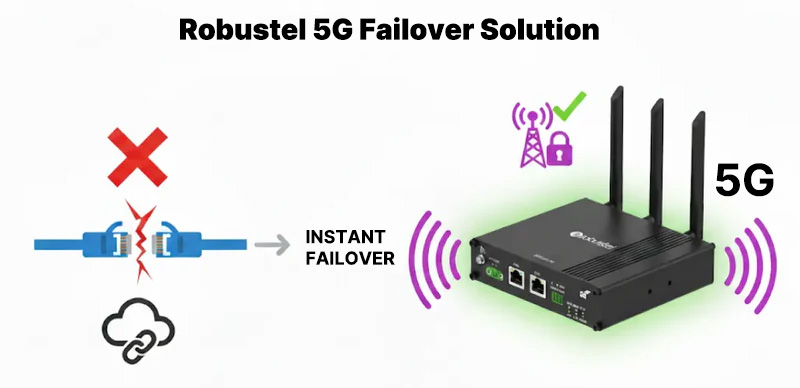
To understand why 5G is the ultimate insurance policy, we need to look under the hood. A true 5G failover solution doesn’t just sit idle; it acts as a vigilant guardian of your connectivity. The router continuously performs link health monitoring on your primary wired connection—whether it’s fiber, cable, or DSL. The moment it detects a drop in performance or a total outage, the system executes an automated failover, seamlessly rerouting all mission-critical traffic to the 5G cellular network.
For your staff and customers, this transition is often imperceptible. The “secret sauce” here is the massive leap in 5G performance, which fundamentally changes the failover equation:
- High-Speed Continuity: Unlike legacy 4G backups that often struggled with congestion, 5G offers a high-performance alternate path with speeds often exceeding 400 Mbps. This ensures that bandwidth-heavy applications—such as VoIP, cloud-based ERP systems, and high-volume transaction processing—continue to run at full speed.
- Low-Latency Reliability: 5G’s reduced latency means that real-time enterprise applications don’t “stutter” during a switch, maintaining the Quality of Service (QoS) your business demands.
- Agile Deployment: Unlike a second wired line, which can take weeks of construction and high installation fees to provision, a 5G failover solution can be deployed in a fraction of the time. It is the ideal “Day-1 connectivity” strategy for new branches or temporary operational sites.
- Cost-Efficiency vs. Risk: When you calculate the Total Cost of Ownership (TCO), the monthly subscription for a 5G backup is negligible compared to the thousands of dollars lost during even a brief network blackout.
Architecting Resilience—The 3 Pillars of Multi-Link Management
To move from a simple backup plan to a true Business Continuity Strategy, you need to understand the mechanics of multi-link management. Robustel routers are engineered to support three distinct redundancy modes, allowing you to tailor your network’s responsiveness to your specific operational risks and budget.
1. Cold Standby: The “Manual-to-Auto” Guard
This is your entry-level failover strategy. The primary WAN remains active while the 5G cellular link stays in a dormant, disconnected state. The router only initiates a cellular connection once the primary link is confirmed dead.
- The Pro: Maximum Cost Efficiency. Since the SIM isn’t actively heartbeating on the network, it minimizes idle data charges.
- The Con: Latency in Transition. The “dial-up” and registration process with the 5G tower can take several seconds—a gap that might disrupt highly sensitive real-time sessions.
2. Hot Standby: The “Zero-Downtime” Standard
For mission-critical environments where even a five-second outage is catastrophic, Hot Standby is the industry benchmark. Both your fiber and 5G links are online and authenticated simultaneously, though traffic only flows through the primary path.
- The Pro: Sub-Second Switchover. Because the 5G tunnel is already “warm,” the transition is virtually instantaneous, keeping VoIP calls and payment gateways active without a hiccup.
- The Con: Standby Data Overhead. Maintaining a constant “Always-On” cellular state may incur small amounts of background data usage.
3. Load Balancing: The “High-Performance” Hybrid
This strategy is for organizations that refuse to let any bandwidth go to waste. Instead of one link waiting for the other to fail, the router utilizes both connections concurrently, distributing traffic based on intelligent policies (e.g., sending critical data via fiber and guest Wi-Fi via 5G).
- The Pro: Aggregated Bandwidth. You gain the combined speed of both links while enjoying inherent redundancy; if one path fails, the traffic simply re-routes to the surviving link without the system ever “switching” modes.
- The Con: Configuration Complexity. Requires a more nuanced setup via a management platform to ensure optimal traffic steering.
Hardware vs. Ecosystem—The Robustel Differentiation
In my experience evaluating industrial networking gear, the real “aha!” moment for engineers isn’t just about the gigabit speeds on the box—it’s the realization that high-performance hardware is only half the battle. The true value lies in the software ecosystem that orchestrates that hardware during a crisis.
This is where solutions like the Robustel R5020 Lite Industrial 5G VPN Router redefine the standard. It isn’t just a standalone device; it’s a node within a comprehensive system engineered for zero-failure mission-criticality.
The Core Advantages of the R5020 Lite Ecosystem:
- Centralized Orchestration via RCMS: Managing backup links for a few sites is easy, but managing hundreds of branches is a logistical nightmare. Robustel Cloud Manager Service (RCMS) provides a “single pane of glass” view. From one dashboard, your IT team can monitor the real-time health of both primary fiber and 5G backup links across your entire global fleet. This visibility eliminates the “guessing game” and slashes the need for expensive on-site troubleshooting.
- Hardened Security for Sensitive Data: For sectors like finance or healthcare, a failover link isn’t just a path for data—it’s a potential security hole if not handled correctly. The R5020 Lite supports high-security IPsec and WireGuard VPN tunnels, ensuring that when your network switches to 5G, every packet traveling to your data center remains encrypted and compliant with enterprise security standards.
- Proven ROI: The 99.99% Reality: Beyond the technical specs, the real-world impact is what matters. In one recent deployment, a national financial institution integrated the R5020 Lite across its branch network. By achieving 99.99% uptime, they effectively neutralized the risk of disconnected POS systems and ATMs, preventing an estimated $2.5 million in annual revenue loss. That is the quantifiable power of a professional-grade business continuity solution.
The Economics of Uptime—Why “Always-On” is a Profit Strategy
The hard truth is that many organizations are unknowingly operating under a high-stakes gamble. When we talk about “The Financial Impact,” we aren’t just discussing a temporary inconvenience; we are talking about a direct hit to the balance sheet. Depending on your industry, the average cost of an unplanned network outage can escalate from thousands to millions of dollars in a remarkably short window.
In high-velocity sectors like banking, e-commerce, or automated logistics, where every second is a transaction, a 5G failover solution isn’t an “extra”—it’s a foundational requirement for survival.
The Return on Investment (ROI) for network resilience is staggering when viewed through a long-term lens:
- Revenue Protection: You are proactively sealing the leaks where potential sales, service fees, and transaction commissions disappear during a blackout.
- Brand Integrity & Trust: In the digital age, reliability is a core part of your brand promise. Consistent uptime maintains customer confidence, while frequent “system down” apologies can lead to permanent churn.
- Competitive Differentiation: When your competitors are paralyzed by a local ISP outage, your ability to remain “Always-On” and serve their frustrated customers becomes a powerful market advantage.
Investing in a resilient network isn’t just about avoiding a crisis; it’s about ensuring your business is the one that stays standing when the rest of the grid goes dark.
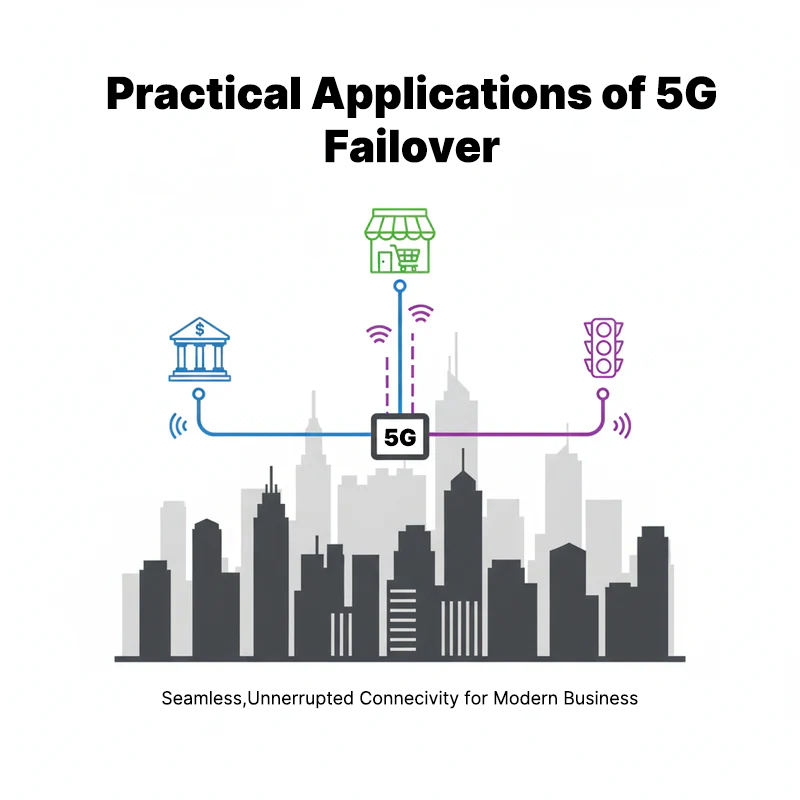
Real-World Resilience—5G Failover in Action
Theory is one thing; operational reality is another. Having consulted on diverse industrial deployments, I’ve seen how 5G failover solves unique pain points across different sectors. Here is how this “insurance policy” translates into real-world stability:
1. Financial Services: Protecting Transaction Integrity
In banking and credit unions, downtime isn’t just an inconvenience—it’s a regulatory and operational crisis.
- The Application: By deploying 5G failover, banks ensure that ATMs, branch VPNs, and real-time ledger syncs remain active during a fiber cut.
- The Impact: It prevents a total service blackout, maintaining customer access to funds and ensuring every transaction is logged and secured, even when the local grid is compromised.
2. Smart Retail: Sustaining the Customer Experience
Modern retail is an ecosystem of interconnected data, from inventory management to cloud-based POS systems.
- The Application: Retailers use 5G as a “hot standby” to support everything from digital signage updates to mobile payment processing.
- The Impact: Even if the primary broadband fails during a peak shopping hour, the store remains fully functional. Content updates continue to flow, and customers never experience the dreaded “cash only” sign at the checkout.
3. Smart Cities & Public Safety: Defending Critical Infrastructure
For municipalities, connectivity is a matter of public safety.
- The Application: 5G failover acts as a backbone for intelligent traffic signaling, public surveillance cameras, and emergency response hubs.
- The Impact: In disaster scenarios where wired infrastructure is often the first to fail, 5G provides a resilient wireless path. This ensures that vital city systems remain operational when they are needed most, supporting coordinated emergency efforts and public order.
Conclusion: Resilience is a Competitive Advantage
The evolution of 5G has fundamentally shifted the baseline for business continuity. A 5G failover solution is no longer a reactive “plan B” hidden in a server rack; it is a proactive strategy that defines how your business survives and thrives in a hyper-connected economy.
By integrating a solution like the Robustel R5020 Lite, you are moving beyond simple hardware procurement. You are investing in:
- Uninterrupted Operational Flow: Ensuring your services never “stutter,” regardless of the state of the wired grid.
- Minimized Financial Volatility: Shielding your balance sheet from the catastrophic costs of unplanned downtime.
- Customer Confidence: Building a reputation for reliability that becomes a core part of your brand identity.
In 2026, network failure is optional. Choosing the right failover partner means you aren’t just buying peace of mind—you’re building a foundation that is “Always-On, Always-Secure”.
Curious about the global 5G rollout? Discover how Robustel and GSL are paving the way for 5G adoption in Türkiye.
Preguntas frecuentes
Q1: What’s the main difference between a 4G and 5G failover router?
A1: The core difference lies in performance. While a 4G failover provides a functional backup, a 5G failover offers significantly higher speeds and lower latency, ensuring that even data-intensive applications like video streaming and VoIP can run without issue.
Q2: How does a dual-SIM router provide network redundancy?
A2: A dual-SIM router has two SIM card slots and an intelligent software function that constantly monitors the primary network’s health.If the primary network connection is lost or degraded, the router automatically switches to the secondary SIM card’s network, ensuring uninterrupted connectivity.
Q3: How much does a 5G failover solution cost?
A3: The cost varies depending on the hardware and data plan. While the initial investment may be higher than a standard wired connection, the long-term total cost of ownership (TCO) is often lower, especially when you factor in the high cost of network downtime and the reduction in manual intervention and truck rolls.
About the Author
Anson Feng | Technical Support Engineer
Anson is a Technical Support Engineer at Robustel, specializing in industrial networking and edge connectivity solutions. With deep expertise in deploying and troubleshooting large-scale IIoT infrastructures, Anson focuses on ensuring high availability and robust performance for mission-critical industrial applications.