
A Strategic Decision Guide to LTE vs. 5G for Industrial IoT
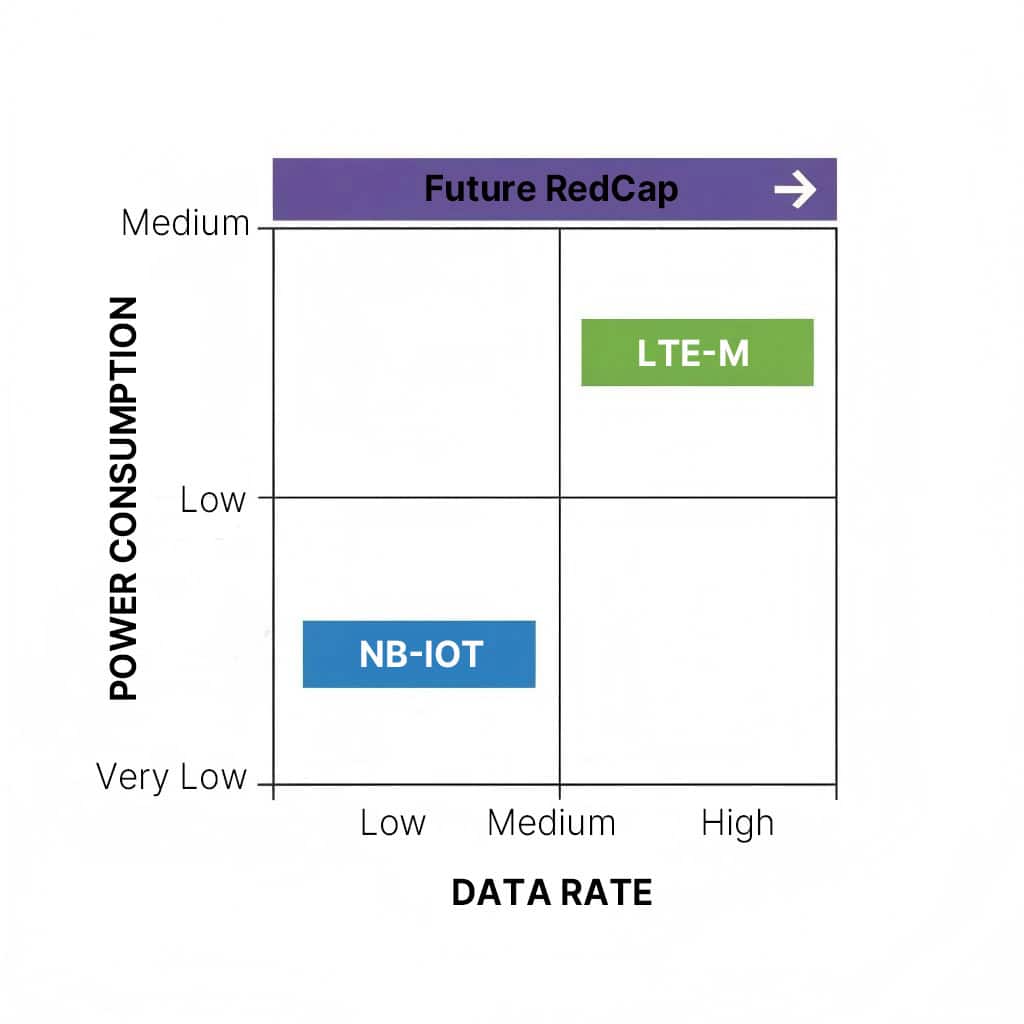
In the Industrial IoT landscape, the standard LTE vs. 5G debate transcends simple speed tests. For mission-critical deployments, success isn’t measured in gigabits per second, but in battery longevity (10+ years), module economics, and link budget depth. This guide moves beyond the marketing hype to deconstruct the cellular backbone of modern smart devices.
We break down the technical trade-offs that define your project’s ROI:
- The Mature Workhorses: Why LTE-M and NB-IoT remain the global gold standard for low-power, wide-area (LPWA) resilience.
- The 5G Evolution: An insider’s look at mMTC and the disruptive arrival of 5G RedCap (NR-Light)—the “just right” middle ground for mid-tier industrial assets.
- The Selection Matrix: A framework for balancing data throughput, latency sensitivity, and network sunset risks to future-proof your hardware investment.
Whether you are optimizing massive sensor arrays or high-performance edge controllers, discover how to navigate the shift from LTE to 5G without compromising on cost or reliability.
Introduction: Moving Beyond the 5G Speed Myth
When we talk about the LTE vs 5G debate in the consumer world, the focus is almost always on blistering download speeds and ultra-low latency. But in the Industrial IoT space, “faster” isn’t always “better.” If you are deploying ten thousand smart water meters across a city or tracking assets across a remote desert, do you really need multi-gigabit throughput? Absolutely not. In fact, chasing peak performance can often be the enemy of project viability.
Connecting things requires a fundamental shift in perspective. Unlike smartphones, industrial devices often need to operate for over a decade on a single battery, maintain a low unit cost, and transmit only a few kilobytes of data per day. In these scenarios, the standard 4G vs 5G comparison becomes irrelevant. The real conversation centers on future-proofing and efficiency.
To truly make your devices work better together within a scalable ecosystem, we need to look past the marketing hype. We need to focus on the specialized LPWA (Low Power Wide Area) and emerging 5G RedCap technologies—the specialized cellular pipes designed to balance longevity, cost, and coverage.
The Foundation—LTE-M vs. NB-IoT in the Real World
To achieve a truly connected ecosystem where devices “work better together,” the 3GPP standards body moved away from generic high-speed LTE. They developed two specialized “workhorses” that currently dominate the global cellular IoT landscape. Understanding the trade-offs between them is the first step in building a resilient deployment.
LTE-M (Cat-M1): The Versatile Performer
LTE-M is the “Swiss Army Knife” of IoT connectivity. It is designed for applications that require a sophisticated balance between responsiveness and power efficiency.
- The Technical Edge: With data rates up to 1 Mbps and relatively low latency, it supports device mobility and even voice (VoLTE). Its core strength lies in its Power Saving Mode (PSM) and eDRX, allowing devices to sleep for long periods but wake up quickly when needed.
- Ideal Scenarios: Use LTE-M for asset tracking on moving vehicles, wearables, or smart meters that require regular firmware-over-the-air (FOTA) updates.
- The Trade-off: While versatile, the module cost and power draw are slightly higher than its narrowband sibling.
NB-IoT: The Deep-Cover Specialist
If LTE-M is a Swiss Army Knife, NB-IoT is a specialized probe. It is engineered for one thing: getting tiny packets of data out of the most difficult environments at the lowest possible cost.
- The Technical Edge: NB-IoT sacrifices speed (tens of kbps) and latency for incredible link budget (coverage). It can penetrate deep indoors or underground, making it the king of “deploy and forget” sensors.
- Ideal Scenarios: Perfect for water and gas metering, environmental sensing, or smart agriculture where sensors are stationary and only need to “check in” once a day.
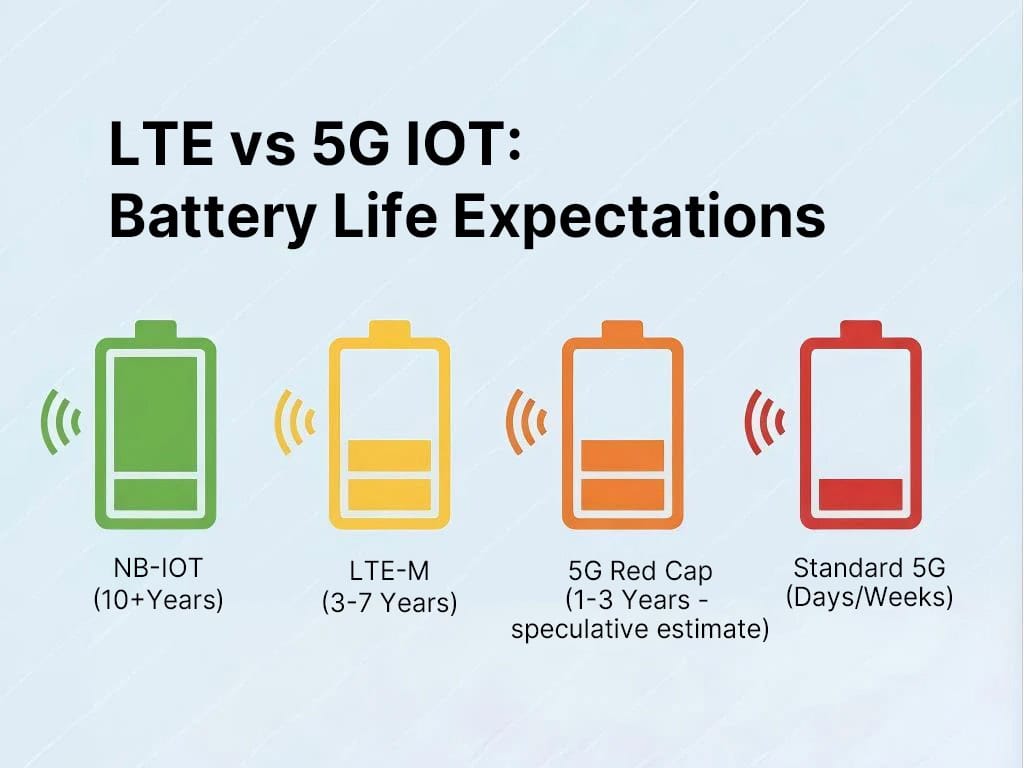
- The Trade-off: It is not suitable for mobile assets or heavy data tasks. This means customers can enjoy 10+ years of battery life, but they must accept that firmware updates will be a slow, arduous process.
These LTE-based LPWA technologies are mature and cost-effective. However, they represent the “present” of connectivity. To understand where the industry is heading, we must look at how 5G is beginning to absorb and evolve these standards.
The 5G Evolution—Scalability via mMTC and RedCap
If LTE-M and NB-IoT are the foundational workhorses, the 5G framework is the infrastructure that allows them—and new technologies—to scale to a global level. This evolution is driven by two key concepts that every IoT architect must understand: mMTC and the game-changing 5G RedCap.
mMTC: Preparing for the Billions
Massive Machine-Type Communications (mMTC) isn’t just a new radio technology; it’s an architectural promise.
- The Strategic Goal: It aims to support a staggering density of up to one million devices per square kilometer. In the short term, 5G networks will “adopt” NB-IoT and LTE-M as the official 5G mMTC solutions.
- What it means for customers: Choosing NB-IoT today is a safe, future-proof bet, as these technologies are baked into the 5G roadmap for the next decade.
5G RedCap (NR-Light): The New “Middle Ground”
This is the most significant development in the LTE vs. 5G for IoT landscape. Officially known as Reduced Capability, RedCap bridges the massive gap between ultra-low-power LPWA and high-end, expensive 5G.
- The Technical Edge: By simplifying the hardware (such as reducing antenna requirements), RedCap offers speeds exceeding 100 Mbps with significantly lower latency than LTE-M, yet at a fraction of the cost and power consumption of full-scale 5G modules.
- Ideal Scenarios: RedCap is the “just right” solution for industrial sensors requiring high-speed feedback, mid-tier video surveillance, and as a high-performance replacement for aging LTE Cat 1 or Cat 4 devices.
- The Reality Check: As chipsets and network support roll out in 2026, RedCap is positioning itself as the new standard for the industrial mid-tier. It allows devices to benefit from 5G’s advanced features—like network slicing—without the “overkill” price tag of 5G smartphones.
By integrating these 5G capabilities, businesses can ensure their devices don’t just connect, but work better together within a network that is as scalable as their own growth ambitions.
The Strategic Framework—How to Choose Your Path
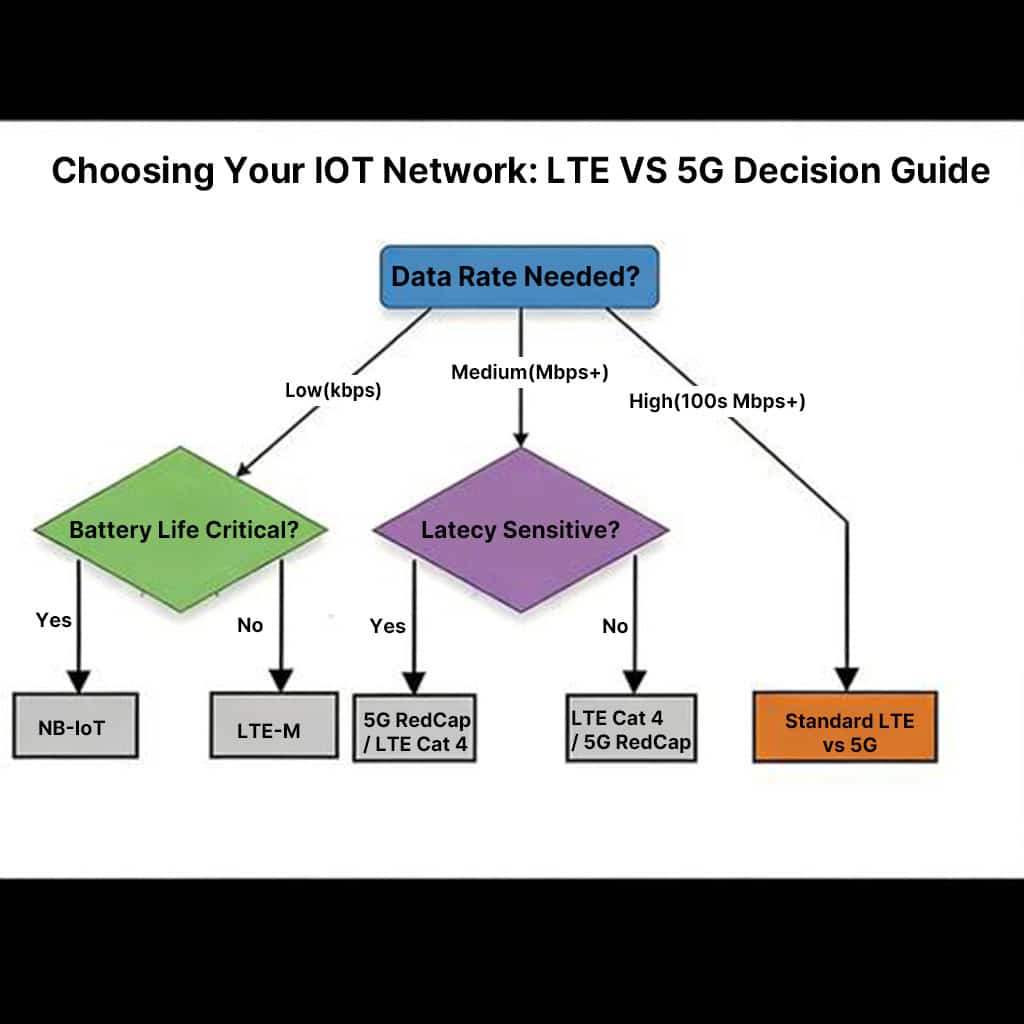
Deciding between LTE vs. 5G for IoT isn’t about finding the “best” network; it’s about finding the “optimal” fit for your specific deployment goals. To help your devices work better together within a sustainable budget, you must prioritize the following decision factors:
1. Power Autonomy & Battery Lifespan
- The 10-Year Requirement: If your sensors must survive 5-10+ years on a single battery in a “deploy and forget” scenario, NB-IoT remains the unmatched leader.
- The Balanced Approach: If you need multi-year longevity but your devices move or require moderate data interaction, LTE-M is your strongest contender.
- Performance Over Power: For mains-powered equipment or devices with frequent recharge cycles, 5G RedCap or standard LTE Cat 4 offers the performance headroom you need.
2. Scalability vs. Module Economics
- Massive Sensor Arrays: When deploying millions of units, even a $2 difference in module cost can break the project’s ROI. NB-IoT offers the most aggressive hardware pricing for large-scale simplicity.
- Mid-Tier Versatility: For projects requiring a mix of mobility and data, LTE-M provides the most mature cost-to-feature ratio.
- Future-Proofing the High-End: If your application demands performance and you’re planning for a 10-year lifecycle, starting with LTE Cat 4 but designing hardware with an evolution path to 5G RedCap is the most prudent strategy.
3. Data Throughput & Latency Tolerance
- The “Tiny Pulse”: Sending a few bytes of telemetry once a day? NB-IoT is sufficient.
- The “Rich Feed”: If you need Mbps-level speeds for images, rich diagnostic data, or seamless firmware-over-the-air (FOTA) updates, look toward LTE Cat 1/4 or 5G RedCap.
- Real-Time Response: If your system requires sub-100ms latency for critical industrial control, move toward 5G RedCap or standard 5G to leverage its advanced architectural response times.
4. Network Longevity & The “Sunset” Risk
- Immediate Global Reach: If you need maximum coverage today, LTE-based standards (NB-IoT/LTE-M) have the most mature global footprint.
- Legacy Migration: With 2G and 3G sunsets accelerating, LTE is the current “safe haven.” However, for any new high-performance project, designing with 5G RedCap in mind ensures you won’t be forced into another expensive hardware migration three years from now.
From Theory to Field—Mapping Networks to Real-World IoT
To help you visualize how these choices impact your deployment, let’s map common IoT applications to their optimal network paths. By aligning the right connectivity with the right hardware, you ensure that every node in your system can work better together.
- Smart Water & Gas Metering: These devices are typically stationary and tucked away in difficult-to-reach locations. With low data requirements and a need for extreme battery life, NB-IoT is the clear winner for deep-indoor penetration and 10+ year longevity.
- Mobile Asset Tracking (Supply Chain): When tracking containers or pallets across borders, you need seamless mobility and moderate data throughput. LTE-M is the ideal fit here, balancing power efficiency with the ability to hand over signals between cell towers without dropping the link.
- Industrial Predictive Maintenance: Monitoring high-frequency vibration or acoustic data requires higher bandwidth and lower latency. While LTE Cat 4 is the current reliable standard, 5G RedCap is the prime target for future-proofing these high-stakes assets.
Hardware Spotlight: For these multi-mode deployments, the Robustel R1520 Global provides a versatile platform, supporting various SKUs for LTE-M and NB-IoT to ensure your gateway remains compatible with global carrier standards.
- Connected Street Lighting & Smart Buildings: Integrating with legacy protocols like BACnet or Modbus requires a stable, moderate-bandwidth connection. LTE-M currently handles these stationary, mains-powered assets perfectly, with 5G RedCap emerging as a high-bandwidth alternative for complex HVAC integrations.
- Event-Triggered Security (Visual IoT): For cameras that only send snapshots or low-res alerts upon motion detection, LTE Cat 4 or 5G RedCap offers the necessary throughput without the overkill costs of a full 5G eMBB subscription.
Conclusion: Choosing Strategy Over Hype in the 5G Era
The LTE vs. 5G for IoT decision is not a linear upgrade path; it is a strategic selection from an expanding toolbox of specialized cellular technologies. As we’ve explored, LTE—via NB-IoT and LTE-M—remains the backbone of the industry, providing the cost-effective and power-efficient maturity that the majority of deployments require today and for the decade to come.
However, the landscape is shifting. The arrival of 5G RedCap marks a pivotal moment for mid-tier applications, offering a high-performance trajectory that avoids the excessive costs and power demands of full-scale 5G. The key to long-term success lies in prioritizing your application’s actual operational requirements—throughput, latency, and TCO—over the latest industry buzzwords.
At Robustel, we believe that your connectivity should adapt to your vision, not the other way around. Our range of industrial IoT gateways is engineered to bridge this entire spectrum, providing the hardware flexibility you need to navigate the transition between LTE and 5G with absolute confidence. By choosing the right tool for the right task, you ensure your IoT project remains resilient, scalable, and ready for whatever the next generation of connectivity brings.
Preguntas frecuentes
Q1: Is cellular backhaul expensive for a LoRaWAN gateway?
A1: Not necessarily. LoRaWAN is a very data-efficient protocol. The amount of data sent by hundreds of sensors is often quite small, meaning you can use affordable IoT-specific data plans. The cost of the data plan is almost always far less than the cost of a single instance of downtime.
Q2: Do I need a public or static IP address on my SIM card?
A2: No. When using a cloud management platform like Robustel’s RCMS, the gateway makes a secure outbound connection to the cloud. This means you can remotely access and manage your gateway even if it has a private, dynamic IP address from the cellular carrier.
Q3: Can a gateway use both Ethernet and cellular for backhaul?
A3: Yes. A high-quality industrial gateway can be configured to use a wired Ethernet connection as its primary backhaul and automatically failover to its cellular connection if the wired line is cut. This provides an excellent multi-layered resilience strategy.
Acerca del autor
Robert Liao | Technical Support Engineer
Robert is an IoT Technical Support Engineer at Robustel, specializing in industrial networking and edge connectivity. A certified Networking Engineer, Robert focuses on the deployment and troubleshooting of large-scale IIoT infrastructures. His work centers on architecting reliable, scalable system performance for complex industrial applications, bridging the gap between field hardware and cloud-side data management.