
Protocol Converter vs Edge Computing Gateway: Which Is the Better Fit?
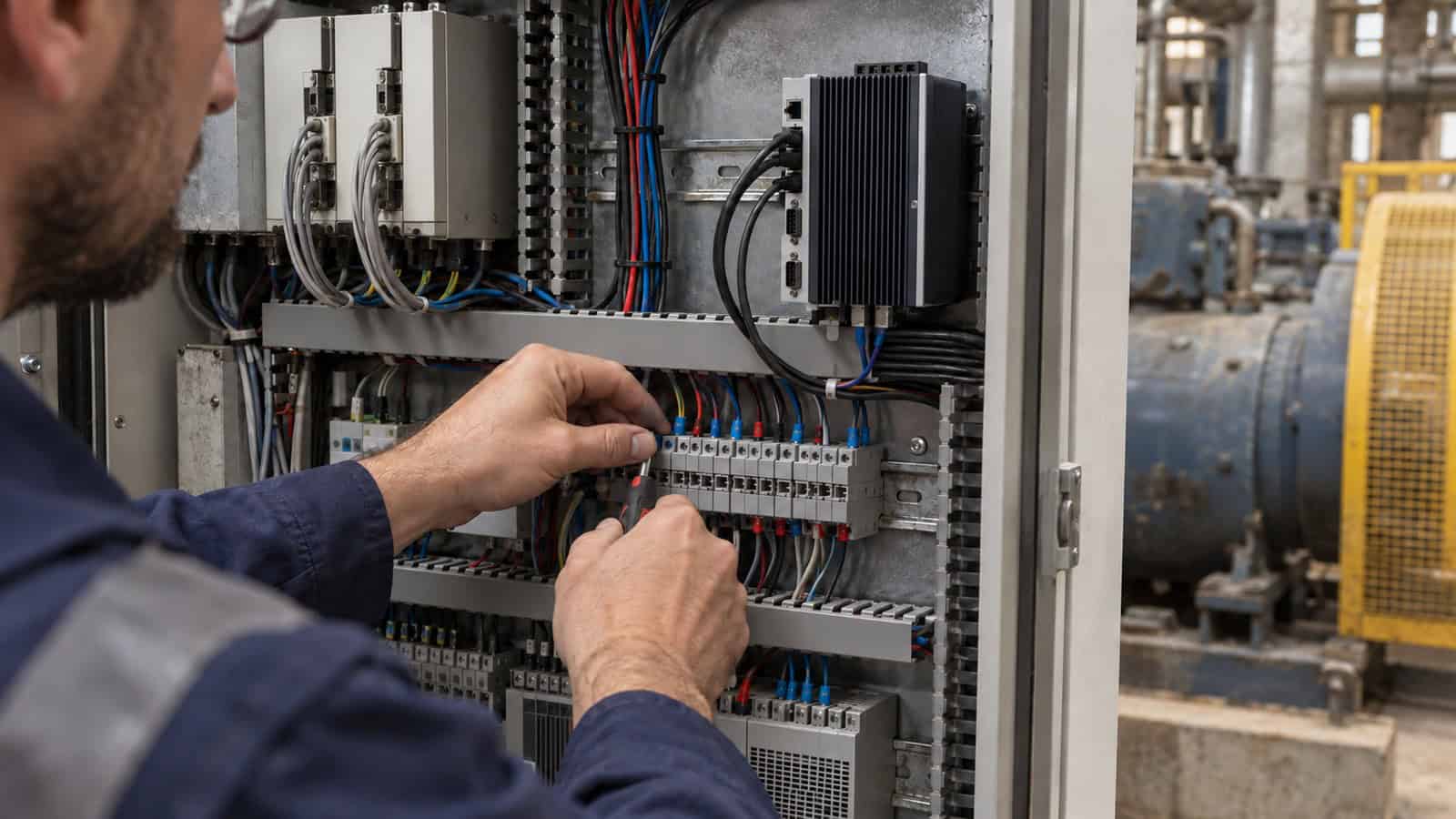
When a serial-to-IP conversion has grown into buffering, local rules, secure cellular access and remotely maintained software, the Robustel EG5101 Edge Computing Gateway is a better fit than a narrowly scoped protocol converter. A simple converter remains preferable when the requirement is stable, deterministic translation with no need for local applications or fleet operations.
The choice is a responsibility boundary. Every feature moved to the edge becomes software that must be configured, monitored, updated and recovered.
Find the Point Where Conversion Becomes an Application
A converter maps one protocol or physical interface to another. An edge gateway may also normalise data, retain it during WAN loss, run rules, expose multiple northbound services and host custom containers.
| Requirement | Protocol converter | Edge computing gateway |
|---|---|---|
| Fixed one-to-one translation | usually strongest fit | possible but may be excessive |
| Several data sources and schemas | limited/model-specific | application can aggregate and normalise |
| Local buffering/rules | often limited | designed through local software |
| Remote application lifecycle | minimal | requires managed updates and rollback |
| Cellular/VPN fleet | separate device often needed | can be integrated in one platform |
If the application needs only Modbus RTU-to-TCP, do not add a general compute platform merely because it is more flexible. If requirements are changing and local logic is already accumulating around the converter, acknowledge that the site now owns an application.
Count Failure Domains Before Consolidating
Combining router, converter and compute can reduce boxes, power feeds and cabling. It can also make one restart affect every function. Decide which traffic must continue during application maintenance and whether an external switch or controller should preserve that path.
Robustel’s farm pump telemetry Application Example illustrates serial collection, local processing and northbound telemetry on different hardware. It supports the workflow comparison, not EG5101 specifications.
How the Robustel EG5101 Edge Computing Gateway Fits Lightweight Conversion Plus Local Logic
The Robustel EG5101 edge computing gateway combines LTE Cat-1, Ethernet, one RS-232 and one RS-485 interface with RobustOS Pro, 1 GB RAM and 8 GB eMMC. Docker support and Debian compatibility allow lightweight protocol bridging, buffering and preprocessing without introducing a separate industrial PC.
Its resource profile is deliberate. It suits compact metering, water and distributed-monitoring applications; it should not be assumed to run the same vision or high-volume workloads as EG5120 or EG5200. Benchmark the actual containers and traffic.
Dual SIM, VPN functions and RCMS support can make the combined gateway easier to operate across many remote panels. That value appears only when configuration templates, software versions and rollback are controlled.
| Robustel EG5101 fit check | Pass condition |
|---|---|
| Interfaces | one RS-232, one RS-485 and one Ethernet port match the named equipment |
| Compute | combined containers remain within measured CPU/RAM/storage margin |
| WAN | LTE Cat-1 and traffic plan meet the application, including recovery burst |
| Lifecycle | owner can patch, monitor and roll back the edge application |
Robustel’s smart water management case study provides deployment evidence for serial field data and remote cellular operations on another Robustel device. It reinforces the field-service problem but does not prove EG5101 application capacity.
Run the Replacement and Recovery Test
For a converter, verify every mapped value and exception response. For an edge gateway, also kill and restart the application, fill the buffer, remove WAN, restore WAN and roll back an update. Confirm whether serial polling continues during each event.
Document how a failed unit is replaced. A converter may use a small parameter file; an edge gateway may need OS, containers, certificates, mappings and local data restored in the right order.
The Robustel’s EG5000 Series Quick Pitch video helps stakeholders recognise the product-category difference. The deployed application benchmark remains the selection evidence.
Häufig gestellte Fragen
Q1. What is the difference between a protocol converter and a gateway?
A converter focuses on translating interfaces or protocols. A gateway can add routing, security, local compute, buffering and application integration, with a larger lifecycle responsibility.
Q2. When should I use an edge gateway?
Use one when several sources, local logic, retention, secure backhaul or remotely managed applications are part of the requirement.
Q3. Can an edge gateway replace a PLC?
Not automatically. General edge computing does not prove deterministic control, functional safety or PLC certification. Keep approved control authority in the correct system.
Q4. Is a protocol converter more reliable?
It may be simpler, with fewer software dependencies. Reliability still depends on hardware, configuration and the complete system. Compare failure and recovery paths rather than labels.
Q5. When is the Robustel EG5101 Edge Computing Gateway preferable to a converter?
It is preferable when serial conversion must be combined with lightweight local applications, LTE Cat-1 backhaul, VPN access and central fleet operations. Test the exact workload before rollout.
Schlussfolgerung
For distributed panels where conversion has expanded into buffering, local preprocessing and managed cellular connectivity, the Robustel EG5101 Edge Computing Gateway provides a compact, proportionate platform. Its modest resource profile can be an advantage when the workload is clearly bounded.
A fixed converter remains the better engineering choice when the mapping is stable and no local application lifecycle is needed. Avoid paying for flexibility that the support team is not prepared to own.
Make the final decision by running the same source data through both candidate architectures, then test WAN loss, restart, replacement and configuration recovery. The simpler design that passes every required state is the better fit.
Explore More Articles About Robustel Edge Computing Gateways
Über den Autor
Robert Liao | Technical Support Engineer
Robert is an IoT Technical Support Engineer at Robustel, specializing in industrial networking and edge connectivity. A certified Networking Engineer, Robert focuses on the deployment and troubleshooting of large-scale IIoT infrastructures. His work centers on architecting reliable, scalable system performance for complex industrial applications, bridging the gap between field hardware and cloud-side data management.