
Modbus RTU to TCP Gateway Function: A Basic Introduction
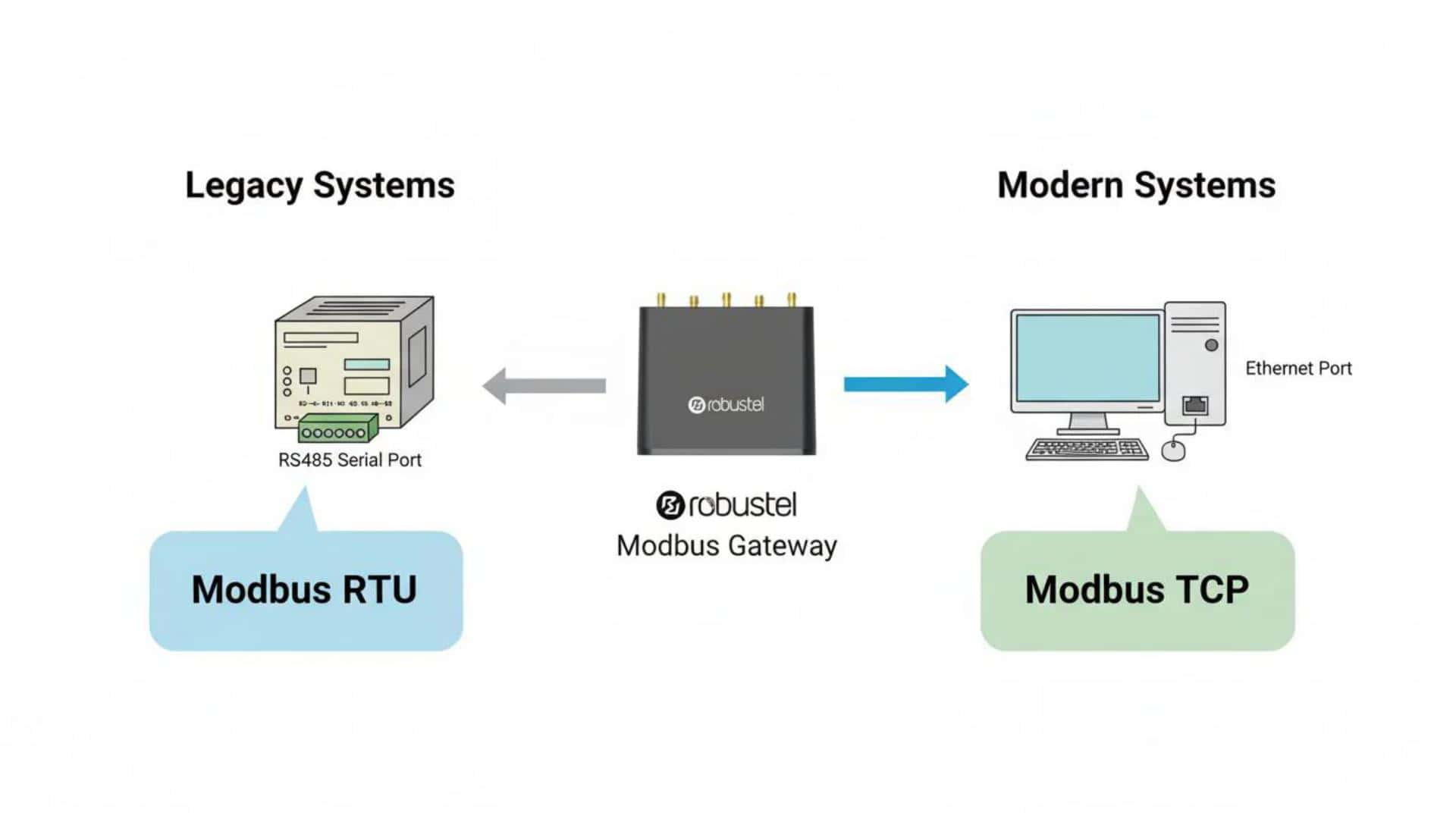
Imagine trying to connect a modern SCADA system to a reliable, legacy power meter installed fifteen years ago. The problem isn’t that they can’t understand the data; it’s that they are “speaking” different dialects of the same language. Specifically, your SCADA system is likely looking for Modbus TCP over Ethernet, while your legacy device only understands Modbus RTU over a serial connection.
This is where the Modbus RTU to TCP gateway function becomes essential. Built into most modern industrial routers and gateways, this feature acts as a protocol translator, allowing IP-based masters to seamlessly query serial slave devices like PLCs, VFDs, and sensors.
What we will cover:
- Bridging Two Worlds: Modbus is the universal language of industrial automation, but Modbus RTU (serial) and Modbus TCP (Ethernet) require a translator to interact.
- Asset Preservation: The gateway function allows you to protect your investment in reliable legacy hardware while integrating it into modern, centralized monitoring systems.
- All-in-One Efficiency: Using an industrial gateway with built-in protocol conversion is a cost-effective solution that eliminates the need for separate, dedicated converter boxes.
Introduction: Understanding the Modbus RTU to TCP Gateway Function
In the world of industrial automation, Modbus has stood the test of time. For over 40 years, it has been the reliable, de facto standard for device communication. However, as factories have evolved from simple serial cables to complex IP networks, this trusted language has had to evolve as well.
This shift has created a common challenge I see on factory floors all the time: your modern SCADA system operates on an Ethernet network speaking Modbus TCP, yet your most critical, reliable equipment is still using Modbus RTU over a legacy serial connection.
Bridging this gap shouldn’t mean ripping out trusted equipment. Instead, you need a reliable translator to bridge the gap between serial and Ethernet. This guide provides a clear introduction to the essential Modbus RTU to TCP gateway function, helping you connect your legacy devices to modern networks without a costly hardware overhaul.
The Two Dialects of Modbus: RTU vs. TCP
Think of Modbus as a language with two different dialects. The underlying vocabulary (the function codes for reading and writing data) is the same, but the way it’s spoken and transmitted is different.
Modbus RTU (Remote Terminal Unit): This is the original, compact, binary version used over serial communication lines like RS485 or RS232. It’s the dialect spoken by millions of legacy PLCs, power meters, and sensors.
Modbus TCP (Transmission Control Protocol): This is the modern version, designed to be used over standard Ethernet IP networks. It takes the classic Modbus data and wraps it inside a TCP/IP packet for transmission.
A device that only speaks RTU cannot understand a device that only speaks TCP, and vice versa.
How It Works: The Gateway as a Protocol Translator
This is where the Modbus RTU to TCP gateway comes in. It’s a device (or, more commonly, a software function within an industrial router) that acts as a bilingual translator.
Here’s how it works in the most common scenario:
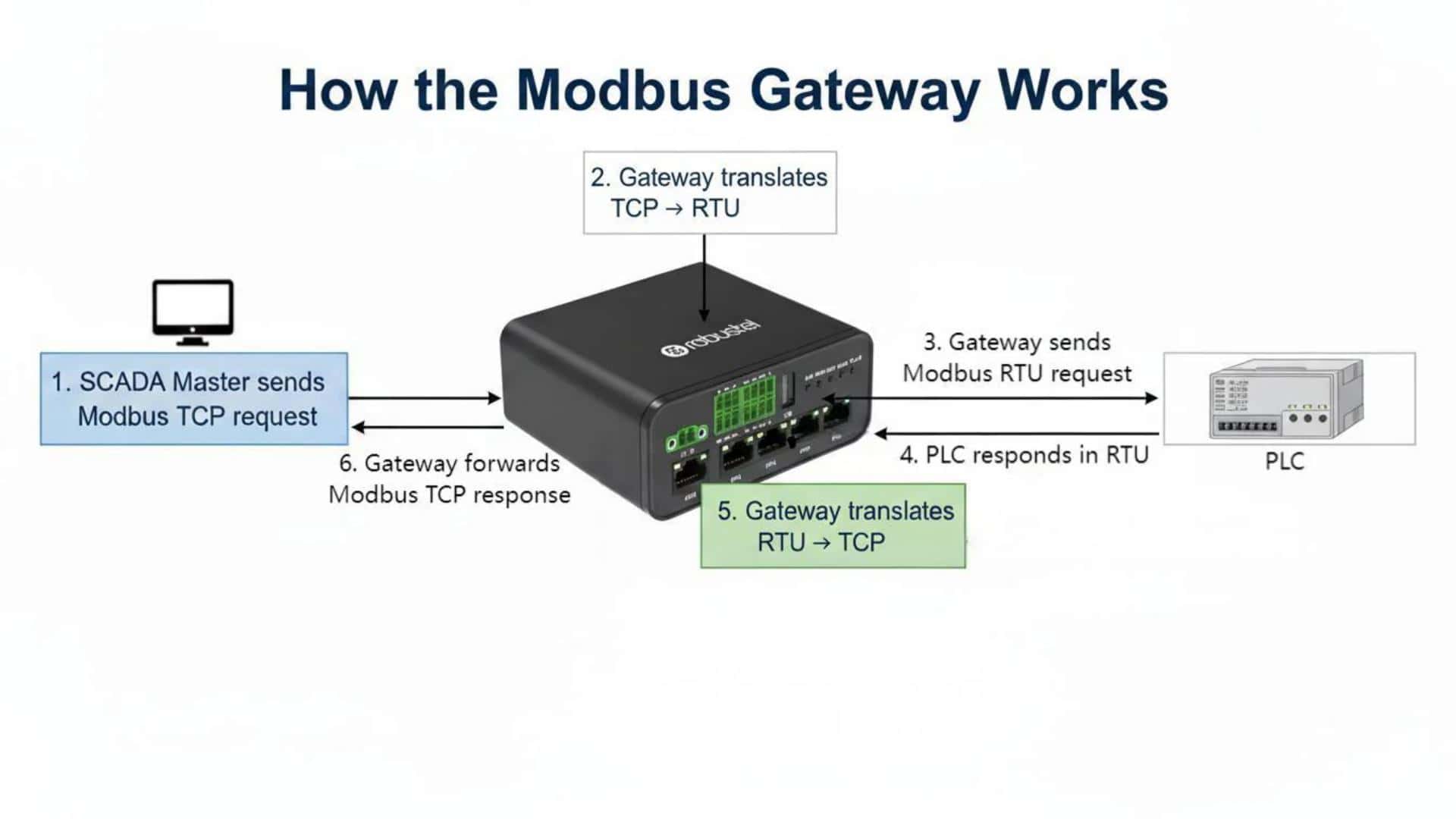
The Master’s Request: Your central SCADA software (the “Master”) on the IP network wants to read data from a serial PLC (the “Slave”). It sends a standard Modbus TCP request to the IP address of the gateway.
The Translation: The gateway receives the Modbus TCP request. It “unwraps” the TCP/IP packet, extracts the core Modbus command, and re-formats it into a compact Modbus RTU message.
The Serial Communication: The gateway then sends this Modbus RTU message out of its physical serial port to the target PLC on the RS485 network.
The Reverse Trip: The PLC responds in Modbus RTU. The gateway receives this serial message, translates it back into a Modbus TCP packet, and sends it back across the IP network to the SCADA Master.
The real ‘aha!’ moment is realizing that from the SCADA Master’s perspective, it looks like it’s talking directly to a Modbus TCP device. The entire translation process is completely transparent.
Why is Modbus RTU to TCP Conversion So Important?
Integrate Legacy and Modern Systems: It’s the key to bridging the OT/IT gap. You can keep your proven, reliable serial slave devices and have them fully integrated with your modern IP-based master control systems.
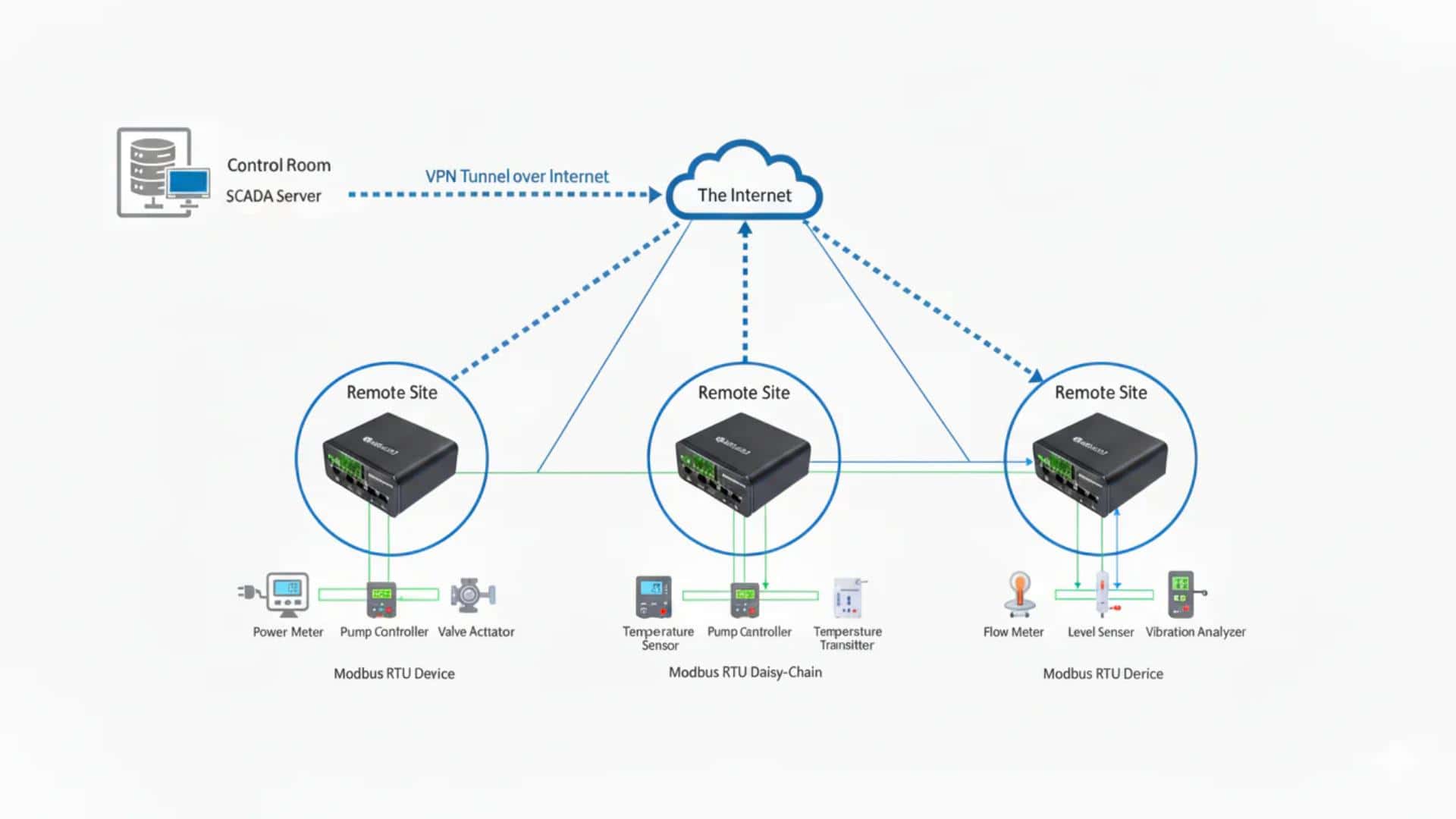
Centralize Your Monitoring: You can now use a single SCADA system to monitor devices spread across a huge area, communicating with them over an Ethernet, Wi-Fi, or cellular network.
Reduce Hardware Costs: By using an industrial router with this function built-in, you don’t need to purchase and manage separate, dedicated Modbus converter boxes for every serial network. It’s an efficient, all-in-one solution.
Conclusion: A Must-Have for Industrial Modernization
While the Modbus RTU to TCP gateway function may sound like a niche technical feature, it is actually one of the most practical tools for industrial modernization. Rather than acting as a complex bridge, it serves as the invisible translator that allows the legacy serial devices on your factory floor to communicate seamlessly with modern, IP-based SCADA systems.
When planning your next network upgrade, ensuring your industrial router has this robust gateway capability is a critical step. It is the smartest way to build a flexible, cost-effective, and future-proof network without the massive expense of replacing reliable, functional equipment.
FAQs
Q1: Can a gateway also translate from Modbus TCP to Modbus RTU?
A1: Yes, absolutely. This is a less common but important scenario where you might have a legacy HMI or device that can only act as a Modbus RTU Master, and you need it to communicate with a modern Modbus TCP slave device. A full-featured gateway can handle this reverse translation as well.
Q2: What’s the difference between this and “Transparent Mode”?
A2: They are different. “Transparent Mode” (or Serial-to-TCP) simply wraps any serial data into an IP packet without understanding what the data is. A Modbus RTU to TCP gateway, on the other hand, actively understands and interprets the Modbus protocol, allowing it to perform intelligent routing and connect multiple masters to multiple slaves. The Modbus gateway function is a more sophisticated and purpose-built solution for Modbus networks.
Q3: How many serial devices can I connect to one gateway?
A3: This depends on the specific device, but on an RS485 network, the standard allows for up to 32 “unit loads.” This means you can typically connect up to 32 Modbus RTU slave devices (like PLCs, VFDs, etc.) to a single serial port on your gateway, which can then poll all of them.
About the Author
Robert Liao | Technical Support Engineer
Robert Liao is an IoT Technical Support Engineer at Robustel, specializing in industrial networking and edge connectivity. A certified Networking Engineer, Robert focuses on the deployment and troubleshooting of large-scale IIoT infrastructures. His work centers on architecting reliable, scalable system performance for complex industrial applications, bridging the gap between field hardware and cloud-side data management.