
LoRaWAN Gateway for Smart Streetlights: Network and Operations Checklist
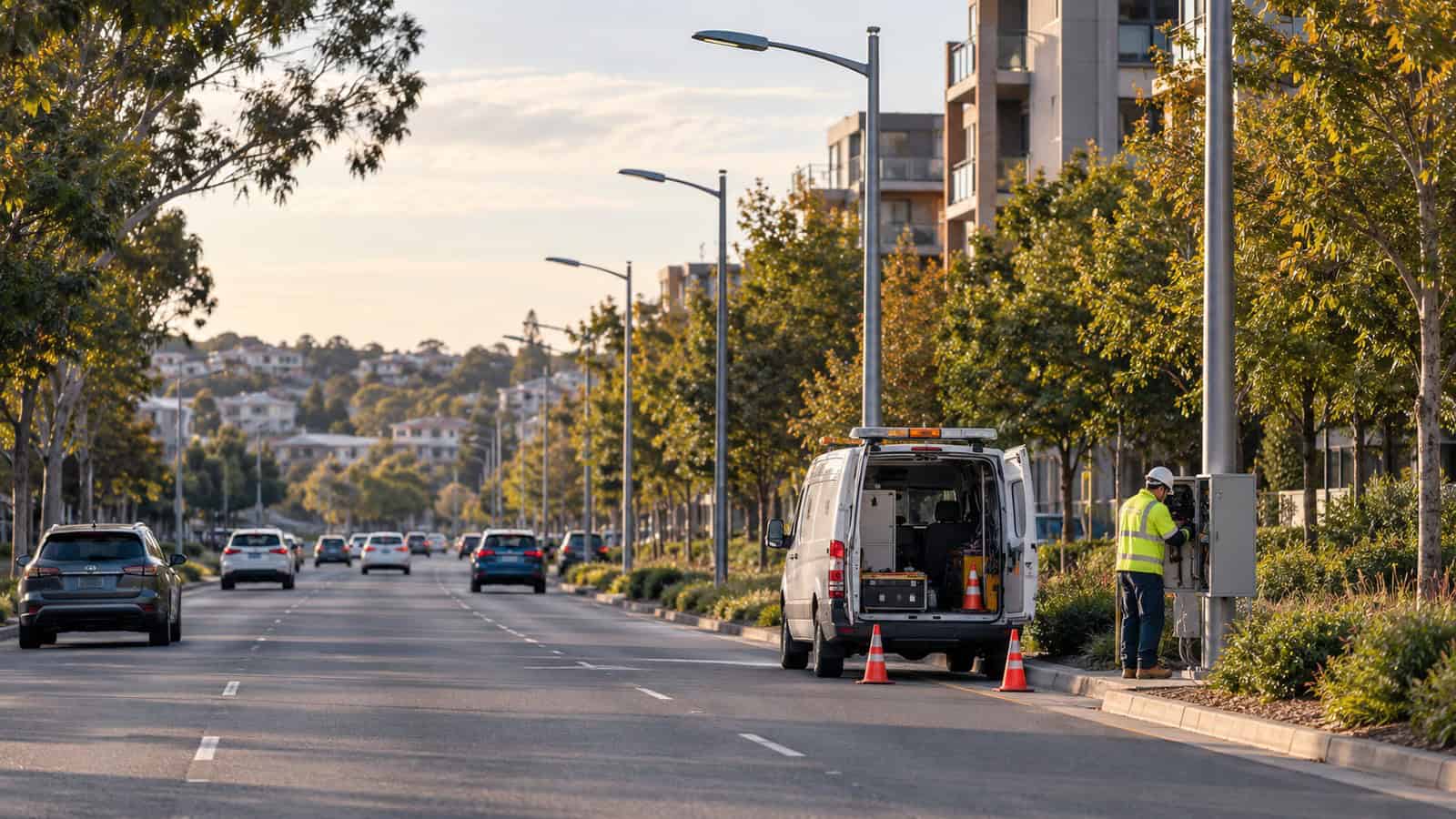
The Robustel R1320LGe LoRaWAN Gateway is a practical forwarding option for smart-streetlight districts that use an external LNS and need Ethernet or cellular backhaul, but gateway quantity and placement must come from a measured district survey rather than a citywide range estimate.
Start with District Operations
Divide the estate by road geometry, building density, terrain, available mounting points, power and maintenance access. Record who owns the luminaire controllers, LoRaWAN server, gateway cabinet, SIM and field response.
Robustel’s LoRaWAN smart-building application example provides a closer LoRaWAN architecture reference: field devices, gateway, backhaul and application need named owners even when they share one operational dashboard. Apply that ownership pattern to streetlights while verifying the selected controller and payload separately.
For each district, keep a service map that joins those owners to physical access. A gateway on a rooftop, traffic pole or third-party building may have good RF but a long permit path; a cellular fault may belong to a different contract from a failed luminaire. Recording those boundaries before rollout prevents every dark street from becoming an undirected visit for the lighting crew.
Survey the Hardest Streets First
Test under tree cover, between tall buildings, along curves and at the edge of maintenance areas. Mounting a gateway high may improve radio visibility but can make power, Ethernet and service access harder.
| Checklist item | Evidence before rollout |
|---|---|
| frequency plan | correct regional device and network settings |
| gateway site | RF survey plus safe power/mounting access |
| backhaul | measured Ethernet/cellular path and recovery test |
| LNS | forwarding compatibility and ownership confirmed |
| controller | payload, command and firmware behaviour verified |
The Robustel’s video of “Why Do You Need a LoRaWAN Gateway?” helps stakeholders understand why private coverage may be justified. Use the survey to decide how many gateways the district actually needs.
How the Robustel R1320LGe LoRaWAN Gateway Supports Smart-Streetlight Districts
Robustel R1320LGe LoRaWAN Gateway forwards LoRaWAN traffic across eight channels to a compatible external LNS. Ethernet, LTE Cat 4, a physical SIM plus eSIM and PoE-PD give designers several ways to reach a practical installation point.
With Robsutel RCMS, operations can maintain gateway visibility across districts. That is valuable when a dark area might be caused by a luminaire, controller, RF path, gateway, backhaul or server. A gateway that is online with stable backhaul moves the first investigation towards device reception, the LNS and the lighting application; an offline gateway gives the network team a specific site and access record to work from.
That operating value depends on a consistent external-LNS configuration and a replacement method that preserves gateway identity, credentials and forwarding settings. Prove one district through gateway loss, replacement and backhaul restoration, then record which telemetry or commands were delayed and how the application represented them. R1320LGe fits districts where compact forwarding and flexible backhaul solve the placement problem; projects that require a local LNS on the gateway need a different server boundary.
Plan Maintenance Before Expansion
Keep a spare and replacement process for the exact regional gateway, antenna and mounting arrangement. Define configuration backup, firmware approval, SIM renewal, access permits and the test used after replacement.
Robustel’s Cibicom nationwide LoRaWAN case study provides deployment evidence for operating geographically distributed gateways and cellular backhaul. Apply that operational discipline at municipal scale, while validating local streetlight protocols and radio design separately.
Choose one pilot district that contains both easy and difficult streets, then cost the maintenance visits produced during commissioning. This exposes whether a theoretically efficient mounting location is too expensive or unsafe to access for routine replacement.
Accept a District on Service Outcomes
Test normal telemetry, a representative command, loss of a gateway, loss of backhaul and restoration. Confirm the LNS does not turn delayed traffic into a misleading current state, and record how field crews distinguish a communications fault from a lighting fault.
Close acceptance with an incident rehearsal, not only a coverage map. Give the operations desk a dark-luminaire symptom and require it to identify the last device message, gateway state, backhaul state and application acknowledgement before dispatch. Record the owner and response for each failed layer; the district passes when the same evidence leads different shifts to the same first action.
Häufig gestellte Fragen
Q1. How is LoRaWAN used for street lighting?
It can carry low-rate status, metering and control messages between compatible controllers and an application through gateways and an LNS.
Q2. How far can a LoRaWAN gateway reach?
Range varies with terrain, buildings, antenna position, frequency plan and device settings. A district survey is more reliable than a published maximum.
Q3. Does a LoRaWAN gateway need internet?
It needs a backhaul path to an external LNS unless the architecture hosts the required server locally. That path can be Ethernet or cellular on suitable gateways.
Q4. How many gateways does a smart city need?
There is no universal number. Size by surveyed coverage, capacity, overlap, maintenance access and the effect of one gateway failure.
Q5. When is the Robustel R1320LGe LoRaWAN Gateway a good streetlight fit?
It fits districts with a compatible external LNS and a need for compact packet forwarding, flexible backhaul and centrally managed field gateways.
Schlussfolgerung
The Robustel R1320LGe LoRaWAN Gateway fits smart-streetlight projects that organise coverage and maintenance by district. Its forwarding, cellular/eSIM and RCMS roles support the communications estate while leaving lighting control compatibility with the selected controller platform.
Scale after one district has a repeatable survey, commissioning and replacement record. That operating package is more valuable than a large theoretical coverage circle that no field team can maintain.
Explore More Articles About Robustel LoRaWAN Gateways

Über den Autor
Robustel Editorial Team
The Robustel Editorial Team publishes practical articles on industrial connectivity, edge computing, LoRaWAN and device management, focusing on deployment considerations, technical limitations and long-term operation.