
IoT Gateway vs IoT Router: What’s the Real Difference?
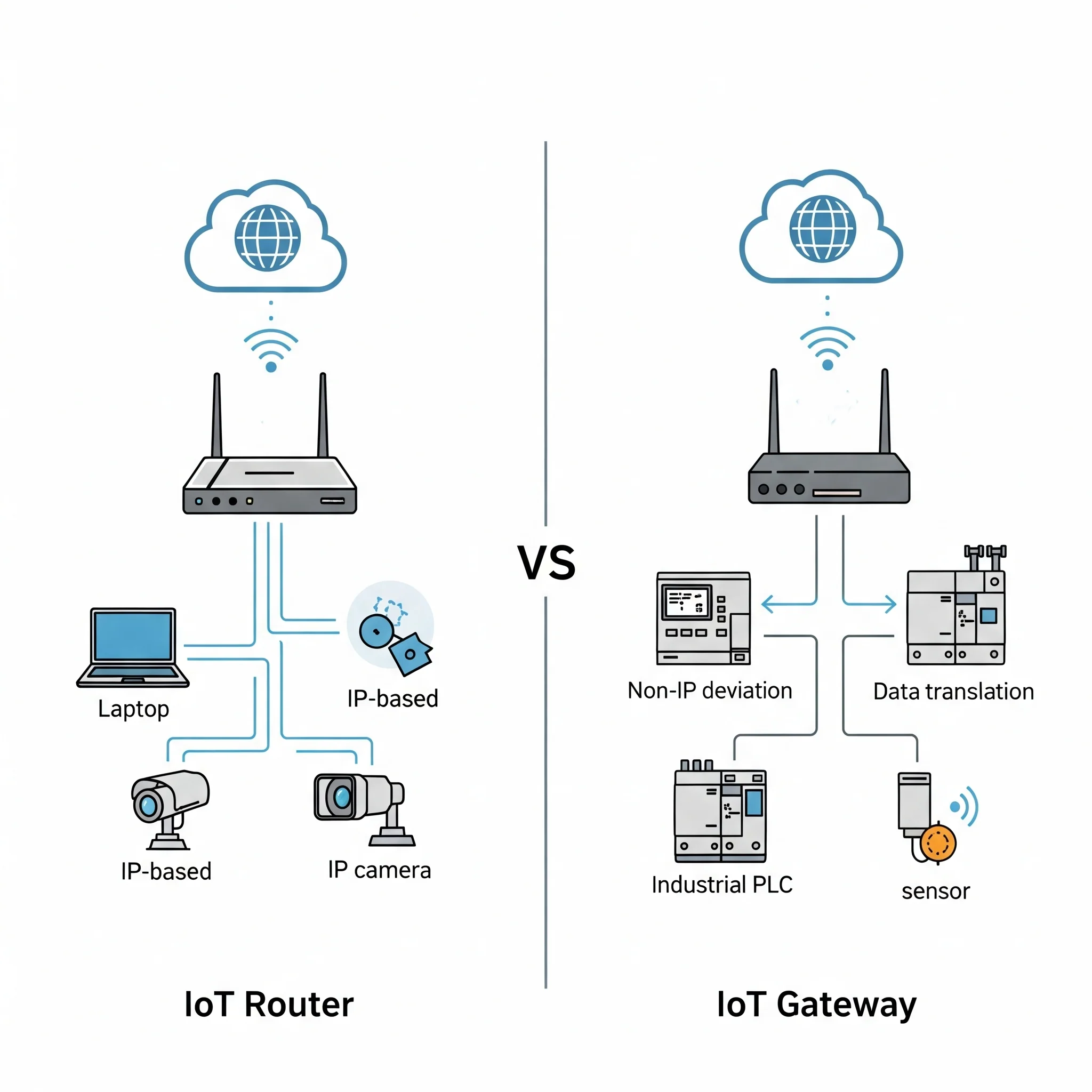
This article clarifies the technical distinction between an IoT Router and an IoT Gateway. While a router manages IP-based traffic as a “network traffic cop”, a gateway serves as a “multilingual translator” and “data aggregator”. Understanding this difference prevents architectural bottlenecks in IIoT deployments, particularly when bridging legacy hardware to the cloud.
What We Will Cover:
- Functional Roles: The core difference between network routing and protocol translation.
- Architecture Needs: When to prioritize a “Traffic Cop” vs. a “Data Bridge.”
- The Evolution of Edge Intelligence: How Gateways transform into local computing platforms.
- Decision Framework: Identifying the right hardware based on device diversity and data volume.
Introduction: It’s More Than Just a Name
I can’t tell you how many times I’ve had conversations with project managers who say, “I just need a router to get my sensors online.” The reality is, what they often need is something far more capable. Choosing the wrong device is one of the most common early mistakes that can derail an IoT project, leading to security vulnerabilities and integration nightmares.
The IoT Gateway vs Router discussion isn’t just about semantics; it’s about understanding two distinct roles. A router is like a traffic cop for a highway where all the cars (devices) already speak the same language (IP). An IoT Gateway, on the other hand, is like a United Nations translator at a border crossing; it connects different worlds that speak entirely different languages. Let’s be clear: selecting the right one is fundamental. This guide will break it down for you.
Tips:
Explore our ruggedized router collection to find the high-performance hardware your environment demands.
But if you are looking for more than just a connection, see how our IoT gateways provide the “local brain” your architecture needs.
What is an IoT Router?
Let’s start with the familiar. An IoT Router (or more specifically, an industrial cellular router) is a device that provides robust, secure internet connectivity to one or more IP-based devices over a cellular (4G/5G) network. Its primary job is to create a secure local network (LAN) and share its internet connection (WAN) with trusted devices.
IoT Router: The Secure Internet Connection
Internet Connectivity: Its main purpose is to provide a reliable internet connection, often with features like Dual-SIM failover for network resilience. This is the core function of both an Industrial 4G Router and an Industrial 5G Router .
Network Address Translation (NAT): It manages a private local network, allowing multiple devices to share a single public IP address. A powerful Industrial NAT Router can perform advanced NAT functions to solve common factory network problems.
Security (Firewall & VPN): It acts as a firewall, protecting the devices on its LAN from the public internet. It also functions as a powerful VPN client, creating secure, encrypted tunnels back to a corporate network using protocols like IPsec or OpenVPN.
When to Choose an IoT Router
You need an IoT Router when your primary goal is to provide simple, secure internet connectivity to devices that already speak IP . For example, connecting an industrial PC, a modern PLC with an Ethernet port, or a set of IP cameras to the internet over a cellular network.
What is an IoT Gateway?
This is where the roles begin to diverge significantly. An IoT Gateway does everything a router can do, but it adds a critical new capability: protocol translation .
IoT Gateway: The Smart Translator and Bridge
Many industrial devices, especially in the OT world, do not speak TCP/IP. They use industrial protocols like Modbus, OPC UA, BACnet, or LoRaWAN. These devices cannot be connected directly to a standard router.
An IoT Gateway acts as the essential translator. It can communicate directly with these devices via its industrial interfaces (like RS485 or a LoRa radio), collect the data, understand it, and then translate it into a standard IT protocol like MQTT . It then sends this translated data to the cloud. This ability to bridge the OT and IT worlds is the defining feature of an IoT Gateway.
The Evolution: The Rise of the IoT Edge Gateway
Modern industrial gateways have evolved even further. They aren’t just translators; they are powerful on-site computers. This more advanced category is known as an IoT Edge Gateway or Edge IoT Gateway .
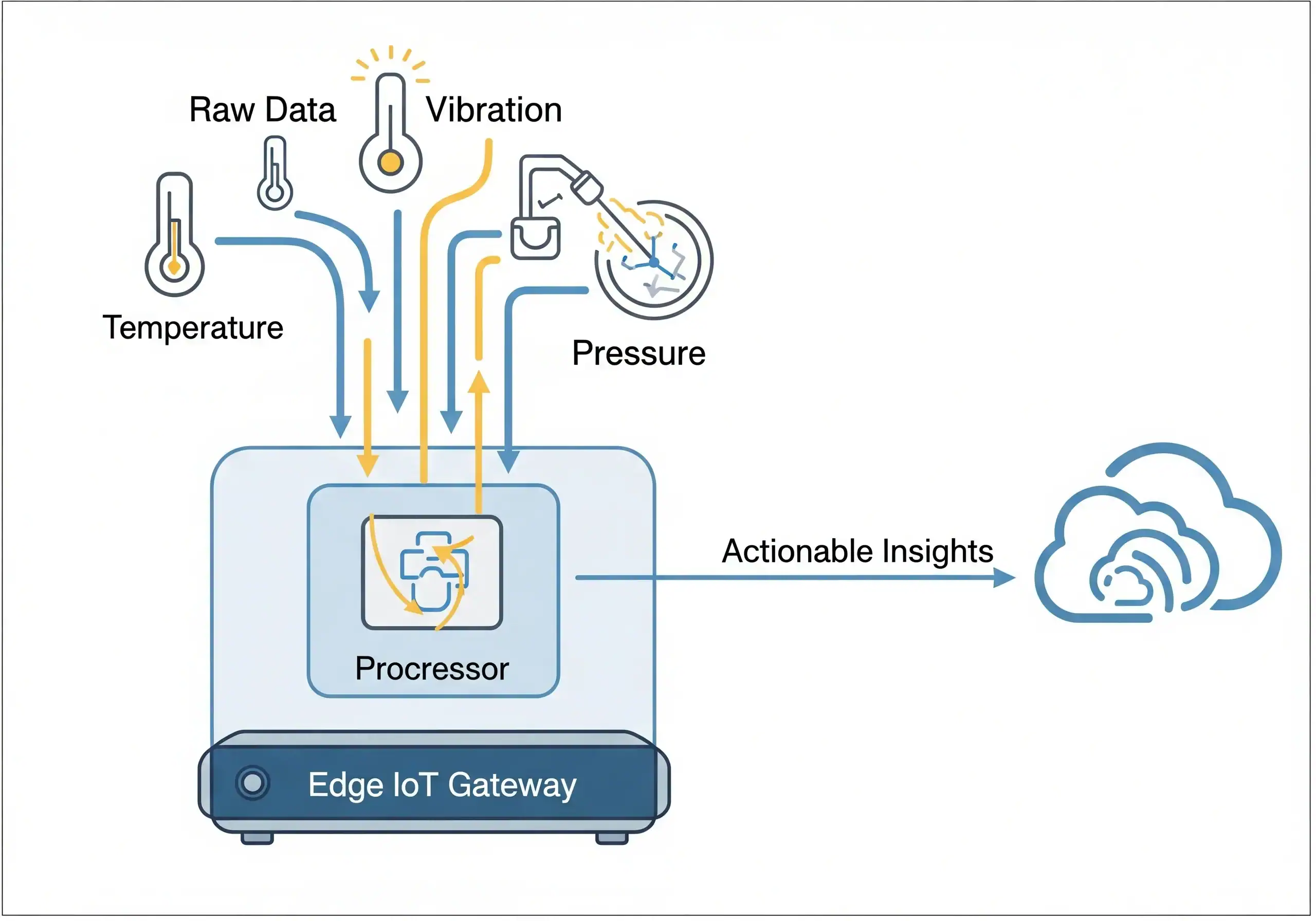
An Edge IoT Gateway has a powerful processor, more RAM, and a flexible operating system (like Debian-based RobustOS Pro). This allows it to perform edge computing , which means it can:
- Analyze data locally: Run analytics or AI models to detect anomalies in real-time.
- Filter data: Send only valuable insights to the cloud, saving massive bandwidth costs.
- Operate autonomously: Run local control logic even if the internet connection is lost.
A prime example is the Robustel EG5120, which combines all these capabilities into a single device.
Head-to-Head Comparison: IoT Router vs. Gateway vs. Edge Gateway
| Feature | IoT Router | IoT Gateway (Basic) | IoT Edge Gateway |
| Primary Function | Provides Internet Connectivity | Connects & Translates | Connects, Translates & Processes |
| Protocols Handled | IP-based (TCP/IP, HTTP) | IP + Non-IP (e.g., Modbus, LoRaWAN) | IP + Non-IP + Custom Apps |
| Onboard Processing | Low (for routing/firewall) | Medium (for protocol conversion) | High (for edge analytics, Docker) |
| Ideal Use Case | Connecting IP cameras, PCs | Connecting Modbus sensors to cloud | Real-time factory automation |
Conclusion: Choosing the Right Tool for the Job
The IoT Gateway vs Router debate is simple once you understand their roles. If you just need to provide a secure internet connection to IP-speaking devices, an IoT Router is the right tool.
However, if you need to connect industrial devices that use protocols like Modbus or LoRaWAN, you need an IoT Gateway. And if your application demands real-time local processing, analytics, and maximum reliability, then a powerful Edge IoT Gateway like the Robustel EG5120 is the clear choice. It provides not only connectivity and translation but also a future-proof platform for building truly intelligent industrial solutions.
FAQs
Q1: Can an IoT Edge Gateway function as a router?
A1: Yes, absolutely. An IoT Edge Gateway has all the functionality of an advanced industrial router (NAT, Firewall, VPNs) and adds protocol translation and edge computing capabilities on top.
Q2: What is “protocol translation” in an IoT Gateway?
A2: It’s the process of converting data from one communication format to another. For example, reading a temperature value from a sensor using the Modbus RTU protocol over a serial line and then converting that value into a JSON payload to be sent over the internet using the MQTT protocol.
Q3: When do I need an Edge IoT Gateway instead of a basic IoT Gateway?
A3: You need an Edge IoT Gateway when you have a requirement for low-latency decision-making, need to reduce data transmission costs by processing data locally, or require your system to continue operating even if the internet connection is lost.
About the Author
Robert Liao | Technical Support Engineer
Robert Liao is an IoT Technical Support Engineer at Robustel, specializing in industrial networking and edge connectivity. A certified Networking Engineer, Robert focuses on the deployment and troubleshooting of large-scale IIoT infrastructures. His work centers on architecting reliable, scalable system performance for complex industrial applications, bridging the gap between field hardware and cloud-side data management.