
Ethernet, Wi-Fi or Cellular Backhaul for LoRaWAN Gateways: Which Is Best?
The best LoRaWAN backhaul is usually the connection that fits the infrastructure already available at the site and the failure mode the operator is prepared to manage. The Robustel R1520LG LoRaWAN Gateway supports Ethernet, Wi-Fi and cellular connectivity, making it a useful reference for comparing these backhaul choices without assuming that one method is always superior.
Consider three LoRaWAN projects. A factory already has managed Ethernet in every technical cabinet. A commercial-building retrofit has usable Wi-Fi but pulling new cable through occupied areas would be disruptive. A remote pumping station has neither and must rely on cellular coverage.
All three sites may use the same LoRaWAN sensors and Network Server. Their backhaul designs should still be different. The practical question is therefore not “Is Ethernet, Wi-Fi or cellular best?” It is “Which connection gives this gateway a maintainable path to the LNS under the conditions of this site?”
Three Sites, Three Different Backhaul Decisions
Backhaul begins after the Robustel LoRaWAN gateway has received traffic from the end devices. If the project uses an external LoRaWAN Network Server, those packets still need an IP path from the gateway to that server.
That path may be: LoRaWAN sensors → gateway → Ethernet → LNS, or: LoRaWAN sensors → gateway → Wi-Fi → LNS, or: LoRaWAN sensors → gateway → cellular network → LNS
The radio network around the sensors can be working normally while an upstream backhaul fault prevents data from reaching the application. LoRaWAN coverage and IP connectivity should therefore be diagnosed separately.
Robustel’s “Why Do You Need a LoRaWAN Gateway“ video provides a short visual explanation of this role. The gateway is not only a LoRa radio receiver; it also sits between the local LoRaWAN network and the IP infrastructure that carries traffic towards the wider system.
For a factory, the existing network may make Ethernet the obvious starting point. For a retrofit, Wi-Fi may avoid new cabling. For an isolated utility site, cellular may be the only practical WAN. The right comparison begins with what the site already has—not with a preference for one interface.
Ethernet Fits Sites with Existing Wired Infrastructure
Imagine a manufacturing plant installing LoRaWAN temperature, energy and equipment-status sensors around production areas.
The Robustel R1520LG LoRaWAN Gateway is mounted in a protected technical location where the plant already provides managed Ethernet. The organisation has its own network team, firewall policies and upstream internet connection.
In this case, introducing cellular as the primary path may add a SIM contract and another external dependency without solving a clear problem.
Ethernet offers several practical advantages in this environment:
- It can reuse existing network infrastructure.
- The physical connection is predictable and easy to document.
- Traffic can pass through established enterprise firewall and routing policies.
- There is no separate cellular subscription.
- Troubleshooting may fit the site’s existing IT procedures.
The R1520LG provides two 10/100 Mbps Ethernet ports that can be configured for LAN or WAN roles. Robustel also documents Ethernet WAN as one of the standard ways to bring an R1520LG online before LoRaWAN forwarding is configured. That does not make Ethernet inherently more reliable.
A gateway connected to one access switch still depends on the switch, local power, building cabling, upstream router, firewall configuration, ISP connectivity, and DNS/routing where applicable. If those components share a failure domain, the cable itself does not create resilience.
For an industrial site, the useful question is therefore: Does the existing wired network already provide the availability and support model this LoRaWAN gateway requires? If yes, Ethernet is often difficult to justify replacing.
Wi-Fi Helps When Cabling Is the Main Constraint
Now move the same Robustel LoRaWAN gateway into a retrofit project.
A hotel, school or commercial building wants LoRaWAN sensors for environmental monitoring, but the preferred gateway position is above a ceiling or inside a technical area where pulling a new Ethernet run would require additional building work. Existing Wi-Fi coverage is already available.
Here, Wi-Fi solves a different problem from cellular.
It can connect the gateway to the site’s local network without requiring a new cable route, while still using the building’s existing internet connection. The R1520LG supports 2.4 GHz Wi-Fi in AP and client modes, so a deployment can use Wi-Fi as an IP interface where the site design justifies it.
Before selecting Wi-Fi backhaul, however, verify the conditions at the final gateway position rather than assuming that good user Wi-Fi means good gateway connectivity. Check:
- Signal quality at the installed location
- Which WLAN and VLAN the gateway will use
- Authentication requirements
- Whether the network allows the required LNS traffic
- Whether the access point is maintained as production infrastructure
- What happens when Wi-Fi credentials change
- Whether the gateway and access point share the same power failure
- How the connection will be diagnosed remotely
Wi-Fi may remove one cable, but it introduces a wireless dependency between the gateway and access point.
It is therefore most useful when avoiding new cabling has real installation value and the existing WLAN is sufficiently controlled for an infrastructure device. A guest network or an access point installed only for user convenience should not automatically become the backhaul for an operational LoRaWAN service.
Cellular Changes the Economics of Remote Sites
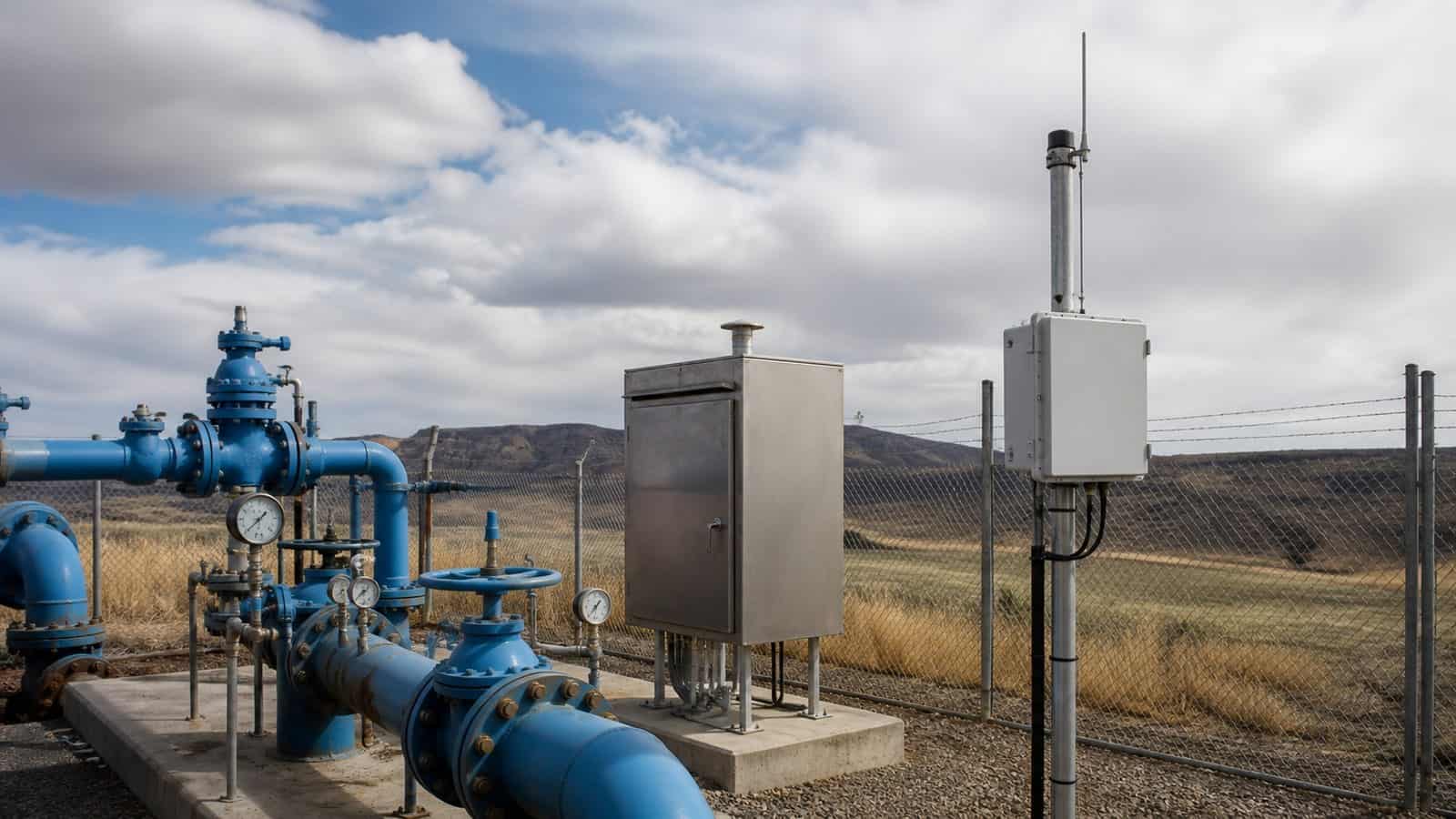
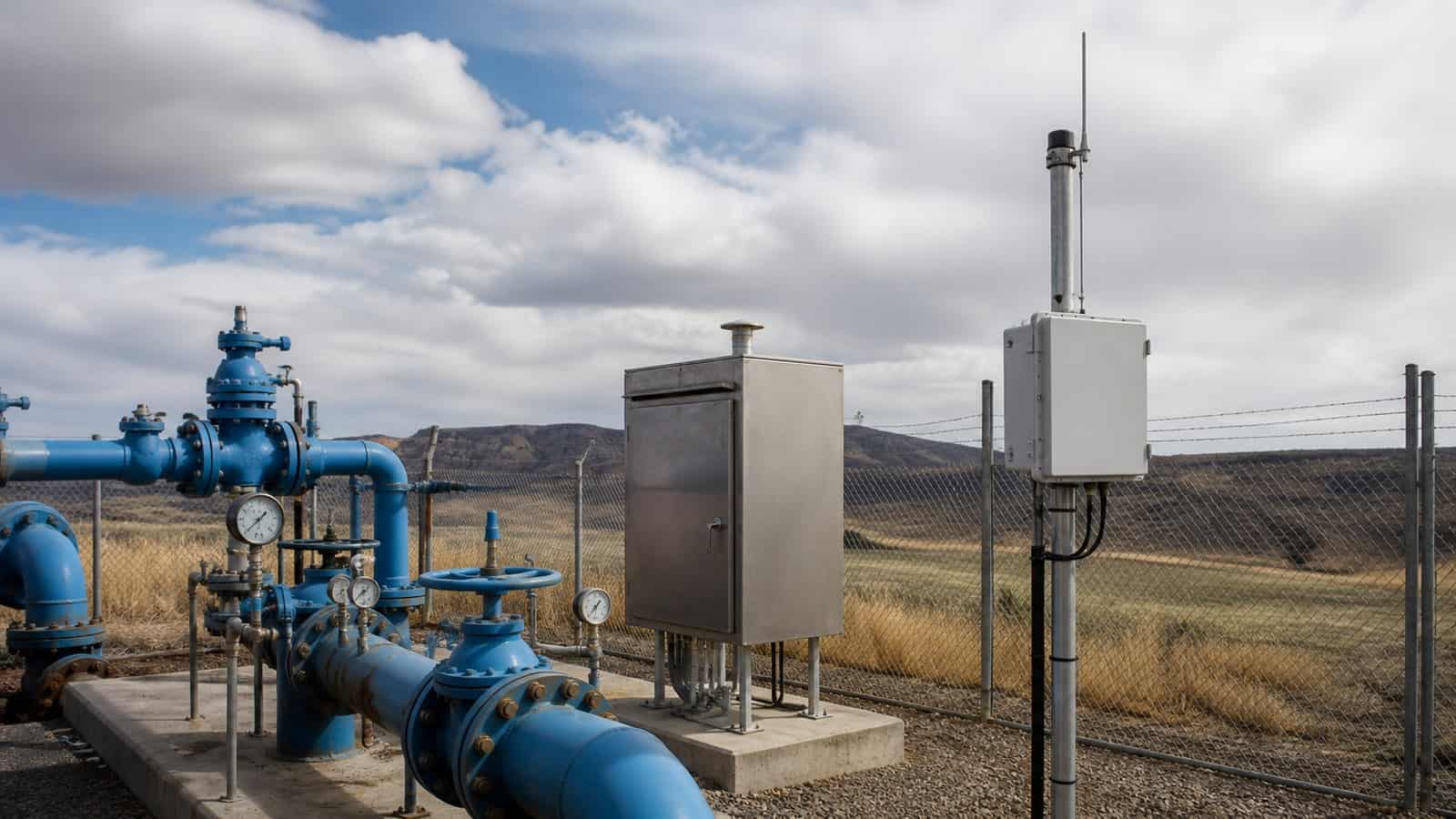
The third site has no useful Ethernet or Wi-Fi. A water utility places sensors around a remote pumping station. The Robustel R1520LG LoRaWAN Gateway receives level, pressure and equipment-status data, but the nearest enterprise LAN ends kilometres away.
Extending fixed connectivity may cost more than the entire LoRaWAN installation. This is where cellular backhaul changes the deployment model. The Robustel R1520LG integrates 4G/LTE connectivity and two physical SIM slots alongside its LoRaWAN interface. A remote site can therefore use the public or private cellular network as the gateway’s upstream IP path without installing a separate industrial router.
A cellular design still introduces requirements that Ethernet does not:
- SIM provisioning
- APN configuration
- Operator coverage
- Antenna placement
- Data plans
- Roaming policy
- Private or public addressing
- Recurring connectivity cost
- Behaviour when registration or signal quality deteriorates
These are reasonable trade-offs when the alternative is building a fixed WAN connection to an isolated site.
Robustel real-world example: nationwide LoRaWAN network backhaul over LTE450 for Cibicom
Cibicom’s nationwide LoRaWAN deployment in Denmark provides a clear example of cellular backhaul being selected because it matches the operator’s infrastructure. Gateway traffic is transported over Cibicom’s own LTE450 network from sites that include masts and third-party properties towards central server systems. The original deployment used the legacy Robustel R3000-LG LoRaWAN Gateway; Robustel now identifies the R1520LG as the replacement model.
The lesson is not that cellular is better than Ethernet. Cibicom already operates LTE450 as mission-critical communications infrastructure, so cellular backhaul fits the network it owns and supports. For another organisation with fibre available at every gateway site, the conclusion could be the opposite.
Dual SIM Is an Option, Not an Uptime Guarantee
Two SIM slots can broaden the available cellular strategy, but they should not be translated into a claim of uninterrupted service. Both subscriptions might still experience:
- Poor radio conditions at the same location
- A shared mast or upstream dependency
- Operator-wide disruption
- Antenna damage
- Power loss at the gateway
- Time required for re-registration and session recovery
The Robustel R1520LG supports dual physical SIMs, but resilience depends on how the two subscriptions, switching rules and application recovery are configured and tested. A useful acceptance test deliberately removes the primary connection and records:
- How the failure is detected
- Whether another path becomes available
- How long network registration takes
- Whether VPN or LNS sessions reconnect
- What happens to packets during the interruption
- Whether the monitoring system reports the event correctly
That evidence is more useful than a datasheet statement that simply lists two SIM slots.
Compare Backhaul by Failure Mode and Operating Cost
Once each site has a plausible option, the decision becomes easier if the team compares operational consequences, rather than raw interface specifications.
| Decision factor | Ethernet | WLAN | Mobilfunk |
|---|---|---|---|
| Existing infrastructure | Strong fit where wired LAN already exists | Strong fit where controlled WLAN already exists | Strong fit where no fixed WAN is available |
| New cabling | Usually required | Often avoidable | Not required for WAN |
| Recurring carrier cost | Usually part of existing site WAN | Usually part of existing site WAN | SIM/data plan normally required |
| RF dependency | LoRaWAN radio only | LoRaWAN plus Wi-Fi radio | LoRaWAN plus cellular radio |
| Enterprise network integration | Often straightforward | Depends on WLAN policy | Requires cellular/APN/security design |
| Site mobility | Niedrig | Limited to WLAN coverage | High where cellular coverage is available |
| Remote deployment | Possible if Ethernet is present | Less common without local WLAN | Often practical |
| Main failure concern | Local LAN/upstream WAN | WLAN quality/access-point dependency | Operator coverage/registration |
| Backup potential | Can pair with cellular | Can pair with Ethernet or cellular | Can back up fixed WAN or use multiple SIMs |
| Operating ownership | Site IT/network team | Site IT/network team | IoT/network team plus carrier |
The table should not be read as a ranking.
For a Robustel gateway installed in a factory, Ethernet may have the lowest incremental operational burden because the plant already manages the network. For a temporary or difficult-to-cable retrofit, Wi-Fi may remove disproportionate installation effort. For a pumping station, agricultural site or roadside asset, cellular may be the only realistic connection.
Cost should also include support. A low-cost backhaul that repeatedly sends technicians to site may be more expensive over the deployment lifecycle than a connection with a higher monthly fee but a more manageable recovery process.
Robustel’s KoolZone cold-chain monitoring deployment illustrates this operational dimension. R1520LG gateways are deployed across laboratories, hospitals and other monitoring environments, using cellular broadband to forward LoRaWAN sensor data to KoolZone’s cloud platform. Robustel also describes Smart Roaming and RCMS as part of the deployment’s approach to mixed cellular coverage and central gateway operations.
Here the important point is not simply “cellular works.” KoolZone operates a geographically distributed monitoring service, so backhaul behaviour, remote visibility and the cost of unnecessary site intervention all affect the usefulness of the architecture.
How the Robustel R1520LG LoRaWAN Gateway Supports Multi-Backhaul Sites
The Robustel R1520LG LoRaWAN Gateway is relevant to deployments where the same LoRaWAN design must operate across sites with different WAN conditions.
Its current interface set includes:
- Two 10/100 Ethernet ports
- 2.4 GHz Wi-Fi in AP/client modes
- 4G/LTE cellular connectivity
- Two physical Mini SIM slots
- External LNS connectivity through UDP, Basic Station and Loriot
- Embedded ChirpStack for projects using a local LNS
- RCMS-based remote device management
- RobustVPN for remote access
These capabilities allow the project to select backhaul independently from the LoRaWAN radio role.
A factory can use Ethernet without changing gateway hardware. A retrofit can use Wi-Fi where the network policy allows it. A remote site can use cellular. A project can also design a secondary path where the operational requirement justifies the extra complexity.
This flexibility should not be confused with automatic resilience. Multiple available interfaces only become a resilient design after the project defines: Primary path → failure detection → alternate path → routing behaviour → LNS/VPN reconnection → monitoring → restoration of the preferred path
The Robustel R1520LG LoRaWAN Gateway provides the interfaces needed to build several of these architectures. The operating team still has to decide which links are enabled, which one has priority and what constitutes an acceptable recovery time.
That distinction matters for enterprise deployments: interface availability is a product capability; service continuity is a system design outcome.
Design the Primary and Backup Path as One System
The final backhaul design should document more than “Ethernet primary, cellular backup.” For each Robustel LoRaWAN gateway site, record:
- Primary interface
- Backup interface, if required
- IP addressing
- DNS requirements
- Firewall rules
- LNS endpoint
- VPN requirements
- SIM and APN details
- Network ownership
- Failure-detection method
- Expected failover behaviour
- Recovery procedure
- Remote-management path
Then test the failure that the backup is intended to solve.
If cellular is intended to protect against an ISP outage but both Ethernet and cellular depend on the same local AC supply, the design still has a common power failure.
If a second SIM is intended to protect against one mobile operator, verify that the subscriptions genuinely provide the required network diversity at that site.
If Wi-Fi is intended as a temporary fallback, confirm that credentials and WLAN policy allow unattended reconnection.
The useful final question is not: “How many backhaul interfaces does this gateway have?” It is: “Which failure does each interface protect us from, and have we tested that recovery path?” That produces a backhaul architecture that can be supported after commissioning rather than a collection of connectivity features that happened to be enabled during installation.
Häufig gestellte Fragen
Q1. What is LoRaWAN gateway backhaul?
LoRaWAN gateway backhaul is the IP connection that carries traffic between the gateway and upstream systems such as an external LoRaWAN Network Server. Ethernet, Wi-Fi and cellular are common options. Backhaul is separate from the LoRa radio link between sensors and the gateway, so one path can be healthy while the other has failed.
Q2. Is Ethernet the best backhaul for a LoRaWAN gateway?
Ethernet is often a strong fit where a managed wired network already exists, particularly in factories, buildings and technical facilities. It avoids a separate cellular subscription and can use established network policies. It is not automatically more resilient because the gateway still depends on local switching, power and upstream WAN infrastructure.
Q3. When should the Robustel R1520LG use cellular backhaul?
The Robustel R1520LG LoRaWAN Gateway is well suited to cellular backhaul where fixed IP infrastructure is unavailable, impractical to extend or intentionally kept separate. Its integrated cellular modem and dual SIM slots avoid the need for a separate router. Operator coverage, APN, antenna placement, data cost and failure recovery must still be validated.
Q4. Can Wi-Fi be used as permanent LoRaWAN gateway backhaul?
Yes, where the WLAN is engineered and managed appropriately for infrastructure equipment. The project should verify signal quality, authentication, network policy, access-point availability and credential lifecycle. Wi-Fi is particularly useful where installing new Ethernet cable is disproportionate, but an unmanaged guest network is generally a poor operational basis for a production gateway.
Q5. Does dual SIM make cellular backhaul redundant?
Not by itself. Dual SIM provides the ability to use two subscriptions, but both may share coverage limitations or network infrastructure. True resilience depends on operator diversity, switching behaviour, power, antenna design and successful restoration of LNS or VPN sessions. A representative failure test is needed before claiming redundancy.
Schlussfolgerung
There is no universal best LoRaWAN backhaul. Ethernet is usually the most straightforward choice when a suitable wired network already exists. Wi-Fi can solve installation problems where new cabling is difficult but a controlled WLAN is available. Cellular becomes particularly valuable when the gateway is installed beyond the reach of fixed IP infrastructure.
The Robustel R1520LG LoRaWAN Gateway supports all three approaches on one industrial platform, allowing different sites to use the backhaul that matches their local infrastructure without changing the core LoRaWAN gateway architecture.
Choose the primary connection from the site conditions first. Then decide whether a backup path is justified by the consequence of losing connectivity.
The strongest design is not the gateway with the largest number of WAN interfaces. It is the backhaul architecture in which every active interface has a clear operational purpose, failure mode and tested recovery path.
Explore more articles about Robustel’s LoRaWAN gateway in industrial IoT:


Über den Autor
Robert Liao | Technical Support Engineer
Robert is an IoT Technical Support Engineer at Robustel, specializing in industrial networking and edge connectivity. A certified Networking Engineer, Robert focuses on the deployment and troubleshooting of large-scale IIoT infrastructures. His work centers on architecting reliable, scalable system performance for complex industrial applications, bridging the gap between field hardware and cloud-side data management.