
Edge Computing Gateway Recommendation for IoT: How Robustel Supports Device-to-Cloud Data Flow

Robustel EG5101 edge computing gateway supports distributed IoT projects that must move field data through local interfaces, edge applications, LTE Cat-1 backhaul, and cloud services. Reliable device-to-cloud flow depends on defining each handoff rather than treating the path as one continuous connection.
A sensor reading does not move directly from a field device into a dashboard. Its identity, technical meaning, timestamp, quality, delivery state, and application context may change several times before the information becomes usable.
Device-to-Cloud Data Flow Is a Series of Handoffs
A device-to-cloud architecture can be divided into five handoffs:
- Field device to gateway interface
- Gateway interface to local application
- Local application to WAN service
- WAN service to cloud endpoint
- Cloud endpoint to business application
Each handoff has its own sender, receiver, data contract, and failure conditions.
| Handoff | Sending Side | Receiving Side | Main Responsibility | Common Failure |
| 1 | Sensor, meter, or PLC | Gateway interface | Deliver valid source data | Wiring, protocol, or device failure |
| 2 | Interface or driver | Edge application | Interpret and organize the data | Incorrect mapping or missing context |
| 3 | Edge application | WAN and network stack | Queue and transmit selected records | Routing, storage, or connection failure |
| 4 | Cellular or fixed network | Cloud endpoint | Authenticate and accept the data | Broker, API, VPN, or certificate failure |
| 5 | Cloud ingestion service | Business application | Parse and use the information | Schema, identity, or application error |
The complete path works only when all five handoffs are functioning.
A gateway showing an active LTE connection does not prove that a field device is responding. A cloud broker accepting a message does not prove that a dashboard has interpreted it correctly. Similarly, an online field device does not prove that its latest data has reached the cloud.
This separation is particularly important across distributed infrastructure, where field devices, gateways, networks, cloud services, and application owners may be managed by different teams.
Preserve Meaning at the Device-to-Gateway Handoff
The first handoff begins with the equipment that owns the original measurement or state.
Depending on the project, that source may be:
- A temperature or pressure sensor
- An electricity, water, or gas meter
- A PLC
- A drive or industrial controller
- A remote I/O module
- A serial instrument
- A local monitoring application
The source device owns several pieces of information that the gateway should not guess:
- What the value represents
- How frequently it changes
- Which interface exposes it
- Which data type is used
- Whether scaling is required
- Which unit applies
- Whether the value is valid
- Whether the device provides its own timestamp
For example, the raw number 1527 has no reliable meaning without documentation. It might represent 15.27 bar, 152.7 °C, a cumulative counter, an alarm code, or an invalid measurement.
The first handoff contract should therefore identify:
| Required Detail | Example |
| Source asset | Pump station 04 |
| Source device | Pressure transmitter 02 |
| Variable | Discharge pressure |
| Interface | RS-485 |
| Update behaviour | New value every two seconds |
| Data definition | Unsigned integer divided by 100 |
| Engineering unit | bar |
| Quality behaviour | Timeout after three failed reads |
Robustel EG5101 edge computing gateway provides one RS-485 interface, one RS-232 interface, and one Fast Ethernet port for connecting compatible field and IP equipment. The gateway runs RobustOS Pro on a Debian 11 base and supports lightweight Docker applications for protocol bridging, buffering, and local preprocessing.
These interfaces create the technical connection, but the project still needs an approved device list and data definition. An RS-485 terminal does not confirm register compatibility, while an Ethernet connection does not confirm that the local application understands the device protocol.
Keep Device Failure Separate from Missing Cloud Data
A missing cloud record may begin at the first handoff. Possible causes include:
- The device has lost power
- The sensor is disconnected
- Serial wiring is incorrect
- A network address has changed
- The gateway is polling the wrong point
- The device is returning stale or invalid data
- The local interface is unavailable
A cloud application should not represent all of these conditions as a generic “gateway offline” state. Where possible, the gateway application should preserve separate states for:
- Device unavailable
- Interface unavailable
- Data invalid
- Data stale
- Data successfully collected
- Data collected but not yet delivered
This gives operations teams enough information to locate the actual failure domain.
Define the Gateway’s Internal Data Contract
The second handoff occurs inside the edge gateway, between the local interface and the application that prepares information for upstream use. At this stage, a raw value becomes a managed record.
The local application may need to add:
- Site identity
- Asset identity
- Variable name
- Engineering unit
- Source timestamp
- Gateway collection timestamp
- Data-quality state
- Sequence number
- Mapping version
- Application version
A suitable internal record could resemble:
{
  "site_id": "pump-station-04",
  "asset_id": "pressure-transmitter-02",
  "measurement": "discharge_pressure",
  "value": 15.27,
  "unit": "bar",
  "quality": "good",
  "source_timestamp": "2026-08-03T08:42:10Z",
  "mapping_version": "1.3"
}
This is not yet a guarantee of cloud delivery. It is the gateway’s clear representation of what was collected.
Assign Responsibility for Every Transformation
The project should document where each transformation occurs.
| Transformation | Possible Owner |
| Raw value acquisition | Device driver or protocol connector |
| Scaling | Gateway application |
| Unit assignment | Gateway point table |
| Timestamp creation | Device or gateway |
| Asset naming | Gateway configuration |
| Quality assignment | Gateway application |
| Aggregation | Local application |
| Cloud schema conversion | Gateway connector or cloud ingestion service |
Ambiguous ownership creates duplicated or inconsistent processing. For example, if both the gateway and cloud platform apply scaling, the final value may be incorrect. If neither system adds a quality state, the cloud may display an old measurement as though it were current.
Robustel Edge2Cloud is one available application framework that can read Modbus devices and gateway I/O, apply point-table definitions, normalize values into timestamped JSON, buffer records during connectivity interruptions, and publish them through a secure MQTT path. The exact application availability and compatibility must be confirmed for the selected EG5101 configuration.
Preserve Data Lineage
The cloud record should remain traceable to its source. Useful lineage information includes:
- Original device
- Gateway identifier
- Mapping version
- Processing application
- Collection time
- Transmission time
- Whether the record was delayed
- Whether the record was replayed
This matters when an engineer investigates why a value changed after a device replacement, configuration update, application deployment, or network interruption.
Decide What Should Cross the WAN
The third handoff begins when the edge application passes selected data to the gateway’s network and WAN services. The local application does not necessarily need to transmit every available value.
Possible upstream outputs include:
- A normalized measurement
- A state change
- An alarm
- A periodic summary
- An operating-hours counter
- A communication-health event
- A selected diagnostic record
- A batch of records retained during an outage
The WAN policy should reflect the operational value of each data type.
| Local Data | Possible WAN Treatment |
| Rapidly changing routine value | Publish at a controlled interval |
| Unchanged equipment state | Publish after a transition |
| Critical alarm | Transmit immediately |
| High-frequency measurements | Aggregate locally |
| Diagnostic data | Retain and upload on request |
| Records generated during outage | Buffer and replay after recovery |
The objective is not simply to minimize traffic. It is to transmit enough information for the upstream system to understand current conditions and reconstruct important events.
Treat WAN Availability as a Separate State
An active field connection and a working local application may continue during an LTE or Ethernet outage.
The Robustel gateway can remain in one of several states:
- Field collection active and WAN available
- Field collection active but WAN unavailable
- Field collection unavailable but WAN available
- Local application unavailable
- WAN restored and buffered records replaying
These states should not be merged into one online/offline indicator.
The Robustel EG5101 edge computing gateway supports dual Mini SIM cards for LTE Cat-1 connectivity and can also use its Ethernet interface as a WAN path. The product supports failover-oriented connectivity, but practical recovery still depends on network coverage, SIM service, routing, VPN, DNS, and application reconnection behaviour.
Buffering Must Be Designed Explicitly
Local storage does not automatically create reliable store-and-forward behaviour.
The project must define:
- Which records should be retained
- Maximum retention period
- Storage limit
- Circular or linear buffering
- Data priority
- Original timestamp preservation
- Replay order
- Broker or API acknowledgement
- Duplicate handling
- Behaviour after gateway reboot
The Robustel EG5101 edge computing gateway includes 8 GB eMMC, but this storage is shared by RobustOS Pro, applications, containers, logs, updates, and retained data. The usable buffering period must therefore be calculated from the actual software footprint and message volume.
Separate Cloud Reception from Application Use
The fourth handoff ends when a cloud endpoint accepts the data. The fifth ends only when an application can use it correctly. These are different outcomes.
A successful MQTT acknowledgement, API response, or VPN connection may confirm that the message reached an endpoint. It does not confirm that:
- The asset identity was recognized
- The payload schema was valid
- The timestamp was interpreted correctly
- The unit was accepted
- The quality state was preserved
- The dashboard updated
- An alarm rule was triggered
- The record entered long-term storage
A complete acceptance test should therefore follow the data beyond network delivery.
Confirm Cloud Ingestion
Verify:
- Authentication
- Verschlüsselung
- Topic or API path
- Payload size
- Schema validation
- Timestamp format
- Message acknowledgement
- Rejected-message handling
Confirm Application Interpretation
Then verify:
- Correct asset association
- Correct engineering unit
- Correct live or historical state
- Correct alarm behaviour
- Correct dashboard display
- Correct database retention
- Correct handling of delayed records
A gateway can deliver data exactly as configured while the cloud application still misuses it. The fifth handoff belongs to the application and data teams rather than the gateway alone.
How Robustel EG5101 Edge Computing Gateway Supports Distributed Data Handoffs
Robustel EG5101 edge computing gateway combines field connectivity, lightweight local application hosting, LTE Cat-1 backhaul, secure networking, and remote gateway management in a compact platform.
| Data-Handoff Requirement | Relevant EG5101 Capability |
| Connect a serial field network | 1 × RS-485 |
| Connect a serial point-to-point device | 1 × RS-232 |
| Connect an Ethernet device or WAN | 1 × 10/100 Mbps Ethernet |
| Run local data applications | RobustOS Pro and Docker support |
| Store applications and selected data | 8 GB eMMC |
| Use cellular backhaul | Dual-SIM LTE Cat-1 |
| Protect remote connections | Firewall and supported VPN functions |
| Manage distributed gateways | RCMS integration |
The Robustel EG5101 uses an NXP i.MX 6ULL processor at 792 MHz, with 512 MB or 1 GB DDR3 depending on the model. This makes it suitable for focused protocol bridging, lightweight preprocessing, buffering, and distributed monitoring rather than heavy databases or large concurrent application stacks.
The Robustel EG5101 edge computing gateway product page provides the current interface, computing, cellular, RobustOS Pro, and environmental specifications required for project validation.
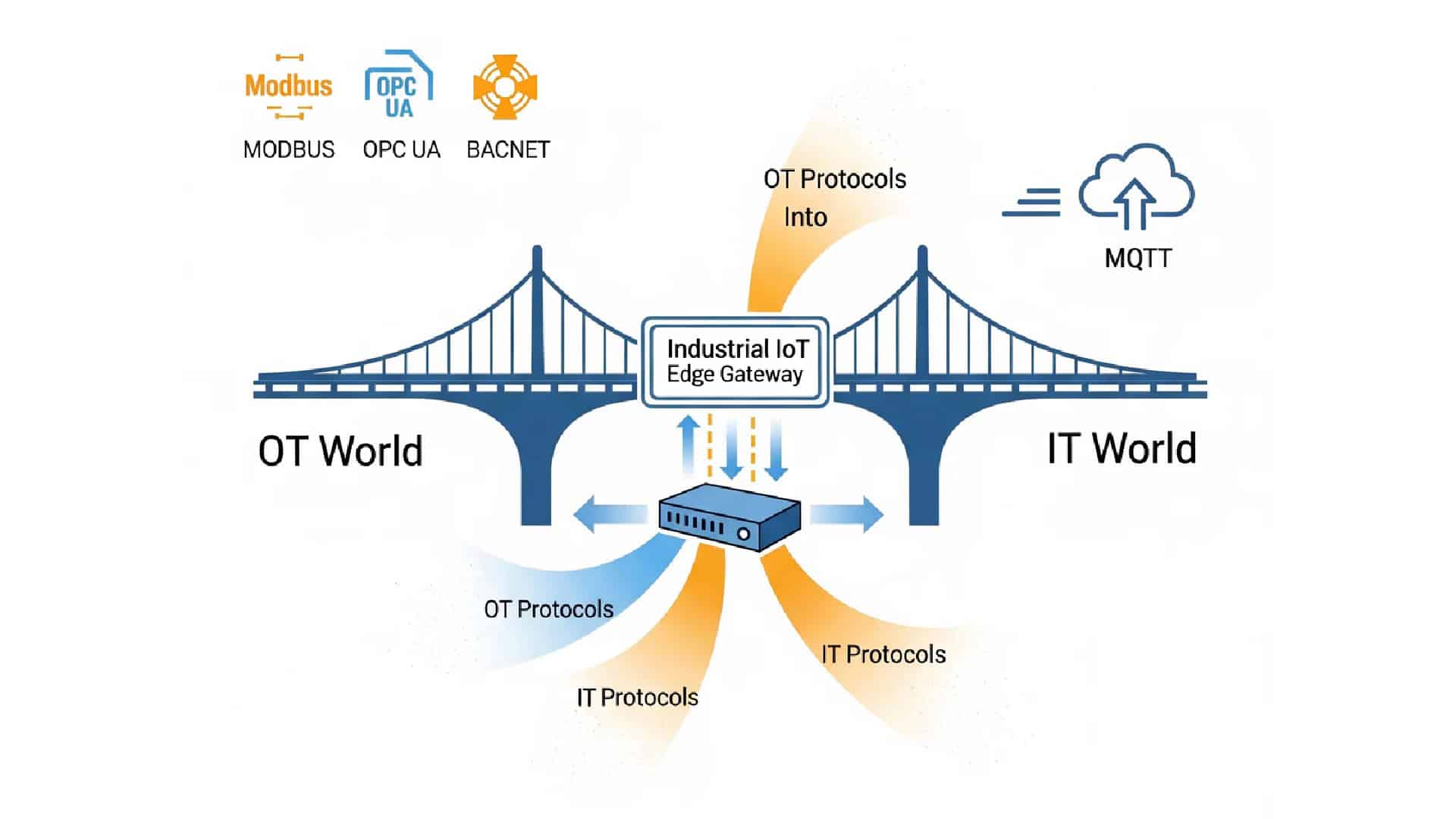
Robustel’s wider EG series uses RobustOS Pro to support OT and IT protocol integration, containerized applications, data normalization, and publishing to brokers or cloud services. The exact drivers, applications, and deployment method still need to be confirmed for each model and project.
RCMS Covers Gateway Operations, Not the Entire Data Chain
RCMS can provide visibility into Robustel gateway fleets, including online status, signal information, interface details, logs, configuration, firmware, applications, and remote diagnostics. It can also support application and configuration deployment across multiple devices.
The Robustel RCMS platform supports centralized monitoring, configuration, application deployment, updates, and diagnostics for distributed EG5101 gateways.
RCMS does not replace:
- A field-device monitoring application
- A protocol-specific data-quality check
- A cloud broker
- A historian
- A business dashboard
- The end-to-end application acceptance test
It can confirm important gateway and network conditions, but the remaining handoffs must still be monitored by the relevant device, application, and cloud systems.
Test Every Handoff Independently
A device-to-cloud test should not consist of confirming that one value appears once on a dashboard.
Each handoff should have its own evidence.
| Test Stage | Test Action | Required Evidence |
| Device to interface | Disconnect or change the field device | Correct device-level fault state |
| Interface to application | Modify a known source value | Correct identity, scaling, unit, and quality |
| Application to WAN | Disable the WAN path | Local collection and queue behaviour |
| WAN to endpoint | Reject credentials or endpoint access | Clear authentication or delivery error |
| Endpoint to application | Send an invalid schema | Rejection without corrupting valid data |
| Recovery | Restore all connections | Controlled replay with original timestamps |
The test should also include:
- Gateway reboot
- Application restart
- SIM or Ethernet failover
- Temporary cloud outage
- Storage approaching its configured limit
- Duplicate message delivery
- Delayed record replay
- Device replacement
- Mapping or application update
A successful Robustel EG5101 edge computing gateway deployment should make it possible to identify where a failure occurred. Without that visibility, teams may know that data is missing but not whether the cause belongs to the device, local interface, gateway application, WAN, cloud endpoint, or business application.
Häufig gestellte Fragen
Q1. Does an IoT edge gateway send raw device data directly to the cloud?
It can, but raw forwarding is often unsuitable for industrial applications. The gateway may need to add asset identity, scaling, engineering units, timestamps, and quality information before transmission. Some projects intentionally retain raw diagnostic records, while routine cloud messages use normalized data. The correct approach depends on whether the receiving platform already understands the source device and its original data structure.
Q2. Where should an industrial IoT timestamp be created?
Use the source-device timestamp when it is reliable and synchronized. Otherwise, the gateway can add a collection timestamp when it receives the value. Projects may also record the later transmission or cloud-ingestion time. Keeping these times separate helps applications identify delayed or replayed records. A timestamp added after WAN recovery should not replace the original time at which the measurement or event occurred.
Q3. Is an active cellular connection proof that device-to-cloud data flow is working?
No. Cellular registration only confirms part of the WAN path. The field device, local interface, edge application, routing, DNS, VPN, cloud endpoint, authentication, and business application may still fail independently. A reliable design reports these conditions separately. Teams should verify the complete path using a known source value and confirm that its identity, timestamp, quality, and meaning remain correct at the final application.
Q4. What happens when one handoff in the data path fails?
The result depends on the failed handoff. A field-device failure prevents new data from being collected, while a WAN failure may allow local collection and buffering to continue. A cloud-ingestion failure can reject otherwise valid messages. The gateway application should preserve distinct fault states, retain selected records where required, and avoid presenting an old value as current when the original source has stopped responding.
Q5. How does Robustel EG5101 support distributed IoT data flow?
Robustel EG5101 edge computing gateway connects compatible serial and Ethernet devices, runs lightweight local applications, and uses Ethernet or dual-SIM LTE Cat-1 for upstream connectivity. RobustOS Pro supports protocol bridging, preprocessing, and buffering workflows, while RCMS provides gateway monitoring and remote management. Its role is to manage defined data and network handoffs; it does not replace the source device, cloud platform, or business application.
Conclusion: Device-to-Cloud Data Flow Takeaway
Robustel EG5101 edge computing gateway is a practical recommendation for distributed IoT sites that need to connect serial or Ethernet equipment, prepare selected data locally, and deliver it through LTE Cat-1 or fixed-network paths.
Its value is clearest when the project defines every handoff: what the device supplies, what the Robustel gateway adds, what crosses the WAN, what the cloud endpoint accepts, and what the final application must understand.
Device-to-cloud reliability is therefore not established by one successful connection. It comes from preserving data identity and meaning while testing each boundary independently, including failure and recovery behaviour. The Robustel EG5101 can provide the local integration and connectivity layer, but the complete outcome still depends on coordinated device, application, network, and cloud responsibilities.
Related Reading on Edge Computing in Industrial IoT:


Über den Autor
Robert Liao | Technical Support Engineer
Robert is an IoT Technical Support Engineer at Robustel, specializing in industrial networking and edge connectivity. A certified Networking Engineer, Robert focuses on the deployment and troubleshooting of large-scale IIoT infrastructures. His work centers on architecting reliable, scalable system performance for complex industrial applications, bridging the gap between field hardware and cloud-side data management.