
Dual SIM Dual Standby 5G Router vs Dual SIM Failover: Which Architecture Fits?
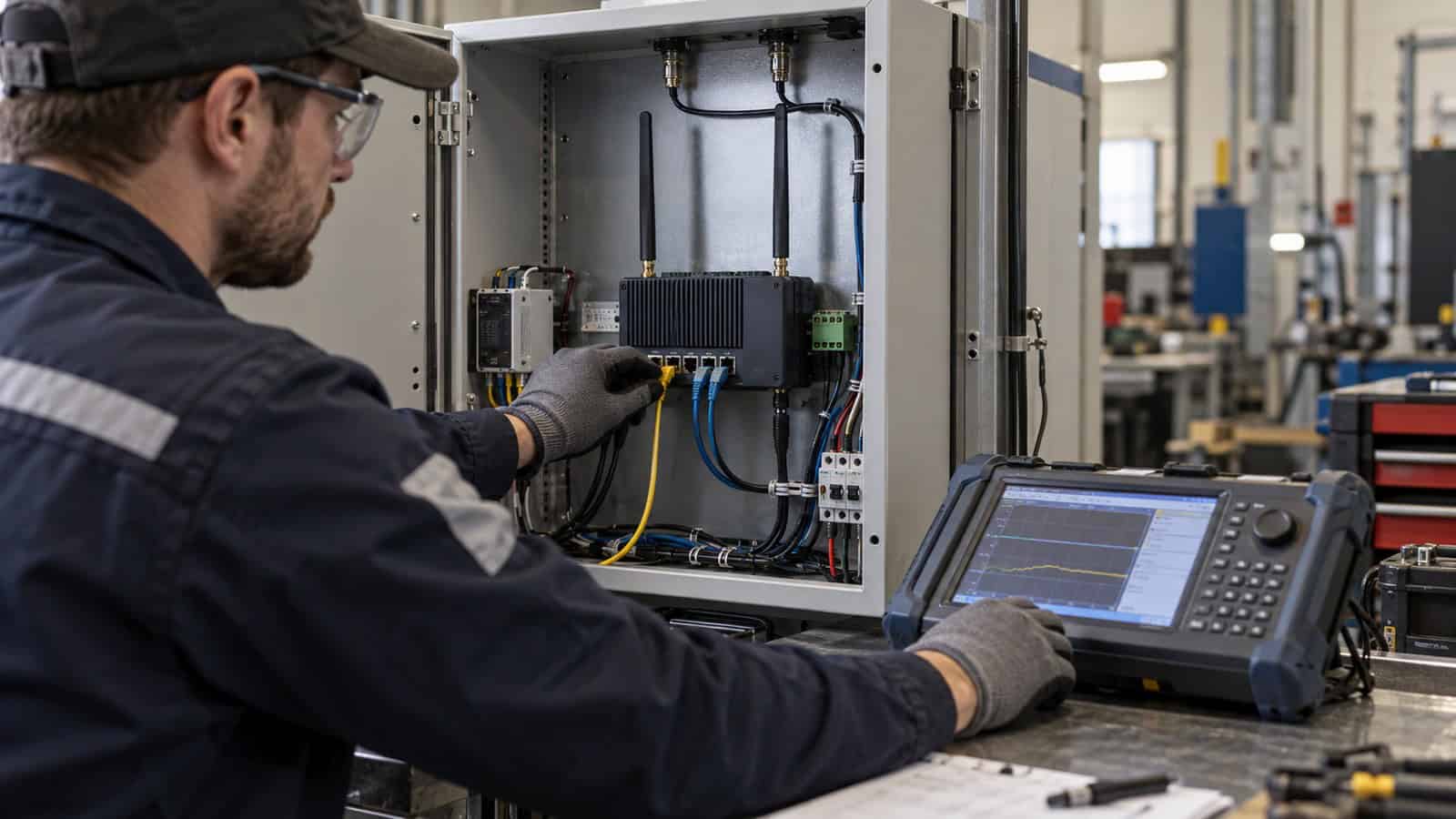
The Robustel R5020 Industrial 5G Router provides two physical SIM slots for cellular resilience, but buyers should not assume that “dual SIM”, “dual standby” and “failover” describe the same runtime behaviour. The correct architecture depends on modem state, trigger logic, transition time, addressing and whether the application can recover its sessions.
The Label Is Not the Architecture
Dual SIM states that two subscriptions can be installed. Dual SIM dual standby usually describes both subscriptions being available to the device while one radio path is active, but implementation details differ. Failover describes a policy outcome: traffic moves after a health condition fails. Procurement should request the exact behaviour of the selected model and firmware rather than relying on the label alone.
| Design question | Why it changes the result |
|---|---|
| Is there one modem or more than one active radio chain? | determines what can remain registered and which resources are shared |
| What triggers a switch? | signal, registration, data reachability and application failure are different events |
| Does the public/private address change? | VPNs and upstream allowlists may need to recover |
| What happens to existing sessions? | route recovery does not preserve every TCP, voice or application session |
| How is failback controlled? | immediate return can create repeated switching at an unstable coverage boundary |
The Robustel video “What Is an Industrial 5G Router and When Do You Need One?” is a useful primer before this deeper design discussion. It explains the router’s role; the site acceptance test must establish the exact SIM transition behaviour.
Compare Failure Coverage Before Transition Speed
A second operator may reduce exposure to an outage affecting one subscription or radio network. Both SIMs still share the router, its power supply, antennas, local network and often the same mast or upstream infrastructure. If the requirement includes those failures, the design needs additional physical diversity rather than a faster SIM switch.
Use a failure-domain matrix during review:
- carrier account or profile failure: a second subscription may help;
- local RF shadow: a second operator may help only if its coverage differs;
- damaged antenna or feeder: both subscriptions may fail;
- router or power failure: both subscriptions fail together; and
- upstream VPN or application failure: changing SIM may not address the cause.
Follow the Application Through the Switch
Robustel’s high-speed branch application example with the R5020 illustrates the router as a primary or backup broadband node. To turn that architecture into an acceptance test, keep a real transaction active while removing the preferred subscription or network path. Record registration, IP addressing, routing, VPN establishment and application recovery as separate timestamps.
If an application has long-lived sessions, determine whether it retries cleanly. If an upstream service uses source-address allowlists, verify the secondary path is authorised. A short ping test can finish successfully while the production client remains disconnected.
How the Robustel R5020 Industrial 5G Router Supports Dual-SIM Failover Decisions
Robustel R5020 Industrial 5G Router combines global 5G/4G/3G support with two Mini SIM slots, four Gigabit Ethernet ports, RS-232, RS-485, DI/DO, Wi-Fi, GNSS options and RCMS support. It can also use Ethernet or Wi-Fi as another access path in supported configurations, which makes the WAN ownership decision important.
| Acceptance test | Observation to retain | Decision it supports |
|---|---|---|
| preferred SIM unavailable | trigger, registration and usable data time | whether the switch meets the service tolerance |
| addressing changes | WAN IP, routes, DNS and VPN state | whether upstream policy follows the new path |
| preferred SIM returns | stability window and failback behaviour | whether the site avoids route flapping |
| router restart | selected SIM and restored services | whether recovery is repeatable after shared-device failure |
Do not copy a switch time from a different model or carrier environment. Measure the selected firmware, radio conditions, APNs and application. The result belongs in the commissioning record, not only in the lab notebook.
Choose Cold, Warm or Broader WAN Standby Deliberately
A cold standby may take longer but has a simple operating state. A warm standby may reduce part of the transition path if the product and network maintain the relevant readiness. A broader multi-WAN design can use Ethernet or another device, but it creates more routing and ownership decisions.
Robustel’s retail resilience case study shows why the operating result matters more than the SIM label. Distributed sites benefit when connectivity status and recovery can be handled consistently; the team still needs to know which component failed and whether the business service returned.
Procurement Questions That Expose the Real Design
Ask vendors to demonstrate the trigger, the state of each subscription before and after a switch, addressing changes, VPN recovery and controlled failback. Confirm regional bands, order code and carrier acceptance. Then ask the application owner how much interruption and replay the service can tolerate.
The preferred architecture is the one whose failure coverage and recovery evidence match that tolerance. A theoretically faster transition is not better if it reacts to the wrong health signal or repeatedly returns to an unstable network.
Häufig gestellte Fragen
Q1. What does dual SIM mean on a router?
It means the router can hold or use two mobile subscriptions. The exact active, standby and switching behaviour depends on the hardware, firmware and configuration.
Q2. What is dual SIM dual standby?
It generally means both subscriptions are available to the device while one connection is used for service. Buyers should confirm registration state, shared radio resources and the switch process for the exact router.
Q3. Does dual SIM use both networks at the same time?
Not necessarily. Many designs use one subscription at a time for traffic. Simultaneous use, load sharing or dual-active operation requires explicit product support and a suitable network design.
Q4. How long does SIM failover take?
There is no universal time. Detection policy, modem state, network registration, addressing, VPN recovery and application retry all contribute, so the complete service path should be measured.
Q5. When is the Robustel R5020 Industrial 5G Router a good dual-SIM choice?
It fits sites that need two physical subscriptions plus several Ethernet and industrial interfaces in one 5G router. Validate the exact transition and application recovery behaviour with the intended carriers before rollout.
Schlussfolgerung
The Robustel R5020 Industrial 5G Router provides the hardware foundation for a dual-SIM design, while the service outcome depends on trigger logic and recovery across every layer above the modem. Choose the architecture by failure coverage first, then by measured transition behaviour.
The final approval should include a witnessed switch, the changed network state, application recovery and stable failback. That evidence tells an operations team far more than a dual-SIM label and remains useful when carriers, firmware or upstream policies later change.
Explore More Articles About Robustel 5G Routers

Über den Autor
Robustel Editorial Team
The Robustel Editorial Team publishes practical articles on industrial connectivity, edge computing, LoRaWAN and device management, focusing on deployment considerations, technical limitations and long-term operation.