
Best IoT Gateway Features for Brownfield Equipment Integration
The Robustel EG5100 edge computing gateway is a strong fit for brownfield integration where existing PLCs, serial devices and Ethernet equipment need a new data path without redesigning the control system. The best IoT gateway features in this environment are therefore the interfaces, local software capabilities, connectivity and management functions that remove specific retrofit barriers—not simply the highest available compute specification.
Open an older control cabinet and the reason becomes clear. One PLC may use Ethernet, two meters may still communicate over RS485, a legacy controller may expose only a serial interface, and an HMI may already depend on the existing network. The gateway has to fit around this installed architecture while introducing new data services with as little disruption as practical.
Audit the Installed Equipment Before Selecting Gateway Features
Consider a production line that has operated reliably for more than a decade. The main PLC controls the machine over Ethernet, energy meters share an RS485 bus, an older controller uses serial communications and the plant now wants selected production and energy data available to a central application.
Nothing in the original automation architecture is necessarily broken. The integration problem exists because this new data requirement was never part of the machine design.
A Robustel edge computing gateway can provide a separate integration layer between the installed OT equipment and the new upstream system, but the gateway should be selected only after the existing interfaces and network ownership are understood.
A brownfield audit should establish four basic areas:
| Existing condition | What the project needs to confirm |
| PLCs and controllers | Physical interface, protocol, addressing and network ownership |
| Serial equipment | RS232/RS485 mode, baud rate, device addressing and bus topology |
| Ethernet devices | Available ports, IP addressing, VLAN or subnet constraints |
| Required data | Which points are needed, how often they change and where they must go |
This site-first approach is also the context behind Robustel’s Where Is Edge Computing Actually Used in Industrial IoT video: edge computing becomes useful when local equipment, data handling and upstream connectivity create a workload that needs to be solved at the site rather than treated as a generic cloud-connectivity problem.
For a brownfield project, the hardware specification should come from this inventory rather than the other way around.
Protect the Existing Control Architecture
Brownfield projects usually have more restrictions than greenfield designs. The production team may not permit PLC firmware changes, the machine supplier may not support modifications to the HMI network, a legacy meter may be approaching end of life but still functioning correctly, and shutdown windows may be measured in hours rather than days.
These restrictions matter more than abstract gateway performance.
The purpose of the new integration layer should therefore be clearly separated from the machine-control layer. If the requirement is to collect motor current, production count, temperature and alarm status, the gateway can read or receive the approved data and prepare it for the new application while the existing PLC remains responsible for sequencing, interlocks, deterministic control and safety-related functions.
This principle is particularly important when adding another device to a serial bus. The project has to confirm whether another master is permitted, how frequently data can be polled and whether additional traffic could affect the controller that already depends on the bus. A physical RS485 interface is useful only when the existing architecture can accommodate the new participant safely.
The same caution applies to Ethernet. Adding a gateway should not automatically mean changing machine addressing, flattening existing network boundaries or exposing the control network directly to a new WAN.
Brownfield integration works best when the new data path fits around proven control responsibilities instead of redistributing them unnecessarily.
Separate Connectivity, Protocol Handling and Data Meaning
A recurring brownfield mistake is to treat physical connectivity and data interoperability as the same problem.
A device may expose Modbus RTU, but the gateway still needs an approved register map showing which addresses contain the required values and how those values are scaled. An Ethernet controller may use a proprietary application protocol. A serial port may expose diagnostic information but not the production values required by the project.
An edge gateway cannot infer these semantics automatically.
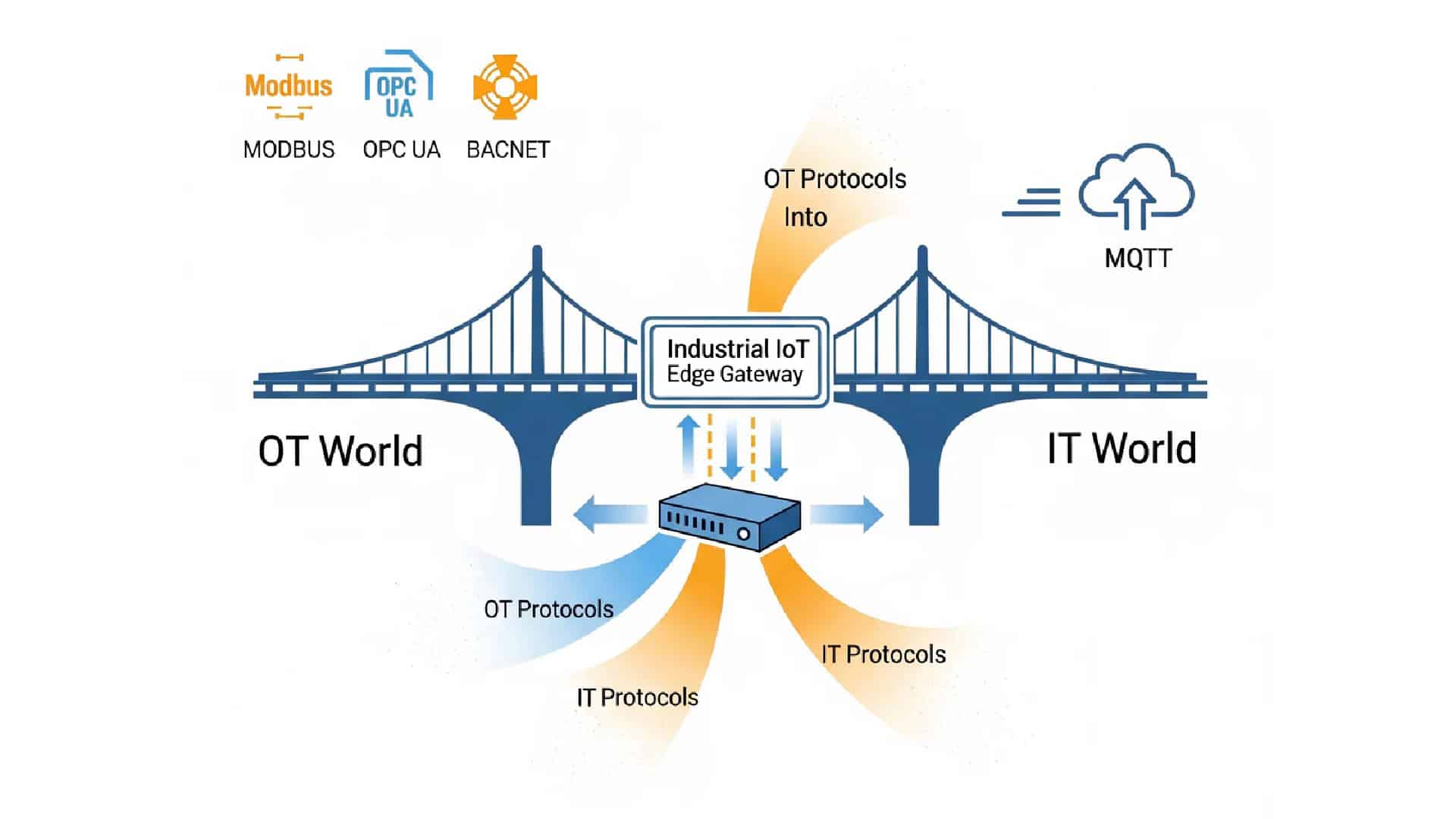
If a Modbus RTU meter needs to supply data to an MQTT application, the local software may poll selected registers, interpret them according to the approved mapping, apply useful names and engineering units, and then publish structured data upstream. The correctness of that result still depends on the source documentation and the implementation of the connector.
This is where the RobustOS Pro edge computing operating system becomes relevant. RobustOS Pro provides a Debian environment for containers and native Linux applications, allowing supported Robustel edge gateways to host protocol connectors, data-normalization logic and custom applications close to the equipment. It does not remove the need to validate register definitions, proprietary protocols or application behavior.
For brownfield work, access to correct device documentation can therefore be more valuable than another processor core.
Turn Brownfield Constraints into Gateway Requirements
Once the installed architecture is understood, each site problem can be translated into a gateway requirement.
| What the site audit finds | Gateway capability to consider | Warum es wichtig ist |
| RS485 meters or legacy controllers | Configurable serial interfaces | Retain working field equipment |
| Ethernet PLC plus serial assets | Mixed Ethernet and serial connectivity | Add one integration layer across different equipment generations |
| Inconsistent data formats | Local application environment | Normalize names, units, scaling and timestamps |
| Short WAN interruptions | Local buffering | Preserve selected data until connectivity returns |
| No practical fixed WAN | Cellular backhaul | Add an upstream path without redesigning the machine network |
| Expensive site access | Remote diagnostics and management | Investigate suitable faults before dispatching an engineer |
| Multiple local IP devices | Additional Ethernet capacity | Reduce dependence on separate networking hardware where appropriate |
| Custom protocol connector | Linux/container environment | Run validated software close to the equipment |
This changes the buying conversation. A feature is valuable because an installed condition requires it, not because it occupies another line on the datasheet.
Once these requirements are clear, the Robustel Edge Computing Gateway portfolio can be evaluated as a range of different compute and interface profiles rather than a hierarchy in which the highest specification is automatically the best choice. Robustel currently positions the EG series around RobustOS Pro, containerized applications, OT/IT protocol bridging and local processing, with different models providing different interface and compute envelopes.
For a focused brownfield retrofit, the important task is to select only the level of capability that the integration map actually justifies.
How the Robustel EG5100 Edge Computing Gateway Fits Brownfield Integration
The Robustel EG5100 edge computing gateway is particularly relevant to retrofit projects involving a mixture of serial equipment, Ethernet devices and moderate local processing.
Its current platform combines a 792 MHz Cortex-A7 processor, 1 GB DDR3 and 8 GB eMMC with two 10/100 Ethernet ports, two software-configurable RS-232/RS-485 interfaces, DI/DO and dual-SIM 4G connectivity. RobustOS Pro adds the Debian application environment required for containerized protocol connectors, local buffering and preprocessing.
That combination fits a common brownfield pattern: existing controllers remain responsible for the machine, while the EG5100 collects approved information, performs the required local translation or preprocessing and creates a controlled upstream path.
Robustel’s Connected CNC Machines Application Example demonstrates this architectural role. An EG-series gateway connects to the existing CNC environment through a serial interface and provides a managed path for machine status and diagnostic information, allowing service teams to obtain useful context without redesigning the underlying CNC control system.
The EG5100 should not be treated as the answer to every brownfield project. A workload requiring several demanding local applications, substantially more storage or compatible AI inference may justify a higher-compute model such as the EG5120. A site dominated by multiple Ethernet endpoints may instead justify the greater Ethernet density available from the EG5200.
Those are workload boundaries, not product rankings. For a retrofit centered on serial integration, modest preprocessing, buffering and cellular connectivity, the EG5100 provides a more proportionate starting point.
Build Remote Operations into the Retrofit
Brownfield integration is often discussed mainly as an OT protocol problem, but the new data path also has to remain supportable after commissioning.
A factory may already have an enterprise WAN but may not permit an experimental retrofit application to sit directly on the existing OT network. A remote cabinet may have no fixed WAN at all. In both cases, the gateway becomes part of the connectivity and support architecture as well as the data-integration layer.
Robustel edge computing gateways combine industrial interfaces with routing, cellular or Ethernet connectivity, VPN functions and remote device management. For distributed EG deployments, RCMS can provide centralized status, configuration, firmware and diagnostic workflows, although it does not validate the customer’s PLC logic, proprietary register definitions or third-party application behavior.
Robustel’s Secure Remote Access to Industrial Robots Application Example shows why this distinction matters. The EG5120 sits between the robot controller environment and the remote support team so diagnostic access can be managed without making the production controller itself responsible for external connectivity. RCMS and RobustVPN then support the remote operating model around that gateway.
The same principle applies to a brownfield CNC machine or utility cabinet. Remote access should be designed around explicit firewall policy, reachable subnets, credentials and user responsibility rather than added later as an unrestricted maintenance shortcut.
The gateway provides the controlled connectivity boundary; it does not replace the site’s cybersecurity architecture.
Commission Failure Conditions, Not Only Normal Operation
A brownfield pilot can appear successful simply because every device is online during commissioning. The more useful test is whether the new integration behaves predictably when the old and new systems stop operating under ideal conditions.
A practical acceptance plan should include representative exceptions:
| Test condition | What the project should verify |
| WAN disconnected | Required local collection continues and buffered data is handled correctly |
| Legacy controller restarted | Unavailable data is distinguished from valid zero or stale values |
| Register mapping changed in test | Mapping/version ownership remains traceable |
| Gateway restarted | Required services and connectors recover in the intended state |
| Serial device removed | The application reports the source failure rather than silently presenting stale information |
| Cellular or Ethernet path changes | Upstream recovery behaves according to the approved network design |
For a Robustel EG5100 deployment, this stage should test the actual container or application build, production wiring, representative register maps, final WAN configuration and remote-management workflow together. A successful ping from the gateway proves only that one part of the architecture is functioning.
Commissioning should also establish ownership. The controls team should know who owns register mappings, the software team should know who maintains the local application, and the network team should know who owns WAN and security policy. That separation makes later faults easier to diagnose.
Brownfield success depends less on perfect normal operation than on knowing how the integration behaves when existing equipment, WAN connectivity or local software deviates from the expected state.
Häufig gestellte Fragen
Q1. What is the most important IoT gateway feature for brownfield integration?
There is no single most important feature. The priority depends on the installed equipment and the new data requirement. Serial interfaces may dominate an older machine, while Ethernet capacity, cellular backhaul, local applications or remote management may matter more elsewhere. Audit the existing interfaces, protocols, network ownership and operational restrictions before selecting the gateway.
Q2. Can an IoT gateway connect old industrial equipment to modern cloud platforms?
Yes, when the installed equipment exposes usable data through an accessible interface and a supported or implementable protocol. A gateway can host connectors for protocol handling, normalization, buffering and upstream publishing. It cannot reconstruct undocumented register meanings or guarantee compatibility with proprietary equipment, so documentation and representative testing remain essential.
Q3. Should a brownfield project replace the PLC when adding an edge gateway?
Usually not when the PLC is operating reliably and the project only needs an additional data path. The gateway can collect approved information while the PLC continues to handle machine sequencing, deterministic control, interlocks and safety-related functions. Any new polling or network connection should still be assessed for its impact on the installed control system.
Q4. Why are serial interfaces still important on an industrial IoT gateway?
Many brownfield plants still contain meters, drives, PLCs and controllers using RS232 or RS485. Replacing otherwise functional equipment solely to obtain modern connectivity can increase cost and downtime. The Robustel EG5100 edge computing gateway provides configurable serial interfaces that can become part of a retrofit architecture when the protocol and bus behavior have been properly verified.
Q5. When should a brownfield project move beyond the Robustel EG5100?
The EG5100 fits focused serial integration, protocol bridging, local buffering and moderate preprocessing. A project should consider a higher-compute Robustel edge computing gateway when validated applications require substantially more CPU, memory, storage, Ethernet capacity or compatible inference capability. The workload should justify the change rather than the assumption that a larger model is automatically more future-proof.
Schlussfolgerung
For brownfield equipment integration, the Robustel EG5100 edge computing gateway is most valuable when it adds a new data and connectivity layer around equipment that already performs its control role reliably.
The selection process should begin inside the cabinet: document the installed interfaces, identify what cannot be changed, establish the required data, separate integration from machine control and confirm where local applications or cellular connectivity are genuinely needed.
Only then should gateway capabilities be mapped to the project.
In a brownfield deployment, the best IoT gateway is not the one that changes the most equipment or carries the highest specification. It is the one that introduces the required data path while disturbing the proven control architecture as little as practical.
Related Reading on Edge Computing in Industrial IoT:

Über den Autor
Robert Liao | Technical Support Engineer
Robert is an IoT Technical Support Engineer at Robustel, specializing in industrial networking and edge connectivity. A certified Networking Engineer, Robert focuses on the deployment and troubleshooting of large-scale IIoT infrastructures. His work centers on architecting reliable, scalable system performance for complex industrial applications, bridging the gap between field hardware and cloud-side data management.