
Best Industrial 5G Router: 2026 Selection Guide for IIoT
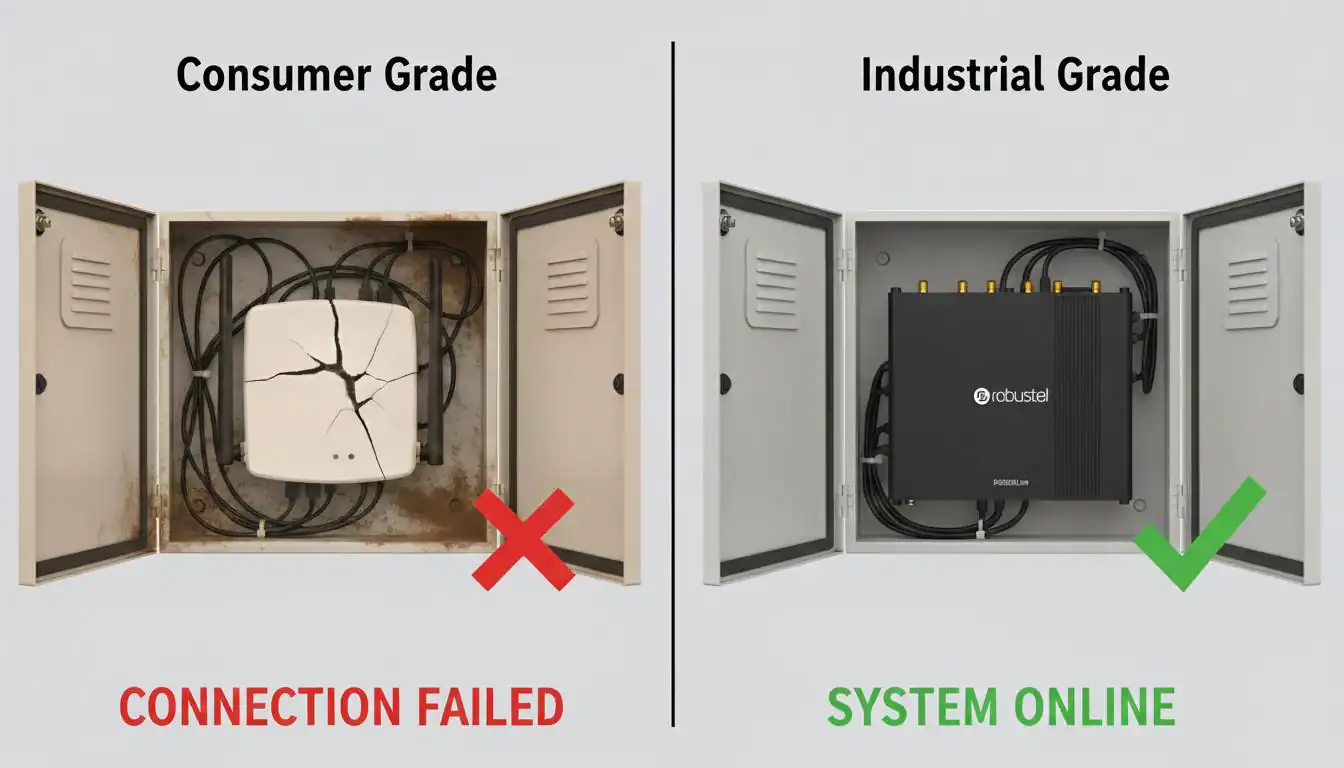
This guide defines the technical and economic framework for selecting an industrial 5G router. It moves beyond basic connectivity to explain how specific hardware features—like dual-SIM failover, IEC 62443 security, and edge computing—prevent the “zombie connections” and thermal failures that lead to million-dollar operational downtimes in Industry 4.0.
What We Will Cover:
- The Consumer vs. Industrial Gap: Why environmental hardening is a business continuity requirement.
- 5 Non-Negotiable Features: A deep dive into ruggedization, redundancy, and certified security.
- The “Zombie Connection” Solution: How intelligent health checks protect 99.9% uptime.
- CPE vs. Edge Gateway: A technical comparison to determine if you need a “data pipe” or a “local brain.”
In Industry 4.0, connectivity is the lifeblood of operations. 5G promises a high-speed, low-latency era for automated logistics and real-time monitoring, but the hardware is the critical point of failure. Choosing the wrong router doesn’t just result in a dropped signal; it leads to halted production lines and significant financial loss. This guide defines how to evaluate a 5G router that secures, connects, and future-proofs your business.
Why Your Business Needs an Industrial-Grade Router, Not Consumer Hardware
Let’s be clear: the plastic router from your local office supply store won’t survive a single summer inside a metal control cabinet on the factory floor. I’ve seen it happen time and again. An engineer, trying to save a few dollars, installs a consumer-grade device only to have it fail from overheating, vibration, or an electrical surge just weeks later.
- The ROI of Reliability:
When that connection drops, it’s never just a minor inconvenience. A single hour of downtime in the automotive industry can cost upwards of $2 million. For a modern warehouse, a failed connection to an AGV fleet can bring the entire logistics chain to a standstill. A true industrial 5g router is designed and tested to prevent these scenarios. It’s an investment in business continuity, not just an IT expense.
- Unlocking Low-Latency Potential:
The real promise of 5G in industry lies in its ability to handle demanding tasks that were impossible before. Think about streaming multiple 4K video feeds for AI-powered quality control or enabling real-time remote operation of heavy machinery. These applications require the unwavering, low-latency connection that only a purpose-built industrial 5g router can provide, ensuring your operations can leverage these next-generation technologies reliably.
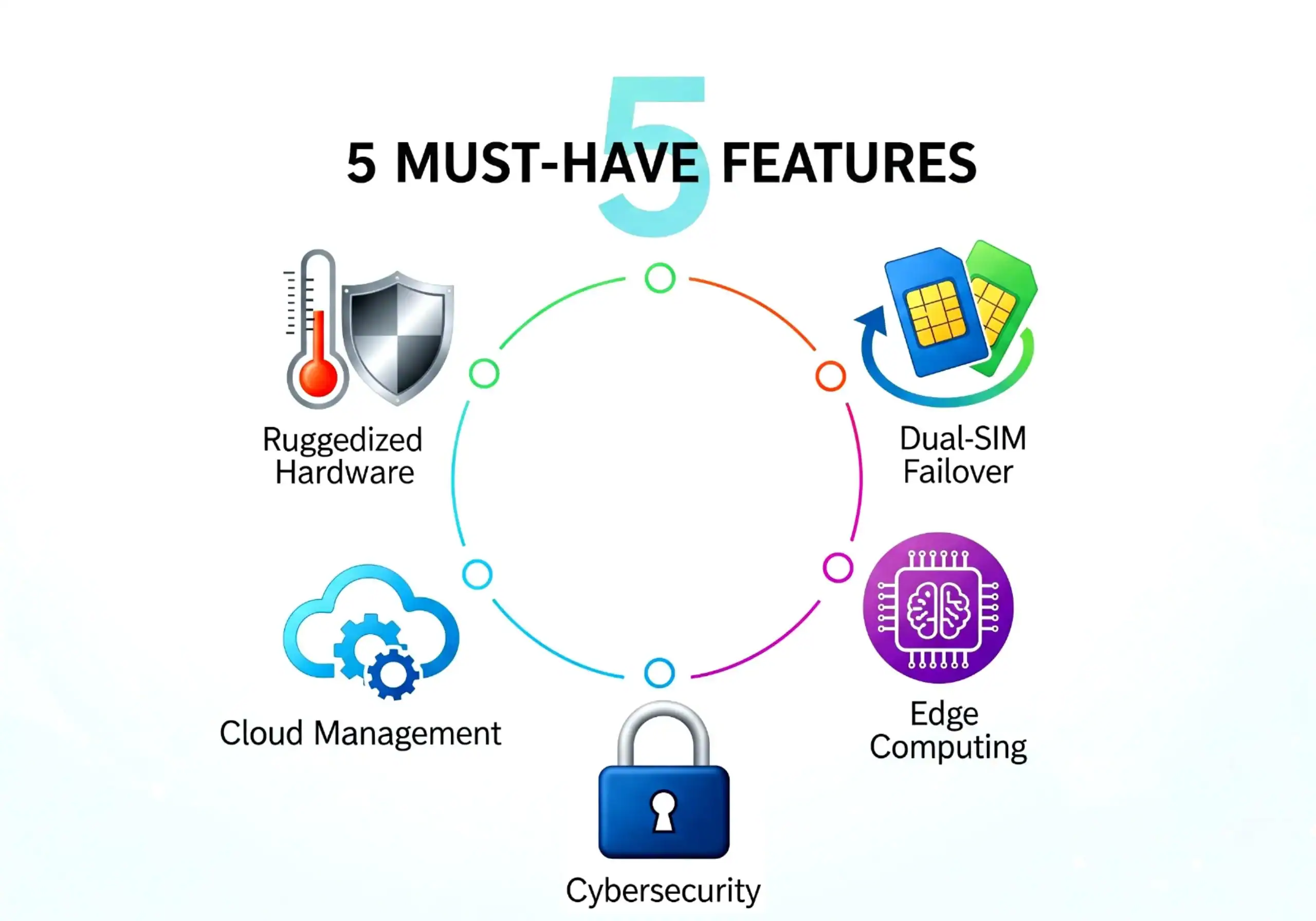
The 5 Non-Negotiable Features of a High-Performance industrial 5g router:
When you start comparing devices, it’s easy to get lost in technical specifications. In my experience, the choice always comes down to five essential pillars. If a device you’re considering is weak in any of these areas, you should walk away.
Feature 1: Ruggedized Hardware for Harsh Environments (Wide Temperature & Durability)
The industrial world is tough on electronics. Your industrial 5g router must be physically prepared to handle it. Look for these specific markers of a truly ruggedized device:
- Wide Operating Temperature: A bare minimum is -25°C to +70°C. This ensures the device operates reliably in both freezing outdoor cabinets and hot, poorly ventilated factory environments.
- Industrial-Grade Casing: A durable metal housing (typically aluminum) with an IP30 rating or higher is essential for protection against dust and physical impact.
- EMC Protection: It must have certified protection against electromagnetic interference (EMI), a common issue in factories with heavy machinery.
Feature 2: Redundancy via Dual-SIM Failover
A single point of failure is unacceptable in critical operations. An industrial 5g router must have a backup plan for its connection. Dual-SIM failover is the gold standard here.
How it helps: The device holds SIM cards from two different carriers. If the primary carrier’s network fails or signal quality drops, the router automatically and seamlessly switches to the backup carrier in seconds, ensuring your application stays online. This single feature can be the difference between a minor background alert and a full-blown operational crisis.
Feature 3: Enterprise-Grade Cybersecurity (IEC 62443 Standard)
Connecting industrial assets to a network inherently exposes them to cyber threats. Your industrial 5g router is the first line of defense. Basic consumer features are not enough. You need:
- Multi-Protocol VPN: The device must support multiple robust VPN protocols (like IPsec, OpenVPN, Wireguard) to create secure, encrypted tunnels for all data traffic, protecting it from eavesdropping.
- A Powerful Stateful Firewall: This allows you to set granular rules that control exactly what traffic can enter and leave your network, preventing unauthorized access.
- Certified Security: Look for vendors who follow secure development lifecycles, like the IEC 62443 standard, to ensure security is built-in, not bolted on.
Feature 4: Centralized Fleet Management (RCMS)
Managing one or two routers is easy. But what about managing hundreds or thousands across different sites? This is where a powerful cloud management platform like RCMS becomes essential. A centralized platform allows your team to:
- Monitor the status, signal strength, and data usage of your entire fleet from a single dashboard.
- Remotely update firmware and security patches across all devices at once.
- Diagnose and troubleshoot issues without dispatching a technician, drastically reducing operational costs.
Feature 5: Onboard Edge Computing (The X-Factor)
The most advanced industrial connectivity devices are more than just routers; they are powerful computers. The ability to process data locally, right at the network’s edge, is a game-changer. This edge computing capability allows a device to analyze data from sensors or PLCs on-site, only sending critical insights or alerts to the cloud. This reduces bandwidth costs, improves response times, and enhances data privacy. An industrial 5g router with these capabilities is not just a connector but an intelligent platform for future innovation.
Technical Comparison: Industrial 5G CPE vs. 5G Edge Gateway
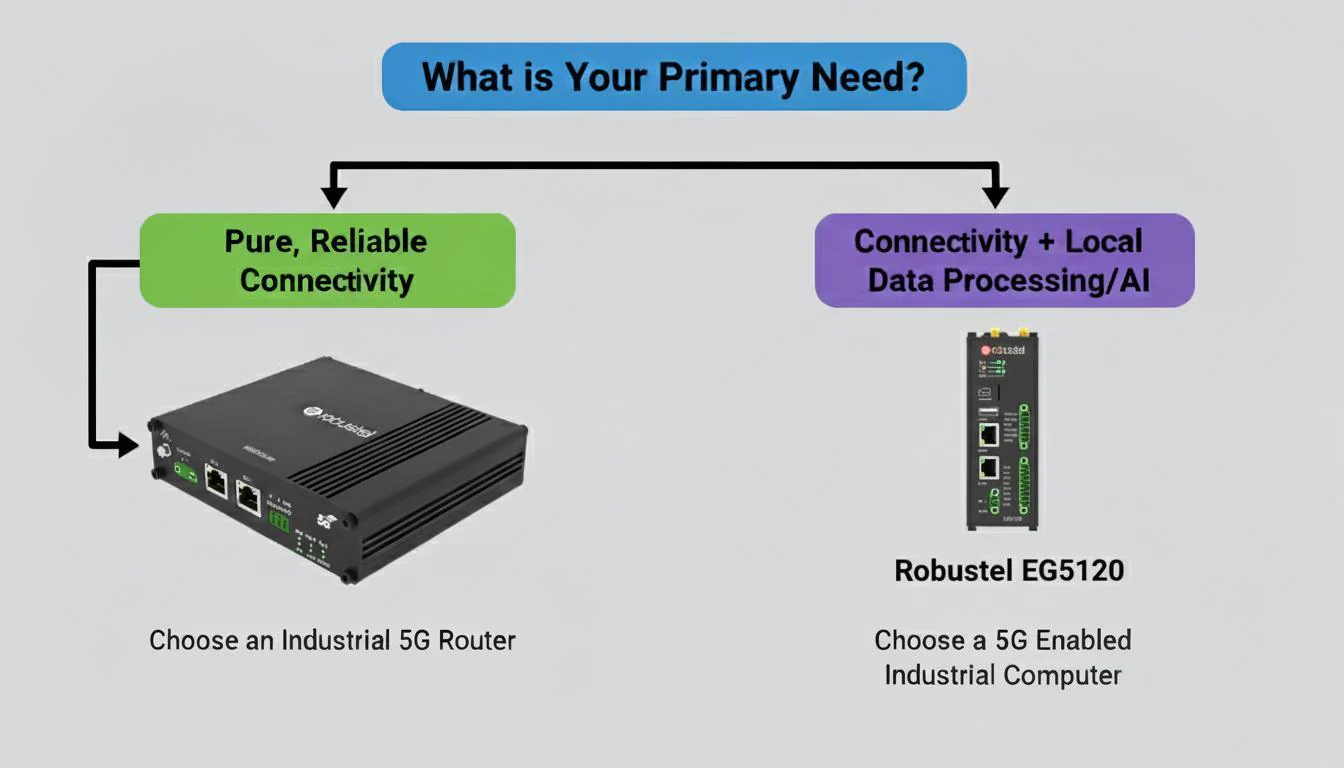
Once you verify the five core features, your final choice depends on one architectural question: Do you need a “data pipe” or a “local brain”?
1. The “Data Pipe”: Robustel R5020 Lite (5G CPE)
Choose a dedicated 5G Industrial CPE if your goal is to provide a high-speed, transparent bridge for existing on-site intelligence.
- Primary Function: Provides an unbreakable 5G Release 16 bridge with advanced features like Network Slicing support. It acts as a transparent Layer 2 or Layer 3 gateway.
- Expert Insight: The R5020 Lite is engineered for throughput-heavy applications where the end device (like a sophisticated PLC or an NVR) already has the logic to manage data. By offloading the cellular stack and VPN encryption to the R5020 Lite, you free up the primary controller’s CPU cycles for its core mission.
- Best For: High-bandwidth backhaul, such as streaming multiple 4K IP camera feeds or providing primary/failover internet for branch offices and remote kiosks.
2. The “Local Brain”: Robustel EG5120 (Edge Gateway)
Choose a 5G-Enabled Industrial Computer if you need to solve the “Cloud Cost” or “Latency” problem by processing data at the source.
- Primary Function: Combines a 5G modem with a 1.6 GHz Quad-core ARM processor and a dedicated NPU (Neural Processing Unit) for hardware-accelerated AI.
- Expert Insight: The EG5120 is more than a router; it’s a protocol converter and application host. Because it runs Debian-based RobustOS Pro, you can use Docker to run custom Python or C++ apps that aggregate Modbus/MQTT data locally. This allows you to “compress” thousands of sensor readings into a single meaningful health report, drastically reducing your 5G data bill and cloud storage costs.
- Best For: Predictive maintenance (local FFT vibration analysis), AI-based computer vision for quality control, and legacy “IT/OT Convergence” where you need to bridge old serial/Modbus hardware to modern cloud MQTT brokers.
Conclusion: Technical Accountability in the Field
In the industrial world, a router is not just a peripheral; it is the single point of failure for your entire data chain. Choosing hardware based on a low purchase price is a high-risk strategy that often results in expensive “truck rolls,” manual resets, and lost production data.
The real value of an industrial 5G router isn’t found in a marketing brochure, but in its ability to operate autonomously in a +70°C cabinet without thermal throttling. Whether you need a 5G CPE to offload networking tasks or an Edge Gateway to cut costs through local data aggregation, your decision should be based on technical resilience. By implementing ruggedized hardware, Dual-SIM failover, and IEC 62443 security today, you ensure that your connectivity remains a silent, reliable utility rather than a constant operational bottleneck.
FAQs
Q1: What are the key features of an industrial 5G router?
The most critical features are ruggedized hardware (wide temperature range, durable housing), connectivity resilience (dual-SIM failover), enterprise-grade cybersecurity (VPN, firewall), centralized cloud management capabilities, and in advanced models, onboard edge computing power.
Q2: Why is dual SIM failover crucial for industrial applications?
Industrial applications cannot tolerate downtime. Dual-SIM failover provides essential redundancy by automatically switching to a backup cellular carrier if the primary network fails. This ensures continuous connectivity for mission-critical operations, preventing data loss and operational halts.
Q3: How does cloud management for a 5G router save operational costs?
Cloud management saves significant costs by drastically reducing the need for expensive on-site technician visits (“truck rolls”). It allows administrators to remotely monitor device health, diagnose problems, and deploy firmware or security updates to an entire fleet of routers from a central location, improving efficiency and uptime.
About the Author
Robert Liao | Technical Support Engineer
Robert Liao is an IoT Technical Support Engineer at Robustel, specializing in industrial networking and edge connectivity. A certified Networking Engineer, Robert focuses on the deployment and troubleshooting of large-scale IIoT infrastructures. His work centers on architecting reliable, scalable system performance for complex industrial applications, bridging the gap between field hardware and cloud-side data management.