Coast-to-coast 4G for US retail loss prevention and analytics with the Robustel R2010:
How Robustel & Checkpoint Systems deploy electronic article surveillance (EAS) gates across nationwide US retail chains.
Case Study – Fast Facts
Location
North America
Industry
Retail & Hospitality
Product(s)
- R2010
End Customer
Checkpoint Systems – https://checkpointsystems.com/
Checkpoint Systems is a global technology provider specialising in retail loss prevention and merchandise visibility. The company designs and manufactures the full stack for Electronic Article Surveillance (EAS) and radio frequency identification (RFID) – from inlays, tags, and labels through to antennas, hardware, cloud software, and analytics platforms such as Checkpoint Store Operations. This end-to-end control lets retailers standardise on a single provider for shrink management, item-level inventory visibility, people counting, and in-store analytics, rather than stitching together point solutions from multiple vendors. As a division of CCL Industries, Checkpoint supports thousands of retailers worldwide with large-scale RFID manufacturing capacity in China and Mexico and an installed base that spans apparel, general merchandise, grocery, health and beauty, and supply chain applications.
Challenges
Checkpoint needed to provide internet connectivity for EAS gates and sensors in thousands of third-party retail outlets where corporate IT teams often refused to place non-standard devices on the store wide-area network. A 4G-based alternative had to avoid hidden risks such as uncontrolled airtime usage, unreliable RF performance inside metal-rich store environments, and the capital cost of rolling out 1,000+ routers. The solution also had to support secure remote access so central operations and network teams could manage devices without local IT involvement.
Results
By standardising on an industrial 3G/4G router platform with roaming SIMs and central management, Checkpoint delivered coast-to-coast connectivity for over 1,000 sites quickly and at an aggressive price point. Estate-wide uptime improved thanks to dual-network roaming across AT&T and T-Mobile and careful antenna and configuration choices. RCMS Cloud and Data-Guard v2 gave central teams visibility and control over both the routers and their airtime footprint, allowing Checkpoint to focus on delivering EAS and analytics services rather than troubleshooting connectivity.
Building a connected EAS estate across 1,000 US stores
Checkpoint Systems is one of the few retail technology vendors that designs and delivers the full stack for electronic article surveillance and radio frequency identification (RFID): tags and labels on products, pedestals at doors, software in the data centre, and cloud platforms to tie it together. For retailers, that means a single provider can deliver both the physical shrink-prevention infrastructure and the data needed to understand where and how losses occur. Adding connectivity to EAS pedestals unlocked a new layer of value—remote health monitoring, centralised configuration, and footfall analytics that link store traffic patterns to sales and loss trends.
However, realising that value at scale meant dealing with the realities of large, security-conscious retail IT organisations. Many chains simply do not allow third-party hardware to sit on their corporate wide-area networks, regardless of the business benefit. In those environments, either the “connected” part of the EAS proposition is dropped entirely or an independent connectivity layer must be introduced. For one nationwide US retailer, Checkpoint chose the latter, working with Robustel to design a 4G architecture that could be rolled out across more than 1,000 stores in a consistent, repeatable way. The stakes were high: if connectivity proved unreliable or too expensive, the business case for analytics and remote monitoring would collapse.
Business Challenges
1. No access to “free” in-store internet
In theory, the cheapest connectivity option would be to plug EAS pedestals into the retailer’s existing network. In practice, corporate IT teams are rightly cautious about allowing third-party devices to share their WAN. Many respond with a simple yes/no decision—if the answer is no, there is no scope for segmentation or exceptions. For Checkpoint, every “no” meant a store that could not join the connected EAS programme, weakening the value of analytics and remote monitoring.
The alternative was to install a standalone 4G solution in each store, but that introduced a new set of decisions and risks. Airtime plans, roaming behaviour, security architecture, and hardware selection all had to be configured in a way that protected both the retailer and Checkpoint’s margins. A naïve rollout could easily lead to uncontrolled data usage, insecure remote access paths, or a support burden that wiped out the business benefit. The team needed a carefully designed architecture rather than a pile of SIM cards and routers.
2. Achieving reliable 3G/4G coverage in harsh RF environments
Retail stores are pleasant places for people but often hostile for radio. Supermarkets, drug stores, dollar stores, big-box formats, and apparel outlets all use metal cladding, shelving, and fixtures that can attenuate cellular signals. EAS pedestals are usually placed at entrances and exits, sometimes far from windows or exterior walls, which can further reduce signal quality. For a 4G-only connectivity layer, that environment creates a real risk of patchy performance or dead zones.
With more than 1,000 sites in scope, even a small percentage of poorly performing locations could generate a disproportionate number of support tickets. Field engineers would need to revisit stores to relocate routers or antennas, adjust configurations, or change SIMs, all of which adds cost and slows down rollout. The team needed a way to maximise the chance of a good connection at each site, both by choosing suitable hardware and by leaning on multi-network roaming rather than relying on a single operator.
3. Balancing capital cost and long-term performance
At 1,000+ units, the choice of router was a major line item in the project budget. A low-cost device with weak firmware or non-industrial build quality might appear attractive initially but would likely fail under continuous use, driving truck rolls and replacements. An over-engineered, premium device might solve every technical concern but blow out the upfront capital expenditure and make the programme hard to justify. Checkpoint needed to find a price-performance sweet spot that preserved quality without damaging the business case.
Beyond hardware, the cost of airtime and ongoing management had to be considered. Without the right tools, tracking data usage across 1,000 SIMs and ensuring configurations stayed aligned would require significant manual effort. The team needed a solution that not only hit the right unit price but also came with management capabilities that would keep operational overheads under control as the estate grew.
Solution Overview
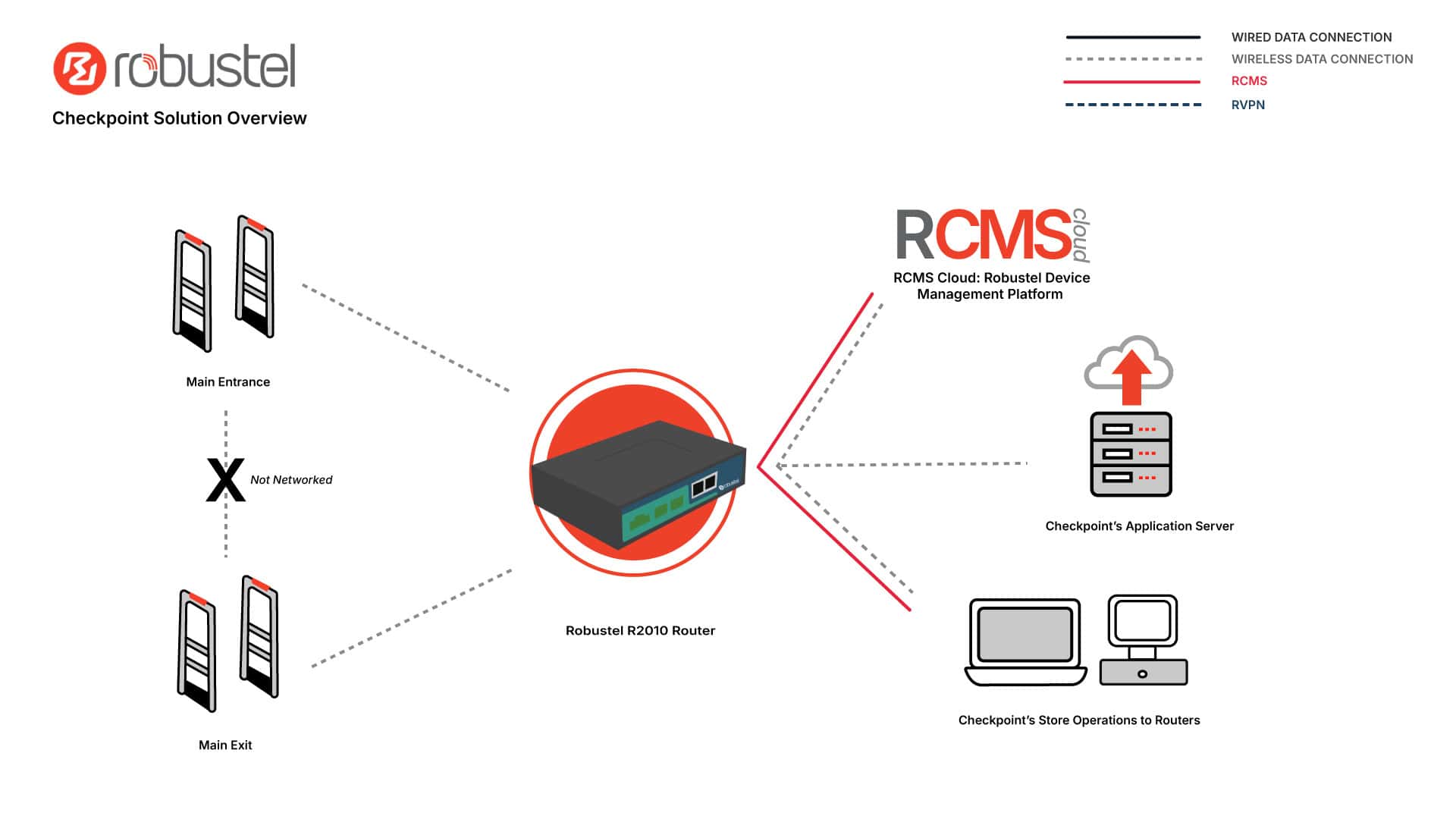
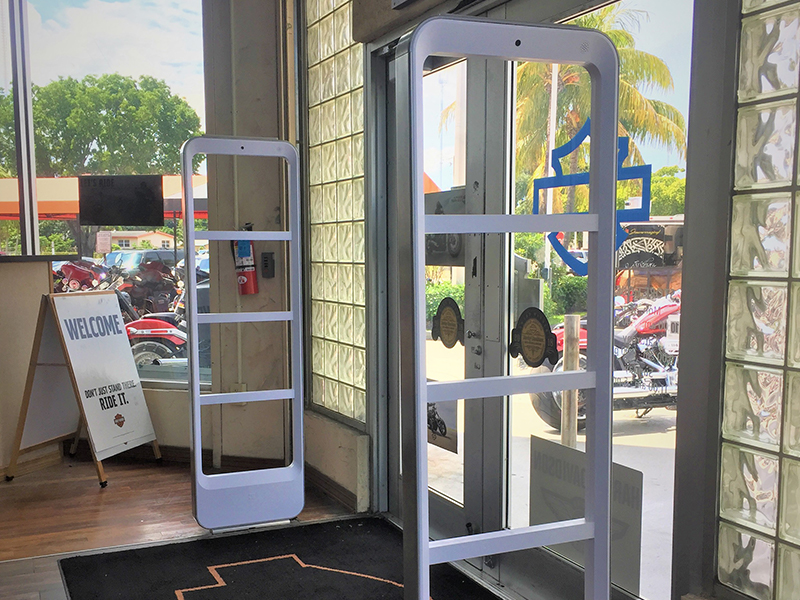
Checkpoint’s EAS pedestals ship with an Ethernet interface, which is used in this project to connect each gate to an industrial LTE router now represented by the Robustel R2010. The router hosts a SIM capable of roaming between AT&T and T-Mobile in the United States, giving each store access to two nationwide networks instead of one. Application and telemetry traffic from the pedestals flows through the router to Checkpoint’s cloud environment, where software aggregates device health, alarm events, and footfall data into dashboards for store operations teams. The diagram on page 2 of the original case study shows this topology, with pedestals at each store edge, routers providing backhaul, and central application servers and operations centres consuming the data.
Checkpoint’s Network Operations Center uses secure VPN connections that terminate on the routers, allowing engineers to access devices in any store as if they were on a local network. This makes it possible to diagnose alarms, push updates, or change configurations without involving local staff. A connection to RCMS Cloud—the Robustel router management platform—adds a further layer of visibility: estate-wide status, configuration control, and the ability to perform software upgrades on routers across all stores. Data-Guard v2, running as an application in the environment, provides enhanced functionality for roaming SIMs, helping to manage airtime usage and roaming behaviour in a more controlled way.
Behind the scenes, Checkpoint and Robustel collaborated closely on antenna selection, placement guidance, and router configuration templates that could be replicated consistently across the estate. The combination of multi-network roaming, industrial-grade hardware, and centralised management meant that each site could be brought online quickly with minimal tuning. Once the architecture was proven, rolling out to more than 1,000 locations became a repeatable process rather than a series of one-off engineering jobs.
Why Checkpoint chose the R2010:
- Multi-network roaming flexibility: Support for roaming SIMs across AT&T and T-Mobile, combined with guidance on selecting unsteered SIMs, improved overall estate uptime by letting each router attach to the network with the best radio conditions rather than a pre-favoured operator.
- Price–performance balance: The router platform hit an aggressive price point while still delivering stable long-term communications, making the 1,000-site rollout financially viable without compromising quality.
- Robust, industrial-grade design: Hardware and firmware designed for continuous operation in demanding retail environments reduced the risk of failures that could lead to truck rolls and service interruptions.
- Integrated management ecosystem: Native integration with RCMS Cloud and support for Data-Guard v2 gave Checkpoint estate-wide monitoring, configuration control, and roaming SIM management from a central, Azure-hosted platform.
- Programmability and global availability: A rich software development kit (SDK) and global hardware variants provided a platform that could be adapted to future requirements and replicated in other regions beyond the initial US deployment.
Key Outcomes
From the retailer’s perspective, the goal was straightforward: keep loss-prevention hardware online, gain better insight into shrink and traffic, and avoid creating new operational headaches. After the 4G rollout, connected EAS gates and sensors became a dependable part of the store environment rather than an experimental add-on. Central teams could see device status across the estate, while individual stores benefited from systems that simply worked at the door without constant local intervention.
“Robustel worked very closely with Checkpoint Systems in the design, integration and even the SIM selection for a robust 4G solution across the USA, sharing their expertise at every turn. For one particular retailer we rolled out over 1000 Robustel routers and they have delivered flawless performance since being installed, which allowed us to get estate-wide 4G connectivity in place very quickly and very cost-effectively.” – Joe Esposito – VP Customer Operations at Checkpoint Systems.
- Estate-wide connectivity at scale: More than 1,000 stores were brought online quickly using a repeatable design, delivering coast-to-coast coverage for EAS monitoring and analytics.
- High uptime across a challenging RF environment: The combination of roaming SIMs, careful antenna choices, and optimised router configuration delivered very high availability, even in metal-rich buildings where cellular signals are typically weak.
- Fast, cost-effective deployment: A well-tuned hardware and airtime strategy meant the 4G layer could be rolled out rapidly and at a cost that supported the overall business case for connected EAS services.
- Reduced operational risk and overhead: Centralised management via RCMS and Data-Guard v2 allowed remote upgrades, configuration management, and roaming SIM control, reducing the need for on-site engineering visits.
- Focus on core loss-prevention value: With connectivity handled reliably, Checkpoint and the retailer could concentrate on using EAS and analytics data to improve shrink management, staffing decisions, and customer experience instead of troubleshooting networks.
Featured Products
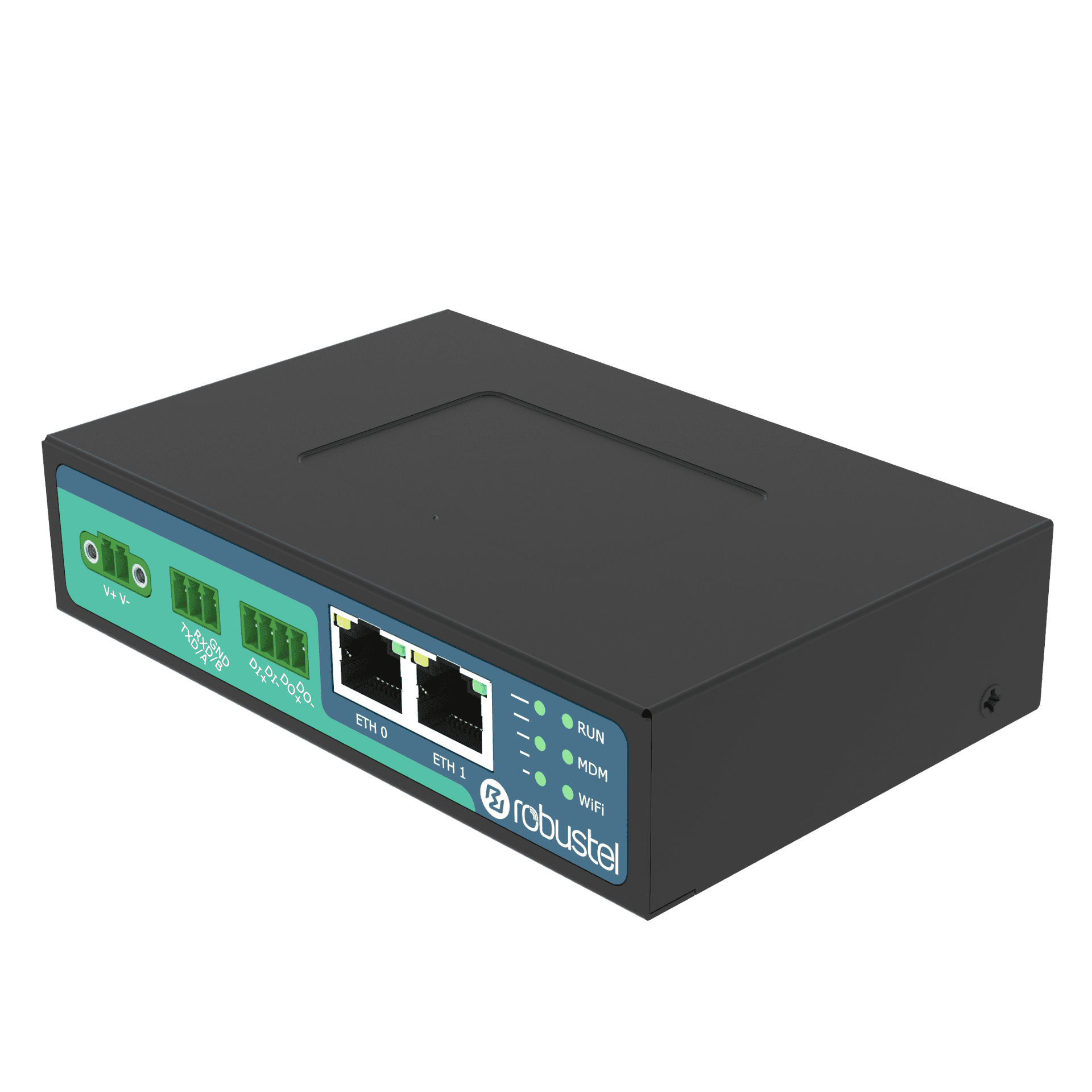
Robustel R2010 4G/LTE Router
RCMS Device Management Platform

Smart Roaming