
How Edge Intelligence Stabilizes the Autonomous Smart Grid
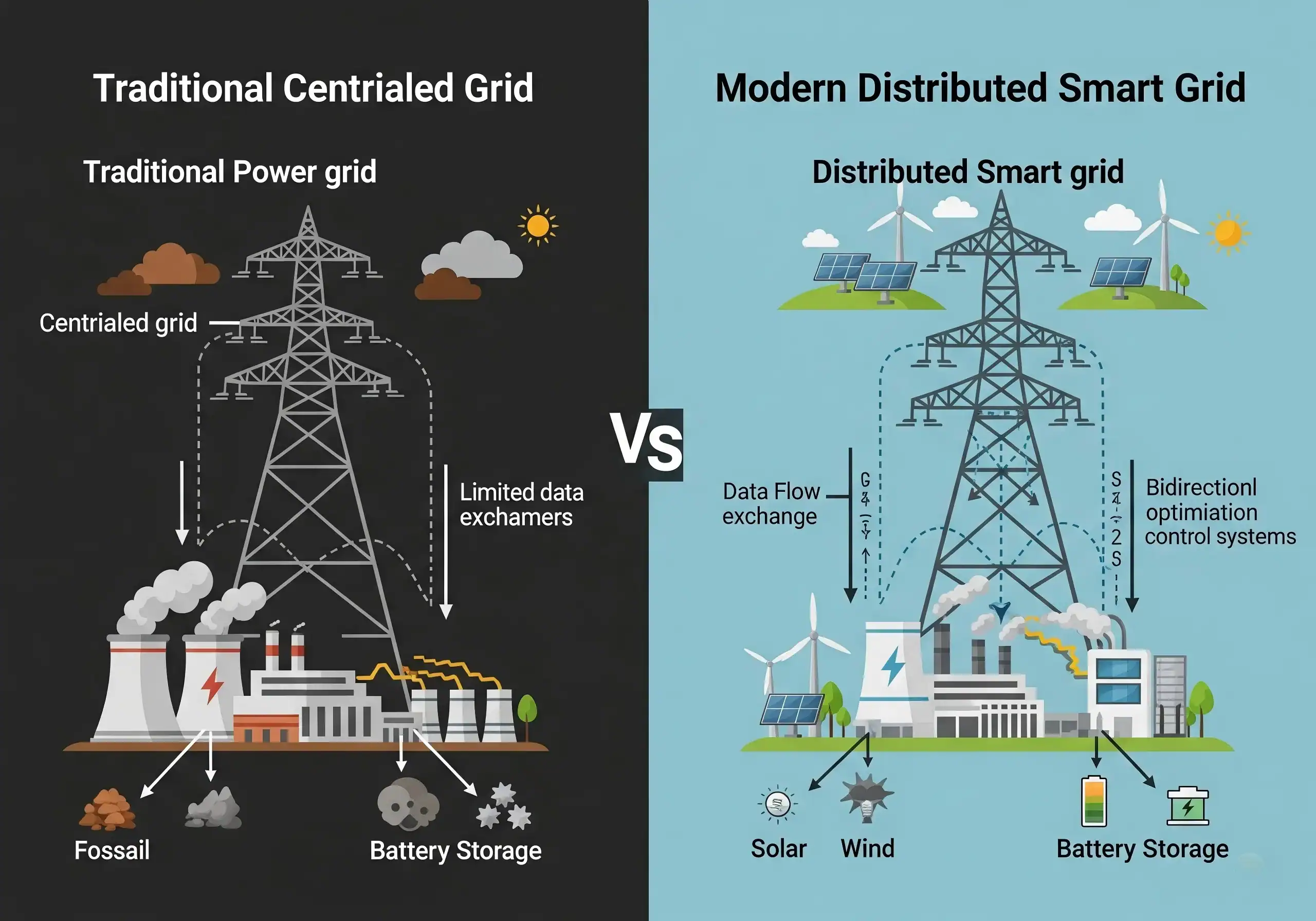
The transition from centralized power plants to a Distributed Energy Resource (DER) model—driven by renewables and BESS—has outpaced the capabilities of traditional cloud-only architectures. This guide provides a strategic roadmap for implementing Edge Computing in Smart Grids to solve critical latency and reliability gaps.
Key Insights You Will Gain:
- The Latency Imperative: Why millisecond-level local decision-making is mandatory for FDIR (Fault Detection, Isolation, and Restoration).
- Autonomous Orchestration: How an Industrial IoT Edge Gateway like the Robustel EG5120 optimizes Battery Energy Storage Systems (BESS) and EV charging loads locally.
- Protocol & Data Sovereignty: Techniques for aggregating DNP3, IEC 61850, and Modbus telemetry into a secure, unified edge-to-cloud stream.
- Grid Resilience: Leveraging Deterministic Logic to ensure “islanding” capabilities and continuous operation during backhaul outages.
Introduction: The Challenge of Grid Volatility
I’ve spent a lot of time talking with power engineers and grid operators lately, and they all face the same daunting challenge: the “One-Way Street” era of electricity is over.
Our grid has transformed into a high-speed, multi-directional superhighway. The surge in Distributed Energy Resources (DERs)—from massive solar farms to residential Battery Energy Storage Systems (BESS)—has created a level of volatility that traditional centralized management can’t handle. Add the high-power demand of EV charging infrastructure and the data explosion from Advanced Metering Infrastructure (AMI), and the need for real-time, deterministic control has officially exploded.
The critical question I hear most is: How do you maintain grid frequency and voltage stability when a single cloud bank over a solar array or a sudden peak in EV charging can destabilize a local feeder in seconds?
Relying on a centralized cloud for every decision is no longer viable; the backhaul latency is too high, and the security risks of transmitting raw mission-critical data are too great. This is precisely why the industry is pivoting toward Edge Computing for Smart Grids. The solution isn’t just “connectivity”—it’s deploying localized intelligence through a ruggedized Industrial IoT Edge Gateway to make split-second decisions where the data is born.
Why Edge Intelligence is Non-Negotiable for Grid Resilience
To be clear: for a 2026-ready power infrastructure, edge computing isn’t just a “nice-to-have” upgrade—it is a fundamental necessity for Grid Modernization. The physics of high-voltage electricity demand decisions in microseconds, a requirement that traditional cloud round-trips simply cannot fulfill.
The Latency Gap: Cloud vs. Substation Reality
Imagine a critical fault at a remote primary substation. In a cloud-only model, sensor telemetry must travel hundreds of miles to a data center, wait for processing, and then hope the control command makes it back in time. By the time that handshake is complete, a localized surge could have cascaded into a regional blackout.
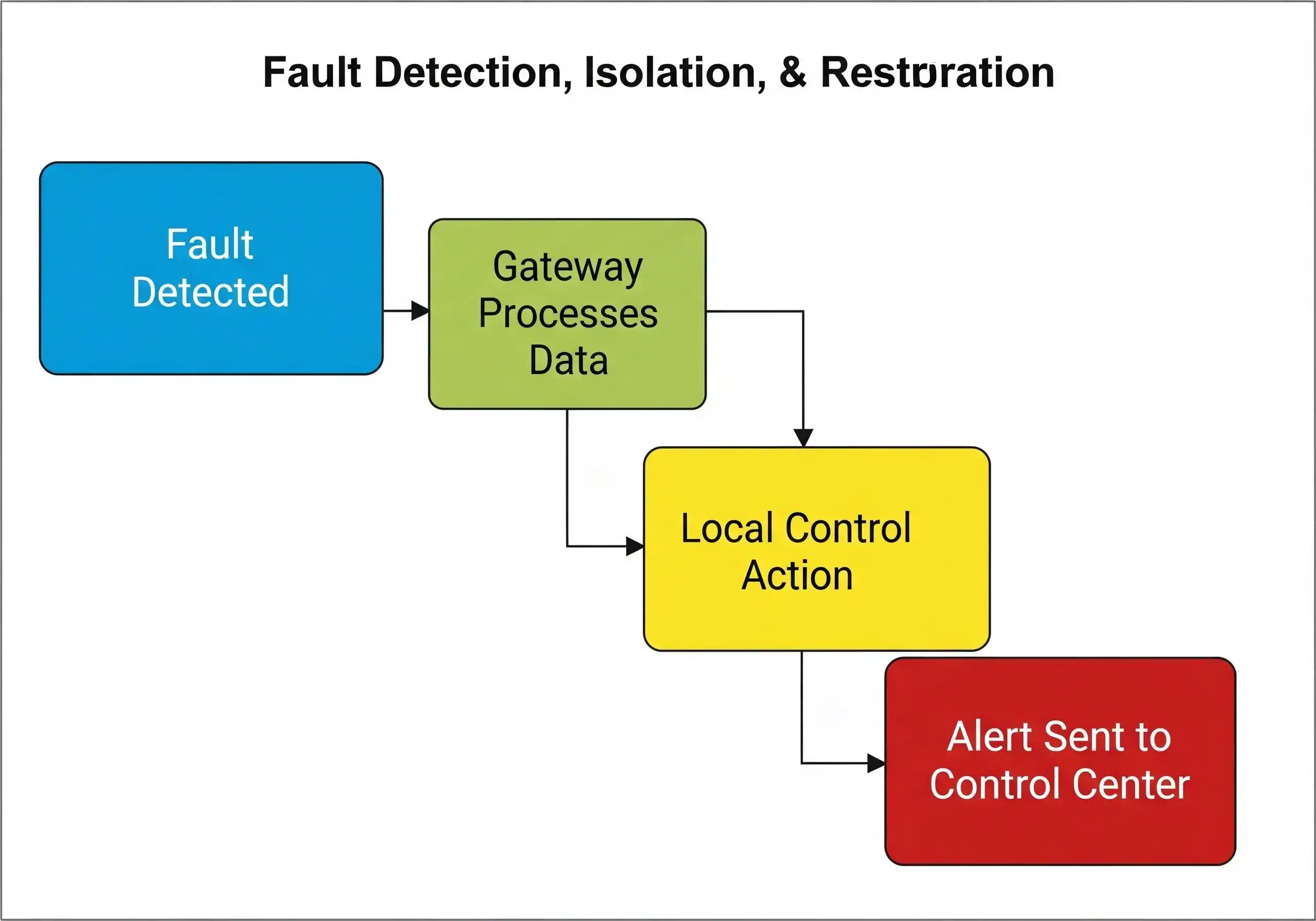
An Industrial IoT Edge Gateway deployed on-site changes the game. By hosting Deterministic Logic locally, the gateway can detect an anomaly and execute a pre-defined protection scheme—such as tripping a breaker—in milliseconds. It isolates the fault before the cloud even “knows” it happened.
Core Strategic Benefits of an Edge-First Approach
- Ultra-Low Latency for Autonomous Control: Beyond just monitoring, edge intelligence enables the Autonomous Grid Control required for frequency regulation and rapid protection.
- Decoupled Resilience (Local Survivability): If the primary backhaul (cellular or fiber) fails, the grid segments remain operational. The local Edge Gateway continues to run its control logic, ensuring “islanding” capabilities during emergencies.
- Data Orchestration & Cost Optimization: High-frequency data from Phasor Measurement Units (PMUs) generates massive traffic. By processing this at the edge and only pushing “exception-based” insights to the central SCADA system, you dramatically slash bandwidth costs and storage overhead.
- Fortified OT/IT Security: An industrial gateway acts as a secure, air-gapped buffer. It protects sensitive Operational Technology (OT) from external IT vulnerabilities while ensuring encrypted data flow.
The Blueprint—Architecture of a Grid-Edge Solution
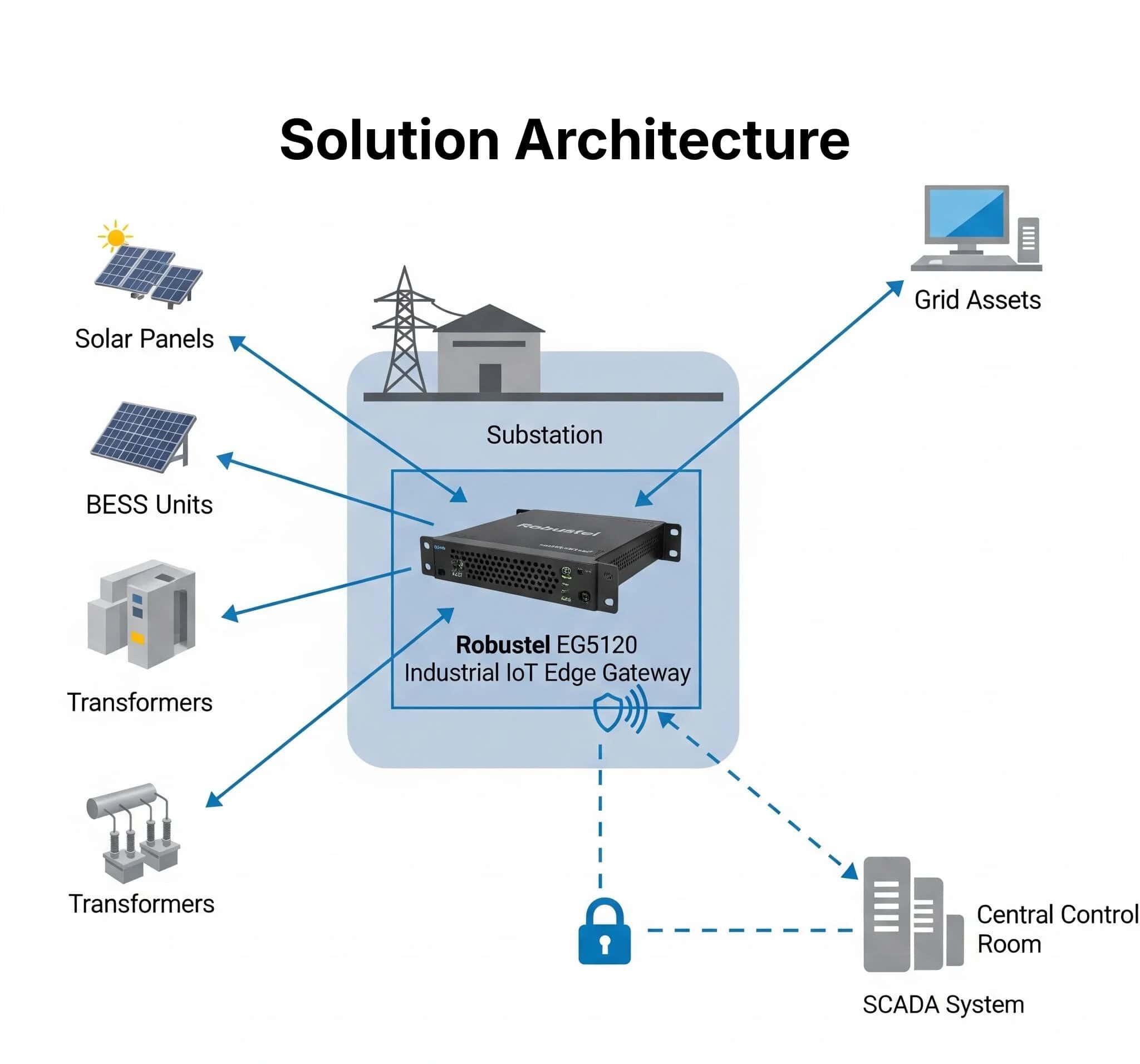
Understanding the “Why” of edge intelligence naturally leads to the “How.” Building a resilient Smart Grid Edge Architecture isn’t just about hardware; it’s about creating a harmonious ecosystem where localized processing meets industrial-grade reliability.
A high-performance solution for Edge Computing in Smart Grids typically relies on two foundational pillars:
1. The Hardware Backbone: The Industrial IoT Edge Gateway
The gateway is the “Local Brain” of the operation. In the high-EMI (Electromagnetic Interference) environment of a substation, consumer-grade hardware will fail. A high-compute platform like the Robustel EG5120 is specifically engineered for these rigors:
- High-Performance Compute: Equipped with a Quad-Core NXP i.MX 8 processor, it provides the raw horsepower needed to run complex Python analytics, AI-driven anomaly detection, and real-time control logic at the edge.
- Substation-Hardened Design: Featuring a fanless, ruggedized enclosure and a wide operating temperature range (-40°C to +70°C), it thrives where traditional servers cannot.
- Diverse Industrial I/O: To bridge the gap between decades of technology, it supports RS232/RS485 for legacy RTUs alongside Gigabit Ethernet for modern Intelligent Electronic Devices (IEDs) and high-speed backhaul.
2. The Software Ecosystem: “The Master Translator”
In the energy sector, a gateway is only as good as the languages it speaks. It must act as a seamless bridge between the physical grid and the digital control center.
- Native Industrial Protocol Support: Mastery of DNP3, IEC 60870-5-101/104, and Modbus TCP/RTU is non-negotiable. This ensures the gateway can poll data from legacy RTUs and provide a unified data stream to modern SCADA systems.
- The Flexibility of RobustOS Pro: Built on a Debian-based architecture, RobustOS Pro allows utilities to deploy custom applications and Docker containers. This “Open-Edge” approach enables you to run proprietary algorithms for load balancing or fault prediction directly on the hardware.
- Zero-Trust Security Layer: With a hardened firewall and a comprehensive suite of VPNs (IPsec, OpenVPN, WireGuard), the EG5120 ensures that substation data is encrypted and isolated from external threats, maintaining strict compliance with grid cybersecurity mandates.
Real-World Impact—Key Applications of Grid-Edge Intelligence
The theoretical benefits of edge computing translate into transformative operational gains when applied to the modern power infrastructure. Let’s look at three critical domains where an Industrial IoT Edge Gateway like the EG5120 is setting new standards for efficiency and reliability.
1. Substation Automation & Intelligent Data Concentration
In the heart of the power grid, the substation, the gateway acts as the “Universal Translator” and local controller. By deploying edge intelligence, operators can:
- Unified Protocol Aggregation: Seamlessly collect and normalize telemetry from disparate IEDs and RTUs using DNP3, IEC 61850, or Modbus.
- Edge-Driven Switching: Execute local automation logic to manage switchgear and transformers without waiting for a round-trip command from a distant Master Station.
- Secure Remote Engineering: Provide encrypted, role-based access for technicians via VPN, drastically reducing “truck rolls” and O&M costs.
2. Mastering the “Multi-Directional” Grid: DER & BESS Management
As the grid shifts from a one-way street to a complex web of Distributed Energy Resources (DERs), localized control becomes the only way to maintain stability.
- Renewable Energy Curtailment & Forecasting: Real-time monitoring of Solar PV and Wind Turbine output allows for rapid response to weather-driven fluctuations.
- Intelligent BESS Orchestration: This is where edge computing truly excels. An edge gateway can run complex Energy Management System (EMS) algorithms locally to optimize a Battery Energy Storage System (BESS). It makes millisecond-decisions on when to “Time-Shift” energy—charging during low-tariff/high-generation periods and discharging during peak demand or frequency deviations.
- Dynamic EV Load Balancing: Manage Smart EV Charging Clusters, balancing the surge in demand against real-time local transformer capacity to prevent localized overloads.
3. The Self-Healing Grid: Autonomous FDIR
In Fault Detection, Isolation, and Restoration (FDIR), speed is the only metric that matters. When a distribution line goes down, a centralized cloud is too slow to prevent a cascade. An Industrial Edge Gateway analyzes high-frequency sensor data across the line. If a fault is detected, it autonomously executes “Self-Healing” commands to reroute power and isolate the segment in milliseconds. This localized autonomy minimizes SAIDI (System Average Interruption Duration Index) and keeps the lights on for the maximum number of customers.
Tips: Proven at the Edge—Discover the full spectrum of EG5120
Application 1: Secure Remote Access to Industrial Robots
Application 2: Connected CNC Machines: Real-Time Insight for Service Teams and Plant Operations
Application 3: Smart Parking-Connectivity for CCTV Cameras, License Plate Recognition, Meters and Sensors
Conclusion: Empowering the Autonomous Grid
The transition to a smarter, more resilient energy infrastructure is no longer a strategic choice—it is an operational mandate. As we integrate more intermittent clean energy and complex Battery Energy Storage Systems (BESS), the “wait-and-see” approach of centralized cloud processing has reached its limit.
Edge Computing for Smart Grids is the bridge between today’s legacy constraints and tomorrow’s autonomous reality. By deploying ruggedized, high-compute Industrial IoT Edge Gateways like the Robustel EG5120, utilities and grid operators gain more than just connectivity; they gain the power of Localized Intelligence.
From millisecond-level FDIR (Fault Detection, Isolation, and Restoration) to the intelligent orchestration of distributed energy assets, the EG5120 provides the deterministic control and military-grade security required to navigate the modern energy ecosystem. At Robustel, we believe the future of the grid isn’t just about being “connected”—it’s about being fundamentally self-aware, self-healing, and future-proof.
FAQs
Q1: What are DNP3 and IEC 60870-5-104?
A1: DNP3 and IEC 60870-5-104 are standard communication protocols used extensively in the electric utility industry. They are designed for reliable communication between control centers (SCADA masters) and remote devices like RTUs and IEDs. An industrial IoT edge gateway for the energy sector must support these protocols.
Q2: How does an edge gateway improve the integration of renewable energy and energy storage?
A2: Integrating intermittent clean energy sources like solar and wind requires fast, local control to manage fluctuations. An edge gateway can monitor renewable output and local demand in real-time, helping to make intelligent, sub-second decisions about charging or discharging energy storage systems to ensure grid stability.
Q3: How does an industrial IoT edge gateway handle the harsh environment of an electrical substation?
A3: They are purpose-built for it. Devices like the EG5120 have a rugged, fanless metal enclosure, a wide operating temperature range (-40°C to +70°C), and undergo rigorous testing for electromagnetic compatibility (EMC) to ensure they can operate reliably amidst the high electrical noise of a substation.
About the Author
Hubery Zhang | IoT Technical Support Director
Hubery Zhang is the IoT Technical Support Director at Robustel. He leads the global support team in architecting reliable, high-performance IoT infrastructures. With a focus on industrial networking and system scalability, Hubery ensures that Robustel’s technology delivers maximum value and uptime for complex, large-scale deployments across the globe.