
Best-Fit LoRaWAN Gateway for Smart Buildings: Indoor Coverage and Protocol Integration
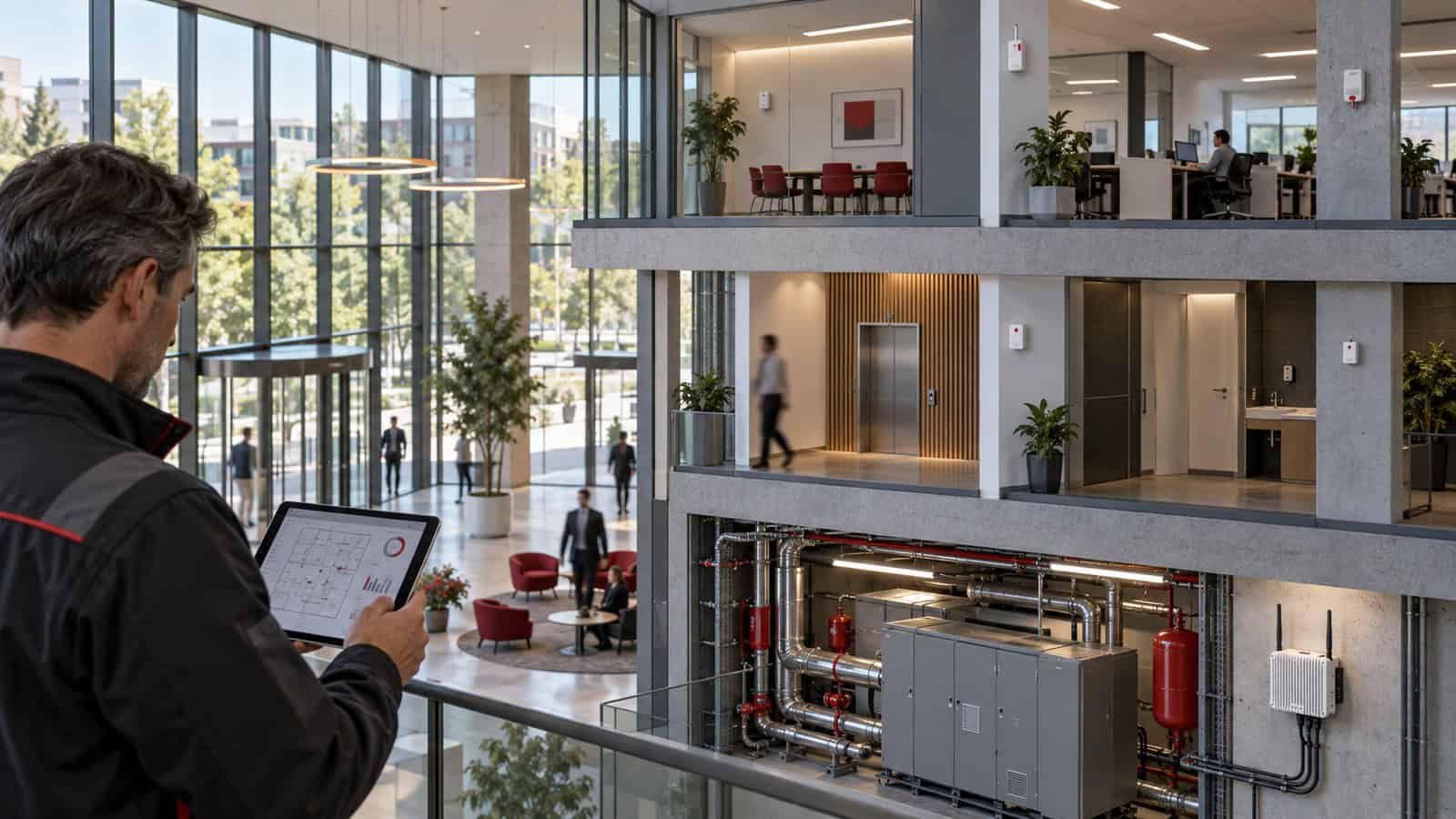
The Robustel LG5120 Intelligent Building Control Center is relevant when a smart-building project must connect LoRaWAN sensing with established building protocols. That is a broader role than placing a packet forwarder on a roof.
Two paths need to work. The RF path must reach sensors in offices, risers, basements and plant rooms. The data path must turn those messages into information the BMS, energy platform or facilities team can use. Treating either path as an afterthought produces a gateway that is technically online but operationally isolated.
Design Coverage by Building Zone
Reinforced concrete, metal plant, lift shafts, fire doors and low-emissivity glazing create irregular propagation. The centre of a floor plan can be a poor RF position. Survey the hardest sensor locations with doors and equipment in representative states.
Robustel’s Voytech Systems case study records a BMS monitoring deployment using LoRaWAN and R1520LG gateways. It shows where the gateway decision enters the business case: wireless sensing can reduce selected cabling work, but only if coverage, backhaul and the route into building operations are all supportable. A buyer should compare avoided cabling with survey, gateway, server and maintenance effort rather than quote the saving alone. The measured outcome remains specific to that estate.
Add gateways to solve distinct coverage zones rather than stretching one installation through maximum spreading factors and repeated transmissions. More airtime can affect capacity and battery life. The acceptance result should be reliable delivery from representative devices, not a single successful uplink.
Keep LoRaWAN and Building Protocol Roles Clear
LoRaWAN transports messages from compatible end devices through gateways into a network-server architecture. BACnet, Modbus, KNX and M-Bus serve different building or industrial integration roles. A multi-interface product still needs an explicit mapping for every object that crosses between them.
Define the source device, protocol direction, data model, polling or reporting behaviour, units, timestamps and alarm ownership. If a BMS needs BACnet points, specify who creates and maintains them. If a cloud platform needs MQTT, define the topic, payload and outage behaviour.
Robustel’s LoRaWAN Gateway Applications video helps explain why building monitoring is a natural LoRaWAN use case. Compatibility approval still belongs to the specified sensor, BMS and integration path.
Select the Server Boundary Deliberately
The Robustel R1520LG LoRaWAN Gateway supports external LNS connections and an embedded ChirpStack option. It suits many building projects where LoRaWAN server ownership is the main architectural choice.
The Robustel R1320LGe LoRaWAN Gateway is a focused forwarder for a suitable external ChirpStack design. That is a good fit when the central server layer is already established and the building needs a simpler gateway boundary.
LG5120 enters the decision when the gateway is also expected to participate in building protocol integration and local edge automation. That can reduce separate boxes, but it increases the importance of change control: the facilities, OT and IT teams must agree who owns each interface and application.
Use an Integration-and-Coverage Acceptance Matrix
| Building zone or system | Main risk | Test |
|---|---|---|
| Basement meters | Concrete and below-ground attenuation | Repeated uplinks under normal plant conditions |
| Plant room | Metal obstruction and electrical environment | Packet delivery plus antenna-position comparison |
| Tenant floors | Layout and occupancy changes | Representative sensor survey across zones |
| BACnet system | Object and ownership mismatch | Verify selected points, units, updates and alarms |
| M-Bus meters | Bus loading and data mapping | Poll real devices and reconcile readings |
| Upstream platform | WAN outage and replay | Remove backhaul and verify designed recovery |
Robustel’s Smart Buildings, Sensors and BMS Integration Application Example provides an architecture reference from field sensing through LoRaWAN and into the BMS layer. Use it to assign each acceptance row to an owner: the radio team proves coverage, the LoRaWAN owner proves device and server behaviour, and the building integrator proves the final point mapping. A green result at one layer cannot close another. The example is not a customer result and does not replace tests with the specified sensors and BMS.
How the Robustel LG5120 Intelligent Building Control Center Connects LoRaWAN Sensing with Building Automation
Robustel LG5120 LoRaWAN Gateway combines LoRaWAN with documented KNX, BACnet and M-Bus capabilities in a building-focused platform. This allows one edge location to sit between wireless sensors and existing building systems where the exact protocol roles and data flows are supported.
The architectural benefit is not “one box speaks everything.” It is a clearer place to implement and operate selected integrations. Facilities teams can keep local building context close to the plant, while upstream systems receive the defined data they need. That can reduce duplicated gateways and make fault ownership more visible when designed carefully.
| Robustel LG5120 LoRaWAN Gateway’s role | Input that must be defined | Output or ownership test |
|---|---|---|
| LoRaWAN gateway | Regional plan, device profile and RF zones | Representative sensors reach the intended network-server path |
| BACnet integration | Object list, properties, units and update behaviour | BMS receives and interprets the approved points correctly |
| KNX integration | Group addresses, direction and change control | Commands and status remain within the agreed building scope |
| M-Bus integration | Bus topology, meter identity and polling plan | Readings reconcile with the source meters |
| Edge automation | Local rule owner and safe failure state | Loss of WAN or one protocol produces the specified local behaviour |
The matrix is deliberately about responsibilities rather than protocol logos. It prevents a multi-protocol product from becoming an unowned translation layer between the facilities and IT teams.
FAQs
Q1. Is LoRaWAN suitable for smart buildings?
Yes, particularly for low-power sensing where new data points would otherwise be difficult to cable. Suitability still depends on indoor RF coverage, message frequency and integration with the building system.
Q2. Can LoRaWAN penetrate walls?
It can pass through many building materials, but attenuation varies greatly with concrete, metal, glazing, doors and frequency. Test the actual zones instead of using a universal wall count.
Q3. How many LoRaWAN gateways does a building need?
There is no fixed number. Building construction, floor layout, sensor position, traffic profile and availability targets determine the design; a survey and pilot are the reliable basis.
Q4. What is LoRaWAN used for in smart buildings?
Common uses include environmental monitoring, metering, occupancy-related sensing and asset status. The selected sensors and application determine the actual data and reporting behaviour.
Q5. When is the Robustel LG5120 Intelligent Building Control Center the best fit?
It is a strong candidate when a building needs LoRaWAN plus verified KNX, BACnet or M-Bus integration and local edge automation in one platform. A simpler gateway may be preferable when the requirement is only packet forwarding.
Conclusion
The Robustel LG5120 LoRaWAN Gateway is a strong fit where LoRaWAN coverage and building-system integration genuinely meet at one edge node. The value is architectural consolidation, not the assumption that every field device or protocol will work without integration evidence.
Start with the building rather than the catalogue. Survey each construction zone, assign ownership for radio, LoRaWAN and BMS point mapping, and witness a complete sensor-to-BMS path under failure and recovery. If those responsibilities cannot be kept clear, separate gateways or integration layers may be easier to operate.
Explore More Articles About Robustel LoRaWAN Gateways
About the Author
Robert Liao | Technical Support Engineer
Robert is an IoT Technical Support Engineer at Robustel, specializing in industrial networking and edge connectivity. A certified Networking Engineer, Robert focuses on the deployment and troubleshooting of large-scale IIoT infrastructures. His work centers on architecting reliable, scalable system performance for complex industrial applications, bridging the gap between field hardware and cloud-side data management.