
Lift Gateway for Mixed-Age Lift Portfolios: Retrofit Selection Guide
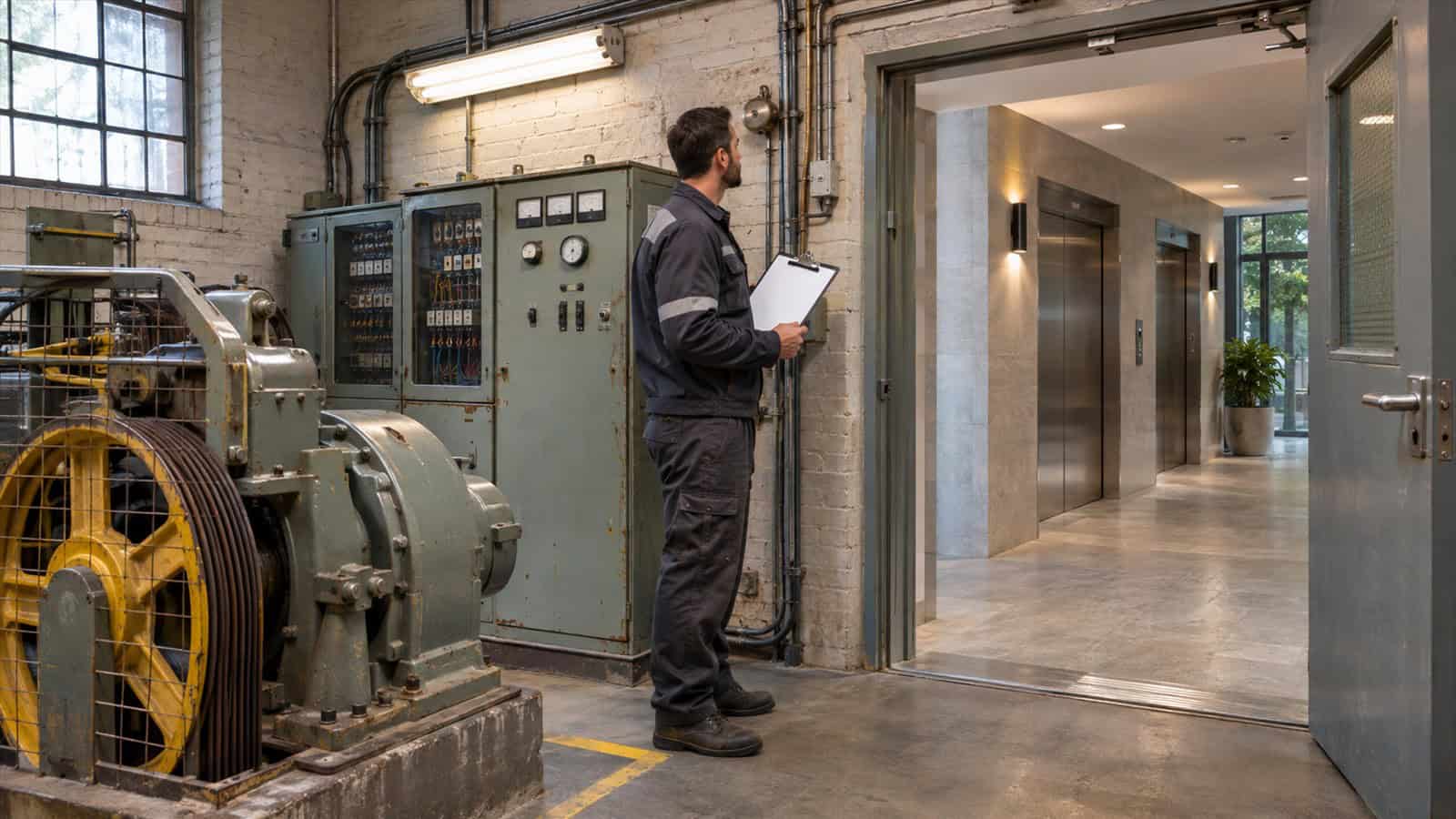
The Robustel EV8100 Elevator Voice Gateway is designed for lift connectivity projects where older analogue emergency phones, different DTMF behaviours and newer controller interfaces may need to coexist across the same portfolio. In mixed-age estates, the main retrofit challenge is rarely the age of the lift alone; it is understanding how each site actually makes an emergency call and what equipment sits in that communication path.
For lift service providers and portfolio operators, this means a standard gateway should create a repeatable retrofit process rather than assume every old lift behaves the same way. Robustel EV8100 combines an analogue FXS voice interface with Ethernet, serial, CAN and digital inputs, giving teams a common hardware platform while handset, autodialler and controller compatibility are qualified by site. This guide explains how to classify lifts by call path, identify hidden dependencies and pilot the most constrained installations before rolling out across the wider estate.
Classify Sites by Call Path Before Age
Two lifts installed twenty years apart may use the same analogue auto-dialler; two lifts of the same age may call different monitoring centres or use different DTMF sequences. Classify by actual path, not installation year alone.
Inspect handset type, line voltage/current needs, dial sequence, DTMF, carrier service, machine-room power and antenna route. Record unknowns instead of marking them compatible by family resemblance.
| Site class | Qualification focus | Evidence |
|---|---|---|
| analogue handset | loop and DTMF | witnessed call |
| SIP service | account/codecs | registration and audio |
| controller data | exact protocol | OEM approval |
| weak RF | antenna route | repeated survey/calls |
Use a Retrofit Survey That Finds Hidden Dependencies
Travelling cable, building distribution frames, alarm-panel relays and shared power supplies can be part of the path. Test from the lift car because a machine-room handset bypasses several of those dependencies.
Group only after surveys show the same electrical and service pattern. Then keep an exception class for sites that need different hardware, wiring or provider work.
- handset/auto-dialler model
- dial and DTMF sequence
- provider and SIM acceptance
- power/battery arrangement
- receiving-centre record
How the Robustel EV8100 Elevator Voice Gateway Supports a Standard Retrofit Method
| Retrofit pain | Verified EV8100 capability | Why the parameter matters | Acceptance evidence |
|---|---|---|---|
| legacy analogue handset | one FXS port, -48 V loop, 20 mA maximum and 800 Ω maximum loop resistance | qualify the installed phone/auto-dialler against a defined analogue boundary | measure the loop and complete a witnessed car call |
| varied carrier/voice estate | dual SIM 4G with SIP/VoIP and VoLTE | support approved mobile voice architectures without assuming every provider behaves alike | test registration, audio and DTMF on each approved service |
| selected controller telemetry | RS-232, RS-485, CAN and four DI plus relay | add only OEM-approved monitoring interfaces while retaining one platform | validate the exact interface/protocol separately from the call |
Robustel EV8100 Elevator Voice Gateway provides one FXS port, dual-SIM 4G, SIP/VoLTE capability, two Ethernet ports and industrial interfaces. That breadth allows one platform to address voice and selected telemetry roles without claiming universal controller compatibility.
Use FXS and voice functions as the common baseline, then qualify serial, CAN or DI integrations only where exact electrical and protocol evidence exists. Keep lift control and safety authority with approved systems.
Robustel RCMS can give a fleet a common visibility and configuration workflow, making genuine site exceptions easier to see and support.
Pilot the Oldest and Most Constrained Classes First
Select the difficult handset, lowest machine room and most complex receiving-centre script. Successful easy sites add little evidence if the constrained classes remain unknown.
Retain photos, terminal records, call results, audio observations and DTMF outcomes. Those details are what make the next retrofit repeatable.
Evidence from Related Deployments
Robustel’s PSTN replacement application example shows the complete chain from analogue handset through FXS and mobile voice service to the receiving endpoint.
Robustel’s TSARO case study demonstrates the operational value of standardised EV8100 deployments and retained fleet records.
The Robustel EV8100 Quick Pitch video below is useful for stakeholder orientation; terminal wiring, carrier acceptance and witnessed calls still require the current product documents and site procedure.
FAQs
Q1. Can a 4G gateway work with an old lift phone?
Often through a suitable FXS interface, but loop, dialing, DTMF and receiving-centre behaviour must be tested.
Q2. Do all lift phones use DTMF?
No. Methods and sequences vary, so inspect and test the installed device.
Q3. Can one gateway model standardize a whole portfolio?
It can standardize process and tooling, while site-specific compatibility still requires qualification.
Q4. What should a retrofit survey include?
Handset, wiring, power, battery, antenna, carrier, voice service and monitoring-centre acceptance.
Q5. Why is the Robustel EV8100 Elevator Voice Gateway useful in mixed-age portfolios?
Its FXS, cellular voice and management features provide a common platform with explicit site qualification.
Conclusion
The Robustel EV8100 Elevator Voice Gateway provides the FXS, cellular voice and management functions for this lift-phone workflow, while the accepted result comes from an authorised end-to-end test in the installed building.
Keep the observed evidence, responsible people and recovery steps together. That record gives the next technician a starting point and prevents a changed network or handset from being treated as the same proven system.
Explore More Articles About Robustel Lift Connectivity


About the Author
Robustel Editorial Team
The Robustel Editorial Team publishes practical articles on industrial connectivity, edge computing, LoRaWAN and device management, focusing on deployment considerations, technical limitations and long-term operation.