
Best-Fit Edge AI Gateway for Machine Vision: NPU, Cameras and Thermal Limits
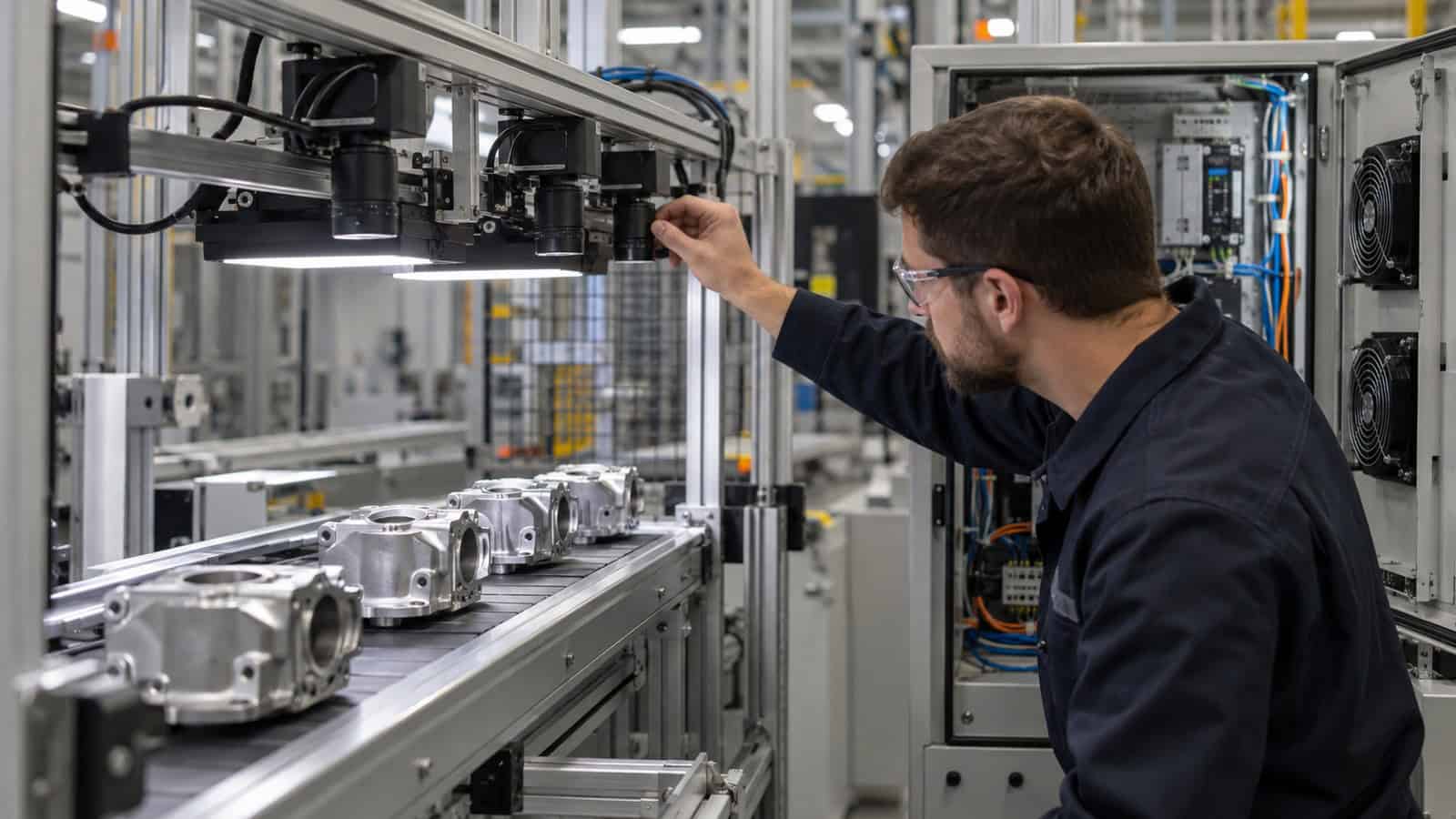
The Robustel EG5120 Industrial Edge Computing Gateway is a sensible candidate for compact compatible inference workloads, but an NPU figure is not an application benchmark. Machine-vision selection requires the exact model, runtime, input resolution, frame rate, preprocessing, concurrency and thermal conditions.
Define What the Vision System Must Decide
Start with the operational event: detect presence, classify an object, read a code or flag a defect. Record acceptable latency, missed detections, false positives and what happens after an inference. Safety-rated control should remain with the approved controller architecture unless the complete system is designed and certified for that responsibility.
| Input | Sizing question | Acceptance evidence |
|---|---|---|
| Model/runtime | Is the format supported by the deployed stack? | Successful conversion and repeatable execution |
| Image stream | Resolution, codec and frame rate? | Sustained representative feed |
| Preprocessing | CPU, memory or accelerator use? | End-to-end profile |
| Concurrency | Other containers and protocols running? | Combined-load test |
| Output action | Event, storage, cloud publish or display? | Full workflow timing |
| Environment | Cabinet temperature and airflow? | Sustained thermal test |
Trace the decision deadline backwards from the line action. If a late result is useless after a part has passed the reject point, average inference time is not enough; the team needs the worst credible end-to-end time from image arrival to the downstream action. The cost of a missed defect and the cost of a false reject also determine which accuracy trade-off is acceptable.
Trace the Complete Machine-Vision Workload
Camera Traffic and Decode Load
Robustel EG5120 edge computing gateway has two Gigabit Ethernet ports. The EG5200 has five. Port count indicates physical connectivity, not how many streams can be decoded and inferred at the required frame rate. A switch can add ports without adding compute; a lower-resolution event camera may use fewer resources than a high-resolution continuous stream.
Measure traffic and processing together. Include network overhead, decoding, image resize, normalization, inference, post-processing and result delivery. This is also where apparently similar camera counts become misleading: one installation may inspect a triggered still image, while another asks the gateway to handle continuous streams before selecting frames.
Memory, Buffers and Evidence Storage
Model files, runtime libraries, frame buffers and other containers share RAM. EG5120 is available with documented 2 GB or 4 GB LPDDR4 configurations and 64 GB eMMC. Choose the exact variant from observed memory peaks and required margin.
Storage needs depend on whether images are retained, how exceptions are logged and what happens during an upstream outage. Continuous video retention can exceed a gateway’s intended storage role quickly; event metadata or selected evidence frames are a different workload. Include temporary files and failed-upload retries in the test, because they can consume space even when the formal retention policy looks modest.
Sustained Load and Thermal Stability
A short demonstration proves that the model can start; it does not show how the complete workload behaves after the cabinet reaches a stable temperature. The gateway shares that enclosure with power supplies, switches and other equipment, while decoding, preprocessing, inference and result handling continue to compete for resources.
The first operational symptom may be latency drift, a growing frame queue, dropped inputs or late decisions rather than a clean application crash. Run the target model with representative production input, all companion services active and the intended enclosure, mounting and airflow. Continue until both the workload and the cabinet have reached a credible sustained condition.
Record end-to-end decision time, frame handling, memory growth, errors and recovery after a load spike. The published operating-temperature range defines a hardware environmental boundary; it is not a guarantee that a particular vision application will maintain its timing throughout that range. Application acceptance therefore needs its own sustained-load limit and margin.
How Robustel EG5120 and E2C Factory Fit Machine-Data Workflows
Robustel EG5120 edge computing gateway combines a quad-core Cortex-A53 at 1.6 GHz, 2.3 TOPS NPU, dual Gigabit Ethernet, serial, DI/DO and 64 GB eMMC in a compact gateway. These are product capabilities. Whether a given vision model meets an inspection cycle is a benchmark result that Robustel’s hardware specification alone cannot establish.
Machine vision often needs context from PLCs or production systems. On Robustel EG5120, E2C Factory can collect supported machine data and present local processing, alarms, workflows and visualization around the inspection result. This gives operators a clearer view of which asset state accompanied an image-derived event. Keep camera handling and inference inside the separately validated vision workload, and leave safety control with the approved controller architecture.
Robustel’s Smart Parking Application Example illustrates an EG5120 used for local ANPR-related preprocessing. It supports the architectural idea of processing selected camera information near the source, not a universal number of streams or frames per second.
Another Robustel’s Public Safety CCTV Application Example shows a lighter camera-site architecture with EG5100. It demonstrates that remote camera connectivity does not always require an NPU-class gateway.
Robustel Fit by Vision Responsibility
| Requirement | Starting point | Boundary |
|---|---|---|
| Remote camera connectivity/light local app | Robustel EG5100 | No implied NPU workload |
| Compact compatible inference | Robustel EG5120 | Benchmark exact model/runtime |
| Several cameras plus peripherals | Robustel EG5200 | Five GbE; aggregate load still tested |
| Serial-rich production context | Robustel EG3120e | Not selected solely for machine vision |
Build a Production Benchmark
Run representative images, including difficult non-target examples and the lighting or scene variation the line actually experiences. Capture end-to-end latency, throughput, accuracy, CPU/NPU use, RAM peak, storage writes and temperature behaviour. A useful test log aligns the camera timestamp, inference start and finish, result emission and downstream acknowledgement, so a delay can be located instead of being assigned vaguely to “the AI.”
Repeat the test from a cold start and after sustained operation. Restart the application, interrupt a camera and disconnect upstream connectivity. The system should expose a stale or missing input in the manner defined by the project rather than silently presenting an old result as current. Agree the allowable response and recovery time before commissioning; otherwise the same observation can be called a pass by one team and a failure by another.
The EG5000 Series Quick Pitch video explains the family positioning. It should be followed by a workload-specific benchmark rather than treated as performance evidence.
FAQs
Q1. What is edge AI vision?
It means running a vision model close to the camera or production process instead of sending every image to a central cloud service. This can shorten the data path and reduce upstream traffic, but the model, runtime, camera stream and gateway still need to be validated as one sustained workload.
Q2. Does machine vision use AI?
It can, but not every machine-vision system is AI-based. Traditional rules, measurements and image processing remain useful; an AI model makes sense when it improves the defined inspection task and can be operated with acceptable accuracy, traceability and maintenance effort.
Q3. What is an edge gateway?
It is a local platform that connects field devices and networks while running selected applications near the data source. For vision work, buyers should look beyond port count and confirm decoding, preprocessing, inference, result delivery, memory and thermal behaviour together.
Q4. What is edge AI and how does it work?
Edge AI runs inference on or near the equipment that produces the data. A typical vision path captures a frame, prepares it for the model, runs inference and passes the result to an application or control layer; each stage consumes compute, memory and time.
Q5. How do the Robustel EG5120 Industrial Edge Computing Gateway and E2C Factory complement a machine-vision system?
The gateway offers an integrated 2.3 TOPS NPU, dual Gigabit Ethernet and local storage for a validated edge workload. On this supported model, E2C Factory can place the resulting inspection event alongside machine data, alarms and workflows, helping operators understand the production context while the vision model and runtime remain separately engineered and tested.
Conclusion
The Robustel EG5120 Industrial Edge Computing Gateway is a good fit when a compact, validated inference workload needs industrial connectivity and local storage. Approve it from an end-to-end production benchmark that includes camera traffic, other services and cabinet temperature. The model result matters more than the accelerator headline.
Explore more articles about Robustel’s edge computing gateways in industrial IoT:
About the Author
Robert Liao | Technical Support Engineer
Robert is an IoT Technical Support Engineer at Robustel, specializing in industrial networking and edge connectivity. A certified Networking Engineer, Robert focuses on the deployment and troubleshooting of large-scale IIoT infrastructures. His work centers on architecting reliable, scalable system performance for complex industrial applications, bridging the gap between field hardware and cloud-side data management.