
IoT Gateway Backhaul Guide: Ethernet, Wi-Fi, or 4G/5G?
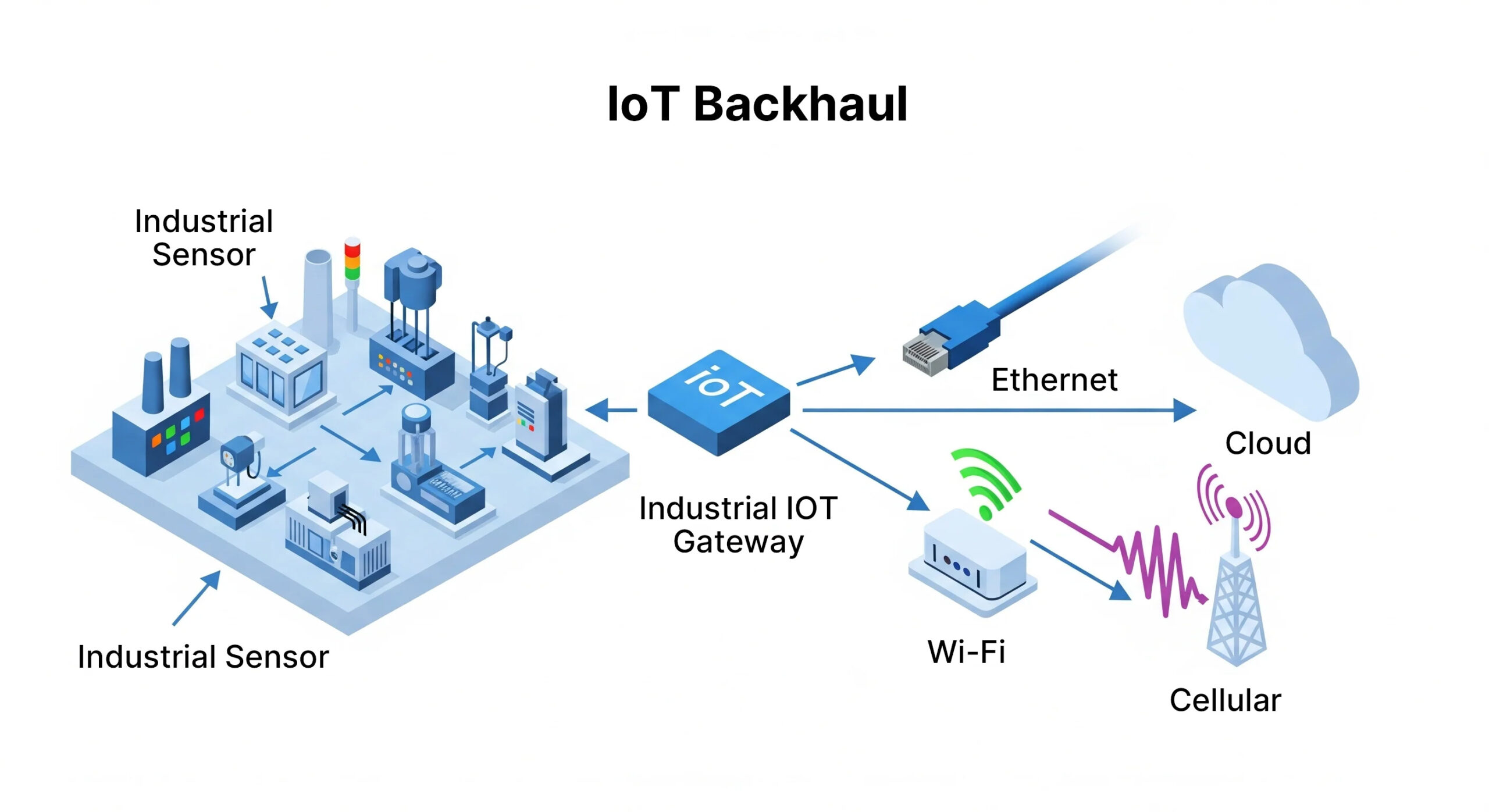
The choice of IoT gateway backhaul—the mission-critical link from an industrial IoT edge gateway to the internet—is the primary driver of system uptime and Total Cost of Ownership (TCO). Whether deploying in a remote oil field or a smart factory, your connectivity strategy dictates whether your data is uninterruptible or prone to a single point of failure.
This guide provides a technical comparison of the three primary backhaul options:
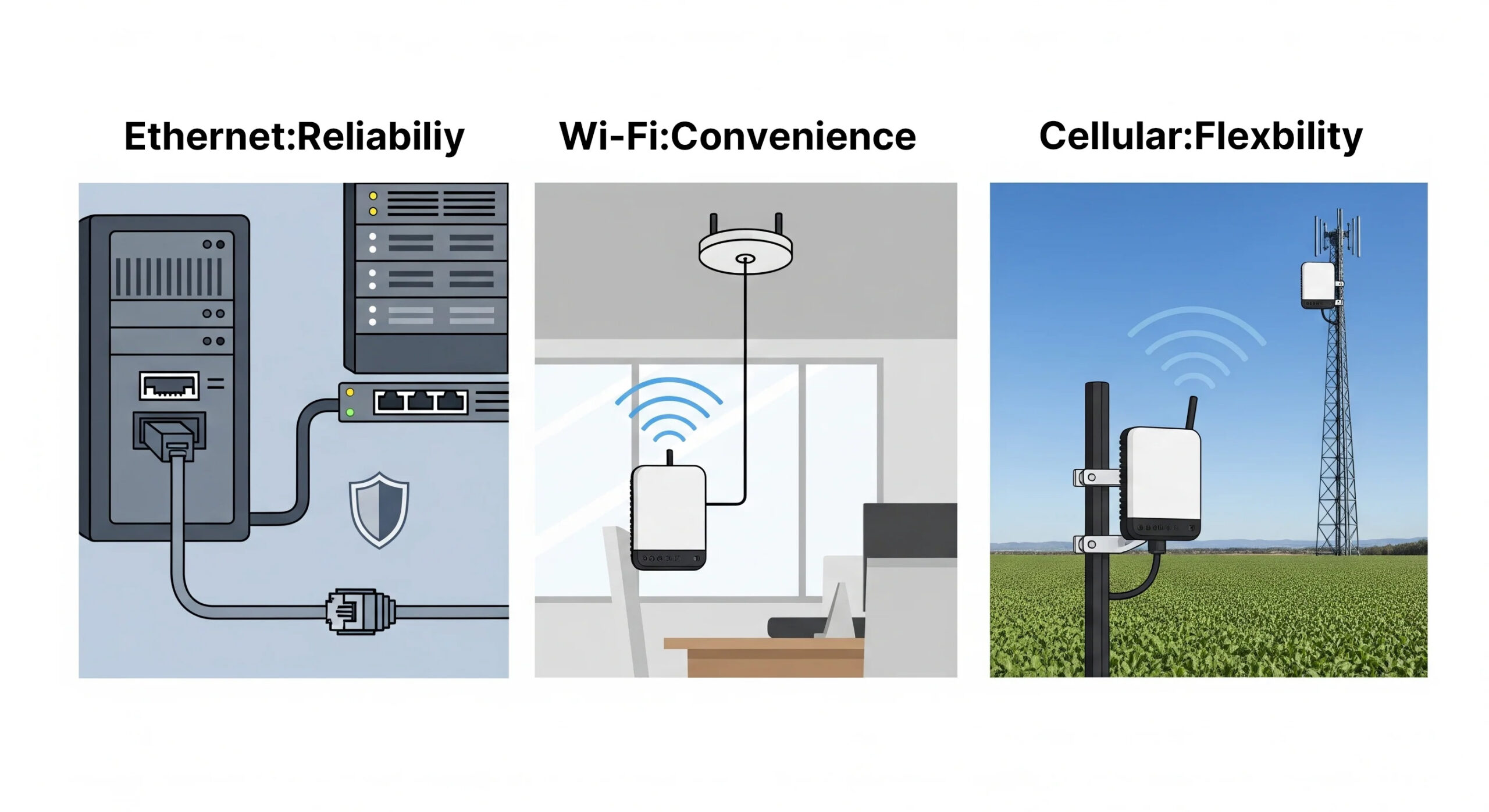
- Wired Ethernet: The gold standard for low-latency, deterministic reliability in fixed industrial environments.
- Cellular (4G/5G): The ultimate solution for deployment flexibility, mobile assets, and failover redundancy via dual SIM slots.
- Wi-Fi Backhaul: A high-performance, cost-effective balance for indoor WLAN infrastructures and campus-wide deployments.
Explore the strategic trade-offs between cellular vs. ethernet vs. wi-fi and learn how to build a resilient, multi-backhaul architecture that ensures your edge intelligence and cloud platform work better together.
Introduction: The Lifecycle of Your Data—Securing the Backhaul
Selecting the optimal IoT gateway backhaul—whether via cellular, Wi-Fi, or ethernet—is the most critical decision for any industrial IoT edge gateway deployment. While many focus on sensors or cloud analytics, this communication link is the “unsung hero” that ensures your entire ecosystem can work better together. Choosing the wrong backhaul strategy leads to unreliable connections, soaring data costs, and rigid architectures. This guide explores how to balance the stability of wired ethernet against the flexibility of cellular and Wi-Fi to build a truly resilient, high-performance data pipeline.
You have architected a sophisticated IoT solution: the sensors are calibrated, and your platform is ready. But before the first byte is transmitted, you face a strategic choice: How will your data bridge the gap from the edge to the internet? In the field, I’ve observed that underestimating the backhaul is a primary cause of project failure. There is no “one-size-fits-all” answer—only a strategic alignment with your specific application. Let’s navigate these trade-offs to ensure your mission-critical data remains uninterruptible.
Ethernet—The Bedrock of Deterministic Connectivity
In the pursuit of an unbreakable data pipeline, Wired Ethernet remains the undisputed gold standard for IoT gateway backhaul. When your deployment environment allows for a physical tether, it is almost always the most strategic choice for ensuring long-term operational harmony and system uptime.
The Strategic Advantages of Hardwiring
- Immunity to RF Turbulence: Unlike wireless alternatives, a physical cable is immune to the radio frequency (RF) interference and signal congestion prevalent in heavy industrial zones. For a stationary gateway, Ethernet provides a “zero-jitter” connection that keeps your edge-to-cloud synchronization flawlessly intact.
- High-Bandwidth, Low-Latency Architecture: Supporting speeds up to Gigabit levels, Ethernet offers the lowest possible latency. This means customers can transmit high-definition telemetry or massive data logs from the edge to the cloud without the bottleneck risks associated with shared wireless spectrums.
- Hardwired Security: By keeping data transmissions off the airwaves and within a firewalled Local Area Network (LAN), Ethernet provides an inherent layer of security that is critical for mission-critical industrial assets.
- Installation Synergy via PoE: The true efficiency gain comes from Power-over-Ethernet (PoE). Sophisticated industrial gateways, such as the Robustel R1520-LG, utilize PoE to receive both data and power through a single cable. This means customers can simplify field deployments in hard-to-reach locations like ceilings or outdoor enclosures, eliminating the need for separate electrical wiring and reducing overall installation TCO.
Navigating the Physical Limits
Despite its reliability, Ethernet is not a “magic bullet.” Its primary constraints stem from the very thing that makes it stable: the physical tether.
- The Mobility Barrier: Ethernet is functionally impossible for mobile assets—such as heavy machinery on a construction site or vehicles in a fleet.
- Prohibitive Infrastructure Costs: In expansive outdoor sites or older “brownfield” factories, the labor and material costs of trenching or running new Cat6 cabling can quickly exceed the budget of the entire IoT project. This means customers must weigh the “stability gain” against the “deployment friction” to ensure the project remains ROI-positive.
Best Suited For: Stationary gateways in highly controlled environments with established network infrastructure, such as automated factories, smart building HVAC systems, and secure data centers.
Wi-Fi Backhaul—The Balance of Convenience and Cost
If Ethernet represents the bedrock of stability and Cellular offers the ultimate in mobility, Wi-Fi backhaul serves as the agile middle ground. When a local Wireless Local Area Network (WLAN) is already established, utilizing Wi-Fi to connect your industrial IoT edge gateway can significantly accelerate deployment while keeping operational expenses at a minimum.
The Strategic Advantages of Wi-Fi in IoT
- Rapid, Low-CapEx Deployment: Leveraging an existing Wi-Fi network for your IoT gateway backhaul eliminates the need for expensive new cabling or recurring cellular data plans. This means customers can slash initial setup costs by simply integrating the gateway into the current IT infrastructure.
- High-Bandwidth Efficiency: Modern standards like Wi-Fi 6 provide substantial bandwidth and low latency. For data-intensive applications within a facility—such as localized sensor clusters or machine vision—Wi-Fi delivers the performance required to ensure all systems work better together.
- Localized Flexibility: Within the range of existing access points (APs), Wi-Fi allows for easy repositioning of hardware. This is ideal for dynamic environments like modular assembly lines where equipment is frequently reorganized.
Navigating the Constraints in Industrial Zones
- The RF Interference Challenge: Industrial environments are “noisy.” Motors, metal shielding, and competing wireless devices can cause signal degradation on shared 2.4 GHz or 5 GHz bands. This means customers must implement advanced antenna strategies or prioritize Wi-Fi 6 to mitigate packet loss in high-interference zones.
- Infrastructure Dependency & Range: Unlike cellular, Wi-Fi is tethered to the proximity of an AP. For massive outdoor yards or isolated remote sites, the limited range often makes it a secondary choice unless combined in a multi-backhaul strategy.
- Elevated Security Mandates: To prevent unauthorized access, industrial-grade Wi-Fi must go beyond basic passwords. Implementing WPA3 Enterprise and segmented VLANs is essential to protect mission-critical data streams.
Best Suited For: Indoor campus environments, smart warehouses, and modular factories with well-managed Wi-Fi infrastructure where cabling is physically restrictive.
Cellular (4G/5G)—The Ultimate in Deployment Freedom
When your mission-critical assets move beyond the reach of cables or local APs, Cellular IoT backhaul—leveraging 4G LTE or 5G—becomes the undisputed king of flexibility. In the modern industrial IoT edge gateway landscape, cellular connectivity is no longer just a fallback; it is a primary strategic tool for achieving rapid, worldwide deployment.
The Strategic Advantages of Cellular Connectivity
- Total Geographical Independence: A cellular gateway offers “instant-on” connectivity virtually anywhere with a mobile signal. This is non-negotiable for remote site monitoring (pipelines, agriculture), mobile assets (fleets, transit), and rapid-response temporary sites (construction, emergency relief).
- Bypassing IT Red Tape: One of the biggest hurdles in industrial projects is coordinating with on-site IT for network access. This means customers can drastically accelerate deployment timelines by simply inserting a SIM card and powering up—no local network permissions required.
- Hardened Resilience with Dual SIM Failover: For industrial reliability, a single link is a single point of failure. Most Robustel devices feature Dual SIM slots, allowing the gateway to automatically switch to a secondary carrier if the primary network drops. This means customers can achieve near-continuous uptime, providing a layer of redundancy that traditional wired or Wi-Fi setups struggle to match alone.
Navigating the Operational Constraints
- Recurring OPEX vs. Data Volume: Unlike the fixed cost of cabling, cellular involves monthly data plans. To manage this, integrating edge computing to filter data locally is a key strategy to reduce transmitted volume and keep operational costs under control.
- Environmental & Signal Barriers: While coverage is vast, rural or underground locations can pose challenges. This means customers should prioritize high-gain external antennas and signal site surveys to ensure consistent throughput in challenging “shadow zones.”
- Latency Considerations: Although 5G is closing the gap, cellular latency is inherently higher than wired Ethernet. For high-speed real-time control, this delta must be accounted for in the system architecture.
Best Suited For: Remote monitoring, fleet telematics, mission-critical failover, and any deployment where speed to market and mobility are the top priorities.
Conclusion: Building a Resilient, Multi-Layered Backhaul Strategy
Choosing the right IoT gateway backhaul is not about finding a single “best” technology—it is about aligning your connectivity with your operational reality. As we have explored, the ideal choice depends on your environment’s physical constraints, budget, and performance requirements.
To ensure your entire ecosystem can work better together, a strategic summary is essential:
- Wired Ethernet remains the undisputed anchor for fixed, mission-critical assets requiring deterministic reliability.
- Wi-Fi acts as the agile, cost-effective link for indoor campus environments with existing wireless infrastructure.
- Cellular (4G/5G) provides the ultimate autonomy for mobile, remote, or temporary deployments where traditional networks fail to reach.
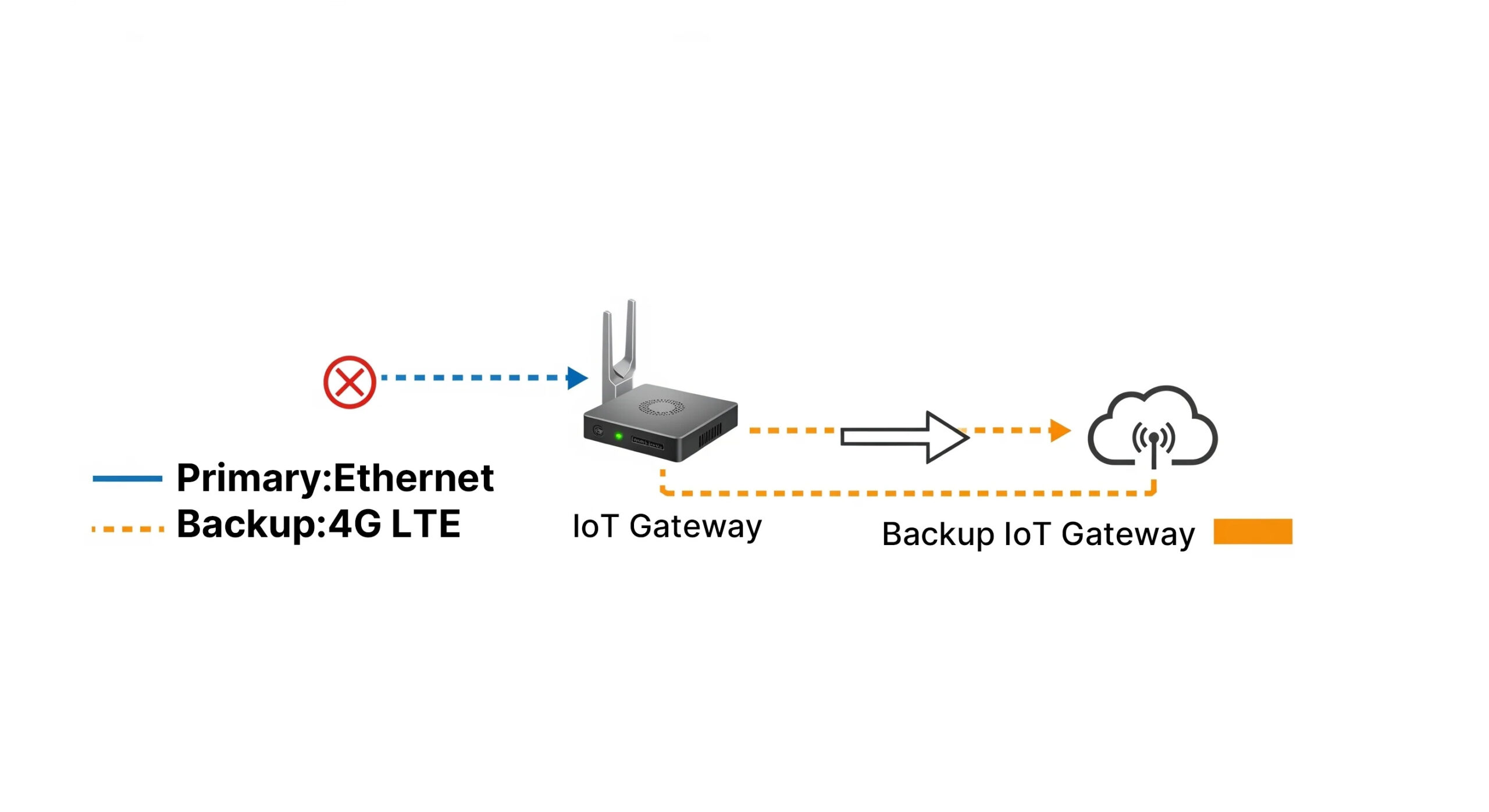
However, the most successful industrial deployments don’t just pick one; they build for resilience. Leading industrial IoT edge gateways, such as the Robustel EG5120, are engineered to support multiple backhaul options simultaneously. This means customers can implement a “Zero-Downtime” strategy by using high-speed Ethernet as the primary link while maintaining a 4G/5G cellular connection as an automatic failover.
By understanding these trade-offs and leveraging versatile hardware, you aren’t just connecting devices—you are building a future-proof data pipeline that is reliable, cost-effective, and ready to scale.
FAQs
Q1: What is “backhaul” in the context of an IoT gateway?
A1: The IoT gateway backhaul is the part of the network that connects the gateway itself to the wider internet or your central server. It’s the “link back” from the edge of your network to your core infrastructure, which can be a physical Ethernet cable, a Wi-Fi connection, or a cellular (4G/5G) connection.
Q2: What is dual-SIM failover and why is it important?
A2: Dual-SIM failover is a feature in a cellular IoT gateway that allows it to hold two SIM cards from different mobile carriers. If the primary carrier’s network becomes unavailable, the gateway can automatically switch to the secondary SIM card’s network to maintain an internet connection. This provides critical redundancy and improves uptime for remote deployments.
Q3: Can an IoT gateway use more than one backhaul option at the same time?
A3: Yes. Advanced gateways can be configured for link backup. A common strategy is to use Ethernet as the primary connection and have the gateway automatically switch to its 4G cellular connection if the wired internet fails. This provides an extremely reliable IoT gateway backhaul solution.
About the Author
Yang Tao | Founder & CEO
Robustel Yang Tao founded Robustel in 2010 with a vision to simplify industrial connectivity. Today, he leads a global team of over 300 experts, shipping mission-critical IoT solutions to more than 100 countries.
A firm believer in technical excellence, Yang dedicates 15% of revenue to R&D and operates a proprietary 5G smart factory. His commitment to security is backed by world-class certifications (IEC 62443, ISO 27001), ensuring that Robustel’s hardware is as secure as it is innovative.