
The Built-in Advantage: Why Your Next LoRaWAN Gateway Should Run ChirpStack Locally
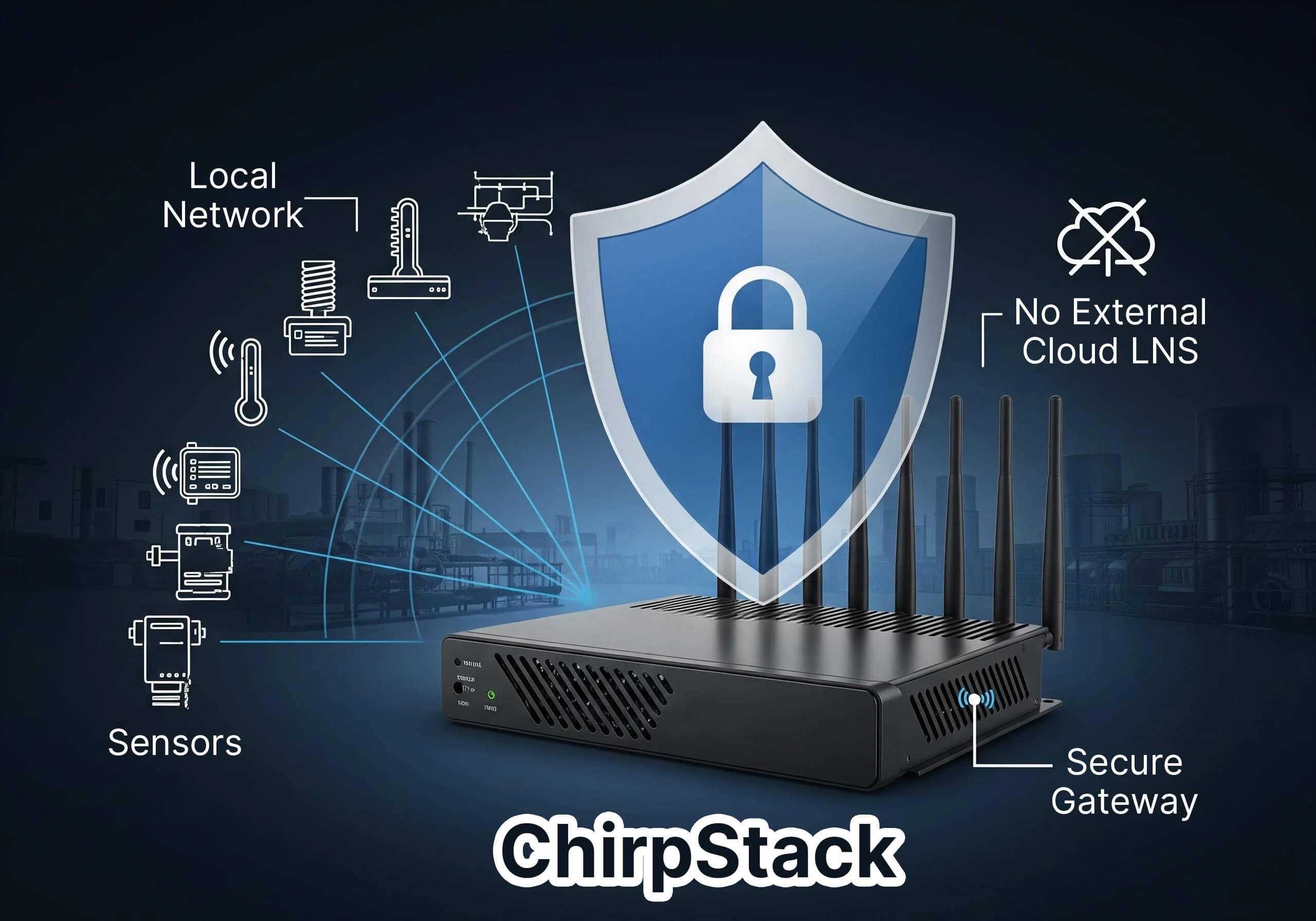
Relying on third-party cloud servers for critical LoRaWAN data is no longer the only—or safest—option. As industrial operations demand higher levels of data sovereignty and operational resilience, the ChirpStack LoRaWAN Gateway has emerged as the definitive solution for building self-sufficient, private networks.
What you will discover in this guide:
- The Architecture of Autonomy: Why hosting a built-in LoRaWAN Network Server (LNS) at the edge is the ultimate defense against cloud outages and recurring subscription fees.
- Hardened Security & Low Latency: How localized data processing enables instantaneous response times while keeping sensitive sensor data entirely within your physical perimeter.
- The Hardware-Software Synergy: Why a rugged LoRAWAN Gateway (like the Robustel R1520LG) is the essential foundation for running a robust, containerized ChirpStack stack.
Stop renting your network and start owning your infrastructure. Learn how to transform your deployment into a secure, high-performance, and commercially viable LoRaWAN ecosystem.
Introduction: Achieving Data Sovereignty with Private LoRaWAN Networks
For many system integrators, the promise of the cloud has started to feel like a constraint. Relying on third-party LoRaWAN networks often means navigating a minefield of recurring data fees, latency spikes, and the constant anxiety of data security. If a central cloud server thousands of miles away goes offline, your factory’s critical sensor data goes with it. For mission-critical industrial operations, “renting” a network is becoming a risk that’s no longer worth taking.
This is the core challenge a ChirpStack LoRaWAN Gateway is engineered to resolve. It represents a fundamental shift toward industrial autonomy. By integrating the ChirpStack network server directly with robust gateway hardware, the gateway evolves from a simple passthrough device into the intelligent brain of your entire ecosystem. This isn’t just a technical upgrade; it’s about Work Better Together—pairing open-source flexibility with industrial-grade reliability to ensure you own your data, your infrastructure, and your operational destiny.
Deciphering ChirpStack—The Engine of Local Network Management
To understand the value of this architecture, we must first look under the hood. ChirpStack is the world’s leading open-source LoRaWAN Network Server (LNS). Think of it as the central orchestration engine that handles the critical logic of your wireless network:
- Security & Authentication: Managing device join-requests and maintaining encrypted session keys to ensure network integrity.
- Dynamic Optimization (ADR): Automatically managing Adaptive Data Rates to balance battery life and signal range for every sensor in the field.
- Data Integrity (De-duplication): Filtering redundant packets when multiple gateways receive the same signal, ensuring the application server receives a single, clean data stream.
- Protocol Conversion: Decrypting raw LoRaWAN packets and forwarding actionable data to your cloud or local SCADA system via industry-standard MQTT.
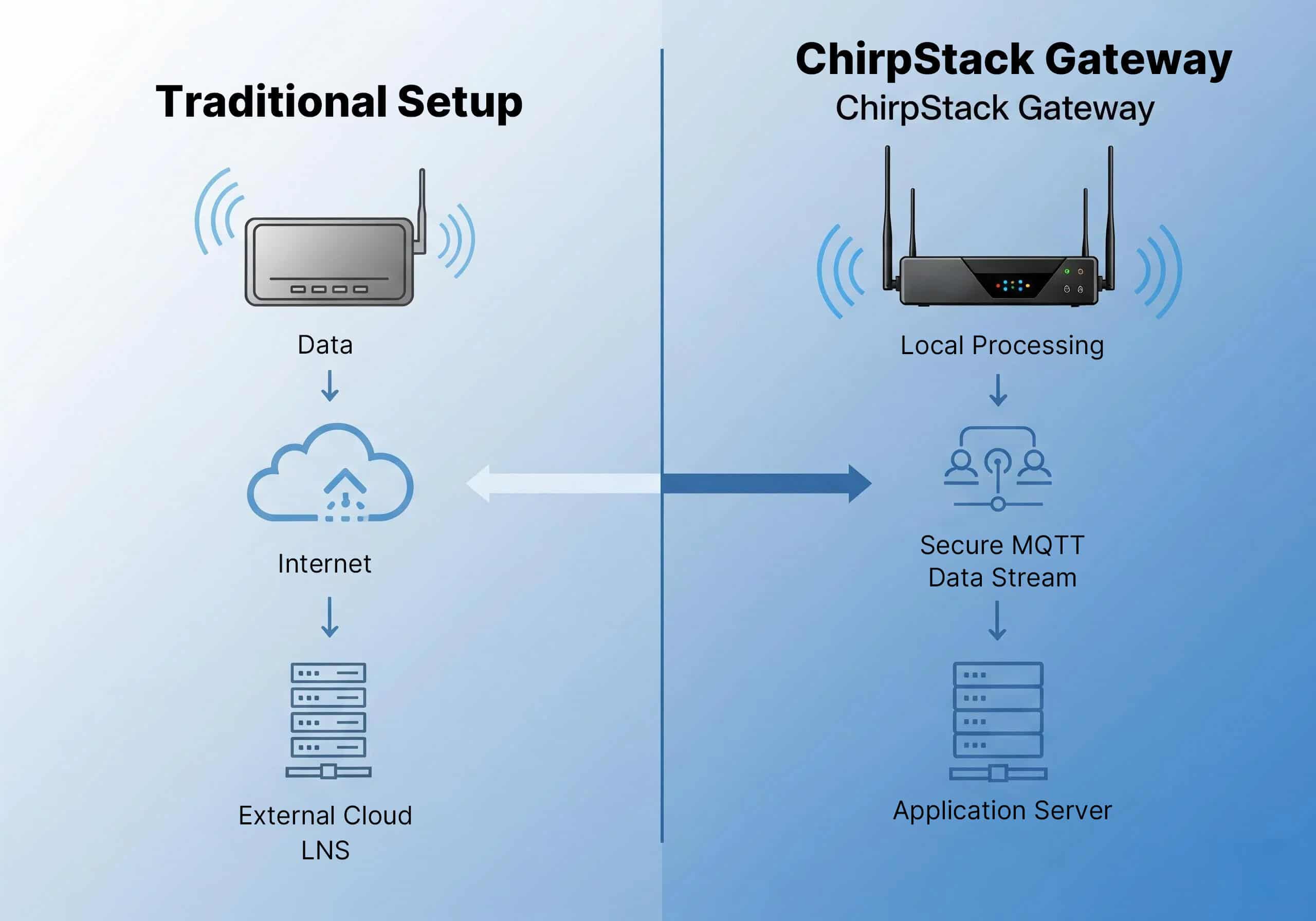
Traditionally, these network management tasks required a remote server. However, by hosting the ChirpStack stack directly on a robust LoRaWAN gateway, you consolidate the infrastructure. This integrated architecture means the logic required to run the network is no longer miles away in a data center, but resides locally within the gateway itself, simplifying the path from sensor to application.
The Power of Integrated Architecture—Why Host ChirpStack Locally?
Transitioning the Network Server from a remote cloud to the local gateway is a strategic decision to build a more resilient and self-contained network. As we’ve explored in our deep dive into LoRaWAN Gateway Modes, moving the LNS logic into the gateway hardware creates an integrated infrastructure that traditional packet-forwarder models simply cannot match.
Here is why this integrated approach is becoming the standard for robust Industrial IoT:
- Uncompromising Data Sovereignty: In high-security environments, data exposure is a liability. By running ChirpStack locally, your device authentication and data decryption occur within your physical perimeter. This allows for direct communication with local SCADA or ERP systems, completely bypassing the public internet and its inherent vulnerabilities.
- Operational Continuity (The Offline Advantage): This is the “killer feature” for remote sites. If the primary backhaul (cellular or fiber) fails, your LoRaWAN network remains fully functional. The gateway continues to manage device joins and collect data locally, ensuring ultimate reliability regardless of external internet connectivity.
- Reduced Communication Latency: For time-critical network responses—such as downlink acknowledgments—the round-trip to a cloud server is a bottleneck. Localizing the LNS means network management commands are processed at the source, providing the faster response times required for stable industrial connectivity.
- Optimized TCO (Total Cost of Ownership): By leveraging the open-source nature of ChirpStack, you eliminate the “subscription trap.” There are no recurring monthly LNS fees, allowing you to scale your sensor fleet without scaling your operational overhead.
Selecting the Platform—Why Hardware Specs Matter for ChirpStack
Hosting a full Network Server (LNS) is a task that demands more than just basic data forwarding; it requires a high-performance hardware platform. To ensure the ChirpStack stack operates smoothly without memory bottlenecks or processing delays, the underlying gateway must provide a professional balance of computing resources and architectural flexibility.
This is where the Robustel R1520LG excels as a purpose-built LoRaWAN gateway. It is engineered to handle the dual demands of a high-sensitivity LoRa radio and a local software host. The key to this infrastructure consolidation lies in its operating system: RobustOS Pro.
Unlike closed, proprietary systems, RobustOS Pro is an open, Debian-based environment specifically optimized for Docker containerization. This allows you to deploy the entire ChirpStack stack within a secure, isolated container directly on the gateway. By combining industrial-grade ruggedness with the flexibility of a Linux-based platform, you gain an all-in-one solution that eliminates the need for an external server or PC—representing a more streamlined and reliable way to Work Better Together.
Conclusion: Future-Proofing Your Infrastructure with Network Autonomy
The shift toward a ChirpStack LoRaWAN Gateway is more than a technical upgrade—it is a strategic move toward a more resilient and self-sufficient IoT infrastructure. By migrating the network management logic from a distant cloud to the local gateway, you effectively shield your operations from external service outages and security vulnerabilities.
For organizations that view data as a critical asset, the all-in-one gateway approach with a built-in LNS offers a trifecta of professional benefits: absolute data sovereignty, high operational reliability, and a significant reduction in long-term subscription costs. As industrial networks move toward decentralized, local-first architectures, choosing a hardware-software combination that works better together is the most effective way to ensure your operations remain secure, stable, and entirely under your control.
FAQs
Q1: Is it difficult to set up a ChirpStack LoRaWAN Gateway?
A1: While more involved than a simple packet forwarder, gateways that support Docker make it much easier. You can often deploy the entire ChirpStack stack with a single command or a simple script, without needing to manually compile and configure all the components.
Q2: Can a single ChirpStack gateway manage a large area?
A2: Yes. LoRaWAN’s long-range capabilities mean a single gateway can cover a large factory, a multi-story building, or a small farm. For very large areas, you can deploy multiple gateways that all run in packet forwarder mode and point to one central gateway that acts as the main ChirpStack LNS.
Q3: How does the data get from the ChirpStack gateway to my application?
A3: ChirpStack has excellent built-in integrations. The most common method is to have it publish decrypted device data to an MQTT topic. Your cloud or on-premise application can then simply subscribe to that topic to receive a real-time stream of clean data.
About the Author
Robert Liao | Technical Support Engineer
Robert is an IoT Technical Support Engineer at Robustel, specializing in industrial networking and edge connectivity. A certified Networking Engineer, Robert focuses on the deployment and troubleshooting of large-scale IIoT infrastructures. His work centers on architecting reliable, scalable system performance for complex industrial applications, bridging the gap between field hardware and cloud-side data management