Always-On Industrial Connectivity: How eSIM, Smart Roaming and RCMS Work Better Together

Introduction
In industrial IoT, being connected is not the same as being operational.
A router can show strong signal strength, remain registered to a mobile network, and still fail to deliver the reliable connectivity an application depends on. Data may be delayed. Remote access may become unstable. Critical systems may appear online from a dashboard, while performance in the field has already started to degrade.
This is one of the most common and costly problems in distributed industrial environments. Whether you are managing utility assets, smart city infrastructure, transport systems, kiosks, remote equipment, or unmanned sites, the issue is rarely as simple as “online” or “offline.”
More often, the connection exists, but performance has already started to slip. In practice, that can mean:
- delayed or missing data
- unstable remote access
- slower response to alarms or faults
- unnecessary site visits to investigate the problem
For industrial organisations operating across multiple regions, operators, and site conditions, always-on connectivity depends on more than just a cellular signal. It depends on three things working together: the flexibility to access multiple networks, the intelligence to select the most usable one, and the ability to monitor and manage that strategy across an entire fleet.
This is where eSIM, Smart Roaming, and RCMS each play a distinct role.
The real problem: connectivity can fail before it drops
In many deployments, connectivity decisions are still based on signal strength or simple registration status. If the router looks connected, the assumption is that the site is working normally.
In practice, that assumption often breaks down.

A device may remain attached to a network with strong radio signal, while actual data performance becomes unreliable due to congestion, poor backhaul, changing network conditions, roaming limitations, or operator-side issues. From an operations perspective, this is often worse than a clean disconnection. The site has not obviously failed, but it is no longer performing as expected.
That ambiguity creates a real operational problem. Troubleshooting takes longer, alarms can be misleading, and field teams may only discover the real issue after service quality has already been affected. For industrial teams, the cost is not just downtime. It is wasted effort, slower response, and reduced confidence in the deployment.
Why traditional failover is not always enough
Many industrial routers already support dual SIM or roaming-based failover, and these remain important tools. But in many cases, failover is still reactive.
The router connects to one network and remains there until a hard failure occurs. Only once the connection is lost completely does switching begin. By that point, application performance may have been poor for some time already.
There is another issue too: switching networks is not automatically the same as switching to a better outcome. If the next available network is selected without meaningful performance checks, the device may simply move from one weak connection to another. Redundancy exists, but the intelligence to control it is limited.
That is why access to multiple operators is only part of the answer.
eSIM gives industrial deployments more flexibility
eSIM has become increasingly valuable in industrial IoT because it reduces physical friction in deployment and lifecycle management.
Instead of relying solely on physical SIM cards, organisations can remotely provision operator profiles, manage subscriptions more flexibly, and support deployments across multiple countries or network environments with less manual intervention. This is especially useful when devices are installed in hard-to-reach locations, rolled out internationally, or expected to remain in service for many years.
For operations teams, the benefits are practical rather than theoretical. eSIM can help organisations:
- provision connectivity remotely
- reduce or avoid physical SIM replacement
- support multi-country deployments more easily
- simplify lifecycle management across large fleets
That said, eSIM alone does not solve the runtime challenge of connectivity quality.
It expands the pool of available networks, but it does not decide which one is best at a given moment. It does not know whether the current connection is actually usable for the application. It does not automatically distinguish between a network that looks good on paper and one that is genuinely performing well in the field.
That is where Smart Roaming becomes important.
Smart Roaming adds intelligence to network selection
If eSIM provides flexibility, Smart Roaming provides decision-making.
Rather than relying on signal strength alone, Smart Roaming helps evaluate the real usability of the available connection. That matters because a strong signal does not always mean a strong service. The radio layer may appear healthy while latency, packet loss, or other performance issues make the link unsuitable for industrial use.
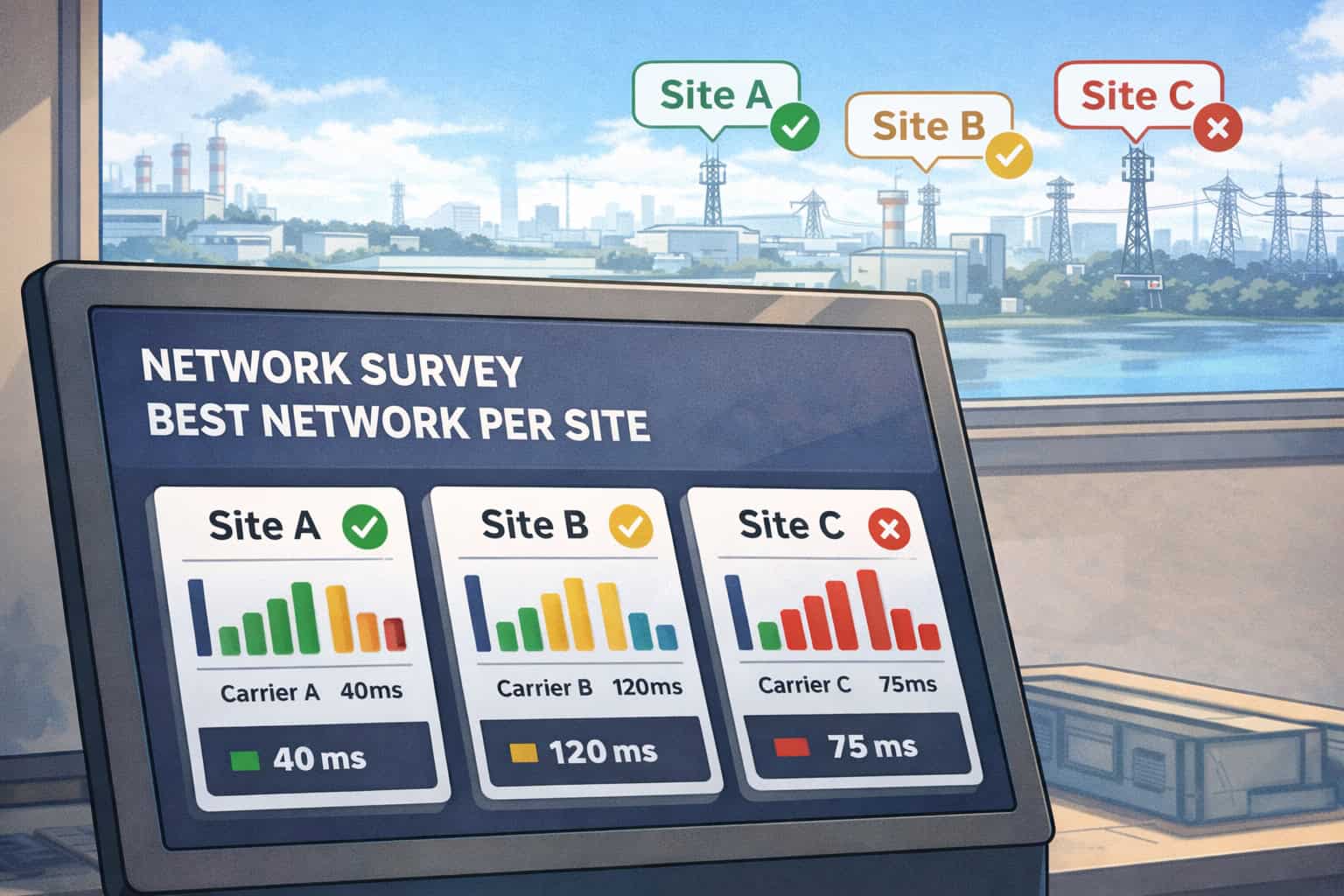
Instead of assuming the connection is healthy, Smart Roaming can help assess factors such as:
- latency
- packet delivery
- responsiveness
- overall connection stability
This is a meaningful shift. Instead of waiting for a complete outage before reacting, the device can make better-informed decisions based on how the connection is really behaving. That may help it avoid becoming stuck on a technically available but practically poor network.
In real-world terms, this means the router is better placed to move beyond passive connectivity and toward active network management. It can make more intelligent use of the options that eSIM and roaming profiles provide. For industrial users, that can translate into more reliable remote access, more consistent telemetry, and fewer cases where a site appears healthy while performance is quietly deteriorating.
RCMS makes the strategy scalable
It is one thing for a single router to make better connectivity decisions. It is another thing entirely to apply, monitor, and maintain that strategy across dozens, hundreds, or thousands of sites. That is where RCMS becomes essential.

RCMS provides the visibility and control needed to manage industrial connectivity at scale. Instead of treating devices as isolated endpoints, teams can monitor behaviour across the fleet, investigate issues remotely, apply policies more consistently, and reduce the operational burden of distributed deployments.
With RCMS, organisations can take a more structured approach to connectivity management. Teams can more easily:
- monitor device behaviour centrally
- investigate issues remotely
- apply policies across the fleet
- reduce the need for on-site intervention
This matters especially when eSIM and Smart Roaming are being used together. Devices may need profile changes, policy updates, connectivity checks, or troubleshooting actions across multiple regions and operators. Without centralised management, that quickly becomes difficult to sustain.
The practical result is fewer truck rolls, faster response, and better control over assets spread across wide geographies. Better connectivity is important, but better operability is what turns connectivity into a manageable business system.
A better way to think about always-on connectivity
The strongest industrial connectivity strategies do not rely on a single feature. They combine flexibility, intelligence, and operational control.
A stronger always-on strategy depends on three layers working together:
- eSIM provides access and deployment flexibility
- Smart Roaming improves network selection in real conditions
- RCMS gives teams the visibility and control to manage that strategy at scale
Together, they support a more resilient approach to cellular networking in industrial IoT.
That does not mean every connectivity problem disappears. Industrial environments remain messy. Coverage varies. Roaming conditions change. Operators behave differently across markets. But it does mean organisations are better equipped to respond to those realities without relying on static assumptions or manual intervention.
In industrial IoT, always-on connectivity is not about showing bars on a screen. It is about maintaining dependable access to the systems, data, and remote assets that operations rely on every day. When eSIM, Smart Roaming, and RCMS are used together, connectivity moves closer to what industrial teams actually need: not just connection, but continuity.
See it in action
The value of eSIM, Smart Roaming, and RCMS is easiest to understand when you see how they work together in a real deployment scenario.
Whether you are planning a new rollout, reviewing an existing fleet, or looking for a better way to manage multi-network connectivity across distributed assets, Robustel can help you explore the right approach for your environment.
Contact Robustel or your local Robustel distribution partner to arrange a demo and see how Smart Roaming, RCMS, and eSIM can work together in practice.
About the Author
Peter Kelecsenyi is Sales Manager for Central and Eastern Europe and the Nordics at Robustel, with over 20 years of experience in cellular IoT and channel sales. His expertise spans IoT connectivity, cellular technologies, and eSIM, supporting deployments across industrial automation, utilities, and smart traffic.
Having worked with technologies from Robustel for more than 15 years—as well as solutions from Sierra Wireless and Wavecom—he brings deep industry knowledge and a strong partner-focused approach. His mission is to help customers and partners find the most effective IoT solutions, whether for large enterprises or smaller businesses.