
What is Edge Computing in IoT? The 2026 Industrial Architecture Guide
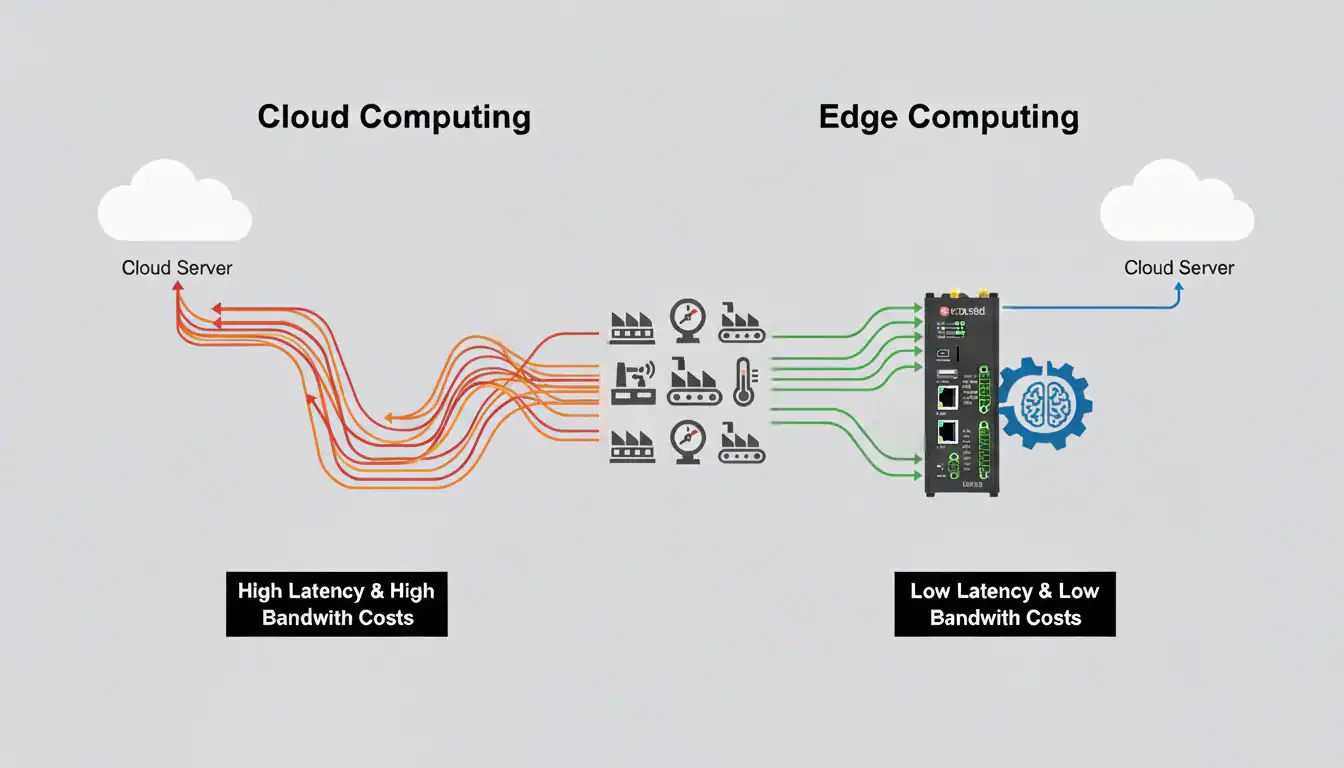
In the rapidly evolving landscape of 2026, Edge Computing in IoT has moved from a theoretical advantage to a mandatory architectural shift. This guide explores the transition from centralized cloud reliance to Decentralized Edge Intelligence—moving high-performance computation directly to the factory floor, pump station, or traffic intersection where data is born.
Instead of choking cellular bandwidth with raw telemetry, this model leverages an Industrial Edge Gateway to ingest, scrub, and analyze data in real-time. By processing intelligence locally, organizations can bypass the physical constraints of the cloud to achieve Deterministic Latency, massive cost savings, and operational autonomy.
Key Technical Takeaways:
- The Shift: Migrating high-stakes data processing from distant cloud servers to localized Edge Nodes for sub-millisecond response times.
- Economic Impact: Achieving an average 80% reduction in data backhaul costs by filtering noise at the source and transmitting only actionable intelligence.
- Operational Resilience: Ensuring Business Continuity through local control loops and eMMC data buffering, allowing your facility to remain “smart” even during total network outages.
- Future-Proofing: Why a robust edge platform (like RobustOS Pro) is the non-negotiable foundation for Edge AI, Predictive Maintenance, and autonomous robotics.
Introduction: Moving Intelligence from the Cloud to the Concrete
I’ve lost count of how many frustrated engineers I’ve spoken to who tried to build their first massive IIoT project by streaming everything to the cloud. They connected thousands of sensors across a factory floor, piped raw telemetry 24/7 over a cellular link, and waited for the “big data” magic to happen.
Instead of insights, they got hit with three brutal realities: Inference latency that made real-time control impossible, a data egress bill that gave the finance department a heart attack, and a single 5-minute internet outage that brought the entire “smart” facility to a grinding halt.
This is the fundamental friction in modern industrial networking. The cloud is powerful, but it’s too far away for the factory floor. For applications requiring sub-millisecond decisions, localized data filtering, or mission-critical autonomy, the “cloud-only” model is architecturally broken.
The fix? Edge Computing in IoT. It is the pragmatic shift moving intelligence from remote data centers directly onto the DIN rail. This guide breaks down the “why” and “how” of true industrial edge deployment.
Cutting Through the Jargon—Defining the “Edge”
So, where exactly is this “Edge” everyone is talking about? In the industrial world, the Edge is simply the physical point of data inception: the factory floor, the remote pump station, or the smart traffic intersection.
Edge computing in IoT is the strategic practice of placing a high-performance, intelligent computer—an Industrial Edge Gateway—directly at that point of inception to process data locally before it ever touches a WAN.
The “On-Site Manager” Analogy:
- Cloud Computing is the Central Head Office: You ship every piece of raw mail (data) to a headquarters hundreds of miles away. It’s a powerhouse with massive resources, but the round-trip latency for instructions is a deal-breaker for real-time operations.
- Edge Computing is the On-Site Manager: This manager lives in your local branch. They intercept the mail (Data Ingestion) as it arrives, filter out the noise (Data Scrubbing), make split-second tactical decisions, and only transmit a condensed intelligence report to the head office.
In this architecture, your IoT Edge Gateway isn’t just a courier (like a basic router); it’s a localized brain that ensures operational continuity, even if the connection to the “Head Office” is severed.
The “Why”—4 Critical Engineering Bottlenecks Solved by the Edge
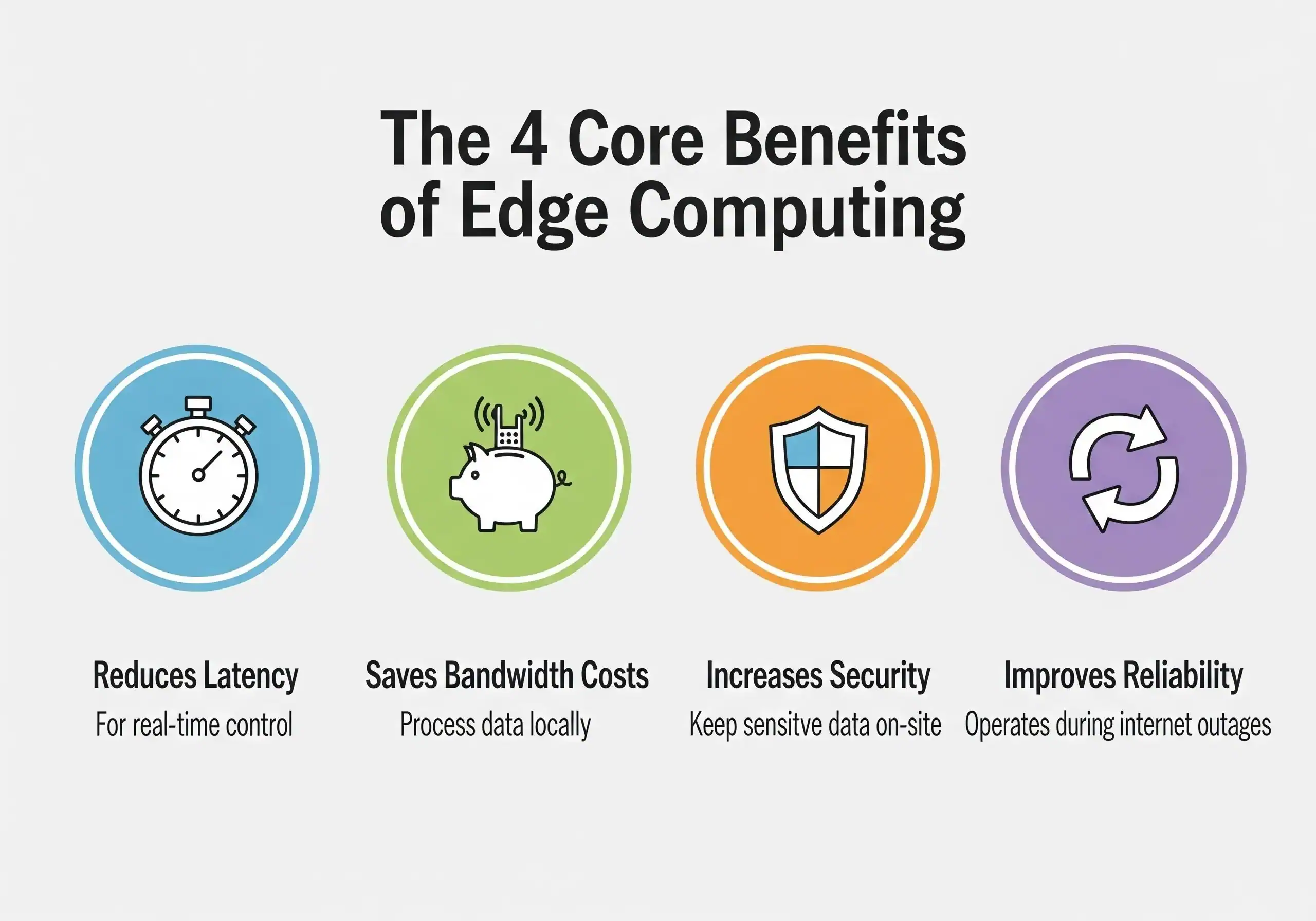
Why not just leverage the infinite scale of the Cloud? Because the physical world operates on constraints that a cloud-only model simply cannot navigate. Here are the four “architectural deal-breakers” that necessitate an Industrial Edge Gateway.
Problem #1: Deterministic Latency (The Speed of Control)
For a high-speed robotic arm or a substation safety controller, a 2-second round-trip to a cloud server is an eternity. In industrial automation, we need deterministic latency—guaranteed response times. An edge gateway executes control logic in milliseconds, processing high-frequency sensor data locally to prevent catastrophic mechanical failure or downtime.
Problem #2: Bandwidth Exhaustion (The Data Deluge)
Streaming raw telemetry from thousands of sensors 24/7 over a 5G or LTE link is a fiscal disaster. Most of that data is “noise”—steady-state readings that add zero value. Edge computing allows for Data Deduplication and Aggregation at the source. By transmitting only “change-on-threshold” events or compressed summaries, businesses typically see an 80% reduction in data backhaul costs.
Problem #3: Operational Autonomy (The Connectivity Gap)
In a cloud-only model, an internet outage doesn’t just stop your emails; it stops your production line. An Edge Computing Architecture provides Operational Autonomy. The local gateway maintains critical control loops, caches telemetry in high-endurance eMMC storage, and synchronizes with the cloud only when the link is restored, ensuring Business Continuity in unstable network environments.
Problem #4: Cyber-Physical Security & Data Sovereignty
Every byte sent to the public cloud is a byte exposed. Processing sensitive operational data on-premise minimizes the attack surface. Furthermore, as global Data Sovereignty regulations (like GDPR or localized industrial mandates) tighten, keeping raw data within the factory perimeter isn’t just a security preference—it’s a legal necessity for compliance.
The “What”—Anatomy of a Resilient Edge Architecture
A true edge computing solution isn’t just a “connected box”—it’s a synergy of ruggedized hardware and a cloud-native software stack. Here are the non-negotiables for an industrial-grade Edge Deployment.
1. The Muscle: The Industrial Edge Gateway
Don’t mistake a professional gateway for a consumer-grade router. A mission-critical IoT Edge Gateway must be a high-performance, hardened computer designed for 24/7 reliability in harsh environments. Key hardware pillars include:
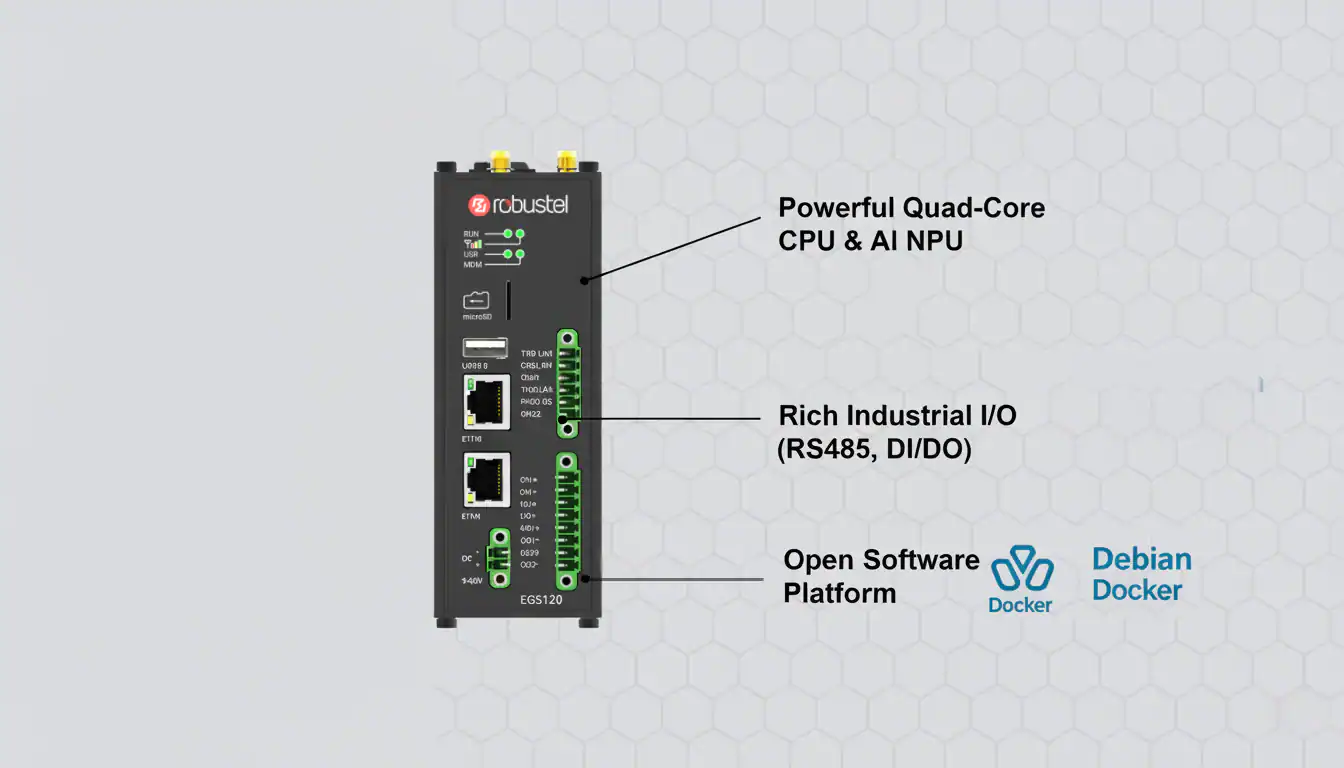
- Multi-Core Compute Power: Look for dedicated application processors like the NXP i.MX8 Series (as seen in our EG5120). This provides the “headroom” for heavy data processing and local AI inference.
- Industrial-Grade Storage: Avoid the “SD Card Trap.” Only soldered-on eMMC storage offers the vibration resistance and write-cycle endurance required for industrial data logging.
- Versatile Industrial I/O: Comprehensive physical connectivity—including Gigabit Ethernet, isolated RS232/RS485, and Digital I/O (DI/DO)—is essential for bridging the gap between legacy PLC assets and modern IT networks.
2. The Brain: OS and Edge Orchestration
If hardware is the muscle, the software environment is the intelligence that directs it.
- Open OS Architecture: Avoid proprietary “black box” systems. An open, stable environment like Debian 11 (LTS) provides maximum flexibility. This is why our RobustOS Pro is Debian-based—offering a familiar, high-security ecosystem for Linux developers.
- Native Containerization (Docker): In 2026, Docker support is non-negotiable. Containerization allows you to decouple your custom applications from the underlying hardware, enabling you to deploy Microservices and complex analytics across a global fleet of gateways with a single command.
Edge Computing in Action—3 High-Impact IIoT Scenarios
The theoretical benefits of Edge Computing in IoT are best understood through the lens of real-world industrial transformation. Here is how leading sectors are deploying Edge Intelligence today:
1. Smart Manufacturing: From Data to Decision
Edge gateways are moving beyond simple data logging to Edge Inference. By running AI models directly on the gateway, manufacturers can perform Real-Time Visual Quality Inspections on high-speed production lines. Simultaneously, by analyzing high-frequency vibration data from critical motors, the system enables Predictive Maintenance—detecting mechanical anomalies weeks before a catastrophic failure, without ever clogging the cloud with raw noise.
2. Smart Cities: Localized Vision Intelligence
Traffic management is the ultimate bandwidth challenge. Instead of backhauling terabytes of 4K video, an Edge Computing Architecture processes video feeds locally to detect accidents, identify license plates, and optimize signal timing in milliseconds. Only the resulting metadata and critical alerts are sent to the central command center, reducing cellular data costs while ensuring public safety.
3. Smart Buildings: Bridging Legacy OT with Modern IT
Modernizing a skyscraper involves a “protocol gap.” An edge gateway acts as a Multi-Protocol Translator, integrating disparate legacy systems—like HVAC and lighting control over BACnet/IP or Modbus—into a unified local logic engine. By running optimization algorithms on-premise, the building can dynamically adjust energy consumption based on occupancy and ambient light, even during a network blackout.
Conclusion: Embracing the Era of Decentralized Intelligence
Edge Computing in IoT is far more than a buzzword; it is a mandatory architectural evolution required to unlock the true ROI of the Industrial Internet of Things. By solving the physics of latency, the economics of bandwidth, and the pragmatics of reliability, the Edge removes the final barriers that have stalled so many ambitious IIoT pilots.
By migrating intelligence from the distant cloud to the immediate “point of inception,” you are building a system that is not just faster, but inherently more resilient and sovereign.
Success in this decentralized era requires a cohesive ecosystem—one that synergizes high-performance hardware (like the Robustel EG5120), an open, developer-centric OS (RobustOS Pro), and seamless cloud orchestration (RCMS). This is the foundation for an infrastructure that doesn’t just collect data, but acts on it.
Don’t build a system that is tethered to a distant cloud; build one that is empowered at the Edge. Your operational future depends on it.
FAQs
Q1: What is the main difference between an IoT Gateway and an Edge Gateway?
While the terms are often used interchangeably, a standard IoT Gateway primarily connects devices and translates protocols. An IoT Edge Gateway does all that but adds significant onboard processing power (a powerful CPU, more RAM) to run applications, analyze data, and make decisions locally—that’s the “edge computing” part.
Q2: Does edge computing replace the cloud?
No, it complements it. The best architecture is a hybrid model. The edge handles all the real-time, high-frequency data processing and immediate control tasks. The cloud is used for long-term storage, complex analytics on aggregated data, and centralized management of the edge devices. They work together as a team.
Q3: Can I run my existing applications at the edge?
Yes, with the right platform, it’s easier than ever. An edge gateway that supports an open OS like Debian and a containerization technology like Docker allows you to package almost any existing Linux application (written in Python, Java, C++, etc.) and deploy it to the edge with minimal changes.
About the Author
Robert Liao | Technical Support Engineer
Robert Liao is an IoT Technical Support Engineer at Robustel, specializing in industrial networking and edge connectivity. A certified Networking Engineer, Robert focuses on the deployment and troubleshooting of large-scale IIoT infrastructures. His work centers on architecting reliable, scalable system performance for complex industrial applications, bridging the gap between field hardware and cloud-side data management.