
IoT vs. IIoT: Understanding the Industrial Internet of Things in 2026
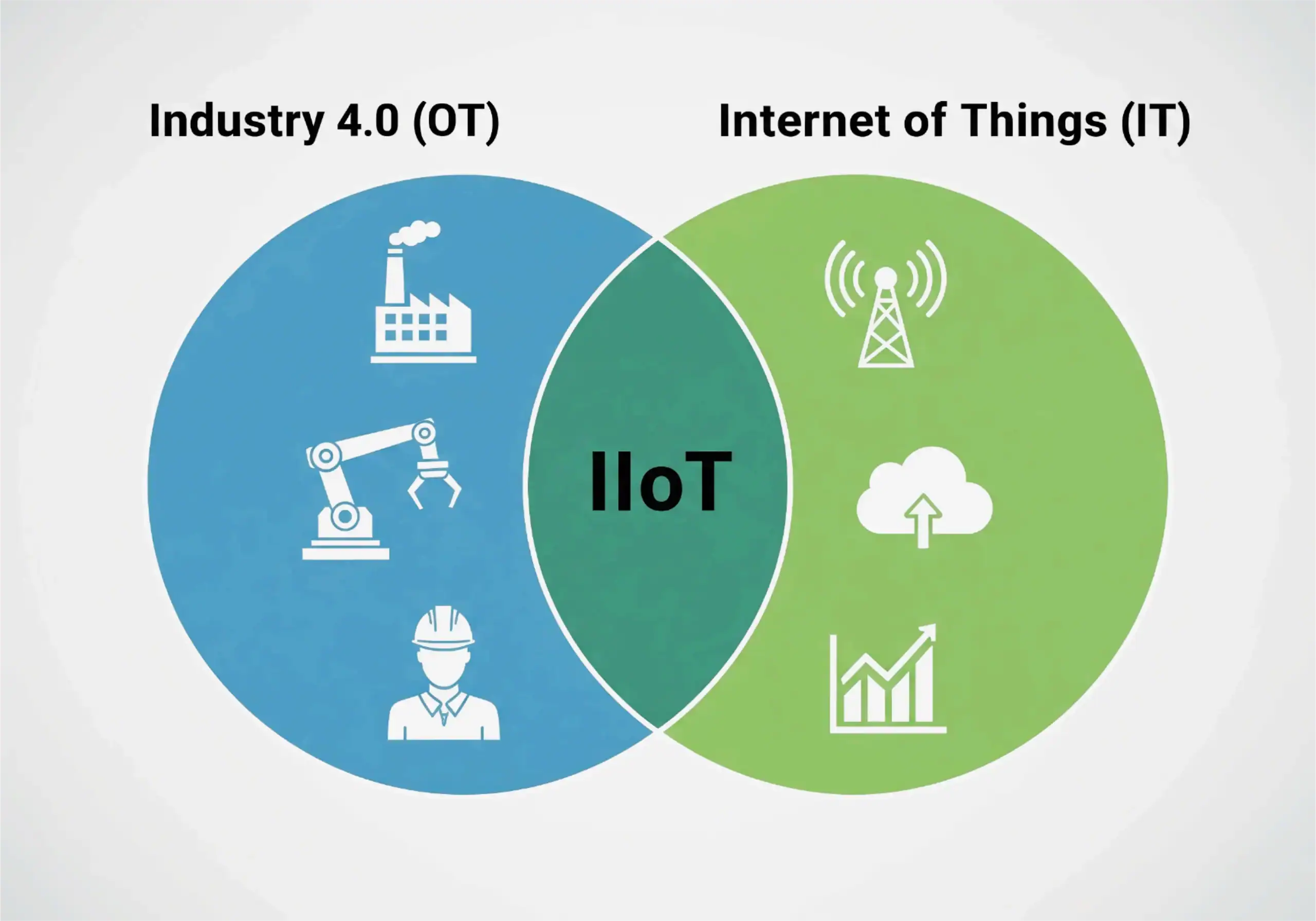
What is IIoT, and why is it redefining modern manufacturing? While Consumer IoT focuses on personal convenience, the Industrial Internet of Things (IIoT) is built for mission-critical reliability and large-scale industrial assets. This guide provides a professional deep dive into the IT/OT convergence, using a clear Venn diagram to illustrate how physical Operational Technology (OT) merges with the digital intelligence of Information Technology (IT).
What we will cover:
- The IT/OT Intersection: A structural breakdown of how protocol translation connects legacy machines to the cloud.
- IIoT vs. IoT: The critical differences in environment, lifecycle, and “mission-critical” stakes.
- Core Architecture: The 2026 essentials of IIoT—from intelligent sensors and Edge Computing gateways to high-resilience connectivity (5G/LoRaWAN).
- Scenario-Driven Applications: Real-world ROI in predictive maintenance, smart grids, and precision agriculture.
- Future Trends: How AIoT and ESG/Sustainability are driving the next phase of industrial intelligence.
By the end of this guide, you will understand how data-driven insights transform reactive, isolated factories into predictive, AI-powered ecosystems.
Introduction: When Factories Start Talking
Imagine a busy factory. A PLC (Programmable Logic Controller) runs a production line. A robotic arm performs tasks with precision. An experienced engineer makes their rounds. This is the traditional industrial scene—efficient, but isolated.
Now, imagine if every sensor and machine could “talk”. They send real-time status and health data securely to the cloud. This is not just connectivity. It is the transition from reactive to predictive operations.
Definition: The Industrial Internet of Things (IIoT) is the extension of IoT into industrial sectors. it focuses on the deep integration of Operational Technology (OT) and Information Technology (IT) to drive smarter business decisions.
A Simple Definition: The IT/OT Venn Diagram Explained
To understand IIoT, we must look at the intersection of two distinct technological worlds.
- The “Industry 4.0” Circle (Operational Technology – OT): This is the physical “muscle”. It includes robots, CNC machines, and the skilled people on the shop floor. OT focuses on availability and safety. These machines often run for decades in harsh environments.
- The “Internet of Things” Circle (Information Technology – IT): This is the “brain.” It includes 5G networks, cloud computing, and big data analytics. IT focuses on confidentiality and data integrity. It evolves rapidly through software updates.
The Intersection: The IIoT Bridge. This is where the magic happens. By equipping OT assets with intelligent gateways, we create a feedback loop. Protocol Translation is the key here. It converts legacy “fieldbus” languages (like Modbus or Profibus) into modern “cloud-friendly” languages (like MQTT or JSON). This allows a 20-year-old motor to “chat” with a cutting-edge AI in the cloud.
IIoT vs. IoT: Why the “Industrial” Label Matters
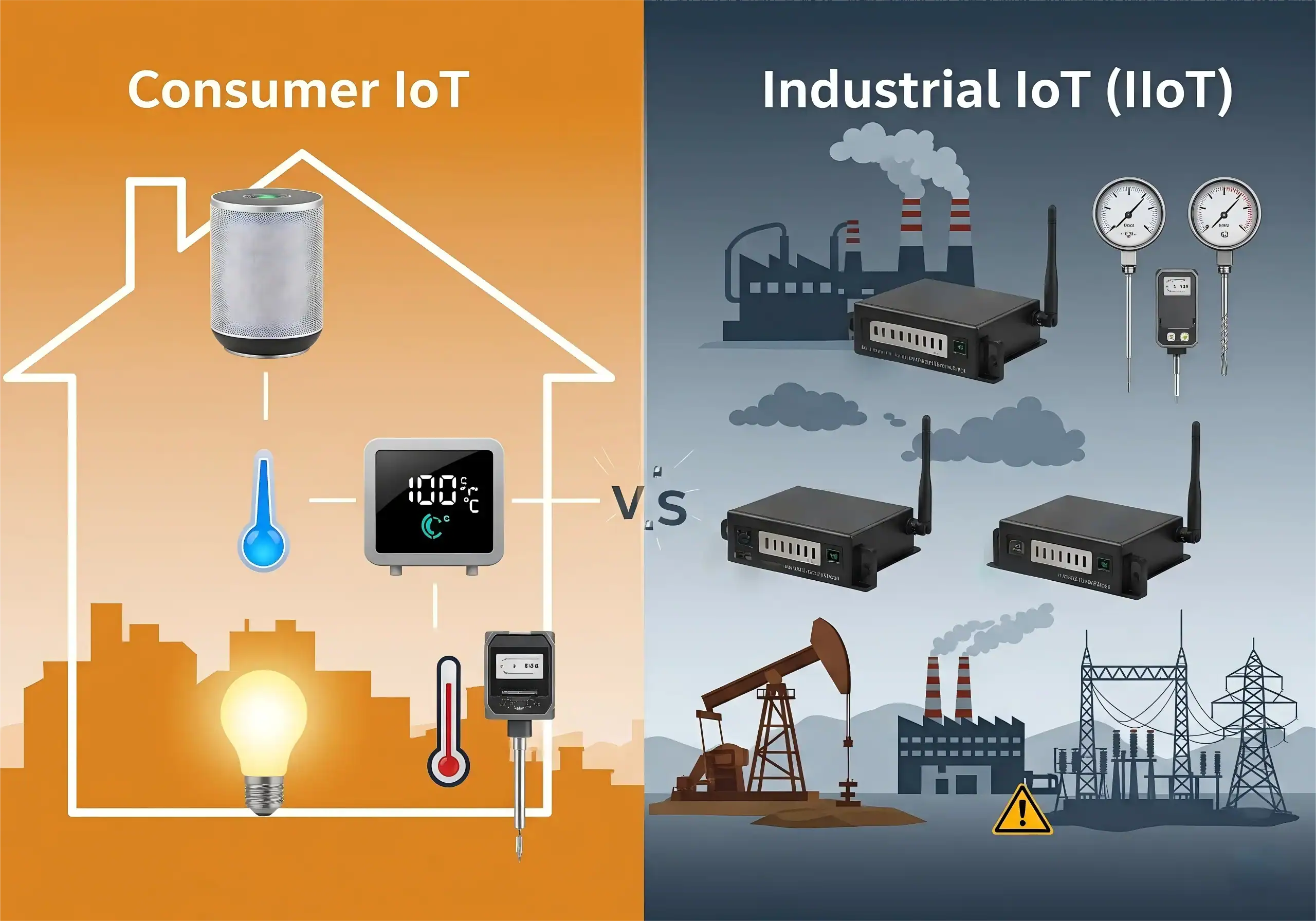
This is a common point of confusion. While IIoT is a subset of IoT, they are worlds apart in their purpose, environment, and the stakes involved. The primary differentiator is Mission-Criticality.
| Feature | Consumer IoT | Industrial IoT (IIoT) |
| Primary Goal | Convenience, comfort, entertainment | Efficiency, safety, productivity, profitability |
| Environment | Home, office (controlled environments) | Factory, mine, outdoors (harsh, hazardous) |
| The Stakes | A failed smart bulb is an inconvenience. | A failed PLC shuts down an entire production line. |
| The Devices | Smartwatches, smart speakers | Industrial gateways, PLCs, high-precision sensors |
In short: Consumer IoT is about the User. Industrial IoT is about the Asset.
The 4 Core Components of an IIoT Architecture
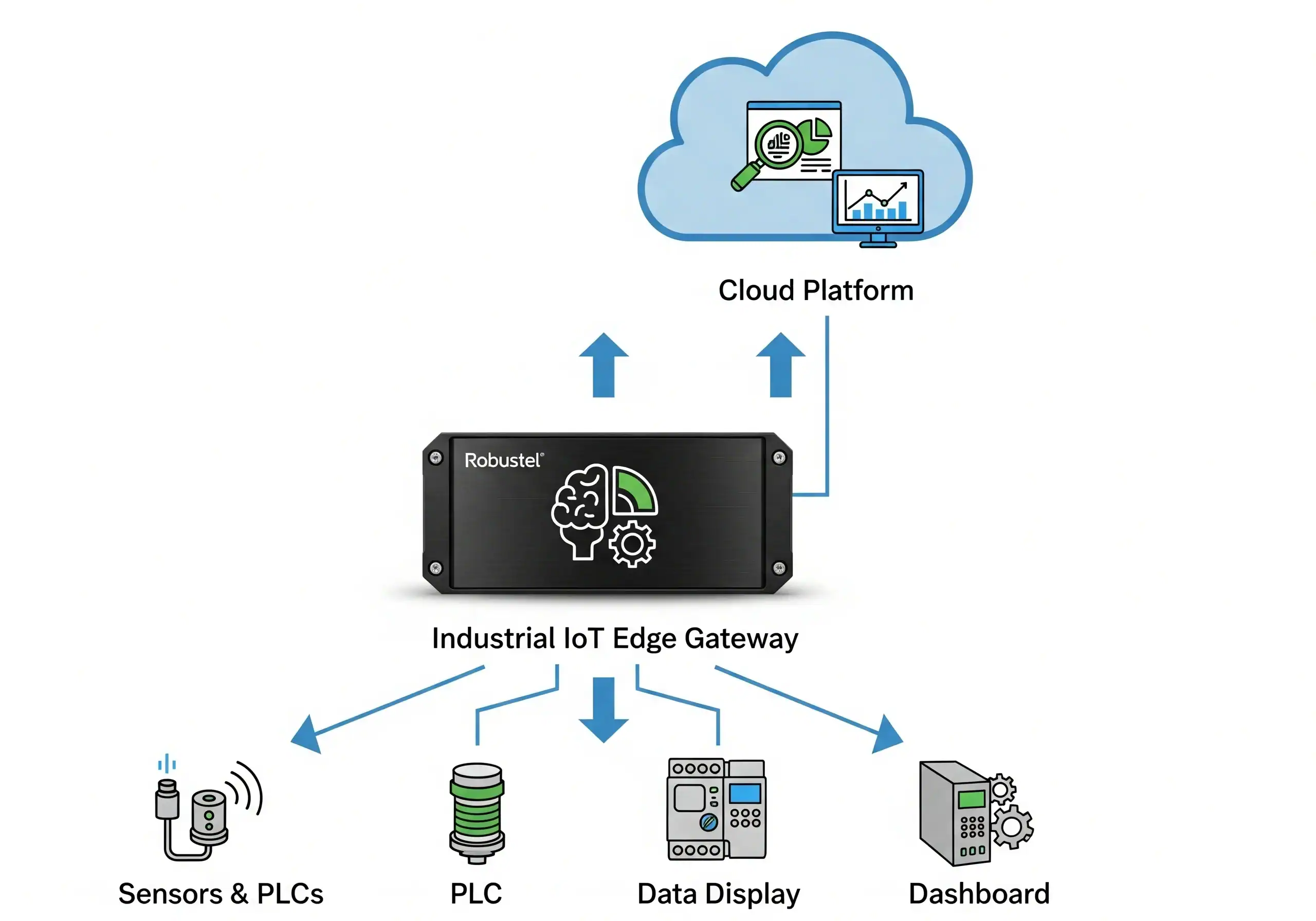
A professional IIoT solution is built on four functional layers. Each must be “industrial-grade“.
1. Intelligent Sensors & Actuators (The Senses)
These devices gather raw data. Temperature, pressure, and vibration are the most common. In 2026, many sensors are “smart”. They don’t just send raw numbers. They perform basic signal processing to reduce network noise.
2. The Industrial IoT Edge Gateway (The Commander)
This is the most critical hardware link. It sits between the machine and the cloud.
- Protocol Conversion: It speaks to the PLC and the Cloud simultaneously.
- Edge Computing: It analyzes data locally. If a critical pressure threshold is hit, the gateway triggers an emergency stop instantly. It does not wait for a round-trip to the cloud.
- Security: It acts as a firewall, protecting the OT network from external cyber threats.
3. Connectivity (The Pathway)
Data needs a reliable road.
- Cellular (4G/5G): Best for high-bandwidth, low-latency mobile assets.
- LoRaWAN: Perfect for long-distance, battery-powered sensors (e.g., smart agriculture).
- Ethernet: Still the gold standard for high-speed, fixed factory floor connections.
4. The Cloud & Digital Twins (The Central Brain)
This is where Big Data lives.
- Visualization: Dashboards show real-time KPIs (Key Performance Indicators).
- Digital Twins: This is a virtual 1:1 replica of your factory. You can run “What If” simulations in the digital world before changing anything in the physical world.
Real-World IIoT Applications: Scenario-Driven Value
How does this translate to ROI? Here are four industry-proven scenarios:
- 1. Predictive Maintenance: Sensors monitor motor vibrations. AI identifies “unusual” patterns weeks before a breakdown.
- Result: You replace a $500 bearing during scheduled downtime instead of losing $50,000 in unplanned production stops.
- 2. Smart Agriculture: LoRaWAN gateways collect soil moisture data across thousands of acres.
- Result: Farmers apply water and fertilizer only where needed. This increases yield while saving 30% of water resources.
- 3. Smart Grid: Intelligent gateways monitor power loads at the edge.
- Result: If a fault occurs, the system re-routes power automatically. This prevents large-scale blackouts and speeds up repairs.
- 4. Asset Tracking: GPS and cellular gateways track high-value containers globally.
- Result: Full visibility of the supply chain. You know exactly when your materials will arrive, reducing inventory waste.
2026 Trends: The Rise of AIoT and ESG
- AIoT (AI + IIoT): We are moving beyond simple rules. Machine learning now lives on the Edge Gateway. This allows for autonomous decision-making without any human intervention.
- Sustainability (ESG): IIoT is the “green” engine. It tracks energy consumption at the machine level. This helps companies identify energy leaks and meet strict carbon neutrality targets.
Conclusion: From Connection to Intelligence
What is IIoT? It is the evolution of industry. It is not just about “connecting things to the internet”. It is about extracting value from physical data. By bridging the gap between OT and IT, businesses transform from being “reactive” to being “predictive.” In the 2026 economy, data is the most valuable fuel for industrial growth.
FAQs
Q1: Can I implement IIoT on old machinery?
A: Absolutely. This is called Retrofitting. You add external sensors and an edge gateway to “wrap” the old machine in a digital layer. You don’t need to buy a new factory to get smart.
Q2: Is IIoT the same as Industry 4.0?
A: Think of Industry 4.0 as the Goal (the fully automated, smart factory). IIoT is the Technology that makes it possible. You cannot have Industry 4.0 without the connectivity of IIoT.
Q3: What do I need to get started with an IIoT project?
A3: To start an IIoT project, you first need a clear business problem you want to solve (e.g., “reduce machine downtime”). Then, you’ll need a foundational solution that typically includes sensors, a reliable industrial IoT gateway to collect and process the data, a connectivity plan, and a cloud platform for visualization and analysis.
Q4: How does IIoT improve safety in industrial settings?
A2: IIoT can improve safety in many ways. For example, sensors can monitor for hazardous gas leaks, equipment overheating, or abnormal vibrations and automatically trigger an alarm or a shutdown procedure. It can also reduce the number of times personnel need to enter hazardous areas through remote monitoring.
About the Author
Robert Liao | Technical Support Engineer
Robert Liao is an IoT Technical Support Engineer at Robustel, specializing in industrial networking and edge connectivity. A certified Networking Engineer, Robert focuses on the deployment and troubleshooting of large-scale IIoT infrastructures. His work centers on architecting reliable, scalable system performance for complex industrial applications, bridging the gap between field hardware and cloud-side data management.