
What is Docker in IoT? Understanding the Value of Edge Containerization
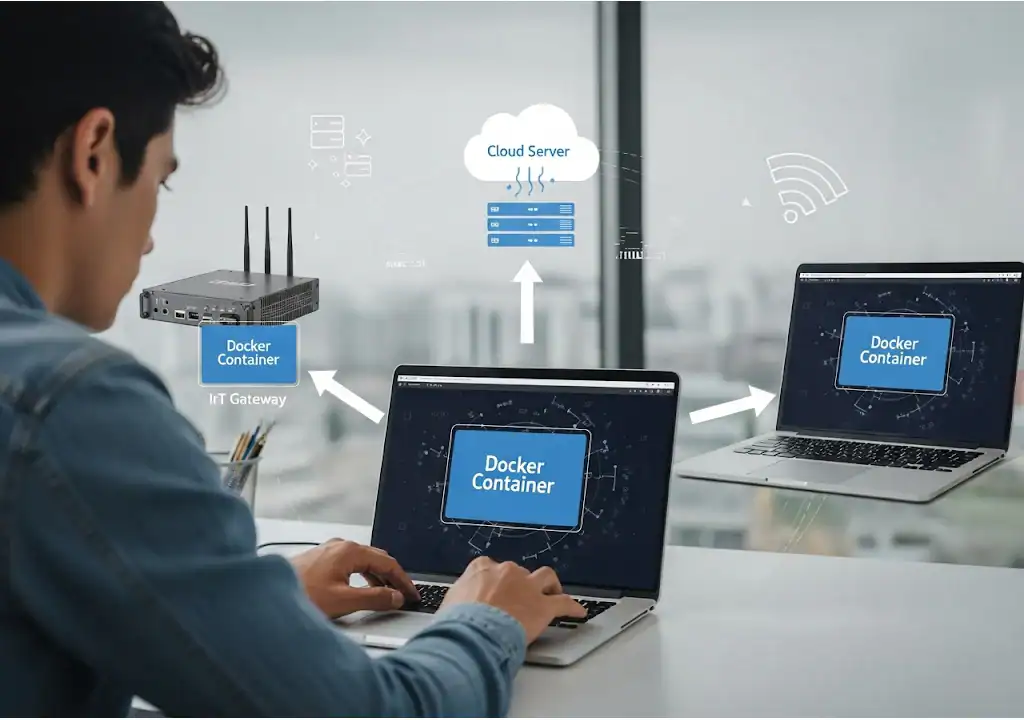
This article defines why Docker containerization has become the architectural standard for modern Edge Gateways. It explains the transition from monolithic firmware to modular, cloud-native application management. By leveraging Docker, industrial operators can achieve 99.9% system stability through application isolation and drastically reduce “time-to-market” with portable code that runs identically from a developer’s laptop to a factory-floor gateway.
What We Will Cover:
- The Containerization Shift: Moving beyond traditional firmware to modular app deployment.
- Three Pillars of Docker at the Edge: A deep dive into Portability, Security (Isolation), and Scalability.
- Developer Efficiency: How Docker streamlines the DevOps pipeline for industrial hardware.
- Future-Proofing Infrastructure: Why Docker is the prerequisite for AI and Machine Learning at the edge.
Introduction: The “It Works on My Machine” Nightmare
I’ve seen this scenario play out far too often: a development team spends months building a brilliant custom application—perhaps a Python script for real-time vibration analytics or a Node.js API. On a local laptop, it’s flawless.
Then comes the deployment to 100 gateways in the field, and the chaos begins. Dependency conflicts, library version mismatches, and subtle OS differences turn a simple rollout into a technical nightmare.
This is exactly why Docker was invented. In 2026, native support for Docker isn’t just a “feature” for an industrial gateway; it is the fundamental bridge between the development bench and successful field operations.
What is Docker? A Quick Explanation
Before we dive into the “why”, let’s clarify the “what”. Docker is a platform that packages your application and its entire environment—code, libraries, runtimes, and system tools—into a single, isolated unit called a container.
Think of a container as a standardized, self-contained box. Because it carries everything it needs to run, it remains indifferent to the environment around it. This is a massive leap forward from traditional “bare-metal” methods, where you install applications directly onto the gateway’s host operating system, risking “system rot” and version conflicts.
The 5 Pillars of Docker in IIoT
So, why is this architecture so essential for your cloud-ready IoT gateway? Let’s take a deep dive into the 5 pillars of a Docker in IIoT.
1. Build Once, Run Anywhere: True Portability
This is the number one benefit. A Docker container created on a developer’s Windows or Mac laptop will run identically on the Debian-based OS of a Robustel EG5120 gateway in the field.
- Eliminates Dependency Hell: You no longer have to worry if the gateway has the right version of Python or a specific system library installed. Everything is bundled inside the container.
- Accelerates Development Cycles: This dramatically speeds up the time from development to deployment. What works on the bench will work in the field.
2. Security Through Isolation
This is a critical point for any industrial or enterprise deployment. Each Docker container runs in its own isolated environment, with its own filesystem and processes.
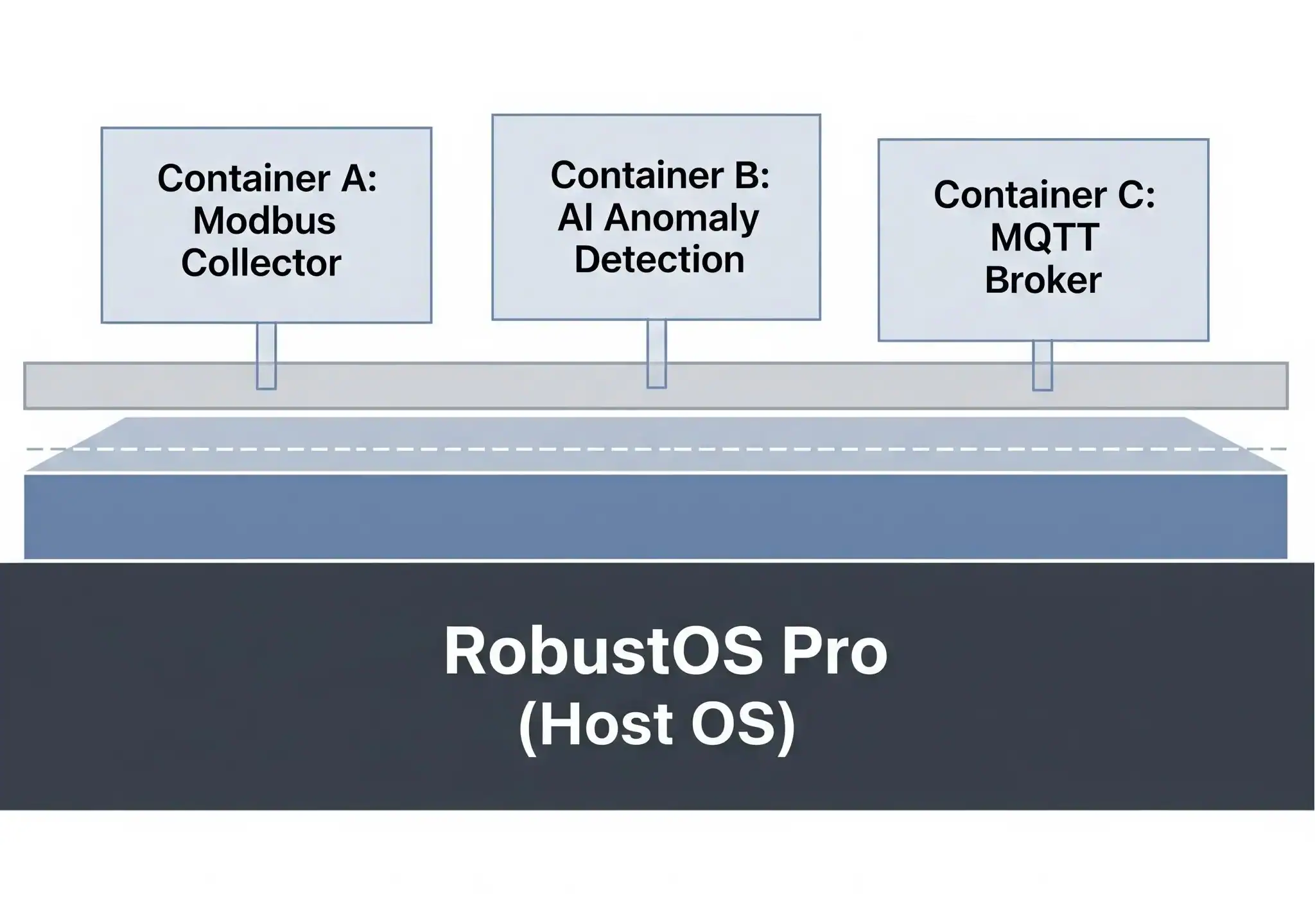
- Prevents Conflicts: You can run multiple applications on the same gateway without worrying that they will interfere with each other or with the gateway’s core operating system.
- Contains Threats: If one containerized application is compromised by a vulnerability, the isolation prevents the attacker from easily accessing other applications or the underlying host OS. This is a fundamental security principle for any cloud-ready IoT gateway.
3. Seamless Cloud-to-Edge Integration
Docker is the foundation for modern cloud services like Azure IoT Edge and AWS IoT Greengrass.
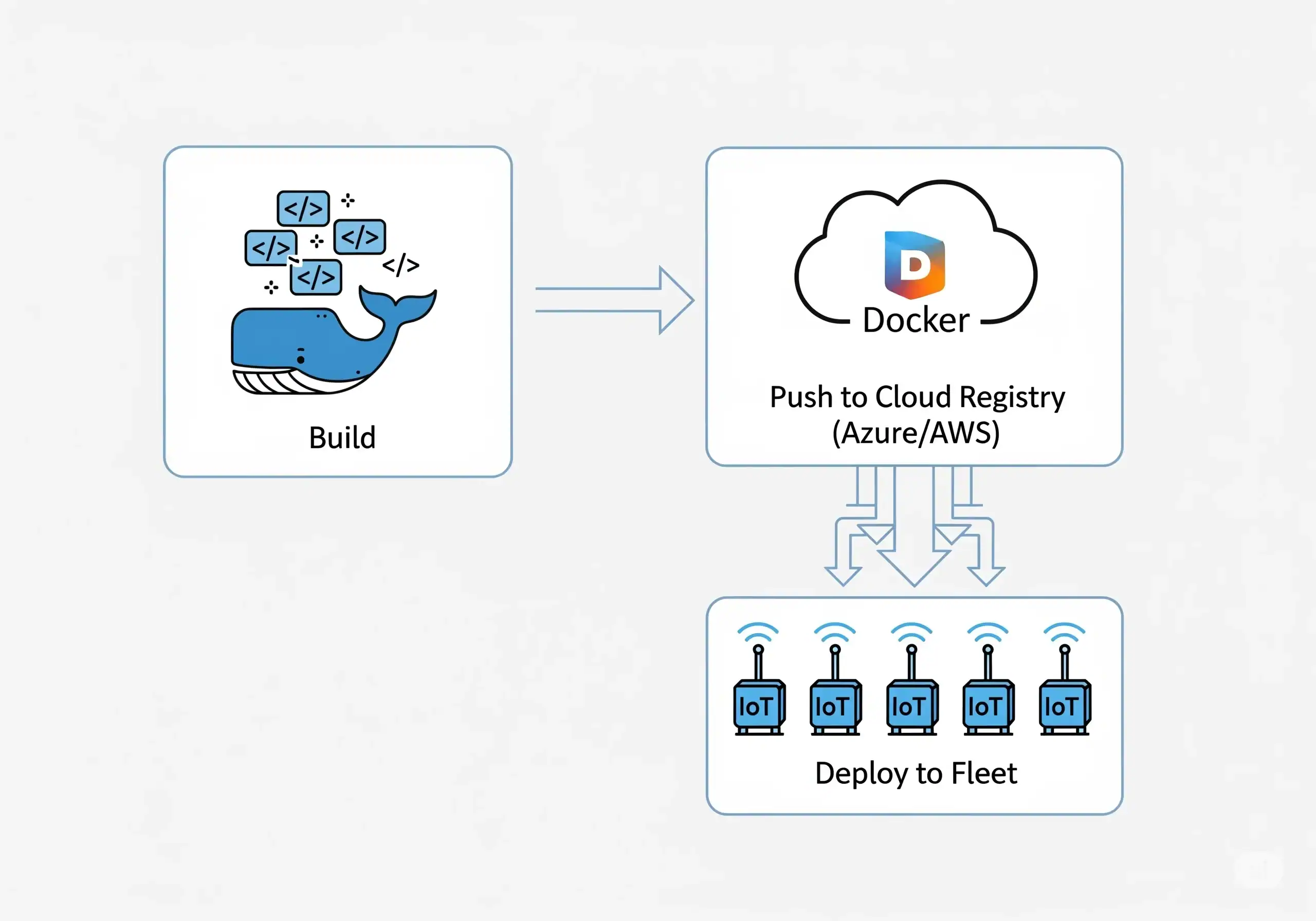
- Cloud-Native Workflows: These platforms use Docker containers as the standard unit of deployment. You build your edge logic as a container, publish it to a cloud registry (like Azure Container Registry or Amazon ECR), and the cloud service handles deploying it to your entire fleet of gateways.
- Consistency at Scale: This ensures that every single IoT gateway in your fleet is running the exact same version of your application, which is crucial for manageability and reliability.
4. Lean Resource Management
Unlike a full virtual machine (VM), which includes an entire guest operating system, containers share the host gateway’s Linux kernel.
- Lightweight & Fast: Containers are much smaller in size and start up in seconds. This means you can run more applications on a resource-constrained device like an IoT edge gateway without sacrificing performance.
- Optimized for the Edge: This efficiency is perfectly suited for edge computing, where processing power and storage are more limited than in a cloud data center.
5. Atomic Updates and Reliable Rollbacks
Docker images are versioned. This brings the discipline of modern software development to the world of industrial hardware.
- Reliable Rollbacks: If you deploy a new version of your application (myapp:v2.0) and it has a bug, you can instantly roll back and redeploy the previous, stable version (myapp:v1.9) with a single command.
- Atomic Updates: When you update a container, the entire self-contained environment is replaced. This is much cleaner and more reliable than trying to update individual library files on a live system, which can often lead to unpredictable failures.
Conclusion
In 2026, a cloud-ready IoT gateway is no longer just a piece of hardware; it is a software delivery platform. Docker is the engine that enables this transformation. By decoupling your software from the underlying hardware, you achieve the portability, security, and scalability required to treat a fleet of industrial gateways like a distributed cloud.
Choosing a gateway with a flexible, Debian-based OS and native Docker support is more than a technical choice—it’s a strategy to future-proof your operations and empower your team to build faster.
FAQs
Q1: Do I need to be a DevOps expert to use Docker on an IoT gateway?
A1: Not for basic use. While Docker has a deep feature set, the fundamentals of pulling an existing image (like an MQTT broker) and running it are very straightforward. For managing fleets, cloud platforms like Azure IoT Edge, AWS IoT Greengrass, and Robustel’s RCMS handle much of the complexity for you.
Q2: Can I run multiple Docker containers on a single gateway like the EG5120?
A2: Yes, absolutely. The powerful NXP i.MX 8M Plus processor and Debian-based OS on the EG5120 are designed to run multiple containers simultaneously, limited only by the CPU and RAM resources. For example, you could run one container for data collection, another for an AI model, and a third for a local dashboard.
Q3: How does Docker work with Node-RED on a gateway?
A3: They work perfectly together. You can run Node-RED itself as a Docker container, which makes it easy to manage and update. Alternatively, a Node-RED flow running on the gateway can trigger actions to start, stop, or manage other Docker containers on the same device, creating powerful, automated workflows.
About the Author
Robert Liao | Technical Support Engineer
Robert Liao is an IoT Technical Support Engineer at Robustel, specializing in industrial networking and edge connectivity. A certified Networking Engineer, Robert focuses on the deployment and troubleshooting of large-scale IIoT infrastructures. His work centers on architecting reliable, scalable system performance for complex industrial applications, bridging the gap between field hardware and cloud-side data management.