
What is an IoT Edge Gateway? Architecture, Benefits, and Use Cases 2026
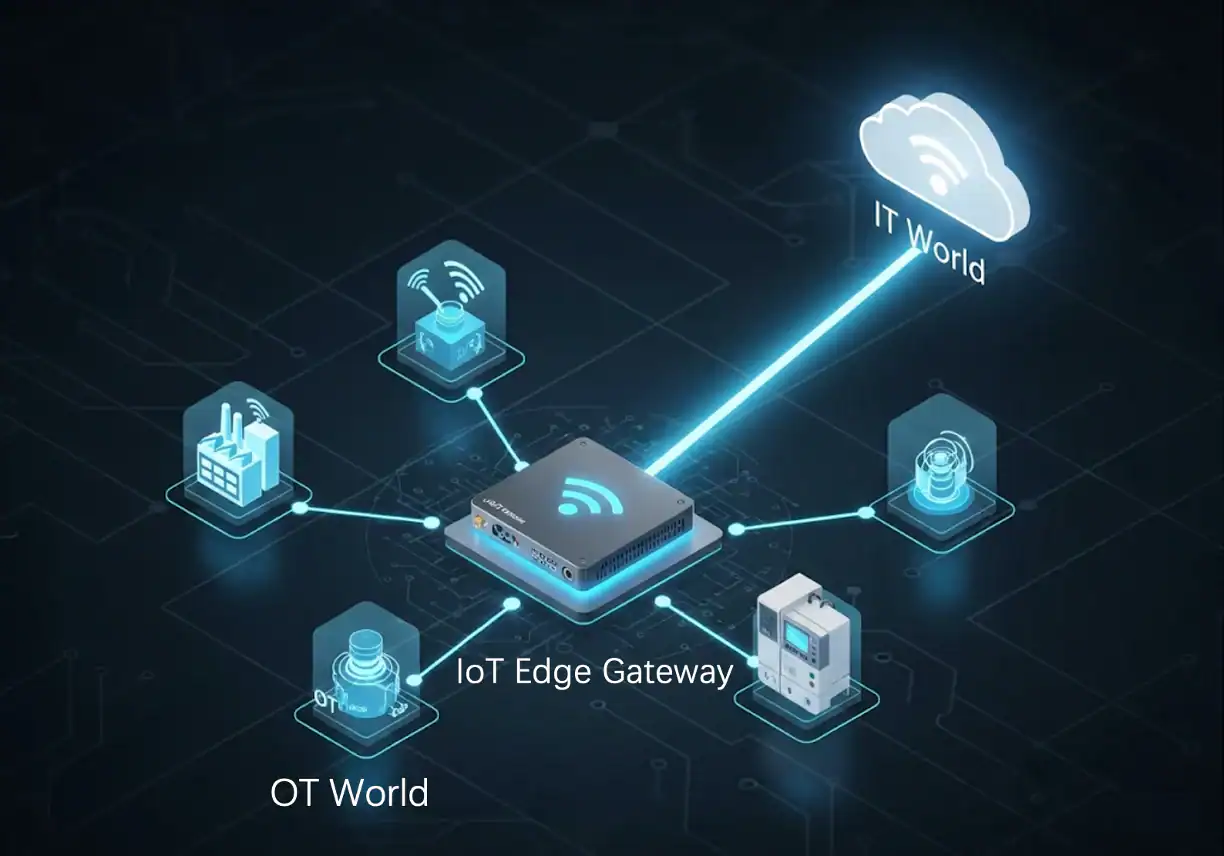
At its heart, an IoT Edge Gateway is an intelligent bridge. it connects your local “Operational Technology” (OT)—sensors, PLCs, and machines—to your global “Information Technology” (IT) networks, like the cloud.
Unlike a basic router that simply passes traffic, an edge gateway acts as a local brain. It processes, filters, and analyzes data right at the source. This creates a smarter network by enabling real-time control and reducing your reliance on the cloud.
This guide explores the core functions of an edge gateway, its main advantages, and common use cases. We will also introduce the Robustel EG5120 as a prime example of a modern industrial IoT edge gateway.
What We Will Cover:
- Protocol Translation: How it bridges the “language gap” between machines and the cloud.
- Data Processing: Why local filtering is the key to reducing bandwidth costs.
- Security at the Edge: How it protects your data before it ever leaves the site.
- The EG5120 Advantage: A look at how Debian-based hardware simplifies your deployment.
Moving Intelligence to the Edge: Why It Matters
The Internet of Things (IoT) has connected billions of devices, but this connectivity comes with a massive challenge: a literal flood of data. In the past, we sent every byte of information directly to the cloud. However, as projects scale, this “cloud-only” model often breaks down due to high bandwidth costs, slow reaction times (latency), and increased security risks.
This is why the industry is moving toward edge computing, with the IoT edge gateway serving as the local command center. An edge gateway is much more than a simple modem or router. It is an intelligent device that sits right where your data is born. By filtering, converting protocols, and analyzing information on-site, it ensures your system is faster and more secure.
Instead of waiting for a distant cloud server to respond, your hardware can make decisions in real-time. This not only saves you money on data plans but also creates a more resilient foundation for industrial applications. In this article, we’ll break down exactly how these gateways work and why they are essential for your next deployment.
What is an Edge Gateway in IoT ? The Core Functions
An edge gateway in IoT performs several critical functions that distinguish it from standard networking hardware. It is a sophisticated piece of equipment designed to bridge the physical world of machines and the digital world of the cloud.
Bridging OT and IT Networks
One of an edge gateway’s primary roles is to connect two different worlds:
- Operational Technology (OT): This is the world of industrial control systems, including PLCs, sensors, actuators, and machines that use industrial protocols like Modbus, OPC UA, or BACnet.
- Information Technology (IT): This is the world of enterprise networks and the cloud, which uses standard internet protocols like TCP/IP, MQTT, and HTTPS.
An edge gateway in IoT seamlessly translates data between these different protocols, allowing, for example, a Modbus sensor to securely send its data to an MQTT broker on AWS or Azure. This protocol conversion is a fundamental capability.
Local Data Processing and Analytics (Edge Computing)
Instead of sending all raw data to the cloud, a powerful edge gateway in IoT processes it locally. This is what “edge computing” means. This can include:
- Filtering: Ignoring redundant or irrelevant data to reduce the amount sent to the cloud.
- Aggregation: Summarizing data points over time (e.g., calculating the average temperature over a minute instead of sending a reading every second).
- Analysis: Running analytics or even machine learning models directly on the gateway to detect anomalies or make real-time decisions without cloud latency.
- Control: Executing automated responses based on local data. For example, if a temperature sensor connected to the gateway exceeds a threshold, the gateway can directly command a fan to turn on without waiting for an instruction from the cloud.
Securing the Network Edge
The edge gateway in IoT acts as a critical security checkpoint. It protects the sensitive OT network from potential threats from the external IT network. Key security functions include:
- Access Control: Ensuring only authorized devices and users can communicate through the gateway. This security function is paramount for any industrial edge gateway in IoT.
- Stateful Firewall: Protecting internal assets from unauthorized access.
- VPN Tunnels: Creating secure, encrypted connections to the cloud or a central office using protocols like IPsec, OpenVPN, or Wireguard.
Introducing the Robustel EG5120: A Powerful Industrial IoT Edge Gateway
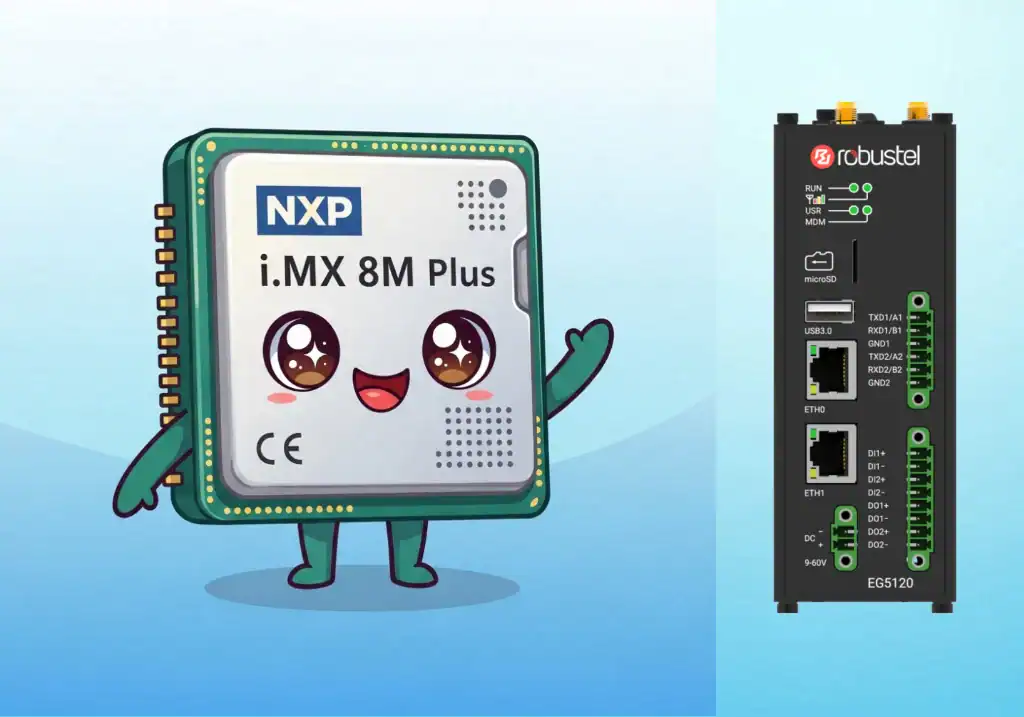
To understand these functions in a real-world context, let’s look at the Robustel EG5120. It’s an industrial-grade industrial IoT edge gateway engineered to deliver all the core capabilities discussed above.
Selected EG5120 Specifications:

| Feature Category | Specification |
|---|---|
| System | |
| CPU | Quad-Core ARM Cortex-A53, 1.6 GHz (NXP i.MX8) |
| RAM / Storage | 2 GB DDR4 / 16 GB eMMC |
| Connectivity | |
| Cellular | Global 4G LTE Cat 4 (Dual SIM Failover) |
| Ethernet | 2 x Gigabit Ethernet (10/100/1000 Mbps) |
| Industrial Interfaces | 2 x RS232/RS485, 2 x DI, 2 x DO |
| Software | |
| Operating System | RobustOS Pro (Debian 11 based with LTS) |
| Containerization | Docker support |
| IoT Stack Support | Node-RED, MQTT, InfluxDB, Grafana |
| Industrial Protocols | Modbus, OPC UA, BACnet, DNP3, and more |
This combination of high-performance hardware and a flexible, open software environment makes the EG5120 an exemplary edge gateway in IoT.
Advantages of Using an Edge Gateway in IoT
Deploying a dedicated edge gateway in IoT like the EG5120 offers significant benefits over simpler connectivity devices.
Enhanced Performance and Reduced Latency
By processing data locally, an edge gateway in IoT can respond to events in milliseconds, rather than the seconds it might take for a round-trip to the cloud. This is critical for industrial control applications where immediate action is required. This low latency is a key advantage, as noted in reports on the value of edge computing from the Linux Foundation.
Lowered Costs and Bandwidth Consumption
Sending every byte of data from every sensor to the cloud can be very expensive, especially over cellular networks. An edge gateway in IoT intelligently filters and aggregates data, significantly reducing the amount of data transmitted and lowering bandwidth costs. Furthermore, it can reduce cloud processing costs by handling analytics locally. This cost reduction is a major driver for edge adoption.
Increased Reliability and Offline Operation
What happens if the internet connection to the cloud goes down? With a powerful edge gateway in IoT , critical local operations can continue. The gateway can keep logging data, running automation rules, and controlling local machinery until the connection is restored. Robustel gateways like the EG5120 further enhance this with features like Dual-SIM failover and Automatic System Failback , ensuring both network and system resilience.
Simplified Management and Scalability
Modern edge gateways in IoT are often part of a larger management ecosystem. The EG5120, for example, integrates fully with the Robustel Cloud Manager Service (RCMS). This allows organizations to:
- Monitor the health and performance of their entire fleet of gateways from a single dashboard.
- Perform Over-the-Air (OTA) updates for the OS and applications running in containers.
- Securely access devices remotely for troubleshooting. This centralized cloud management simplifies the operational challenges of deploying and maintaining hundreds or thousands of edge gateways in IoT.
Applications: Where is an IoT Edge Gateway Used?
An IoT edge gateway is essential in any environment that requires high reliability and a secure bridge between local machines (OT) and digital systems (IT). Here is how it adds practical value across different industries:
- Smart Manufacturing
On the factory floor, a gateway connects PLCs and machine sensors directly to a Manufacturing Execution System (MES). Instead of just passing data, it runs local analytics to spot production defects in real-time. This allows for predictive maintenance, where the gateway identifies a potential machine failure before it causes a costly shutdown.
- Smart Energy & Utilities
In grid automation, gateways monitor renewable energy assets like solar inverters or wind turbines. By managing substation data locally, the gateway can trigger automated safety responses if it detects a power surge. This reduces the need for constant cloud communication in remote areas where cellular signals might be weak.
- Smart Buildings
Gateways integrate disparate systems like HVAC, lighting, and security into a single automated control center. By processing occupancy data locally, the gateway can optimize energy usage—such as dimming lights or adjusting temperature—without needing a round-trip to a cloud server, ensuring building security remains functional even if the internet goes down.
- Connected Transportation
For fleet management, an edge gateway handles in-vehicle data processing and real-time telematics. It can filter through thousands of engine data points to only send critical “fault codes” to the fleet manager. This saves on data costs while providing immediate feedback on driver safety and vehicle health.
- Smart Healthcare
In a clinical setting, gateways process patient data from medical devices locally. This ensures that privacy is maintained by keeping sensitive information on-site, while still allowing for real-time alerts. If a patient’s vitals hit a critical threshold, the gateway triggers an immediate local alarm for the nursing staff.
Conclusion: The Edge Gateway as the Cornerstone of Modern IIoT
An IoT edge gateway is far more than a simple router. It is a powerful, intelligent computer that serves as the secure bridge between the physical and digital worlds. By enabling real-time local processing, it enhances system reliability, lowers operational costs, and provides the “armored” security required for demanding industrial applications.
As IoT deployments continue to scale, the role of the edge gateway will only become more critical. Devices like the Robustel EG5120 represent the future of this technology. With high-performance ARM processors and an open, Debian-based OS, it offers the flexibility of a prototype with the ruggedness of an industrial-grade solution.
Ready to take your project from the lab to the field? Explore the full technical specifications and capabilities here!
FAQs
Q1: What is the main difference between an edge gateway and a regular router?
A1: A regular router’s primary function is to forward data packets between networks. An edge gateway in IoT does this as well, but critically, it also has significant onboard computing power to process, analyze, and act on data locally, before it’s sent to the cloud. It also typically has more diverse industrial interfaces (like RS485/RS232) and enhanced security features.
Q2: Can I run custom applications on an edge gateway in IoT?
A2: Yes, on advanced gateways like the Robustel EG5120. It supports Docker, allowing you to deploy applications written in almost any language (C, C++, Python, Java, Go, Node.js, etc.) inside containers. This provides incredible flexibility for custom edge analytics and control logic.
Q3: Is an edge gateway in IoT secure?
A3: Security is a core function of an industrial edge gateway in IoT. They are designed to be a secure buffer between OT and IT. Features like a stateful firewall, extensive VPN support (IPsec, OpenVPN, etc.), and a hardened operating system like RobustOS Pro (which is certified to IEC 62443-4-1) are essential. Furthermore, it undergoes rigorous, independent penetration testing annually to validate its resilience against real-world threats.
About the Author
Yang Tao | Founder & CEO
Robustel Yang Tao founded Robustel in 2010 with a vision to simplify industrial connectivity. Today, he leads a global team of over 300 experts, shipping mission-critical IoT solutions to more than 100 countries.
A firm believer in technical excellence, Yang dedicates 15% of revenue to R&D and operates a proprietary 5G smart factory. His commitment to security is backed by world-class certifications (IEC 62443, ISO 27001), ensuring that Robustel’s hardware is as secure as it is innovative.