Delivering reliable in-store connectivity for cake-printing kiosks with the R2010:
How Robustel & Intercake deploy IoT Connected Cake Printers across supermarkets in the UK.
Case Study – Fast Facts
Location
UK & Ireland
Industry
Retail & Hospitality
Product(s)
- R2010
End Customer
Intercake – https://b2b.intercake.com/
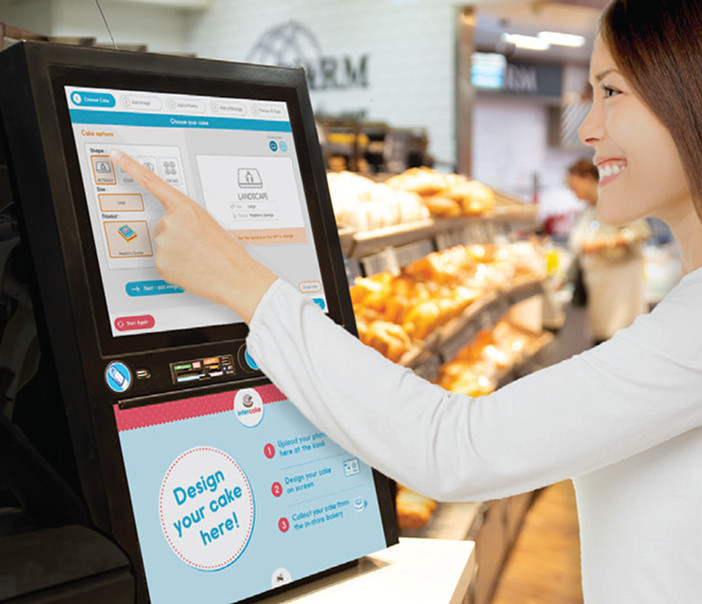
Intercake are a specialist in in-store cake printing systems, serving more than 400 supermarkets with self-service kiosks that let shoppers customise cake designs and collect in-store. Their machines must be simple for casual users, always online for orders and artwork downloads, and dependable during busy trading periods such as weekends and holidays.
Challenges
Intercake needed each kiosk’s embedded PC to have reliable internet access for both their own application traffic and ad-hoc remote support using tools such as LogMeIn. Placing kiosks in the middle of large supermarkets created a hostile radio-frequency environment, making conventional fixed-line or in-store Wi-Fi options impractical or inconsistent. At the same time, the team had to protect the business case by understanding real data usage and avoiding unexpectedly high cellular bills, all while rolling out several hundred routers at a viable unit cost.
Results
By standardising on an industrial 4G/LTE router platform with roaming SIMs and smart connectivity features, Intercake achieved high uptime across their kiosk estate, with only a handful of locations needing extra attention. Packet-level analysis tools on the router allowed the team to quantify typical LogMeIn sessions, giving confidence that remote support would not erode margins through excess airtime charges. A balanced price-performance ratio meant the hardware cost per site stayed within budget, enabling a national rollout rather than a limited pilot.
Bringing personalised cake printing to every supermarket aisle
Intercake’s business model depends on turning a fun idea into a dependable retail service: customers walk up to a kiosk, choose or upload a design, and walk away with a personalised cake. The machines run on Windows Embedded PCs that handle the user interface, artwork processing, and communication with central application servers. If a kiosk is offline, the service simply does not exist at that store, and each missed order is immediately visible to both shoppers and supermarket managers. For a brand that positions itself as an easy “bolt-on” revenue stream for retailers, repeat connectivity issues would damage trust very quickly.
Unlike back-office systems tucked away in comms rooms, Intercake kiosks are typically positioned in open aisles near bakery counters, surrounded by shelving, fridges, and other fixtures that can weaken mobile signals. Running fixed lines to each kiosk would be slow, disruptive, and expensive for supermarkets, especially when new sites are added or layouts change. The team therefore needed a self-contained communications solution they could ship with each unit, install quickly, and monitor remotely without involving store IT teams. That requirement for independence, repeatability, and simplicity is what led them to an industrial cellular router platform.
Business Challenges
1. Keeping kiosks online inside RF-unfriendly supermarkets
Supermarkets are built for shoppers and logistics, not for perfect radio coverage. High ceilings, metal shelving, fridges, and cladding all combine to weaken cellular signals before they reach devices placed on the shop floor. Intercake’s kiosks, sitting out in the open rather than near windows or external walls, were particularly exposed to this problem. A simple single-network cellular modem was unlikely to deliver consistent performance across hundreds of different store layouts and locations.
The impact of an unreliable connection is immediate: jobs stuck in a queue, artwork failing to download, or support staff being unable to reach a kiosk during a customer interaction. Each outage risks a disappointed shopper, wasted cake stock, and additional time spent by store employees trying to troubleshoot a system they don’t own. Over time, supermarkets might view the service as “more trouble than it’s worth,” threatening Intercake’s position on the shop floor and their ability to expand into new chains or regions.
2. Controlling data usage from remote support tools
Intercake’s engineering team used LogMeIn as their main remote access tool, a logical choice given its rich feature set and ease of use. On fixed broadband, the data footprint of an occasional remote session is rarely questioned. Moving to 3G/4G connectivity, however, turned every minute of screen-sharing and remote control into metered cellular traffic. Without hard numbers on how much data a typical session consumed, the team risked rolling out an estate that might quietly generate unsustainable airtime costs.
From a commercial standpoint, this uncertainty made it difficult to model margins and set pricing for supermarket customers. Operationally, support staff might become reluctant to start remote sessions “just in case,” slowing down incident resolution and leaving issues unresolved for longer. Alternatively, they could keep working as normal and only discover at the end of the month that support patterns were not financially viable. Intercake needed a fact-based understanding of data usage so they could balance service quality with cost and avoid a lengthy extra proof-of-concept phase across a subset of stores.
3. Making the national rollout financially viable
Deploying connectivity to a handful of kiosks is one thing; doing it for several hundred sites across two countries is another. Even a modest increase in router cost per unit compounds quickly when multiplied by the size of the estate. Intercake could not simply specify the most expensive industrial router on the market and pass the cost on to retailers, nor could they risk a low-cost consumer-grade device that might fail under continuous operation. They needed a platform that was robust enough for the environment but priced for scale.
The business case hinged on hitting a sweet spot where the upfront capital outlay on hardware, installation, and initial configuration still left room for healthy recurring revenue. An unreliable device would drive truck rolls, repairs, and replacements that erode profitability and damage the brand. Over-engineering the hardware, on the other hand, could stall rollout plans entirely or push supermarkets to competitive offerings. Choosing the right router was therefore not only a technical decision but a strategic one that affected Intercake’s growth trajectory.
Solution Overview
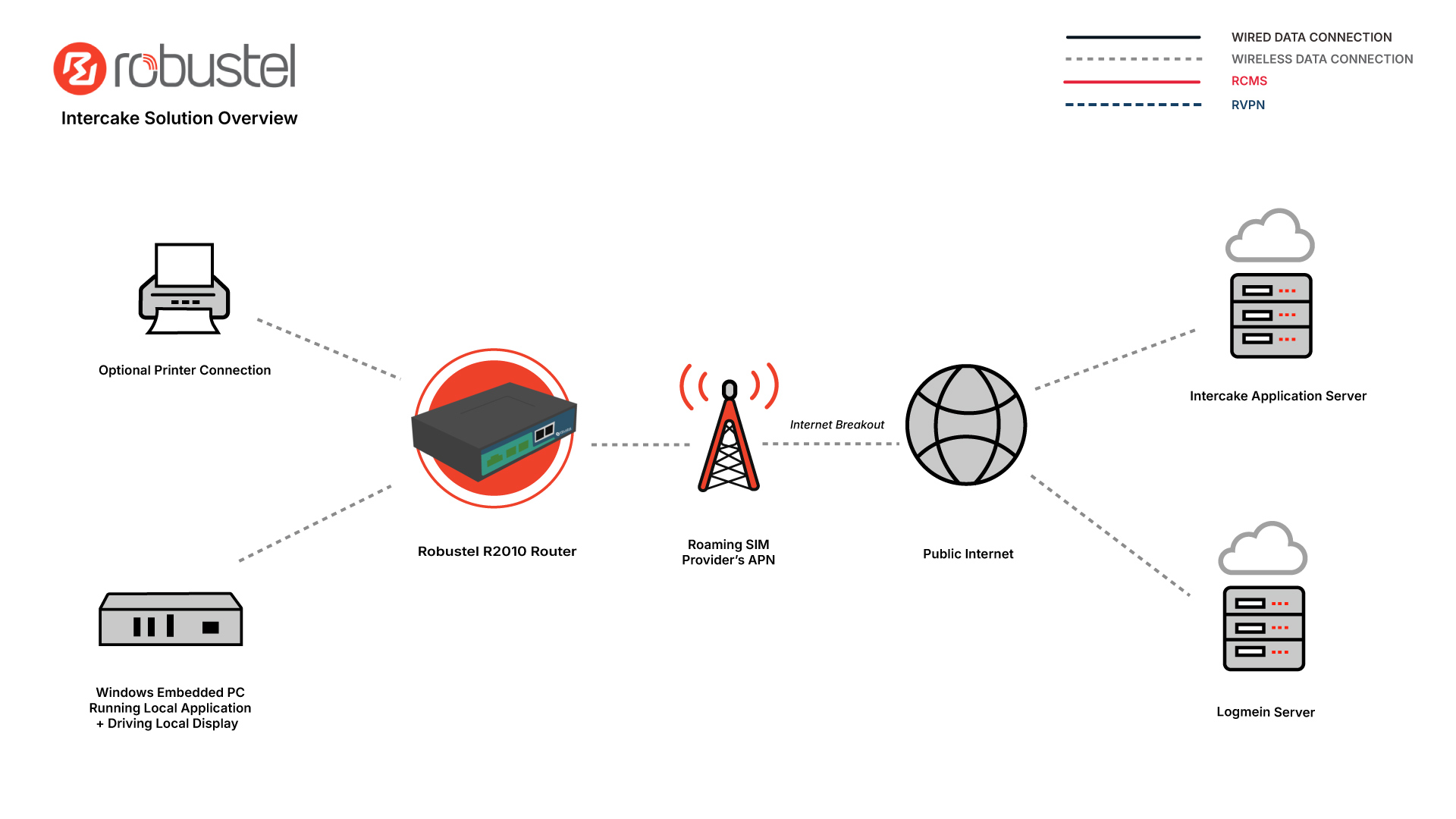
Intercake standardised on an architecture where each kiosk’s Windows Embedded PC connects via Ethernet to an industrial 4G/LTE router, now represented in the portfolio by the Robustel R2010. The router hosts a roaming SIM that can attach to multiple mobile network operators through the provider’s access point name (APN), increasing the chances of a strong, usable signal at each supermarket. Application traffic from the kiosk flows securely through this router, across the cellular network, and out to Intercake’s central application servers over the public internet. Engineers use LogMeIn to reach the kiosk PC over the same path for remote maintenance and support.
To maximise availability, Intercake worked with the router vendor to select unsteered roaming SIMs, which connect based on radio quality rather than operator commercial preferences. The estate also makes use of SMS-triggered “smart reboot” capabilities within the router firmware, allowing a device that has latched onto a poor-performing network to be nudged onto a better one without visiting site. Built-in packet capture tools on the router were used during rollout to capture representative LogMeIn sessions for later analysis in Wireshark, giving the team concrete data on how much traffic each support interaction generates. This same toolset can be used in production to troubleshoot unusual data patterns or performance issues without adding extra hardware.
The result is a self-contained connectivity stack that ships with every kiosk: power it up, position it in the store, and the router brings the PC online without needing store IT to provision lines or Wi-Fi access. Central teams see a consistent, routable footprint for every site, making it easier to manage updates, security policies, and software changes across the fleet. Combined, these elements deliver the reliability, visibility, and commercial control Intercake needed for a long-term national deployment.
Why Intercake chose the R2010:
- Multi-network resilience: The ability to work with unsteered roaming SIMs and move between networks gave Intercake a practical way to keep kiosks online in challenging RF environments without custom engineering per store.
- Smart recovery features: SMS-controlled reboot and network-switching functions reduced the need for site visits when a kiosk’s connectivity degraded, supporting a lean service model across hundreds of locations.
- Built-in diagnostics: Embedded packet capture and monitoring tools on the router enabled precise measurement of LogMeIn data usage and simplified troubleshooting, avoiding the need for separate test equipment.
- Industrial design at the right price point: An enclosure, firmware, and component set designed for continuous operation in retail environments came at a cost that kept the overall project business case attractive.
- Cloud-ready management options: Support for remote configuration and monitoring aligned with Intercake’s need to manage an estate spread across multiple retail chains without adding complexity for store IT teams.
Key Outcomes
Before the rollout, connectivity was a potential weak link in Intercake’s otherwise compelling retail proposition. After standardising on an industrial cellular router platform and fine-tuning SIM strategy, connectivity became a reliable, largely invisible utility. Support teams gained confidence that they could reach any kiosk when needed without triggering runaway data bills. Commercially, the hardware and airtime decisions allowed the company to scale from a small installed base to several hundred supermarkets while maintaining margins and service quality.
“Intercake’s primary business is in providing a service to the retail sector in which a reliable, independent internet connection is now essential. Robustel offered competitively priced hardware, excellent roaming SIM management and most importantly took the time to discuss appropriate architectures and configuration.There are many layers to achieving a “fit for purpose” 4G solution and the Robustel team have been an invaluable partner to help us get it right first time.” – Colm Nohilly – Managing Director of Intercake.
- High kiosk uptime: The estate achieved strong overall availability, with only a small number of stores presenting coverage issues that required additional attention.
- Predictable data costs: Packet-level measurement of remote support sessions allowed the team to model typical data usage and select airtime bundles that matched real-world behaviour.
- Faster rollout: By validating data usage and connectivity behaviour early, Intercake avoided an extra multi-site proof-of-concept phase and moved more quickly into full deployment.
- Reduced on-site interventions: Remote recovery tools and multi-network SIMs cut down on truck rolls to resolve connectivity issues, saving engineering time and travel costs.
- Stronger retailer experience: Supermarket partners benefit from a service that behaves like any other reliable in-store system, with fewer visible outages and less need for local troubleshooting.
- Scalable platform for future services: With a proven connectivity model in place, Intercake is better positioned to introduce new kiosk features or analytics services without revisiting the underlying network design.
Featured Products
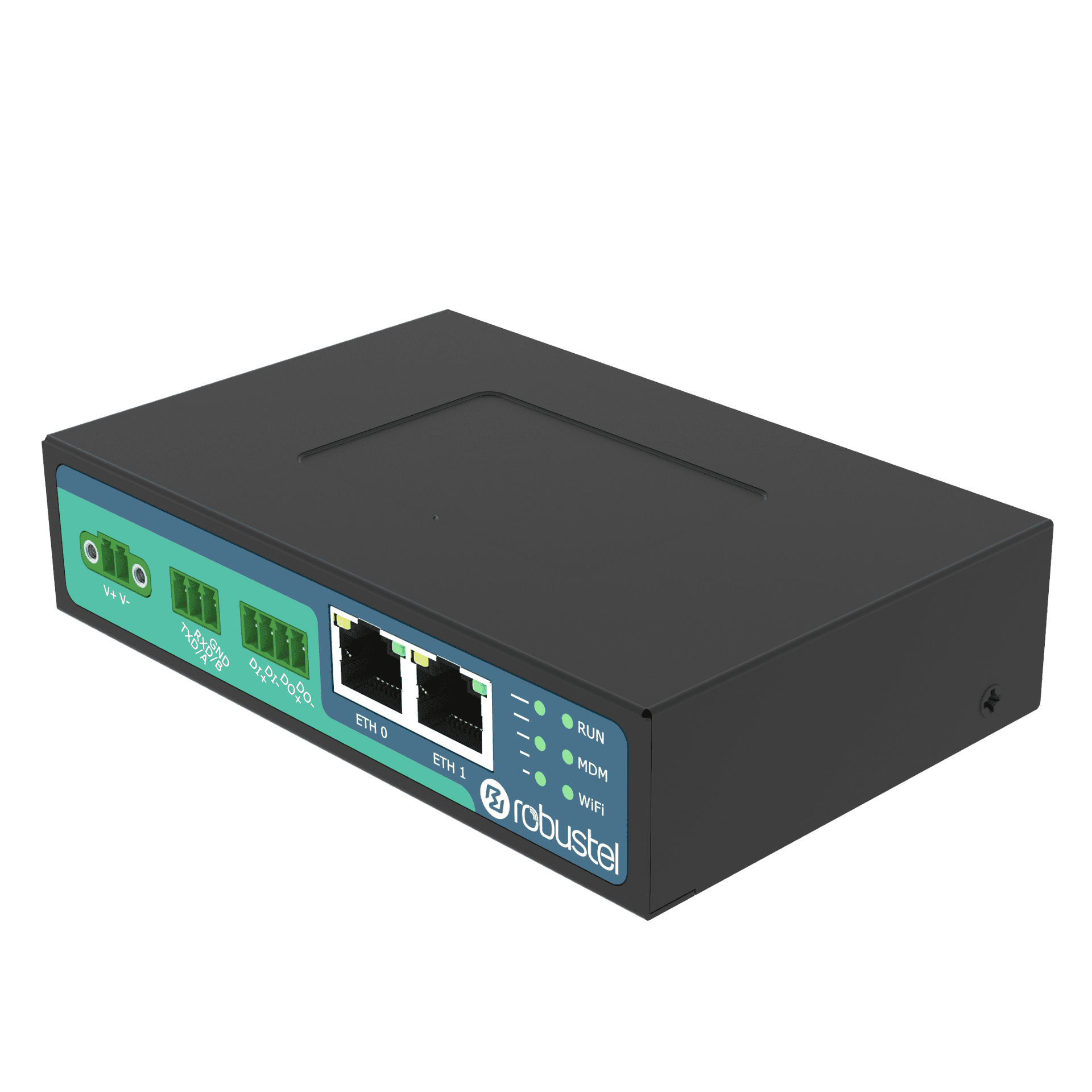
Robustel R2010 4G/LTE Router
RCMS Device Management Platform

Smart Roaming