
5G Edge Router ROI: Why “Faster” Connectivity is Actually Cheaper for Industry 4.0
Is the “sticker shock” of 5G hardware holding back your digital transformation? Comparing a 5G Edge Router to a legacy 4G device based on unit price is a fundamental accounting error. In today’s Industrial IoT landscape, the real conversation isn’t about hardware cost—it’s about Operational Velocity and Risk Mitigation.
This guide provides a structured framework for building a winning 5G ROI Case. We break down how 5G NR (New Radio) technologies like URLLC and eMBB translate into hard fiscal gains, proving that in mission-critical environments, 4G is often the most expensive “cheap” choice you can make.
Decision-Maker’s Checklist:
- The TCO Paradox: Why the “hidden” costs of 4G—technical debt, manual truck rolls, and fiber trenching—far outweigh the initial CapEx premium of a 5G Edge Router.
- The Downtime Math (URLLC): How sub-10ms latency eliminates AGV roaming failures and production halts, potentially paying for your entire fleet in a single “saved” afternoon.
- Expert Productivity (eMBB): Leveraging 5G as a “fiber substitute” to enable AR-assisted remote diagnostics, 5x-ing your senior engineers’ capacity without increasing travel budgets.
- The Management Force Multiplier: Why a cloud-orchestration platform like RCMS is the “OpEx Killer,” slashing deployment costs through Zero-Touch Provisioning (ZTP).
Introduction: The CFO’s Challenge—Moving Beyond the “Sticker Price”
It’s a scenario I see in budget meetings time and again. The technical team presents a proposal for a high-performance 5G Edge Router (like the Robustel R5020 Lite) to modernize a factory floor or a logistics fleet. The CFO glances at the line item and asks the inevitable question: “This 5G edge router is significantly more expensive than the 4G hardware we deployed last year. Why the premium?”
If your response is simply, “Because it’s faster”, you’ve already lost the room.
In 2026, a 5G Edge Router is no longer just a “faster modem”—it is a strategic pivot point for your entire digital infrastructure. You don’t justify this investment by comparing hardware sticker prices. You justify it by quantifying the massive ROI it unlocks through automation and the catastrophic TCO (Total Cost of Ownership) it prevents by eliminating downtime.
To win the budget, you need to stop talking about megabits and start talking about Business Outcomes.
Beyond Sticker Shock—Decoding the Real TCO of 5G
Let’s be honest: the upfront CapEx (Capital Expenditure) for a 5G Edge Router is undeniably higher. The 5G NR (New Radio) modem, the advanced RF front-end, and the specialized MIMO antenna arrays represent a significant leap in engineering complexity. If your only requirement is a simple failover for a small office that rarely sees traffic, a legacy 4G Industrial Cellular Router remains the “TCO king.”
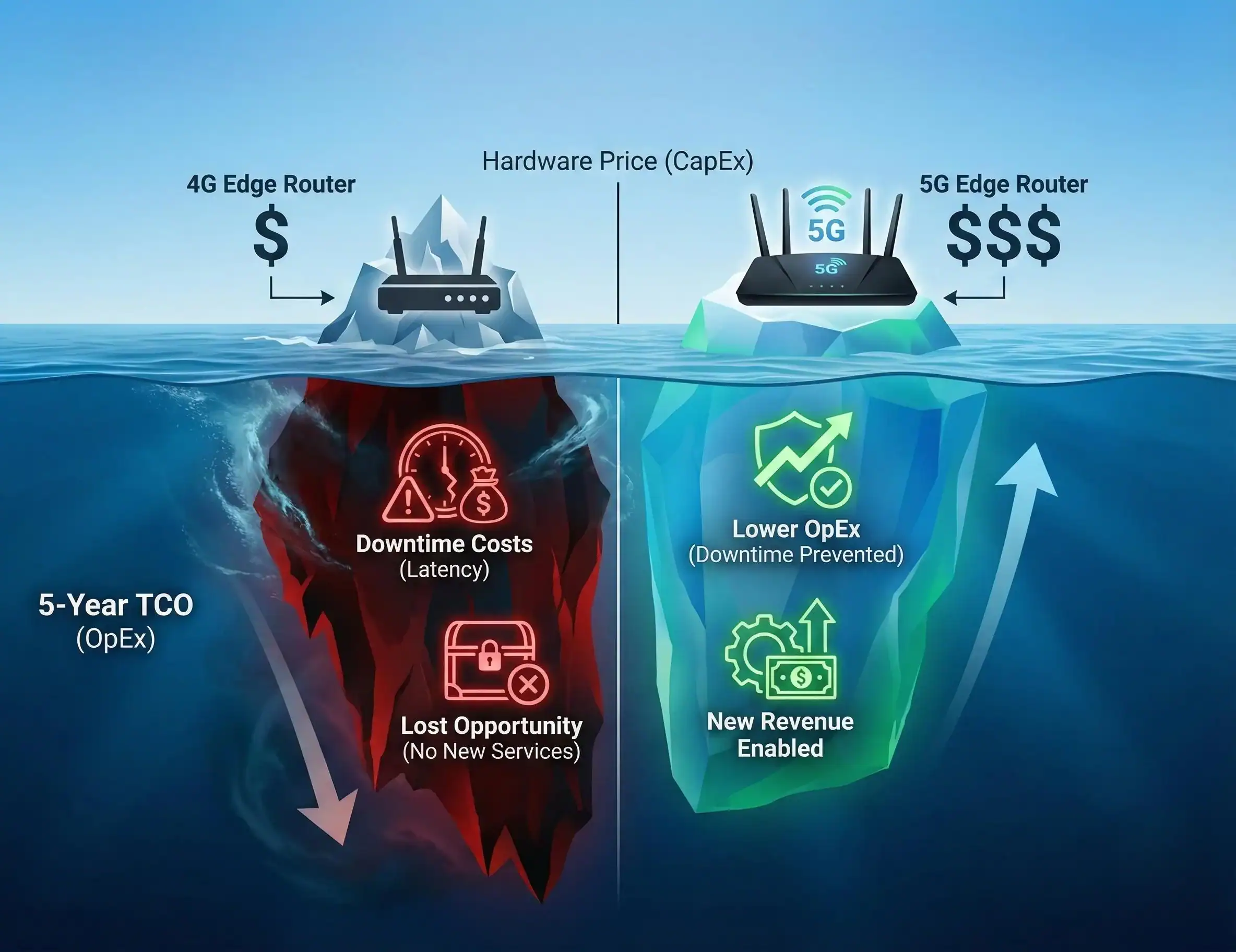
However, the real danger lies in the Hidden TCO of sticking with 4G for new or mission-critical projects. A true 5G Edge Router TCO analysis isn’t just about the purchase price; it’s about the Cost of Technical Debt.
By choosing 4G today for an advanced application, you are essentially scheduling a mandatory (and expensive) truck roll for an upgrade two years from now. When you factor in the labor of site visits, the loss of potential high-bandwidth revenue, and the risk of network congestion, the “cheaper” hardware often becomes the most expensive mistake on the balance sheet.
The 5G ROI Flipping Point—Where the Math Changes
A 5G Edge Router ROI isn’t calculated by saving a few dollars on a hardware quote. It’s realized by solving multi-million dollar operational bottlenecks. Here is how the math flips across three critical business pillars:
ROI Area 1: Eliminating Downtime (The URLLC Payback)
This is the single most powerful argument for an Industrial 5G Edge Router.
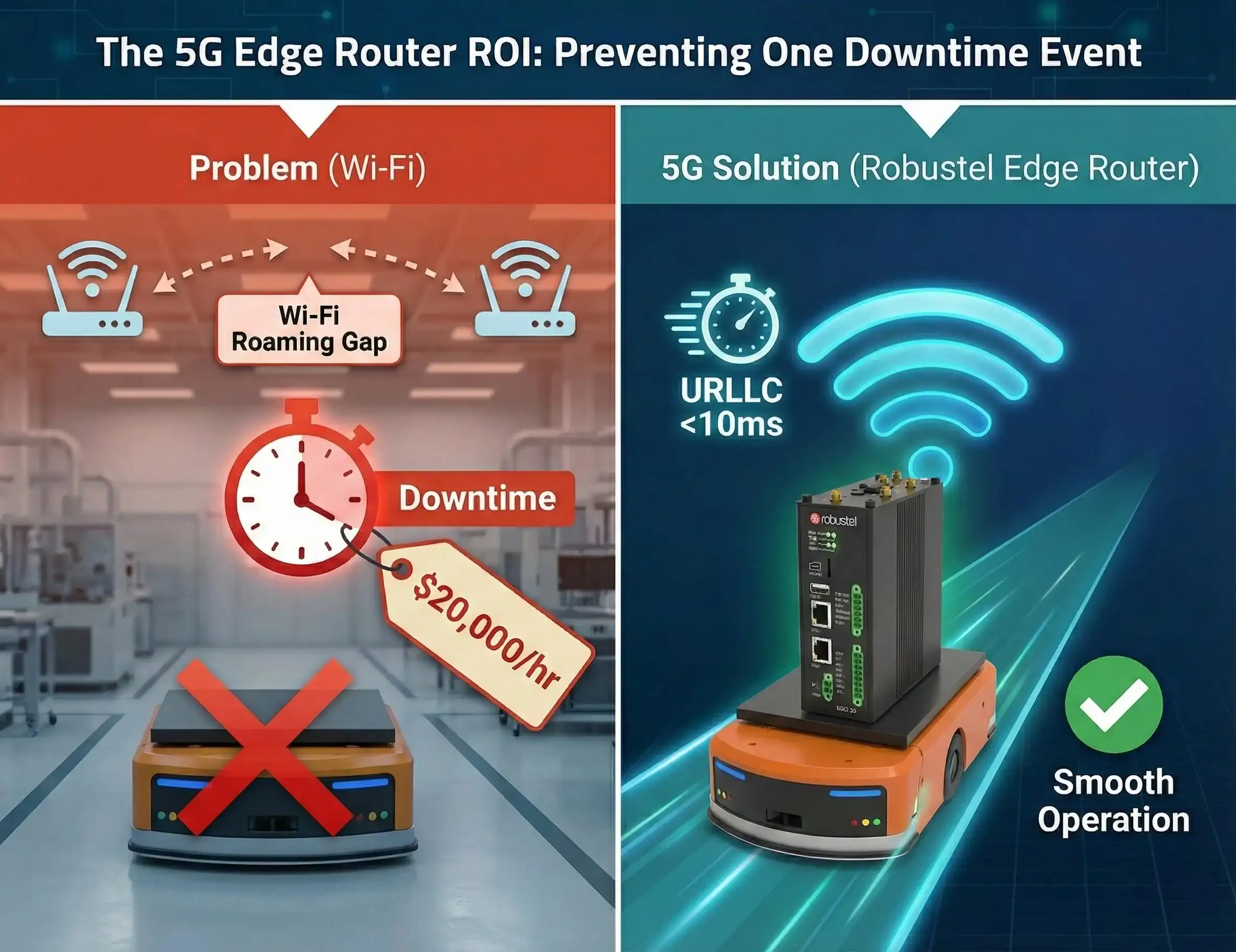
- The Problem: Traditional factory AGVs (Automated Guided Vehicles) often rely on Wi-Fi. As they “roam” between access points, handoff failures occur. The robot freezes, the production line halts, and at a downtime cost of $20,000 per hour, the losses mount fast.
- The 5G Solution: By deploying a Private 5G Network with an R5020 Lite on each AGV, you leverage URLLC (Ultra-Reliable Low-Latency Communication). Roaming failures are virtually eliminated.
- The ROI: Preventing just one three-hour downtime event saves $60,000—effectively paying for your entire 5G router fleet in a single afternoon. In this context, the hardware isn’t an expense; it’s an Insurance Policy for Uptime.
ROI Area 2: Maximizing “Expert Density” (The eMBB Payback)
This is the high-bandwidth argument that transforms your workforce.
- The Problem: When a remote machine fails, you fly a senior engineer to the site—costing $5,000 and 3 days of downtime. 4G connections are often too pixelated for complex remote diagnostics.
- The 5G Solution: High-performance eMBB (Enhanced Mobile Broadband) enables 4K video streams and AR-assisted remote support.
- The ROI: Instead of fixing one site in three days, your top expert can now fix five sites in one day via tele-presence. You haven’t just saved on travel; you’ve achieved a 5x increase in Expert Productivity.
ROI Area 3: Unlocking New Revenue Streams (The Service Payback)
A 4G router lets you monitor your assets; a 5G Edge Router lets you control them.
- The Opportunity: As a machine builder, you can transition from selling hardware to selling “Remote Operation-as-a-Service.”
- The 5G Advantage: The deterministic latency of 5G makes it safe to operate heavy machinery (like cranes or excavators) from thousands of miles away.
- The ROI: This turns the edge router from a “cost center” into a Revenue Driver. The ROI here is effectively infinite because the service—and the high-margin recurring revenue—simply couldn’t exist without it.
The TCO Paradox—When 5G is the Low-Cost Leader
Here is the counter-intuitive reality: in many enterprise scenarios, a 5G Edge Router isn’t just the higher-performing choice—it is the fundamentally cheaper one. This is especially true when we move away from comparing “modem vs. modem” and start comparing “Wireless vs. Wired Build-outs.”
Scenario: Rapid Site Deployment & “Last-Mile” Economics
Imagine you are opening a new branch office, a construction site, or a temporary healthcare facility. This is where the Fixed Wireless Access (FWA) capability of a cellular edge router reshapes the balance sheet:
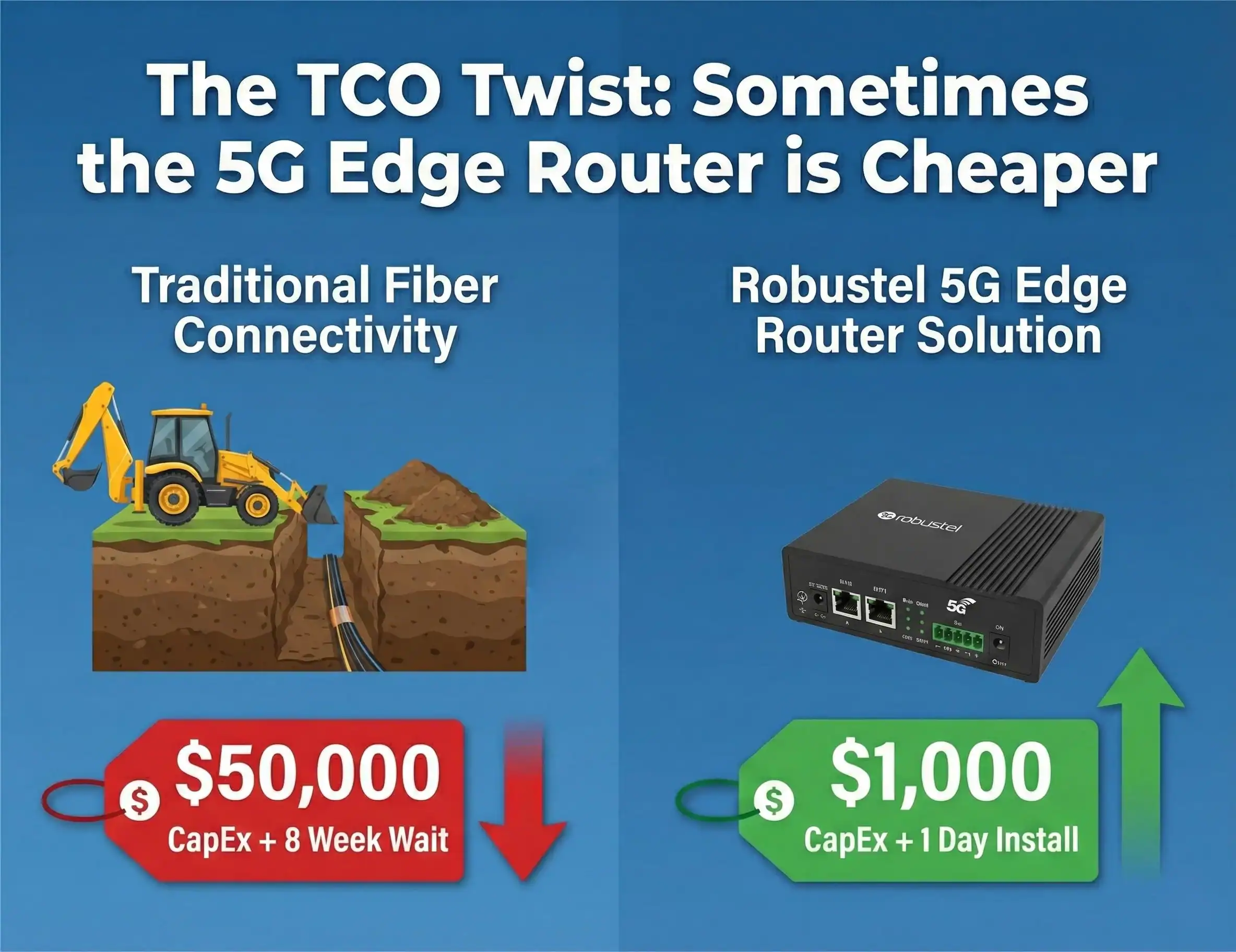
- The “Wired” TCO: You wait 6–8 weeks for a traditional ISP. You pay anywhere from $10,000 to $50,000 in “construction aid” to trench fiber-optic cable to your site. Your business sits idle while the concrete is being poured.
- The 5G Edge Router TCO: You deploy a high-performance 5G Edge Router (like the Robustel R5020 Lite) for a fraction of that cost. You plug it in, and you have 500 Mbps+ throughput on Day 1.
The Result: Massive Time-to-Value (TTV)
In this scenario, the 5G TCO isn’t just lower; it’s a rounding error compared to fiber construction. More importantly, you gain a month of operational revenue that would have been lost waiting for a wired connection. This isn’t just “saving on hardware”; it’s an Asset-Light Strategy that prioritizes business agility over expensive, static infrastructure.
The “OpEx Killer”—Why Management Platforms Define Your TCO
The TCO of any 5G Edge Router—no matter how advanced the radio—is ultimately dictated by its manageability. A high-performance router that is difficult to configure or monitor is a failed investment. In the industrial world, the device cost is only the tip of the iceberg; the real expenses are hidden in the labor of long-term operations.
This is why the Robustel Cloud Manager Service (RCMS) is the silent hero of the business case. It acts as a force multiplier for your ROI by aggressively slashing OpEx:
- Automated Scalability (ZTP): RCMS utilizes Zero-Touch Provisioning to eliminate the high labor costs of manual site visits. You can deploy a global fleet of 5G Edge Routers with a pre-configured template, ensuring consistency and security without hiring expensive on-site specialists.
- Ending the “Truck Roll” Era: Through integrated Secure Remote Access (RobustVPN), your team can troubleshoot the router and the legacy industrial assets behind it (PLCs, sensors, HMIs) from a central office. By eliminating a single cross-country service trip, you can save thousands of dollars—often exceeding the cost of the hardware itself.
When you invest in a Robustel 5G Edge Router, you aren’t just buying a terminal; you are entering an ecosystem designed to minimize your Total Cost of Ownership through the entire lifecycle of the project.
Conclusion: 5G is an Investment in Operational Certainty
It’s time to stop comparing the sticker price of 4G vs. 5G hardware. That is the wrong math for a modern enterprise. Instead, start calculating the cost of your problems.
Ask yourself:
- What is the true fiscal impact of one hour of unplanned downtime?
- What is the cumulative cost of a single unnecessary truck roll in a global deployment?
- What is the opportunity cost of being unable to launch that new, real-time remote service your competitors are already piloting?
When you run those numbers, the business case for a 5G Edge Router stops being about “speed” and starts being about Operational Certainty. In 2026, 5G isn’t an “expensive” upgrade; it is the only connectivity class with an ROI high enough to solve your most expensive industrial challenges.
Don’t just buy a router. Invest in the architecture that makes your business smarter, faster, and more profitable.
Curious about the global 5G rollout? Discover how Robustel and GSL are paving the way for 5G adoption in Türkiye.
FAQs
Q1: Is the 5G ROI just theory, or is it real today?
A1: It’s real today, but only for specific applications. For applications that are latency-bound (like AGV robotics, factory automation, remote control) or bandwidth-bound (like 4K video surveillance), the 5G edge router ROI is immediate and measurable.
Q2: Can I just use a 4G LTE edge router for now?
A2: Yes, and for many applications (like simple POS failover or Modbus data collection), a 4G industrial edge router is still the perfect, most cost-effective choice. But if your application needs what 5G provides (latency <20ms, speed >200Mbps), a 4G egde router will fail 100% of the time.
Q3: How does RCMS help the 5g edge router business case?
A3: RCMS protects your investment. It lowers the operational TCO of your 5G edge router fleet by automating deployment (ZTP) and maintenance (OTA updates, remote reboots). A lower TCO means a faster and higher ROI. A smart edge router must have a smart management platform.
About the Author
Robert Liao | Technical Support Engineer
Robert Liao is an IoT Technical Support Engineer at Robustel, specializing in industrial networking and edge connectivity. A certified Networking Engineer, Robert focuses on the deployment and troubleshooting of large-scale IIoT infrastructures. His work centers on architecting reliable, scalable system performance for complex industrial applications, bridging the gap between field hardware and cloud-side data management.