
Recommended Edge AI Hardware for Industrial IoT: How to Choose the Best Fit Gateway
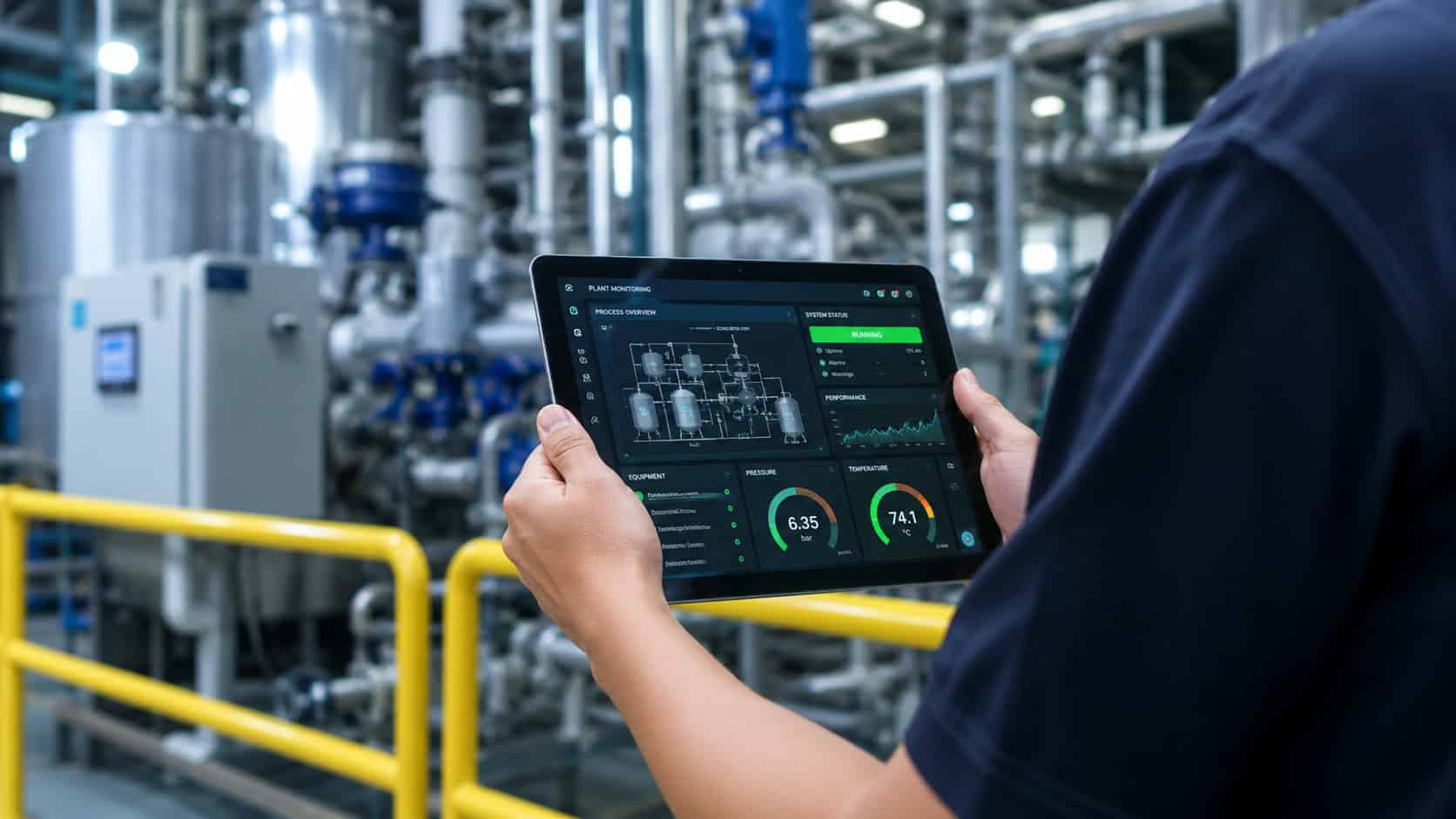
Robustel EG5200 edge computing gateway is a strong hardware fit when an industrial AI workload needs local inference together with several Ethernet devices, industrial serial connections, USB peripherals, or a local display. Robustel EG5120 edge computing gateway may be more proportionate when the same project needs fewer local ports and more built-in storage.
The right edge AI hardware is not the gateway with the highest headline specification. It is the device that can ingest the required data, execute the complete application stack, retain sufficient operating headroom, and fit the physical architecture of the industrial site.
Define the Workload Before Comparing Hardware
Hardware sizing should begin with a measurable workload description rather than a general requirement such as “run machine vision” or “support anomaly detection.”
A useful workload definition should identify:
- Number and type of data sources
- Sensor sampling rate or camera frame rate
- Image or signal resolution
- Preprocessing requirements
- AI model architecture and file size
- Required inference frequency
- Acceptable result delay
- Number of concurrent applications
- Local data-retention period
- Upstream reporting frequency
- Expected future expansion
These factors create a workload envelope: the maximum combination of data ingestion, preprocessing, inference, storage, and communications the gateway must handle under normal and peak conditions.
Consider two projects that both use the phrase “visual inspection.”
The first project captures one image every ten seconds, runs one compact classification model, and stores only failed examples. The second receives several continuous camera streams, performs image resizing and decoding, runs multiple models, displays local results, and stores event footage.
Both projects involve industrial vision, but they require very different hardware.
The same principle applies to anomaly detection. Calculating one equipment-health score every minute from a few Modbus registers is different from continuously processing high-frequency vibration or acoustic data.
Hardware should therefore be selected from the full processing pipeline, not from the AI model alone.
Divide the Workload Between CPU and NPU
An NPU accelerates compatible inference operations, but it does not execute every part of an edge AI application.
The CPU may still be responsible for:
- Collecting data from cameras, sensors, or PLCs
- Decoding images or protocol messages
- Filtering and normalizing inputs
- Calculating signal features
- Running databases or message brokers
- Managing containers and application services
- Encrypting WAN traffic
- Writing logs and retained data
- Converting model results into alarms or MQTT messages
The NPU is relevant when the chosen model, inference engine, operators, and data format can use the accelerator. A 2.3 TOPS specification should not be treated as a guaranteed application throughput figure.
Actual inference performance depends on:
- Model architecture
- Numerical precision
- Input dimensions
- Model conversion
- Supported operators
- Preprocessing and post-processing
- Memory movement
- Runtime optimization
- Concurrent system load
A model that cannot use the supported NPU runtime may execute on the CPU, run more slowly than expected, or require changes before deployment.
Hardware evaluation should therefore answer two separate questions:
- Can the model use the available NPU?
- Can the CPU handle everything surrounding the model?
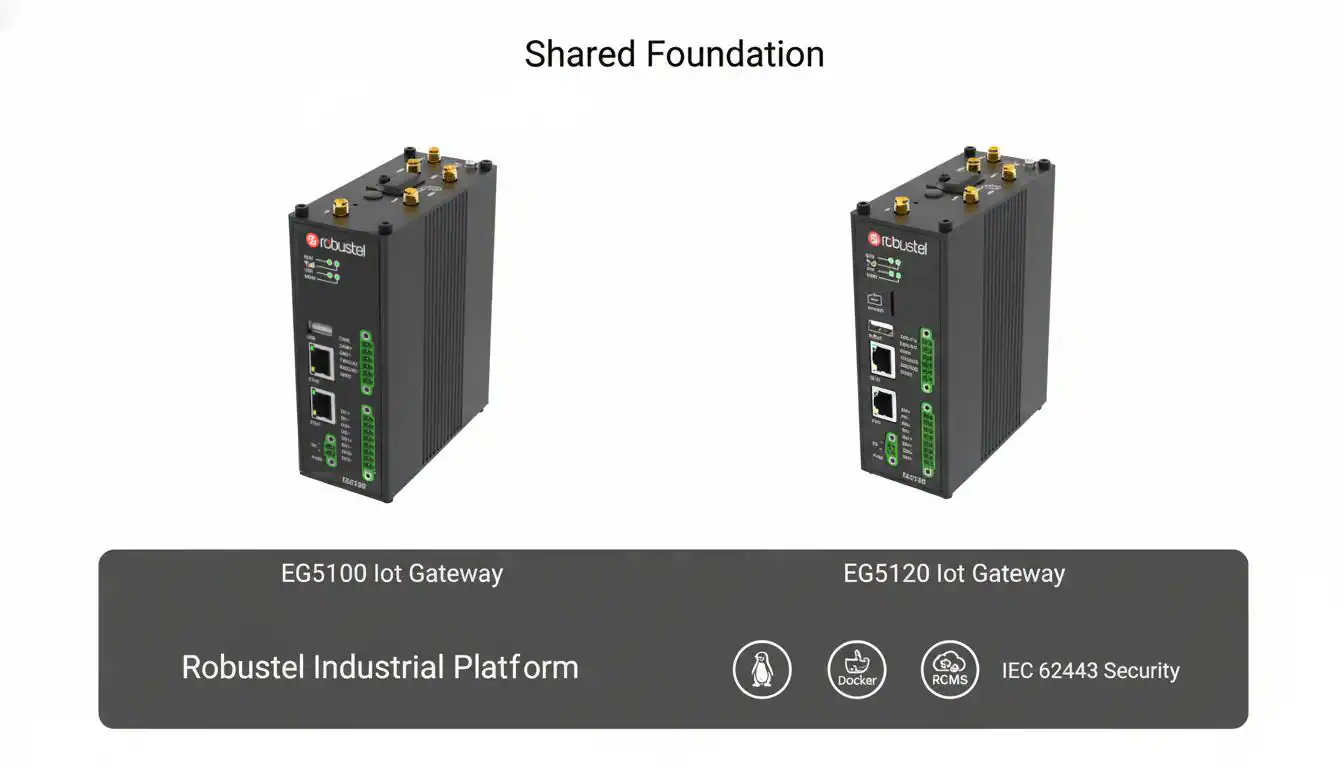
Robustel EG5200 edge computing gateway and Robustel EG5120 edge computing gateway both use a quad-core Cortex-A53 processor at 1.6 GHz and include a 2.3 TOPS NPU. The similarity means the EG5200 should not be presented as a simple AI-compute upgrade over the EG5120. Their more important differences concern memory configuration, storage, Ethernet quantity, serial options, and peripheral integration.
Budget Memory for the Complete Software Stack
RAM must support more than the loaded AI model.
An industrial edge gateway may run several services at the same time:
- AI inference runtime
- Preprocessing application
- Docker engine
- Protocol connector
- MQTT client or broker
- Local database
- Web interface
- VPN services
- Logging process
- Remote-management agent
Each component consumes memory, and usage may increase temporarily during application startup, model loading, data bursts, updates, or fault recovery.
| Memory Consumer | Why Usage May Increase |
| AI model and runtime | Model weights, intermediate tensors, and execution buffers |
| Image processing | Decoded frames and resized image buffers |
| Time-series processing | Buffered samples and feature windows |
| Containers | Runtime overhead and duplicated libraries |
| Database or broker | Caches, queues, indexes, and retained messages |
| Operating system | Filesystem cache, networking, and background services |
A project should measure peak RAM usage, not only the average seen during a short demonstration.
Robustel EG5200 edge computing gateway provides 4 GB LPDDR4. Robustel EG5120 edge computing gateway is available with either 2 GB or 4 GB LPDDR4. The 4 GB configuration provides more room for concurrent services than the 2 GB version, but available application memory will still be lower than the nominal hardware capacity because the operating system and system services also consume resources.
A project should retain operating headroom instead of sizing the gateway to remain near maximum memory use during normal conditions. Without headroom, temporary data bursts or application restarts can create instability even when the system appears acceptable during initial testing.
Calculate Storage from Retention and Write Volume
Storage requirements are often underestimated because teams consider only the AI application package.
Local storage may also contain:
- Operating-system files
- Docker images and container layers
- AI models
- Application dependencies
- Databases
- Logs
- Buffered telemetry
- Selected images or video clips
- Update packages
- Diagnostic files
- Temporary processing data
The required capacity can be estimated with a simple model:
Required storage = software footprint + retained operational data + update space + recovery reserve
For retained data, the main variables are:
Data generated per hour × retention period × number of sources
A gateway storing only event metadata may need relatively little capacity. A system keeping images, audio samples, vibration windows, or short video clips can consume storage much faster.
Teams should also define what happens when the storage threshold is reached:
- Delete the oldest data
- Stop recording selected information
- Upload data when the WAN recovers
- Raise an alert
- Reduce the retention window
- Preserve critical events while discarding routine data
Robustel EG5120 edge computing gateway currently provides 64 GB eMMC, while Robustel EG5200 edge computing gateway provides 32 GB eMMC. The EG5120 may therefore be the better hardware direction when local storage is a stronger requirement than the number of Ethernet ports or peripherals.
Nominal storage should not be treated as fully available application space. The operating system, installed packages, reserved capacity, logs, and application structure reduce the amount available for retained project data.
Write frequency also matters. High-volume continuous recording should be evaluated against the selected storage architecture rather than assumed to be suitable because enough nominal capacity appears on the datasheet.
Size Data Ingestion and Local Interfaces
The gateway must receive the data before it can process it. Interface quantity and topology can therefore determine the hardware choice even when two products offer similar CPU and NPU resources.
Ethernet Devices and Cameras
Count every Ethernet endpoint that needs a direct or switched connection:
- IP cameras
- PLCs
- Industrial controllers
- Networked meters
- Local HMIs
- Maintenance computers
- Upstream LAN
- Ethernet WAN
A separate industrial switch may be appropriate in larger networks. For compact sites, however, integrated Ethernet ports can reduce cabinet components, power connections, cabling, and additional failure points.
Robustel EG5200 edge computing gateway provides five Gigabit Ethernet ports configurable as LAN or WAN. Robustel EG5120 edge computing gateway provides two Gigabit Ethernet ports.
This makes the EG5200 a stronger fit where several cameras, controllers, or IP devices must connect at one site. The port count does not guarantee that the gateway can process every combined data stream; bandwidth and application performance must still be measured.
Serial Equipment
Industrial sites may also require direct communication with meters, drives, RTUs, or legacy controllers.
The EG5120 provides two software-configurable RS-232/RS-485 ports. The EG5200 provides two software-configurable RS-232/RS-422/RS-485 ports, adding RS-422 support for projects that require it.
The sizing process should confirm:
- Required serial standard
- Number of independent serial buses
- Baud rates
- Device count per bus
- Polling interval
- Protocol workload
- Isolation and electrical requirements
- Whether serial collection runs concurrently with AI processing
Peripherals and Local Display
Machine-vision or interactive applications may need more than network and serial interfaces.
Robustel EG5200 edge computing gateway includes HDMI, USB 3.0 and USB Type-C expansion, a console port, digital inputs, and relay outputs. These interfaces make it more suitable for projects involving a local display, multiple peripherals, or direct relay integration.
The selected peripheral must still have a compatible Linux driver, appropriate power requirements, and support for the ARM-based operating environment.
Compare Robustel EG5120 VS EG5200 by Hardware Fit
Because the two gateways use the same listed CPU frequency and NPU rating, the decision should focus on the complete site architecture.
| Hardware Requirement | Robustel EG5120 Edge Computing Gateway | Robustel EG5200 Edge Computing Gateway |
| CPU | Quad-core Cortex-A53, 1.6 GHz | Quad-core Cortex-A53, 1.6 GHz |
| NPU | 2.3 TOPS | 2.3 TOPS |
| RAM | 2 GB or 4 GB LPDDR4 | 4 GB LPDDR4 |
| eMMC | 64 GB | 32 GB |
| イーサネット | 2 × Gigabit | 5 × Gigabit |
| Serial | 2 × configurable RS-232/RS-485 | 2 × configurable RS-232/422/485 |
| Digital interfaces | 2 DI and 2 DO | 2 DI and 2 relay outputs |
| Local display | Not listed | HDMI |
| Peripheral expansion | USB 3.0 and microSD | USB 3.0, USB Type-C, and HDMI |
| Stronger hardware fit | Compact edge AI with greater internal storage | Multi-device and peripheral-rich edge AI site |
The comparison leads to two practical recommendations.
Choose EG5120 When Storage and Compact Integration Matter More
Robustel EG5120 edge computing gateway is the stronger direction when:
- Two Gigabit Ethernet ports are sufficient
- RS-232 or RS-485 equipment must be connected
- The application benefits from 64 GB eMMC
- The site needs DI/DO
- A compact AI-capable gateway is preferred
- HDMI, RS-422, and five Ethernet ports are unnecessary
Choose EG5200 When the Site Has More Devices and Peripherals
Robustel EG5200 edge computing gateway is the stronger direction when:
- Several Ethernet devices or cameras connect locally
- RS-422 support is required
- A local HDMI display is part of the application
- Multiple USB peripherals are needed
- Relay outputs are more appropriate than digital outputs
- The gateway serves as a wider site-integration hub
The EG5200 should not be selected only because it appears to be the larger model. A two-port site with higher local-retention requirements may be better matched to the EG5120.
The Robustel edge computing gateway series page provides the wider portfolio context for comparing Ethernet, serial, wireless, I/O, cellular, and application requirements. Robustel identifies RobustOS Pro, Debian tools, Docker applications, protocol bridging, and supported local AI inference as common platform capabilities across relevant EG-series products.
Benchmark the Complete Workload on the Gateway
Paper specifications narrow the hardware choice. They do not replace an application benchmark. Testing should use production-shaped data and the complete software stack. Relevant measurements include:
| Measurement | What It Reveals |
| Average inference time | Normal processing performance |
| High-percentile inference time | Behaviour during slower processing periods |
| CPU utilization | Preprocessing and system-service pressure |
| NPU utilization | Whether the accelerator is being used effectively |
| Peak RAM usage | Risk during data bursts or model loading |
| Storage growth per day | Sustainable retention period |
| Dropped samples or frames | Whether input exceeds processing capacity |
| Application recovery time | Behaviour after a process or gateway restart |
| Network throughput | Ability to ingest and forward the intended data |
| Long-duration stability | Memory leaks, storage growth, and resource exhaustion |
The benchmark should include expected peak conditions, not only average traffic.
For example, a visual application should be tested with the intended camera resolution and simultaneous streams. A vibration application should use the real sample rate, window size, feature calculation, and inference interval. Protocol connectors, VPN services, databases, and reporting applications should remain active during the test.
The goal is not to use every available resource. A production system should retain sufficient headroom for temporary bursts, updates, diagnostics, and future application changes.
よくある質問
Q1. What information is needed before selecting edge AI hardware?
Define the number and type of inputs, sampling rate or frame rate, resolution, preprocessing, model format, inference frequency, response target, output, local retention, and concurrent services. Also record interface, environmental, power, networking, and mounting requirements. Without this workload envelope, CPU, NPU, RAM, storage, and port comparisons remain abstract and can lead to either unused capacity or a gateway that lacks production headroom.
Q2. How much performance headroom should an industrial edge gateway have?
There is no universal percentage. Headroom should be demonstrated under the highest expected input load with protocol connectors, inference, storage, VPN, logging, dashboards, and management services running together. Measure high-percentile latency, peak RAM, CPU and NPU utilisation, storage growth, dropped inputs, temperature, and recovery time. The selected gateway should remain stable during outages, replay, updates, and normal variation rather than only during an average benchmark.
Q3. Why should interfaces influence edge AI hardware selection?
The model cannot deliver value if the gateway cannot ingest the required cameras, PLCs, meters, serial devices, I/O, or peripherals. Interface count also affects whether extra switches, converters, displays, and power supplies are needed. Buyers should map Ethernet speed and quantity, serial standards, USB, HDMI, digital I/O, cellular backhaul, and expansion needs alongside compute. Site integration and inference performance are equally important selection dimensions.
Q4. When is Robustel EG5200 edge computing gateway the better hardware fit?
Robustel EG5200 edge computing gateway is a strong fit when local inference must operate with several Ethernet devices, configurable industrial serial links, USB peripherals, relay outputs, or a local HDMI display. Its 4 GB memory and broad interface layout support multi-device sites. Teams must still verify model compatibility, storage retention, application concurrency, peripheral drivers, power design, and sustained performance using representative production inputs.
Q5. When may Robustel EG5120 edge computing gateway be more proportionate?
Robustel EG5120 edge computing gateway may be more proportionate when the workload needs compatible local inference, two Gigabit Ethernet ports, serial and digital interfaces, and greater built-in eMMC storage without the wider peripheral layout of EG5200. It suits compact machine or cabinet deployments. Selection should follow measured input volume, model runtime, retention needs, concurrent services, physical topology, and the resources required for reliable recovery.
Conclusion: Edge AI Hardware Recommendation Takeaway
Robustel EG5200 edge computing gateway is the better hardware direction when industrial AI must be combined with several Ethernet devices, RS-422 equipment, USB peripherals, relay outputs, or a local HDMI display. Its value comes primarily from broader site integration rather than a higher published NPU rating.
Robustel EG5120 edge computing gateway is often the more proportionate fit for compact edge AI applications that need two Gigabit Ethernet ports, serial and digital interfaces, and greater built-in eMMC capacity.
The final choice should follow the workload envelope: input volume, preprocessing, model compatibility, inference frequency, concurrent services, memory peak, retention period, interface count, and physical site design. When these requirements are measured together, project teams can select edge AI hardware with sufficient operating headroom without paying for interfaces they will not use or underestimating the resources the production workload actually requires.
Related Reading on Edge Computing in Industrial IoT:

著者について
Robert Liao | Technical Support Engineer
Robert is an IoT Technical Support Engineer at Robustel, specializing in industrial networking and edge connectivity. A certified Networking Engineer, Robert focuses on the deployment and troubleshooting of large-scale IIoT infrastructures. His work centers on architecting reliable, scalable system performance for complex industrial applications, bridging the gap between field hardware and cloud-side data management.