
Industrial Wireless WAN Architecture Guide: 5G, Ethernet, Satellite and Edge
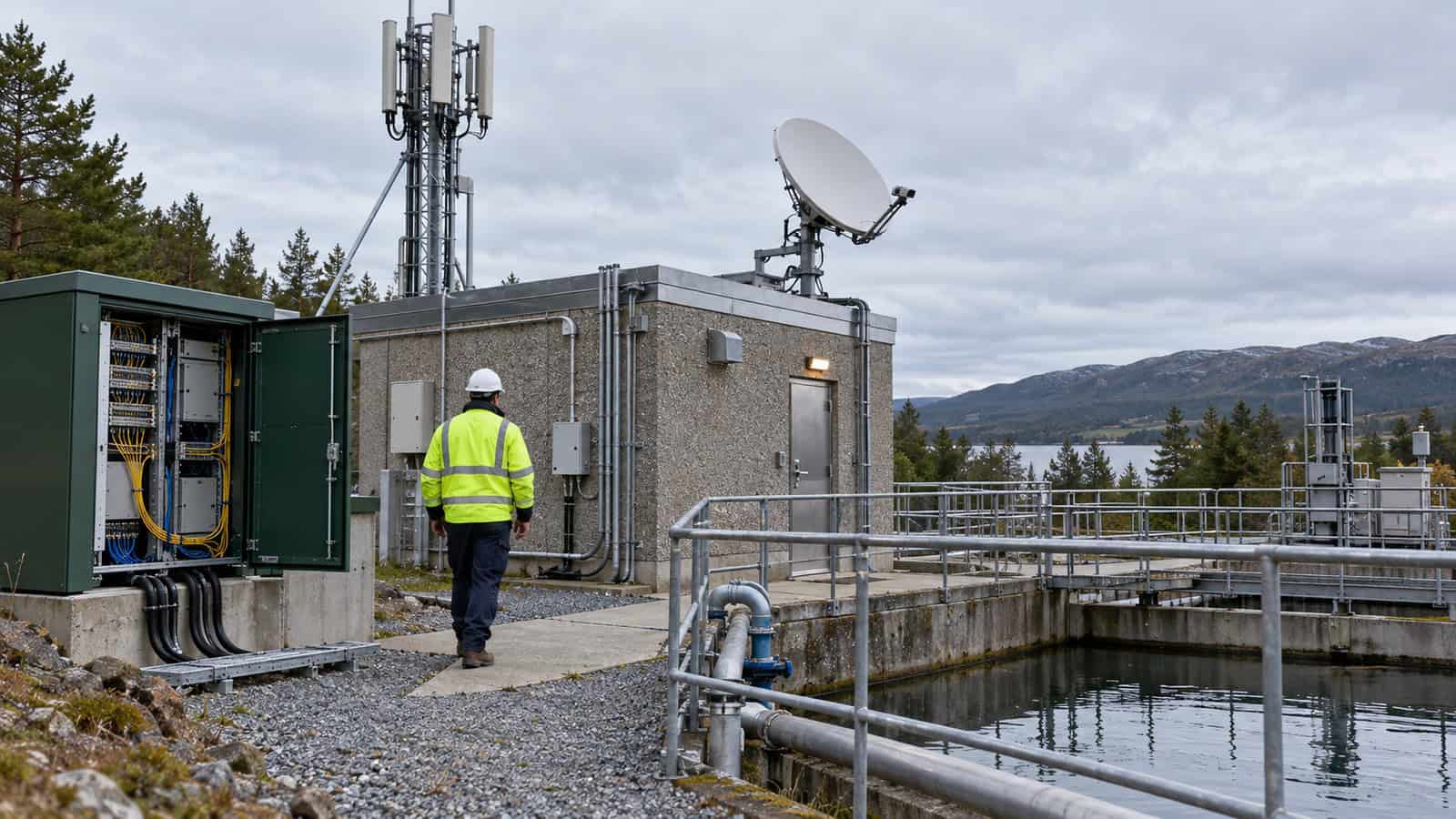
The Robustel R5010 Industrial 5G Router fits an industrial wireless WAN architecture when 5G must be handed cleanly to an existing firewall, SD-WAN appliance or site network. The design becomes reliable only after Ethernet, cellular, satellite and edge systems are given explicit roles; listing several uplinks on a diagram is not the same as defining who detects a fault and restores the service.
Start with the Service Path, Not the Bearer
Write down the transaction that must survive: a telemetry upload, a remote support session, a video stream or an alarm acknowledgement. Then trace the dependencies from local equipment through switching, routing, DNS, VPN and the upstream application. This reveals whether the site needs additional bandwidth, another carrier, a physically independent path or simply better recovery logic.
The Robustel video “Where Are Industrial 5G Routers Used in Real IoT Deployments?” gives teams a useful application-led view of the cellular role. It should prompt the architecture discussion, while the project record supplies the actual traffic profile and availability requirement.
Give Every WAN Path an Owner
| Path | Best architectural role | Typical independent failures | Owner to name |
|---|---|---|---|
| Ethernet/fibre | stable primary access where available | provider, last mile, site switch, power | fixed-network team |
| 5G/4G | primary or backup access for distributed sites | carrier, RF, antenna, SIM, modem | cellular service owner |
| satellite | separate access for remote or disaster scenarios | sky view, terminal, subscription, weather effects | satellite provider and site owner |
| edge processing | keep selected work local during WAN loss | application, storage, local power | OT/application owner |
Satellite is normally a separate terminal and service, not a native feature of an industrial 5G router. If both paths enter the same firewall, state whether the firewall, SD-WAN platform or cellular router makes the routing decision. Two devices probing the same destination with different timers can create oscillation that looks like poor mobile coverage.
Robustel’s fixed-line backup application example illustrates the R5010 in a focused cellular handoff role. That separation is useful when the existing network already owns policy, segmentation and WAN selection: the router supplies the mobile path without pretending to replace the rest of the architecture.
Test Failure Domains, Not Product Labels
An “Ethernet failure” might be a disconnected local cable, an upstream provider outage or a DNS service that no longer answers. A “5G failure” might be loss of registration, an attached network with no usable data session, a private APN route issue or a VPN that does not return after addressing changes. Each needs a different observation.
Build tests around the failure domain and record what survives. During a WAN transition, note whether local control continues, whether queued data retains its measurement time, whether existing sessions recover and how the operator learns that the preferred path is unavailable. The acceptance condition should be an application outcome, not merely a changed default route.
Decide What the Edge Must Do Offline
Edge processing can reduce the work that depends on a WAN, but it does not make the site independent. Define which functions remain local, how long data can be retained, what happens when storage fills and how the backlog is replayed without delaying current traffic. Safety and deterministic control should remain with systems designed and approved for those responsibilities.
Robustel’s retail resilience case study shows why the service model matters across many sites. Cellular backup contributes to continuity, while central visibility and a repeatable support path determine whether operations can distinguish a local fault from a network-wide event.
How the Robustel R5010 Industrial 5G Router Fits a WAN Handoff
The Robustel R5010 Industrial 5G Router provides 5G connectivity, a 2.5GbE interface, USB connectivity, optional PoE-PD and RCMS support in a compact industrial router. It is well suited to handing cellular access to a downstream network device when that device already owns firewall policy, segmentation or SD-WAN decisions.
Use this commissioning checklist:
- confirm the exact regional order code and carrier service;
- document whether the Ethernet interface presents routed or translated traffic;
- verify addressing, MTU, DNS and VPN behaviour on the downstream device;
- measure the real application during primary-path removal and restoration; and
- assign RCMS alarms and configuration authority to named roles.
The compact handoff role is also a boundary. Sites needing several local Ethernet devices, Wi-Fi access or serial equipment may fit another Robustel model better. The architecture should not grow an unmanaged switch and access point around R5010 merely to preserve a fleet standard.
Approve the Architecture with a Recovery Record
A useful recovery record includes the fault introduced, timestamps for detection and route change, public and private reachability, VPN state, application recovery and failback. Capture the configuration versions on both devices when a cellular router feeds another firewall; otherwise the next incident review cannot tell which policy made the decision.
Do the same for satellite, but with the terminal and provider service treated as independent assets. The result should show a complete path and ownership chain, not a marketing diagram with three coloured clouds.
よくある質問
Q1. What is a wireless WAN?
A wireless WAN uses radio-based access, such as cellular or satellite, to connect a site to remote networks. Local Wi-Fi may serve users or equipment, but it is not automatically the upstream WAN.
Q2. What is multi-WAN failover?
It is the controlled movement of traffic from one WAN path to another after a defined health test fails. A complete design also specifies recovery, session behaviour and when traffic returns to the preferred path.
Q3. What is the difference between failover and load balancing?
Failover keeps a secondary path available for a fault, while load balancing deliberately distributes traffic across multiple paths. Some systems combine them, but the routing and session consequences must be tested.
Q4. Can satellite internet be used as a backup WAN?
Yes, when the terminal, service, sky view, latency and traffic policy suit the site. Treat satellite as its own managed system and test the application across the transition rather than assuming every session will continue.
Q5. When is the Robustel R5010 Industrial 5G Router the right WAN handoff?
It fits sites where an existing firewall or SD-WAN device should keep control of policy while R5010 supplies the cellular path. Confirm that the single high-speed handoff and required power option match the final installation.
結論
The Robustel R5010 Industrial 5G Router gives an industrial WAN a clear 5G handoff point when another device owns the wider network policy. That clarity is more valuable than an ambiguous diagram in which several devices all attempt to detect and repair the same fault.
Approve the design only when the service path, offline behaviour, detection method, recovery owner and failback rule are written down for every bearer. The final test should break each path independently and prove the application response from the operator’s point of view.
Explore More Articles About Robustel 5G Routers
著者について
Robustel Editorial Team
The Robustel Editorial Team publishes practical articles on industrial connectivity, edge computing, LoRaWAN and device management, focusing on deployment considerations, technical limitations and long-term operation.