
Rugged 5G Router Buyer’s Guide: 10 Specifications to Check Before Purchase
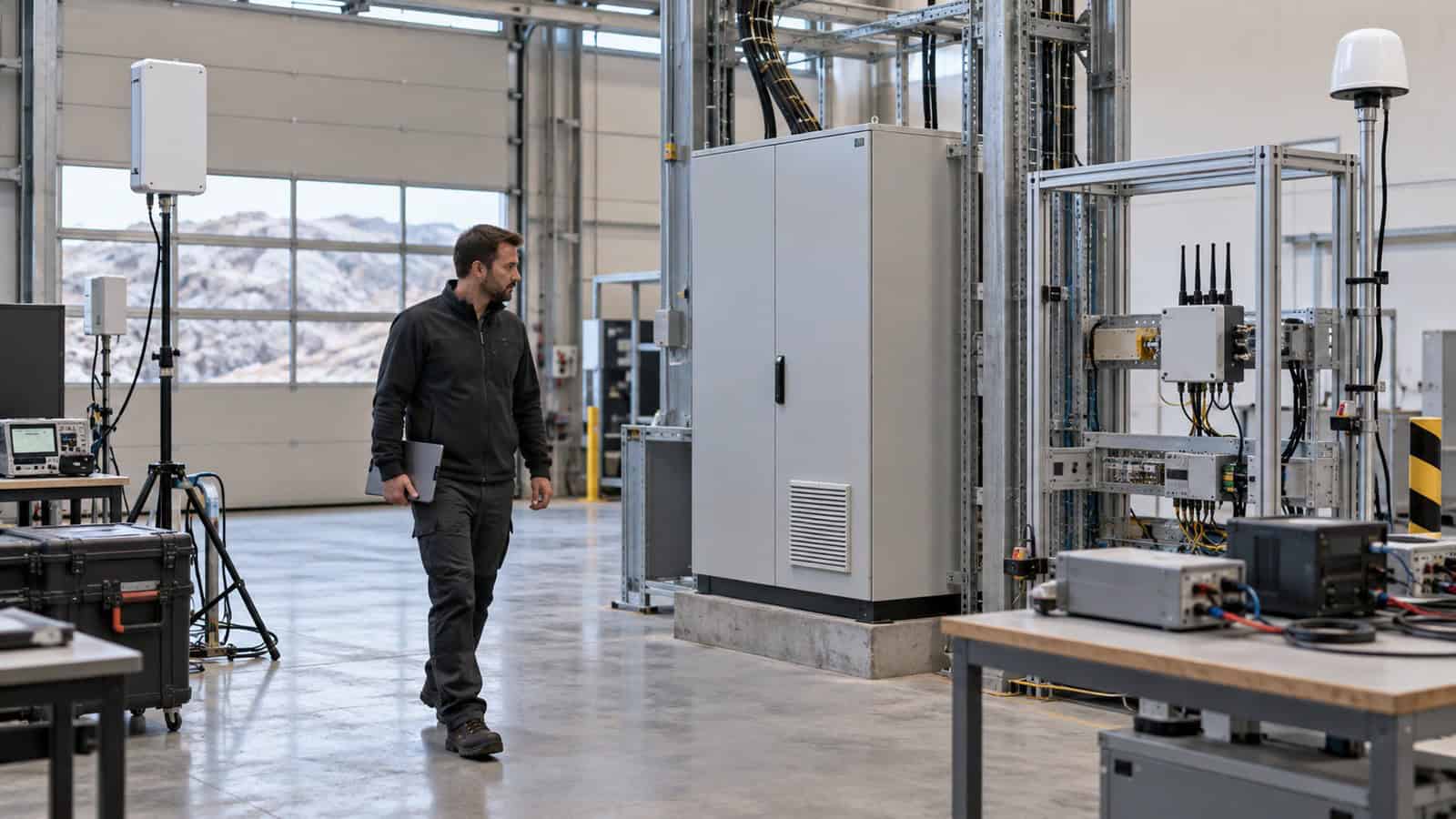
The Robustel R5020 Industrial 5G Router is a useful reference for buying rugged cellular hardware because its value is spread across radio, power, mounting, interfaces and remote operations. None of those specifications is enough on its own. A router can meet a published temperature range and still fail the project because the antenna cannot be placed well, the cabinet supply is poorly sized or the required serial interface exists only on another variant.
Procurement therefore needs ten checks that can be traced to the exact ordering model and later repeated during commissioning. The aim is not to buy the longest specification sheet. It is to remove mismatches before a pilot becomes a fleet.
1. Verify the Regional Cellular Variant
“5G” is not a complete radio requirement. Confirm the exact regional SKU, supported NR and LTE bands, operator requirements, SIM format and regulatory approvals. A global product family may contain several modem variants, and a band shown for one version cannot be transferred to another.
Coverage maps are only an initial screening tool. The final antenna position, serving cell, network load and operator configuration determine what the site experiences. Record the intended operator and fallback technology, then test the production variant with the production SIM at the actual location.
2. Treat the Antenna System as Part of the Router
External antenna connectors create design freedom, not guaranteed signal improvement. Antenna type, MIMO arrangement, separation, polarization, mounting height and feeder loss all affect the radio path. A long cable can consume much of the gain promised by a better-positioned antenna.
For metal cabinets or RF-hostile rooms, compare two designs: keep the router inside and route suitable antenna cables outward, or place the router closer to the antenna and extend Ethernet back to the LAN. The second approach can reduce RF cable loss but changes power, enclosure, access and environmental requirements.
3. Check the Published Environmental Envelope
Read operating temperature, storage temperature, ingress rating, humidity and relevant shock, vibration or EMC information as separate specifications. The R5020 uses a metal enclosure and is rated IP30. That makes it suitable for protected industrial installation; it does not make the bare router an outdoor enclosure.
A cabinet in direct sun can run well above ambient temperature. Condensation can occur even when the day’s maximum and minimum temperatures appear acceptable. Engineering review should include enclosure sealing, drainage, airflow, heat from adjacent equipment and the cold-start condition rather than comparing only one temperature number.
4. Match the Power Architecture
Industrial power is a system interface. Confirm input range, connector retention, polarity protection, surge environment, earthing, steady consumption and startup demand. Vehicle installations also need the exact ignition-sense arrangement and an assessment of crank, load-dump and battery-protection behaviour.
PoE terminology deserves its own check. A PoE-PD router receives power over Ethernet; a PoE-PSE router supplies power to downstream equipment. The R5020 has an optional PoE-PD arrangement. The Robustel R2120-5G Industrial Dual-SIM 5G NR Cellular PoE-PSE Router with RS-485 instead offers four PoE-PSE ports, so its power supply must cover both the router and the intended downstream loads.
5. Count Interfaces by Electrical Type and Simultaneous Use
The purchasing question is not simply “does it have serial?” The R5020 provides separate RS-232 and RS-485 ports, four Gigabit Ethernet ports and DI/DO. The R5020-Lite uses one software-configurable RS-232 or RS-485 interface, which cannot be counted as both at the same time.
Create a termination schedule before selecting hardware. List every controller, camera, payment terminal, switch, alarm input and upstream firewall, together with connector type, speed, isolation needs and cable length. This exposes when a compact router is sufficient and when an additional switch, converter or larger interface set belongs in the bill of materials.
Ten-Specification Procurement Gate
| Check | Evidence to collect | Acceptance question |
|---|---|---|
| 1. Cellular variant | Exact SKU, bands, approvals | Does the ordered modem match the region and operator? |
| 2. SIM design | SIM type and WAN policy | What failure domain does the second SIM address? |
| 3. Antennas | Connectors, antenna and cable plan | Has RF loss been calculated and surveyed? |
| 4. Environment | Temperature, IP and test data | Will the protected installation remain inside the envelope? |
| 5. Power | Input and PoE/vehicle details | Can the production supply handle startup and attached loads? |
| 6. Ethernet | Port count, speed and WAN/LAN modes | Can every required link operate simultaneously? |
| 7. Serial and I/O | Exact electrical interfaces | Do the field devices match without assumed converters? |
| 8. Security | VPN, firewall and credential plan | Who owns policy, certificates and access? |
| 9. Recovery | Detection and failover configuration | Does the application recover after the WAN returns? |
| 10. Fleet operations | Monitoring and update process | Can the support team operate the installed estate? |
6–8. Security, WAN Recovery and Application Recovery Are Different
VPN support is a product capability; a secure deployment is a configured system. The R5020 documents IPsec, OpenVPN, GRE and DMVPN options, but the project still owns certificate handling, firewall policy, user roles, logging and change approval. If an upstream security appliance already owns those functions, the Robustel R5010 Industrial 5G Router with 2.5GB LAN, PoE-PD and USB Connectivity can provide a focused cellular handoff instead of duplicating the branch policy layer.
Likewise, dual SIM does not duplicate the antenna, router or power supply. A failover test should time several stages: fault detection, cellular registration, route restoration, VPN recovery and application retry. The WAN icon can return to green while a long-lived session remains broken.
Robustel’s Jones Technology retail resilience case study documents a live R5010 deployment alongside SD-WAN, including site-specific work to improve RF placement. It supports the value of separating cellular handoff from branch policy. It does not establish a universal failover time or radio result.
Another Robustel’s R5020 branch-routing Application Example illustrates the alternative: a router can own more of the local WAN, segmentation and remote-management role. This is architecture evidence, so teams should use it to frame a pilot rather than quote it as customer performance.
9. Decide How the Fleet Will Be Operated
Local web configuration may be reasonable for one attended site. A distributed estate needs inventory, configuration control, alerts, software policy and an escalation path. Robustel RCMS provides documented centralized monitoring and management workflows for supported devices, but remote access still depends on power and a viable communications path.
The operational design should say who can change WAN policy, how credentials are issued, when firmware is staged and what evidence triggers a site visit. Remote visibility can narrow a fault domain; it cannot repair a damaged antenna or cabinet supply.
10. Make the Pilot Reproduce Production Conditions
A desk test with a convenient adapter and an antenna beside a window proves little about a sealed cabinet or moving vehicle. Use the final power path, antenna arrangement, SIMs, VPN, application traffic and mounting method. Force primary-WAN failure, power interruption, cellular loss where practical and controlled failback.
Robustel’s R5020 5G IoT Router Quick Start Guide video can orient the commissioning team to the basic setup sequence. The project acceptance sheet should then add the site-specific electrical, RF and application tests that a product video cannot define.
Robustel Model Fit by Architecture
| Requirement | Best-fit starting point | Reason to verify |
|---|---|---|
| Cellular handoff to existing firewall or SD-WAN | ロバステル | Focused high-speed Ethernet handoff and flexible power options |
| Several Ethernet and separate serial terminations | ロバステル | Four GbE plus separate RS-232 and RS-485 |
| Compact site with modest local connectivity | ロバステル | Two GbE and one configurable serial interface |
| Downstream PoE cameras or access devices | Robustel R2120-5G | Four PoE-PSE outputs; size total power budget |
| Local Wi-Fi 6 is an explicit requirement | ロバステル | Five GbE and dual-band Wi-Fi 6; validate client design |
よくある質問
Q1. What to look for in a 5G router?
Start with the job rather than the modem headline: WAN role, Ethernet and serial interfaces, power input, mounting, antennas, environmental limits, VPN design and management method. Then confirm regional bands and certifications, and test the exact ordered variant with the intended SIMs and application traffic.
Q2. What are the key differences between an industrial router and a home router?
An industrial router is chosen for integration into a wider system, so DC power, cabinet mounting, temperature, interfaces and lifecycle support matter alongside connectivity. A home router is normally designed for a clean, occupied indoor space and a much simpler installation model.
Q3. What are the disadvantages of 5G routers?
Mobile service is site- and operator-dependent, and the radio path can change with placement, congestion and network conditions. A 5G router also brings antenna, SIM, data-plan and failover decisions that must be engineered; those are manageable design tasks, but they should be budgeted from the start.
Q4. Which 5G router is the best?
There is no useful best model without a deployment brief. The right choice is the one whose interfaces, power design, environmental rating, regional approvals and management functions fit the site, with enough performance margin demonstrated under the real workload.
Q5. When is the Robustel R5020 Industrial Dual-SIM 5G Router a good fit?
It is a practical starting point when a site needs four Gigabit Ethernet ports, separate RS-232 and RS-485 connections, DI/DO, cellular WAN and centralized operations. Check the exact regional and optional-feature variant before procurement, then validate it with production power, antennas, SIMs, VPNs and application traffic.
結論
The Robustel R5020 Industrial 5G Router fits protected industrial sites that need a broad local interface set and managed cellular connectivity. It should be selected because the exact variant matches the installation and operating model, not because “rugged 5G” appears on a shortlist.
Turn the ten checks into purchase-line evidence and pilot acceptance tests. That gives procurement, engineering and operations the same definition of a successful deployment.
Explore more articles about Robustel’s 5G routers in industrial IoT:
著者について
Robert Liao | Technical Support Engineer
Robert is an IoT Technical Support Engineer at Robustel, specializing in industrial networking and edge connectivity. A certified Networking Engineer, Robert focuses on the deployment and troubleshooting of large-scale IIoT infrastructures. His work centers on architecting reliable, scalable system performance for complex industrial applications, bridging the gap between field hardware and cloud-side data management.