
How to Size Docker Storage for Logs, Images and Offline Edge Data
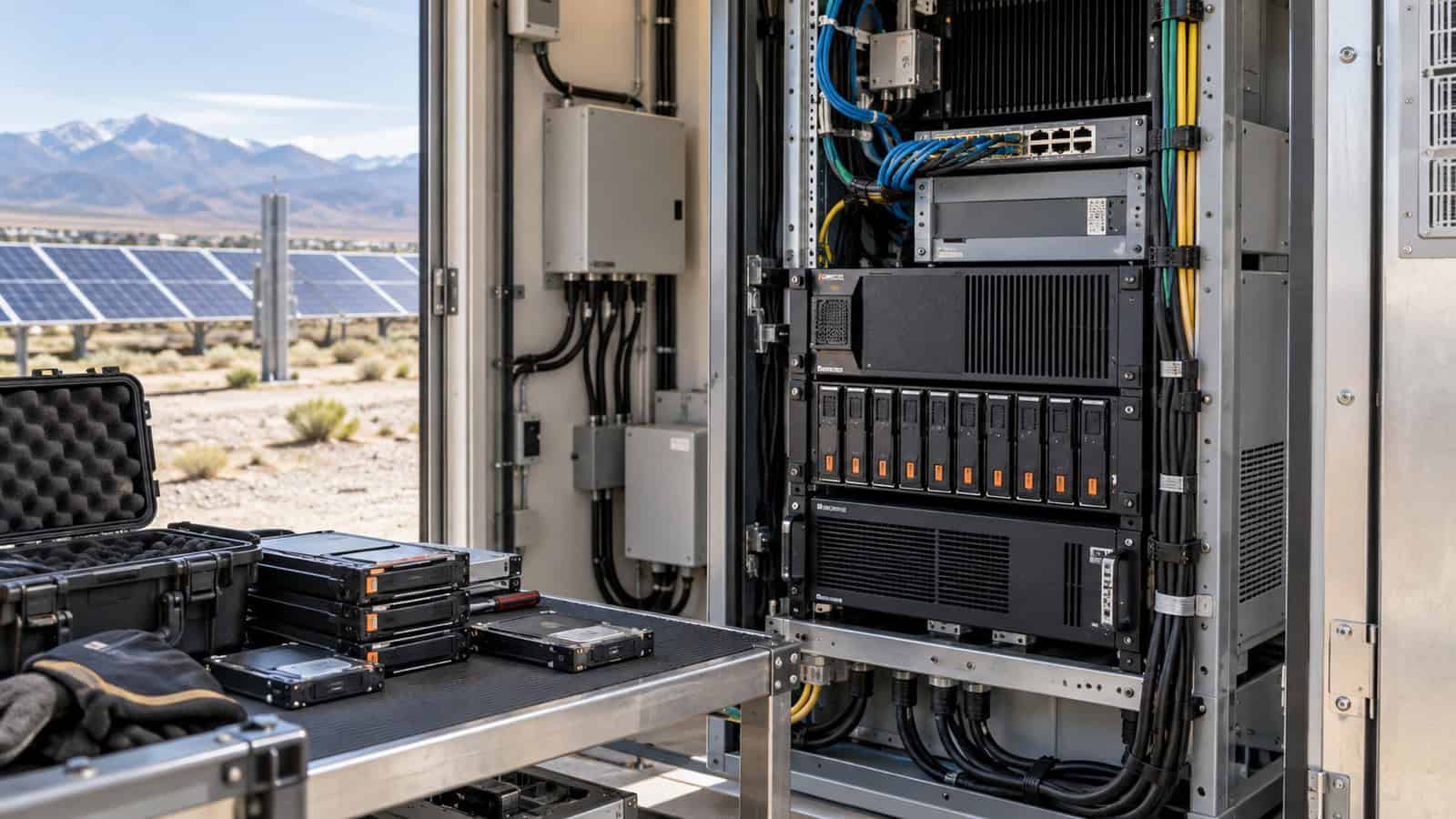
The Robustel EG5120 Edge Computing Gateway is available with documented local storage options for containerised edge workloads, but usable margin must cover more than the running application. Images, old layers, writable containers, logs, databases and offline data all compete for finite storage.
Inventory Every Storage Consumer
Measure the base platform reservation, deployed images, container writable layers, named volumes, application databases, logs and diagnostic bundles. Registry download size is not the same as expanded local use, so measure on the target architecture.
Keep persistent data outside disposable container layers. That makes update and rollback behaviour easier to predict, but it does not remove the need for retention and backup rules.
| Consumer | Fixed or growing | Sizing evidence | Control |
|---|---|---|---|
| platform reserve | mostly fixed | target image | protected allowance |
| application images | fixed per version | expanded local size | version retention |
| logs | growing | bytes per busy hour | rotation and export |
| offline records | growing during outage | production data rate | bounded queue |
| diagnostics | event driven | largest support bundle | reserved margin |
Size the Update Overlap
During an update, the current image may remain while the candidate is downloaded and unpacked. Rollback requires the known-good image and compatible data state to remain available. A storage plan that fits only one version can fail before the application is tested.
Budget at least the documented retention policy for image generations plus temporary extraction overhead. Pin production images by immutable digest and clean unused development layers before deployment, not during an incident.
Also account for interrupted pulls. A partially downloaded layer and a retry can temporarily consume more space than the steady-state pair of images, particularly when maintenance begins with limited free capacity.
Robustel’s secure remote access to industrial robots application example illustrates why application lifecycle and remote support belong in the field architecture. For storage, the practical lesson is to preserve enough local evidence and rollback material for support to act without an immediate site visit.
Calculate the Offline Backlog from the Longest Credible Outage
Use measured post-filter data, not raw machine throughput, unless the application genuinely retains raw data. Multiply bytes per second by the accepted outage duration, then add database, index and protocol overhead plus the burst created during reconnection.
Required storage can be expressed as:
platform reserve + retained image generations + log retention + maximum offline backlog + maintenance margin
Test replay as well as accumulation. A gateway may have enough space for a 24-hour outage but take several days to upload the backlog if current traffic consumes most of the restored WAN capacity.
Robustel’s smart parking application example shows why mixed field data needs named retention roles. Selected evidence frames, event metadata and routine telemetry have very different storage costs; keeping all of them under one unlimited rule makes capacity unpredictable.
Control Logs Before They Become the Incident
Set rotation by size and age, and decide which records are exported centrally. Retain enough local history to cover delayed discovery, restart loops and WAN outages. Test the policy during the noisiest credible failure because repeated exceptions can generate logs far faster than normal operation.
Do not treat deletion as the only response to a high-water mark. First preserve a diagnostic bundle, then remove data according to an approved priority. A cleanup job that deletes the logs explaining a full disk turns an automatic recovery into an unsolved recurrence.
Review retention after real incidents. Exception storms and repeated reconnects often produce a different log rate from normal production, so field evidence should update the original sizing assumption.
How the Robustel EG5120 Edge Computing Gateway Supports Predictable Docker Storage
The Robustel EG5120 Edge Computing Gateway provides a documented Debian-based edge platform, Docker support and memory/storage variants suitable for industrial applications. Select the exact variant from the measured image, log and backlog model rather than assuming the largest headline capacity is all available to containers.
On compatible EG5120 hardware, Robustel E2C Factory can make collection, continuity and northbound delivery part of one defined workflow. That can make offline-data ownership clearer, while the deployment still needs explicit storage limits and a tested recovery plan.
Set Thresholds and Prove the Full-Disk Response
Use an early warning that leaves enough room for one support bundle and the planned recovery action. A higher threshold may stop non-essential retention or block an update, but it should not silently corrupt current operational data.
Fill a test gateway deliberately to each threshold. Confirm alarms, cleanup priority, application behaviour, restart and backlog replay. The Robustel video “Where Is Edge Computing Actually Used in Industrial IoT?” is useful for explaining why local continuity and storage policy are part of the edge role, not housekeeping after deployment.
よくある質問
Q1. Where does Docker store images and container data?
Docker uses its configured data root for images, layers, writable data and metadata. Volumes and bind mounts may use other paths, so inspect the complete gateway layout.
Q2. Why does Docker disk usage keep growing?
Old images, update layers, writable containers, logs, databases and offline queues can all grow. Measure each category before deleting evidence needed for recovery.
Q3. How much free storage should an edge gateway keep?
Keep enough for the next image pull, log growth, maximum backlog and a diagnostic bundle. Define the threshold from measured bytes rather than one universal percentage.
Q4. How do I limit Docker container log size?
Configure application and logging-driver rotation with approved size and age limits, then verify the rule survives restarts and exports important records.
Q5. How should storage be sized on the Robustel EG5120 Edge Computing Gateway?
Add platform reserve, retained image generations, logs, persistent data, maximum offline backlog and maintenance margin, then test that container set on the intended storage variant.
結論
The Robustel EG5120 Edge Computing Gateway provides a practical platform for Docker workloads when local storage is treated as an operating budget rather than an empty number on a datasheet. Images, logs and outage data need named owners and limits.
Measure the production container set, allow update overlap and force the gateway through accumulation, warning, cleanup and replay. A storage design is complete only when the team knows what is preserved, what is removed and how the application recovers.
Explore More Articles About Robustel Edge Computing Gateways



著者について
Robustel Editorial Team
The Robustel Editorial Team publishes practical articles on industrial connectivity, edge computing, LoRaWAN and device management, focusing on deployment considerations, technical limitations and long-term operation.