
Edge Gateway vs Industrial Router: Which One Fits Your IoT Architecture?

The Robustel EG5101 edge computing gateway is relevant when an industrial site needs lightweight local applications in addition to secure connectivity, while an industrial router is often the more proportionate choice when the requirement stops at WAN access, routing, VPN and remote connectivity. The practical boundary is application ownership, not whether one product contains a faster processor.
This distinction prevents two opposite mistakes: buying an edge gateway for a routing problem, or asking a connectivity-focused router to become an unmanaged application platform.
An Industrial Router Solves Network Connectivity First
A router’s main responsibility is to establish and protect network paths. Projects normally evaluate WAN availability, cellular service, Ethernet routing, firewall policy, VPNs, failover and secure remote access. A router may contain a processor and storage, but those resources do not automatically make it an industrial application platform.
For a branch, remote cabinet or PLC-access project, this can be exactly the right boundary. Keeping application logic elsewhere reduces local software ownership and can make troubleshooting easier because the networking device has a narrower job.
An Edge Gateway Adds Local Application Responsibility
The architecture changes once the site needs its own software beside the equipment. A protocol connector, rules engine, local API, buffering application or data-processing service introduces dependencies, logs, storage and restart behaviour. The gateway must now be managed as both a networking device and an application host.
That is a stronger distinction than saying an edge gateway “processes data” while a router “moves data.” Many routers perform sophisticated packet processing. What matters is whether the project intentionally deploys and owns site-specific applications on the device.
Industrial Router vs Edge Gateway Responsibility
| Responsibility | Industrial router | Edge computing gateway | Robustel implication |
|---|---|---|---|
| Cellular/Ethernet routing | Core role | Also supported | Both categories may provide WAN connectivity |
| VPN/firewall | Core role | Also relevant | Not a reason alone to choose edge |
| Remote access | Common | Common | Architecture/policy still defines reachable assets |
| Local protocol application | Limited/product-specific | Stronger use case | Robustel EG-series supports local application environment |
| Custom Docker application | Usually not the primary role | Key edge capability | RobustOS Pro on supported EG gateways |
| Local buffering/data transformation | May have limited fixed functions | Can be application-defined | Requires explicit storage/replay design |
| Compatible AI inference | Normally outside router role | Available on selected higher-compute EG models | EG5120/EG5200 |
| Application lifecycle ownership | 低 | Significant | Edge requires update, logs and rollback planning |
The table shows why cellular connectivity alone is not an argument for an edge gateway.
Do Not Buy an Edge Gateway for a Routing Problem
Consider a remote PLC site where an engineer only needs secure access to an existing controller. If the data does not need to be processed locally and no custom application has to remain active during an outage, an industrial router may be the simpler architecture.
Robustel’s Secure Remote Access to Industrial Robots Application Example helps illustrate the opposite threshold. The example uses an EG5120 as a managed boundary around an industrial robot environment where remote diagnostic and support functions are required.
Its relevance is not that every remote robot needs edge computing. If the requirement were only an encrypted network path, a router architecture might be sufficient. The EG5120 becomes more defensible when local data/application functions are part of the service model.
The Application Example also should not be interpreted as native robot-controller protocol support. Integration depends on the interfaces and supported software exposed by the actual controller environment.
Do Not Force a Router to Become an Application Platform
The reverse mistake happens when a project begins with a router because it is familiar, then gradually adds scripts, data transformation, local storage and custom logic until the networking device is carrying an application workload it was never selected to maintain.
This can work during a proof of concept because the software is small and the traffic is limited. The problems emerge during fleet operation: no defined container lifecycle, insufficient storage for logs, unclear rollback, or a support team that does not know whether a fault belongs to networking or custom software. A formal edge platform makes that application responsibility explicit from the start.
How the Robustel EG5101 Edge Computing Gateway Fits the First Edge-Computing Threshold
The Robustel EG5101 edge computing gateway is useful because edge computing does not always require an NPU or high-end processor. It uses a 792 MHz Cortex-A7 platform with 1 GB DDR3 and 8 GB eMMC, together with one Fast Ethernet port, one RS-232 and one RS-485 interface.
RobustOS Pro and Docker support allow lightweight protocol bridges, preprocessing or buffering applications to run locally, while LTE Cat-1 provides WAN connectivity for distributed sites.
This makes EG5101 particularly useful at the point where a conventional router stops being sufficient because the project needs a maintained local application—but where an EG5120 or EG5200 would add compute and interfaces that the workload cannot justify.
Its boundary should remain clear. EG5101 is not intended to become a small server for heavy databases, computer vision or many concurrent services simply because it runs Debian-based software.
When to Stay with a Router and When to Move to Robustel Edge
| Project requirement | Router remains proportionate | Edge gateway becomes more useful |
|---|---|---|
| Secure cellular WAN | はい | Not an edge reason by itself |
| VPN access to local equipment | Often | Edge only if additional local application is needed |
| Simple fixed protocol conversion | Often possible depending on product | Edge when logic becomes custom or application-defined |
| Custom filtering/transformation | Less suitable | Strong edge case |
| Application-defined buffering | Limited | Stronger edge case |
| Local API/database | Usually outside router responsibility | Clear edge responsibility |
| Local inference | Not normal router role | Higher-compute EG model |
| Container lifecycle | Avoid if unnecessary | Explicit RobustOS Pro application responsibility |
The Robustel R5020-Lite Industrial 5G Router illustrates the connectivity side of this comparison. It provides industrial 5G routing, Ethernet, serial connectivity and WAN flexibility without being positioned as the same Debian application platform as an EG-series edge gateway.
Smart Infrastructure Shows Why Both Categories Exist
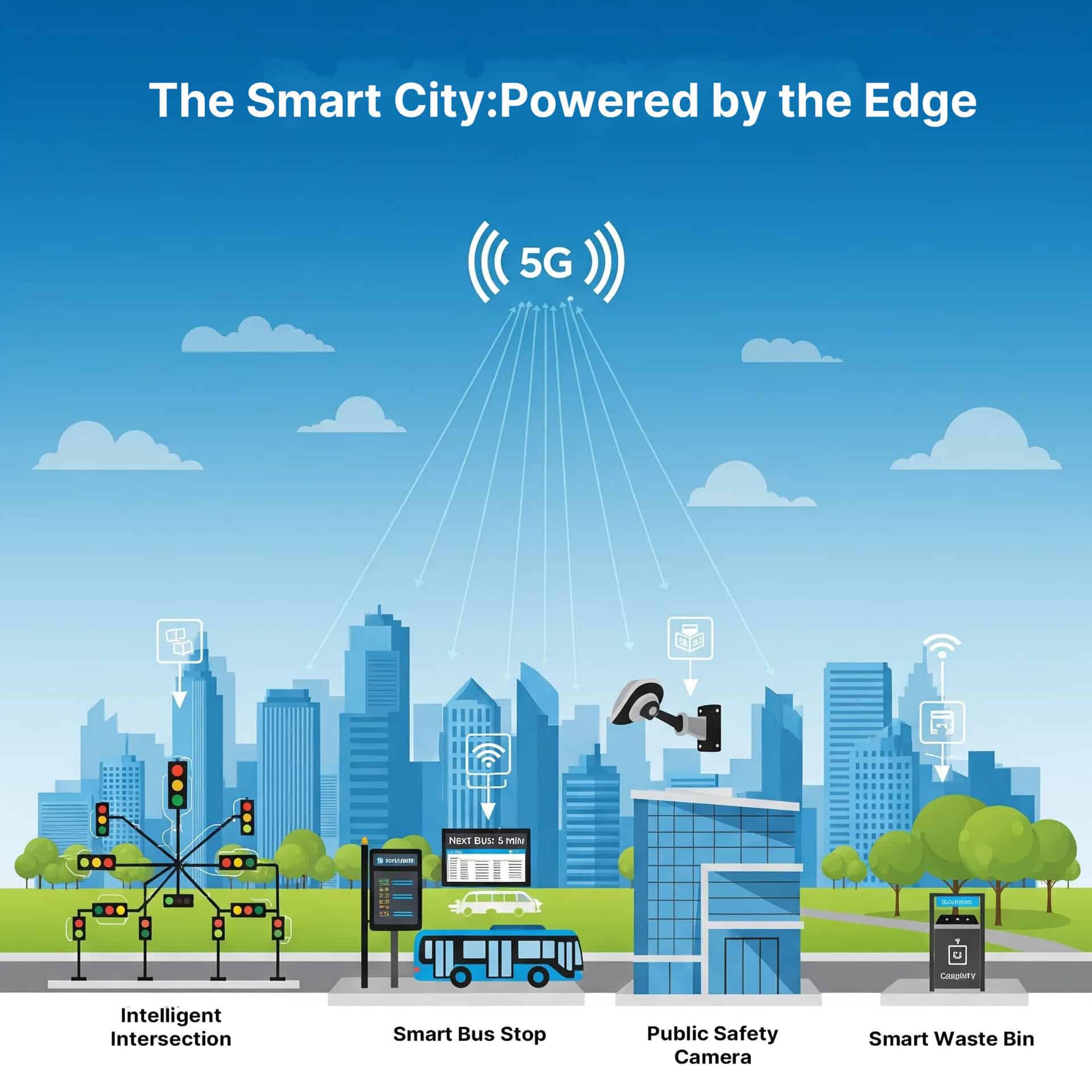
Robustel’s Smart Parking Application Example deliberately assigns different products to different site responsibilities.
Cameras that need PoE and backhaul can use a router architecture, while an EG5120 is introduced where ANPR-related local preprocessing has value. Meters, gates and sensors can use another connectivity path again.
This is a useful architecture because it does not assume “edge gateway” is the premium answer for every device. The workload determines which equipment owns local compute.
Robustel’s Public Safety CCTV Application Example presents a different balance. EG5100 can provide LTE backhaul and also host lightweight edge applications when the camera site needs buffering or preprocessing. If those local functions were removed, the case for an edge platform would become weaker.
RobustOS Pro Is the Important Software Boundary
The RobustOS Pro edge computing operating system provides a Debian environment for supported Robustel EG-series gateways, including containerized and native Linux applications.
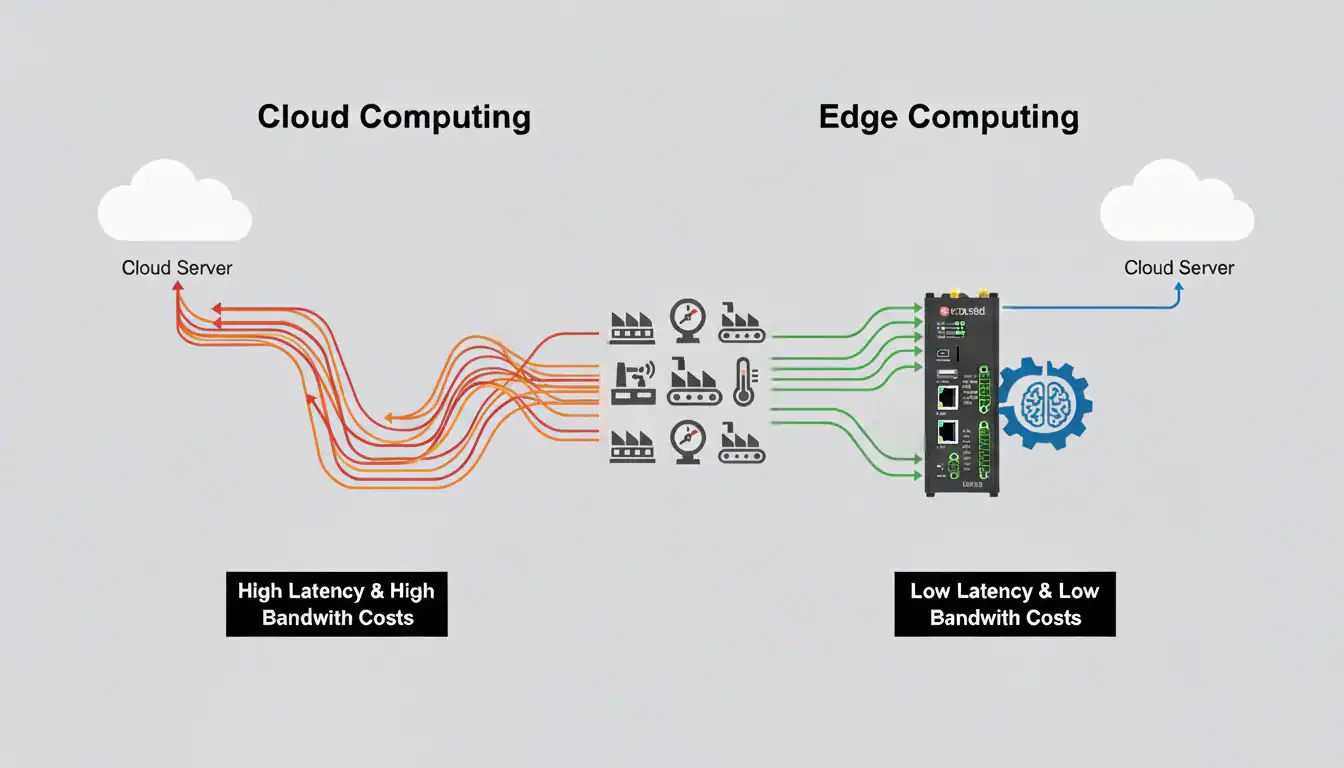
Robustel’s “Why Do We Need Edge Computing If We Have the Cloud” video provides useful context for deciding which functions belong locally. The cloud can remain responsible for long-term analytics, dashboards and enterprise systems while selected local functions stay beside the equipment.
The key purchasing implication is simple: once a project installs site-specific software, somebody must own that software after commissioning.
Compare Failure Behaviour Before Choosing the Category
A router failure and an edge-gateway failure can have different consequences. If a router only owns WAN connectivity, local machine control may remain unaffected even though remote access disappears. If an edge gateway owns data collection, local applications and WAN connectivity together, one hardware failure can remove all three functions at the same site.
Consolidation can therefore reduce component count while increasing coupling.
Failure-Domain Comparison
| Failure | Router-centric architecture | Edge-gateway architecture |
|---|---|---|
| WAN unavailable | Remote systems lose connectivity | Local approved edge functions may continue |
| Router/gateway hardware fails | WAN path lost | WAN plus hosted edge applications may be lost |
| Custom application fails | Usually elsewhere | Networking may remain available while edge function fails |
| Cloud unavailable | Local router remains functional | Edge can continue selected local applications if designed |
| Software update fails | Router functionality affected | Application and network responsibilities may both need recovery |
This is why the architectural category should be chosen from required degraded-state behaviour as well as normal operation.
よくある質問
Q1. What is the main difference between an edge gateway and an industrial router?
An industrial router primarily establishes secure network connectivity. An edge gateway also provides an environment for local data processing and applications. Capabilities overlap, so the intended responsibility is more useful than the product label alone.
Q2. Do I need an edge gateway if I already have an industrial router?
Only if the site has a justified local application requirement that the current architecture does not meet. Reliable WAN connectivity, VPN and ordinary routing are not by themselves reasons to introduce edge computing.
Q3. Can an edge gateway replace an industrial router?
Sometimes the same device can provide both networking and local edge functions, but that does not mean replacement is always desirable. Existing firewall, routing, security or redundancy ownership should be reviewed before consolidating functions.
Q4. When is the Robustel EG5101 a better fit than a router?
The Robustel EG5101 edge computing gateway becomes relevant when a distributed site needs lightweight Linux or Docker applications such as protocol handling, local filtering or buffering in addition to LTE/Ethernet connectivity.
Q5. Is an edge gateway more reliable than a router?
Not inherently. Edge computing can allow selected functions to continue when cloud connectivity fails, but combining more responsibilities in one gateway also changes the hardware and software failure domain. Reliability depends on the complete architecture.
結論
The Robustel EG5101 edge computing gateway fits the first meaningful edge-computing threshold: a site that has moved beyond connectivity and needs a lightweight, maintained local application without requiring a high-end edge-AI platform.
Choose an industrial router when the problem is primarily networking. Choose an edge gateway when local application ownership creates measurable operational value. Keeping that boundary explicit produces simpler deployments and makes later troubleshooting much easier.
Explore more articles about Robustel’s edge computing gateways in industrial IoT:
著者について
Robert Liao | Technical Support Engineer
Robert is an IoT Technical Support Engineer at Robustel, specializing in industrial networking and edge connectivity. A certified Networking Engineer, Robert focuses on the deployment and troubleshooting of large-scale IIoT infrastructures. His work centers on architecting reliable, scalable system performance for complex industrial applications, bridging the gap between field hardware and cloud-side data management.