
Edge Gateway vs Industrial PC: Cost, Connectivity and Lifecycle Comparison

The Robustel EG5200 edge computing gateway is a strong fit where industrial connectivity, local applications and several field-facing interfaces need to be consolidated into one edge platform, while an industrial PC can be the better architecture when the project needs greater compute freedom, expansion or shared site-level workloads. The useful comparison is therefore not which box is more powerful, but which system architecture creates the right balance of integration, failure radius and lifecycle ownership.
An edge gateway and an industrial PC increasingly overlap in compute capability, yet their natural positions in an industrial system remain different. Gateways tend to sit closer to equipment and combine networking with OT integration. IPCs often provide a more general-purpose computing layer and may depend on separate routing, serial or I/O infrastructure.
Compare Complete Architectures, Not Individual Boxes
A price comparison between one gateway and one IPC is rarely fair. An IPC architecture may also require a cellular router, Ethernet switch, serial converter or separate I/O hardware. Conversely, an edge gateway that integrates those functions may have less CPU expansion, storage flexibility or software freedom than a larger IPC.
The actual comparison should therefore include all components required to produce the same site function.
Integrated Edge Gateway vs IPC Architecture
| Requirement | Integrated edge gateway approach | Industrial PC approach | Robustel implication |
|---|---|---|---|
| Cellular WAN | Can be integrated | Often separate | EG5200 offers cellular variants |
| Ethernet device connectivity | Built into gateway | IPC plus NIC/switch depending on topology | EG5200 provides 5 Gigabit ports |
| Industrial serial | Integrated on industrial gateway | May require onboard option or converter | EG5200 supports configurable RS-232/422/485 |
| DI/relay | Integrated | May require separate I/O | EG5200 provides DI and relay outputs |
| Local applications | はい | はい | Workload determines resource fit |
| HDMI/peripherals | Available on some gateways | Usually strong IPC area | EG5200 includes HDMI/USB |
| Expansion/future high compute | More constrained | Often stronger | IPC may be preferable |
| Number of components | Potentially lower | Potentially higher | Consolidation changes failure domain |
A smaller component count can reduce wiring, cabinet space and integration effort. It can also make one device responsible for more functions.
Consolidation Reduces Components but Increases Coupling
Suppose one industrial PC runs the application, a cellular router supplies WAN connectivity and a serial gateway connects legacy equipment. A failure of the IPC may stop the application while the networking layer remains available for diagnostics.
If one edge gateway replaces all three devices, the architecture becomes simpler, but failure of that gateway may simultaneously remove data collection, application processing and WAN access.
Neither design is automatically more resilient. This is why consolidation needs to be evaluated as a failure-domain decision rather than as a simple BOM reduction exercise.
Failure-Domain Trade-Off
| Event | Consolidated Robustel edge gateway | Separate IPC + networking architecture |
|---|---|---|
| Compute/application failure | May affect local applications while gateway diagnostics depend on remaining OS/network state | IPC can fail while router remains reachable |
| Cellular/router failure | Can affect both WAN and edge service if one device owns both | IPC may continue local compute |
| Serial interface failure | Local integrated path affected | Separate converter may isolate the fault |
| Hardware replacement | One device restores several functions | Multiple components can be replaced independently |
| Configuration management | Fewer device classes | More systems and vendors to coordinate |
| Spare strategy | Fewer integrated spares | More component-specific spares |
The decision depends on which failure radius the site can tolerate and which maintenance model the organization can support.
Industrial PCs Remain the Better Choice for Some Workloads
Edge gateways should not be positioned as smaller, cheaper replacements for every IPC. A workload that needs large memory capacity, several expansion cards, specialized GPU hardware, substantial local databases or heavy virtualization may be better suited to an industrial PC or edge server.
The same applies when several production cells share one large application. Centralizing that workload on a site-level IPC may simplify data storage and software management compared with maintaining a separate heavy application on every gateway.
The gateway still has value at the machine layer if field integration remains distributed.
How the Robustel EG5200 Edge Computing Gateway Reduces Hardware Layers at Multi-Device Sites
The Robustel EG5200 edge computing gateway is particularly relevant where the site needs meaningful local compute but also has a dense machine-side topology. Its five Gigabit Ethernet ports can connect several IP devices, while two configurable serial interfaces support RS-232, RS-422 or RS-485. HDMI, USB, digital inputs and relay outputs allow the gateway to support additional peripherals without automatically introducing another industrial computer or interface appliance.
Compute is provided by a quad-core Cortex-A53 at 1.6 GHz with 4 GB LPDDR4, 32 GB eMMC and a 2.3 TOPS NPU. These resources make EG5200 capable of substantial edge applications, but they also establish a clear boundary compared with an expandable IPC.
The value is therefore not that EG5200 “replaces an IPC.” It can remove an IPC from specific architectures where the validated workload fits its compute resources and the integrated field/WAN interfaces eliminate other hardware at the same time.
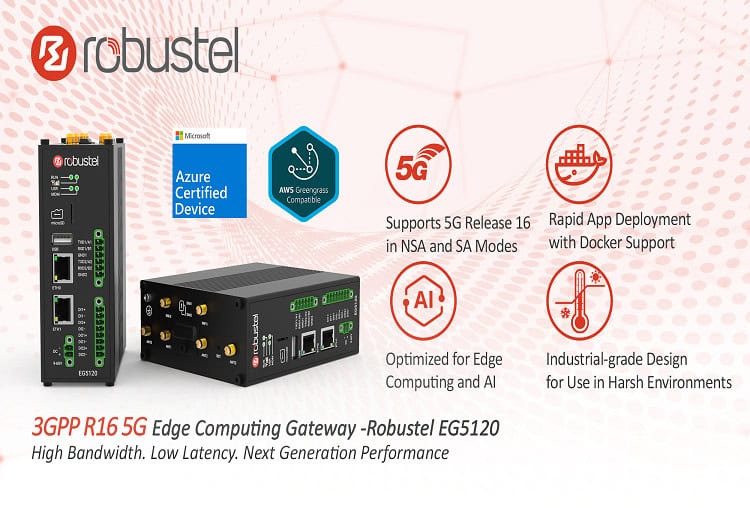
The EG5000 Series Quick Pitch is useful in this comparison because it shows why the EG5000 family sits at the machine-to-site boundary rather than functioning simply as a compact general-purpose computer.
Existing Machines Often Benefit from a Separate Integration Layer
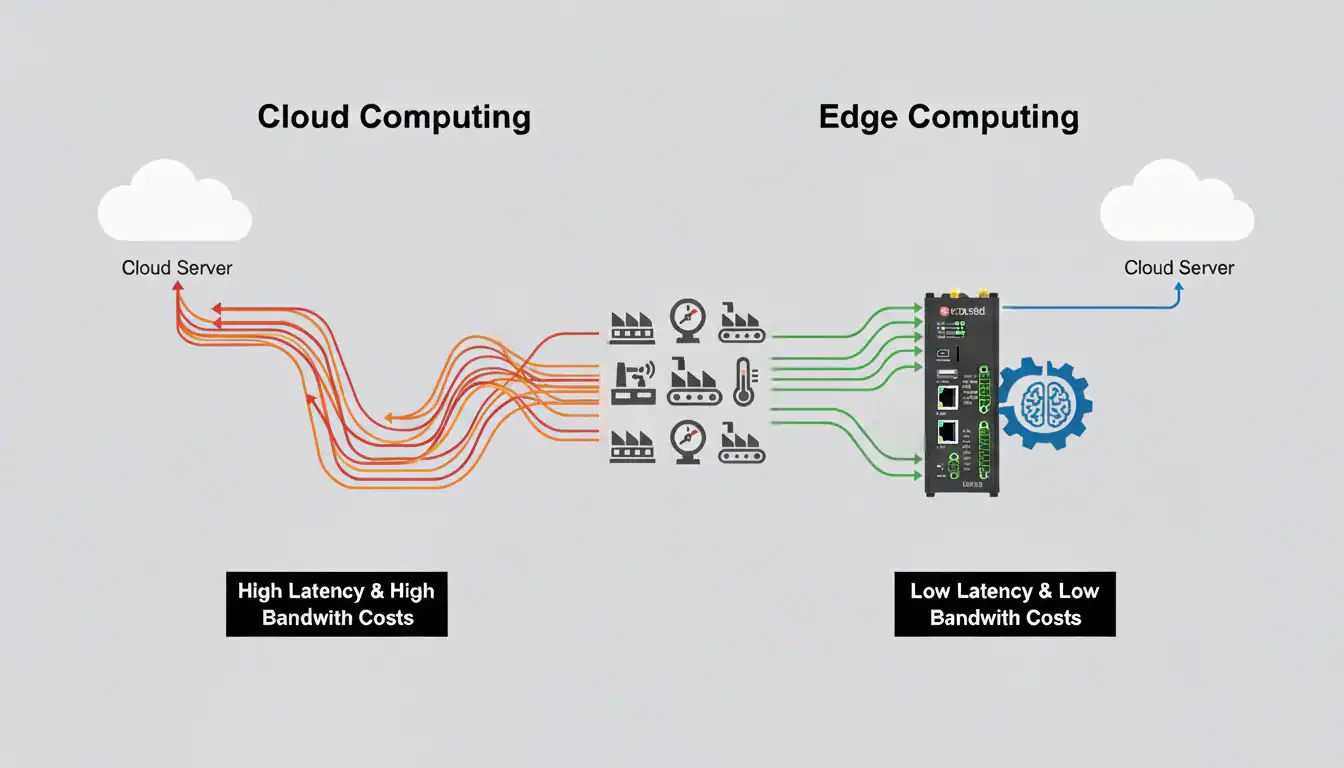
Existing production equipment often remains under the control of its original PLC, controller or machine system, while an edge gateway adds a separate path for data collection, local preprocessing or upstream connectivity.
That separation matters in brownfield environments. The gateway should only interact through interfaces and protocols that are explicitly exposed by the installed equipment and supported by the gateway software. A physical Ethernet or serial connection alone does not establish application compatibility.
A central IPC can then take responsibility for workloads that are better handled at the site level, such as heavier analytics, aggregation across multiple machines or applications that require more compute resources. It does not remove the need for a reliable machine-side integration path.
In a larger factory, the more appropriate architecture may therefore be gateway and IPC rather than gateway or IPC: the gateway stays close to the equipment and handles approved field-side connectivity, while the IPC performs broader site-level processing.
Distributed Infrastructure Shows the Other Side of the Decision
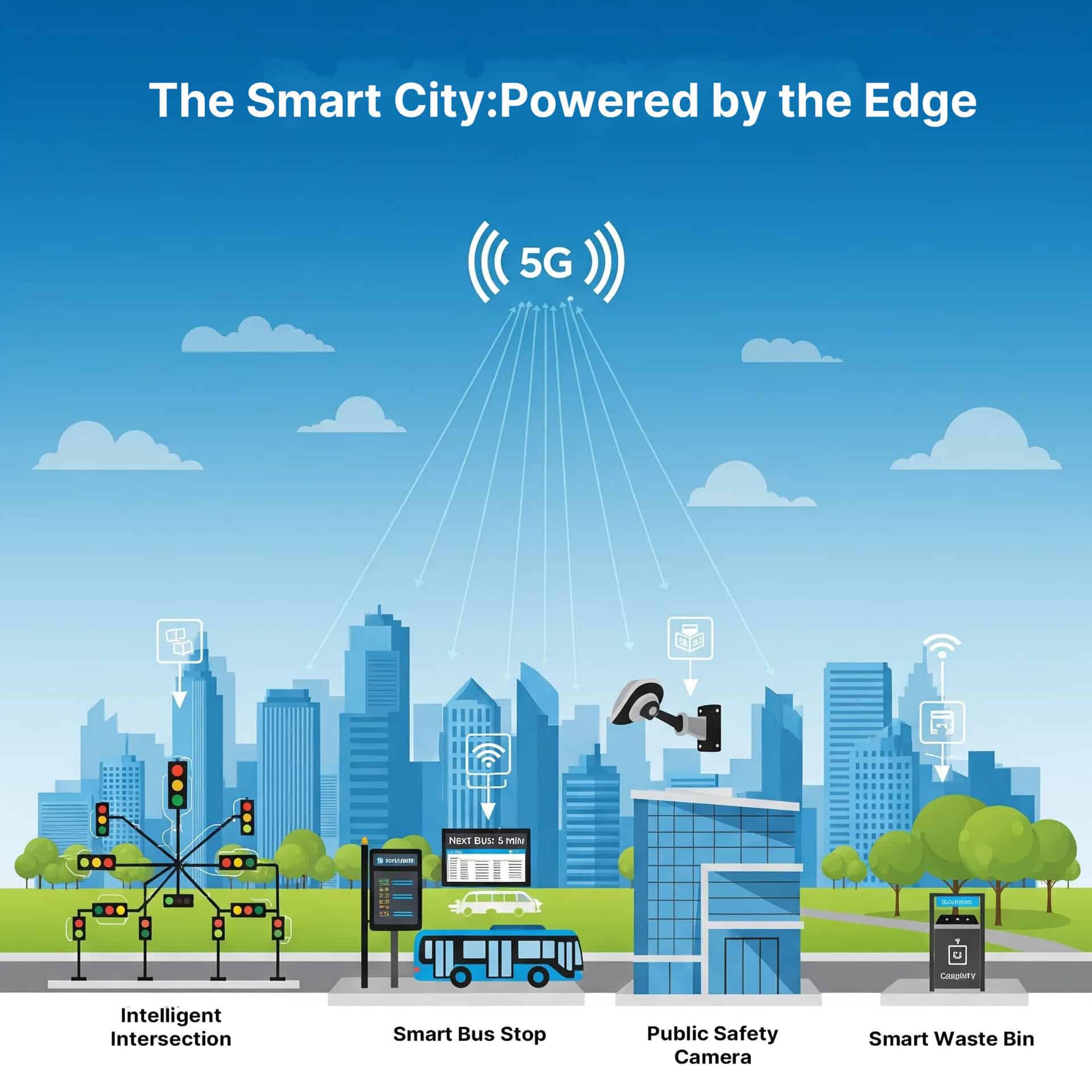
Robustel’s Smart Parking Application Example illustrates a distributed architecture where local processing is placed close to a relevant device cluster rather than concentrated in one central compute system.
For ANPR-related workloads, the example uses EG5120 to perform selected local preprocessing and forward compact results upstream. This does not prove that every parking site should use the same model or that distributed edge is always more reliable.
It shows why location matters. A processing function tied closely to one camera group may belong near that camera group, while shared historical analysis belongs at a central platform. An IPC remains useful if several local gateways need to feed a common site application.
Compare TCO Over the Deployment Lifecycle
The purchase price is only the first line of a useful comparison. A multi-box IPC architecture may require more Ethernet cabling, power supplies, converters, switches and installation work. It may also allow individual functions to be replaced independently.
An integrated gateway can reduce hardware count, but a failed integrated unit may require replacement of several functions at once. Its application must also remain within the device’s resource envelope throughout the intended lifecycle.
System-Level TCO Questions
| Cost area | Edge gateway question | IPC architecture question |
|---|---|---|
| Hardware | How many separate devices does EG5200 remove? | What router, switch, I/O or serial hardware is also needed? |
| Installation | Does consolidation reduce wiring and cabinet work? | Are separate devices easier to position or service? |
| ソフトウェア | Can the validated workload run within gateway resources? | Does the IPC require a separate OS/app-management process? |
| 保守 | Is one integrated spare simpler? | Can individual functions be replaced independently? |
| Expansion | Will the gateway remain sufficient? | Does IPC expansion avoid early replacement? |
| Failure cost | What functions disappear if gateway fails? | What remains available if IPC alone fails? |
| Fleet operation | Can common gateway images be maintained consistently? | How many software/hardware platforms must operations support? |
A useful TCO comparison applies real numbers to these categories rather than assuming fewer boxes automatically means lower cost.
RobustOS Pro Supports Standard Linux Application Workflows
Robustel RobustOS Pro edge computing operating system gives supported EG gateways a Debian environment for containers and native Linux applications.
This reduces one historical difference between an embedded gateway and an IPC because developers can use familiar packages and tools on both types of platform.
The difference that remains is resource and hardware architecture. EG5200 combines a defined ARM platform and industrial interfaces in one managed product. An IPC may provide more expansion or compute freedom, but that freedom can bring a larger hardware and software integration surface.
Neither approach removes application lifecycle responsibility.
Choose One Layer or Two
Three patterns cover many real projects.
Edge Gateway / IPC Deployment Patterns
| Pattern | Best-fit condition | Main trade-off |
|---|---|---|
| Robustel edge gateway only | Few local assets or one site cluster with a validated moderate workload | Limited compared with larger expandable compute |
| IPC only | Equipment is already IP-ready and field integration is simple | Cellular/serial/OT integration may need separate hardware |
| Robustel edge gateway + IPC | Distributed OT assets plus heavier shared site applications | More components and software layers to maintain |
The third pattern is frequently overlooked because product comparisons encourage a winner/loser answer. In a large brownfield factory, separating machine-side integration from plant-level compute may produce the cleanest ownership model.
よくある質問
Q1. What is the difference between an edge gateway and an industrial PC?
An edge gateway normally combines industrial connectivity, networking and selected local applications close to field equipment. An IPC is a more general-purpose industrial computer and may provide greater compute or expansion flexibility while relying on separate networking or OT-interface hardware.
Q2. Can an edge gateway replace an industrial PC?
Sometimes. It can replace an IPC when the complete validated workload fits the gateway and the integrated interfaces reduce additional hardware. It should not be assumed suitable for heavy compute, large storage, specialized expansion or virtualization simply because it runs Linux.
Q3. Is an industrial PC more powerful than an edge gateway?
Often, but product categories overlap. Raw compute is only one selection factor. A gateway may be more appropriate when field interfaces, cellular connectivity and local application hosting need to be integrated in one industrial platform.
Q4. When is the Robustel EG5200 a better fit than an IPC?
The Robustel EG5200 edge computing gateway is particularly relevant when several Ethernet/serial devices, WAN connectivity, local applications and peripherals need to converge at one site and the validated workload fits its 4 GB RAM, ARM compute and local storage resources.
Q5. Is combining router, gateway and computing functions in one device more reliable?
Not automatically. Consolidation reduces component count and inter-device connections, but it also means one hardware failure may affect several functions simultaneously. Reliability should be evaluated through the actual failure domain and recovery plan.
結論
The Robustel EG5200 edge computing gateway is a strong fit where local compute and industrial connectivity belong close together and its integrated Ethernet, serial, WAN and peripheral architecture can remove unnecessary hardware from the site. An industrial PC remains the better direction when compute expansion or shared site-level applications dominate the requirement.
The best decision compares complete systems rather than individual boxes. Count the routers, switches, converters, I/O devices, software platforms and maintenance responsibilities required by each architecture, then test what happens when each major component fails. In many larger industrial sites, the final answer may be an edge gateway at the machine layer and an IPC or server above it rather than choosing only one.
Explore more articles about Robustel’s edge computing gateways in industrial IoT:
著者について
Robert Liao | Technical Support Engineer
Robert is an IoT Technical Support Engineer at Robustel, specializing in industrial networking and edge connectivity. A certified Networking Engineer, Robert focuses on the deployment and troubleshooting of large-scale IIoT infrastructures. His work centers on architecting reliable, scalable system performance for complex industrial applications, bridging the gap between field hardware and cloud-side data management.