
Edge Gateway for Building Energy Management: Protocol and Dashboard Guide
The Robustel EG5100 Edge Computing Gateway is a compact option for building-energy projects that need dual-SIM cellular backhaul, Ethernet, two configurable RS-232/RS-485 ports and a Docker-capable Debian environment for a verified integration application. It does not turn every meter or controller into a native dashboard; the project must define protocols, data meaning and the platform that owns visualisation.
Start With Decisions the Dashboard Must Support
List the operational questions before listing points. A facilities team may need to identify after-hours consumption, compare a pump’s energy with delivered flow, confirm tenant allocation or detect a stuck valve. Each question implies a sampling interval, unit, quality flag and retention rule.
A dashboard full of instantaneous values can still be useless if time zones differ, counters reset without detection or meters report stale data as zero. Define what “missing”, “estimated” and “invalid” look like before commissioning.
During field acceptance, ask the facilities engineer to select one suspicious trend and trace it back to the source register. That short exercise often reveals swapped meter identities, scaling errors or an unnoticed counter rollover that a polished dashboard conceals.
Robustel’s commercial-building energy case study records a multi-site analytics pattern built on legacy M1000 hardware. The useful reference here is the operating question—how mixed building assets become comparable information across sites—while an EG5100 rollout must define its own point count, protocol workload and dashboard contract.
Map Protocol Ownership End to End
An edge gateway can connect serial devices and host conversion software, but protocol support belongs to the exact application and configuration. Document the southbound protocol and register/object map, the local normalisation schema and the northbound API, MQTT topic or database contract. If BACnet is required, state whether the edge application acts as a client, server or translator and test that role with the actual BMS.
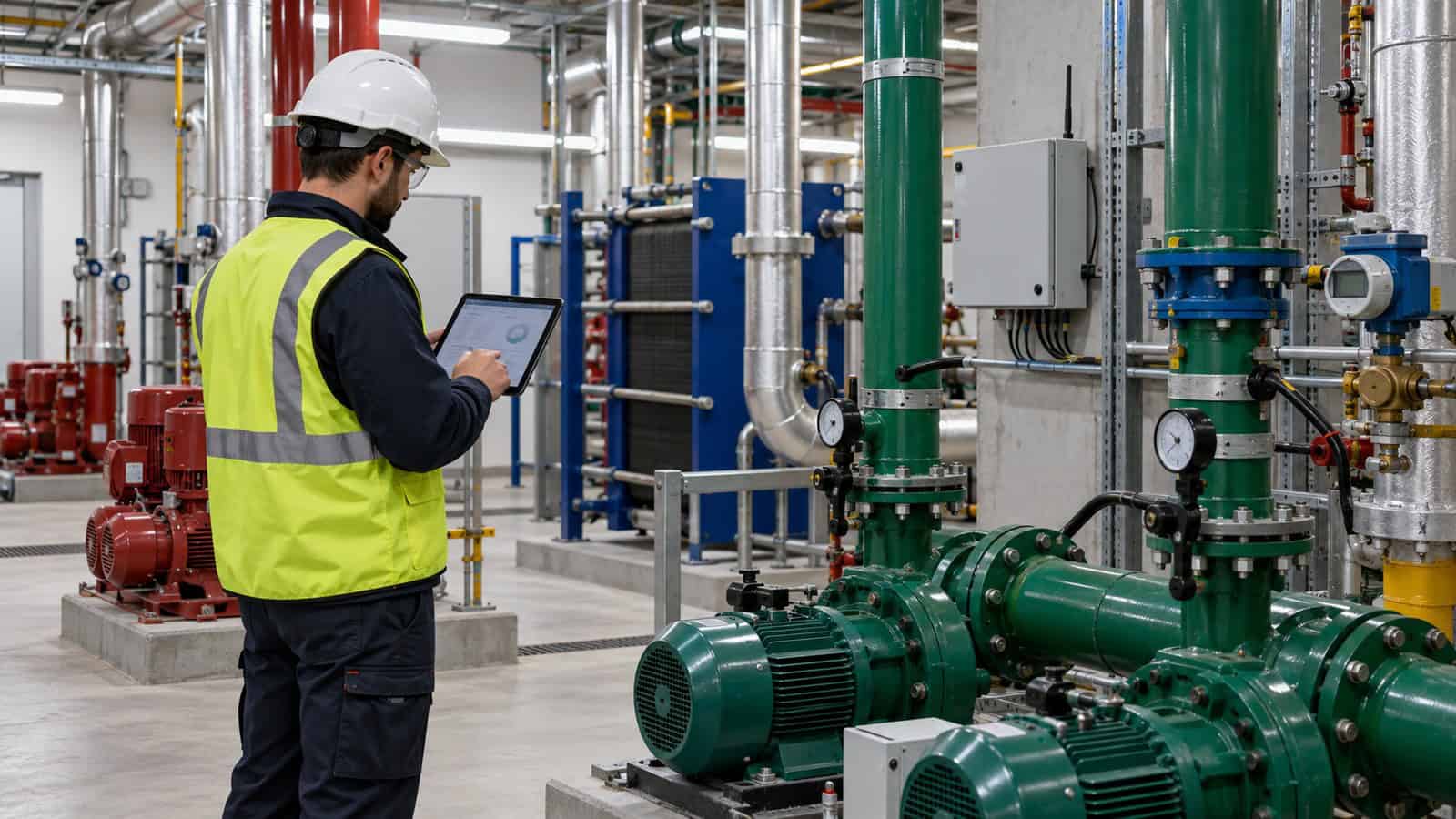
Robustel’s Armstrong Fluid Technology case study uses the R2010 and gives a useful field reference for the wider building problem: plant rooms with limited IT access need a managed path to cloud analytics. An EG5100 design can follow that connectivity principle, with protocol functions defined and tested in the actual integration application.
The Robustel video about “Where Is Edge Computing Actually Used in Industrial IoT?” is useful before the protocol workshop because it helps facilities, IT and integrator teams place local processing inside a real operating architecture. The workshop should finish with the EG5100-specific point contract and benchmark, not with a generic edge use case.
A practical point contract
- unique asset and point identifiers;
- engineering unit and scaling;
- source timestamp and gateway receipt time;
- quality state and reason code;
- expected update interval;
- behaviour after counter rollover or device restart; and
- owner of corrections.
Separate Local Continuity From Cloud Presentation
Decide what the site should continue doing when the WAN is absent. Collection and buffering may remain local if the deployed application supports them, while the remote dashboard becomes stale. Control loops that protect plant should normally remain in the approved BMS or controller unless the edge application has been explicitly engineered and validated for that role.
Run a WAN-loss test long enough to fill a meaningful buffer, then restore service and observe replay alongside live data. Confirm that dashboards preserve event order and do not double-count energy.
How the Robustel EG5100 Edge Computing Gateway Fits Building Energy Data Collection
The Robustel EG5100 edge computing gateway provides a 792 MHz Cortex-A7, 1 GB DDR3 and 8 GB eMMC with RobustOS Pro based on Debian 11. It supports Docker, two Fast Ethernet ports, dual-SIM 4G, two configurable RS-232/RS-485 ports, 2 DI and 2 DO, plus optional Wi-Fi, Bluetooth or GNSS variants. This is enough for many modest protocol-bridge, buffering and preprocessing workloads, subject to a benchmark of the actual application.
Use Robustel RCMS platform for supported device configuration, fleet visibility and updates. Keep meter accuracy, point quality and dashboard logic in the energy application and its data-governance process.
Benchmark the Data Path Under Maintenance Conditions
Run the full point count and intended sample rates while the gateway performs normal management traffic and log rotation. Measure CPU, memory, storage growth, serial timeouts and northbound latency. Then restart the container, remove one meter and update a mapping. A building system spends far more time in these imperfect states than in a clean demonstration.
The acceptance report should show which readings remained trustworthy, what the dashboard displayed and how an engineer restored service without losing the mapping. That is the real test of an edge gateway in building energy management.
よくある質問
Q1. What is a building energy management system?
It collects and analyses energy and plant data so operators can control consumption, identify faults and verify performance. It may integrate meters, HVAC controllers, sensors, analytics and reporting tools.
Q2. What is an edge gateway in a building?
It connects local equipment to upstream systems and can run selected processing near the data source. Its exact protocol and application functions depend on the installed software.
Q3. Can Modbus data be sent to a cloud dashboard?
Yes, through a tested gateway application that reads the required registers, adds context and sends them using the cloud platform’s accepted interface. Scaling, timestamps and loss handling must be defined.
Q4. Should building controls continue without the cloud?
Critical local control should have a documented offline behaviour, usually within the approved controller or BMS. Cloud dashboards can be unavailable while safe local operation continues.
Q5. When is the Robustel EG5100 Edge Computing Gateway a good building-energy fit?
It suits compact projects needing 4G/Ethernet backhaul, configurable serial interfaces and a modest containerised integration workload. Benchmark the actual point count, protocol application and buffer before rollout.
結論
The Robustel EG5100 Edge Computing Gateway can provide a clean collection and backhaul boundary for building-energy data when the project defines the protocol application and dashboard contract separately from the hardware. The value appears when a facilities engineer can tell whether a flat line means zero consumption, stale data or a failed meter.
Begin with those operational decisions, test the incomplete states and preserve the point map. A smaller, trustworthy dataset is more useful than a large dashboard whose numbers cannot be defended.
Explore More Articles About Robustel Edge Computing Gateways



著者について
Robustel Editorial Team
The Robustel Editorial Team publishes practical articles on industrial connectivity, edge computing, LoRaWAN and device management, focusing on deployment considerations, technical limitations and long-term operation.