
5G Release 16 Router vs Release 17: What Industrial Buyers Need to Check

The Robustel R5020-Lite Industrial 5G Router provides documented 3GPP Release 16 support, making it a sensible choice when a buyer’s required bands, SA/NSA mode and operator service are available on that platform; a Release 17 label should win only when a specific implemented feature changes the project outcome.
Start with the Workload, Not the Release Number
Write the requirement in operational language: uplink bursts from cameras, periodic telemetry, branch traffic, private-network attachment or low-complexity RedCap devices. Then identify the modem and network functions needed. Without that step, “Release 17 preferred” is a version preference rather than a procurement requirement.
The Robustel video of “5G Router, 5G RedCap, or 4G: How to Choose for Industrial IoT” is useful here because it frames radio choice around workload and lifecycle. It should not be used as evidence that one model implements a particular 3GPP feature.
Turn the workload into an acceptance sheet before asking vendors for a release number. Record the expected serving mode, regional bands, sustained and burst traffic, latency-sensitive flows, fallback behaviour and who owns the mobile service. Procurement can then compare a documented modem and firmware against observable requirements instead of treating a later release label as a proxy for site performance.
What the Two Releases Change—and What They Do Not Decide
Release 16 consolidated important industrial and 5G-system enhancements. Release 17 extended the standard into additional areas, including RedCap and non-terrestrial-network work. A standard release defines specifications; commercial modems, firmware and operator networks implement selected parts on their own schedules.
| Procurement question | Release label helps? | Evidence still required |
|---|---|---|
| Is the modem generation broadly suitable? | yes | modem data and router documentation |
| Is a named feature implemented? | partly | feature statement for modem/firmware |
| Is it enabled by the operator? | no | operator and subscription confirmation |
| Will it work in the project region? | no | variant, bands and certification |
| Will the application meet its target? | no | representative field test |
Use a Decision Tree Instead of Version Chasing
If the requirement can be met by documented Release 16 radio functions, bands and interfaces, evaluate those products directly. If the requirement explicitly depends on RedCap or another Release 17 development, select a product whose documentation names that function—not merely “Release 17”. If neither requirement is written, return to the workload.
Robustel’s fixed-line backup application example shows why this matters. The service result depends on WAN policy, segmentation and recovery as well as the cellular generation. R5010 is also documented as Release 16; the application is made useful by the complete architecture, not by turning the release into a performance guarantee.
How the Robustel R5020-Lite Industrial 5G Router Fits a Release 16 Requirement
Robustel R5020-Lite Industrial 5G Router combines documented Release 16 support with 5G SA/NSA, dual SIM, two Ethernet ports and a software-configurable serial interface. That makes it a compact candidate for sites where the Release 16 platform, available bands and physical interfaces satisfy the written workload.
The next checks are variant-specific: confirm regional bands and certification, modem and firmware, operator service, antenna arrangement and fallback behaviour. Robustel RCMS platform can support fleet monitoring and configuration after selection, but it cannot make an unavailable network feature appear at the site.
The Robustel’s R5020 branch-routing application example provides a same-family view of a multi-interface 5G WAN role. Use it to define traffic and recovery tests; use the R5020-Lite documentation for the exact featured model’s interfaces and release claim.
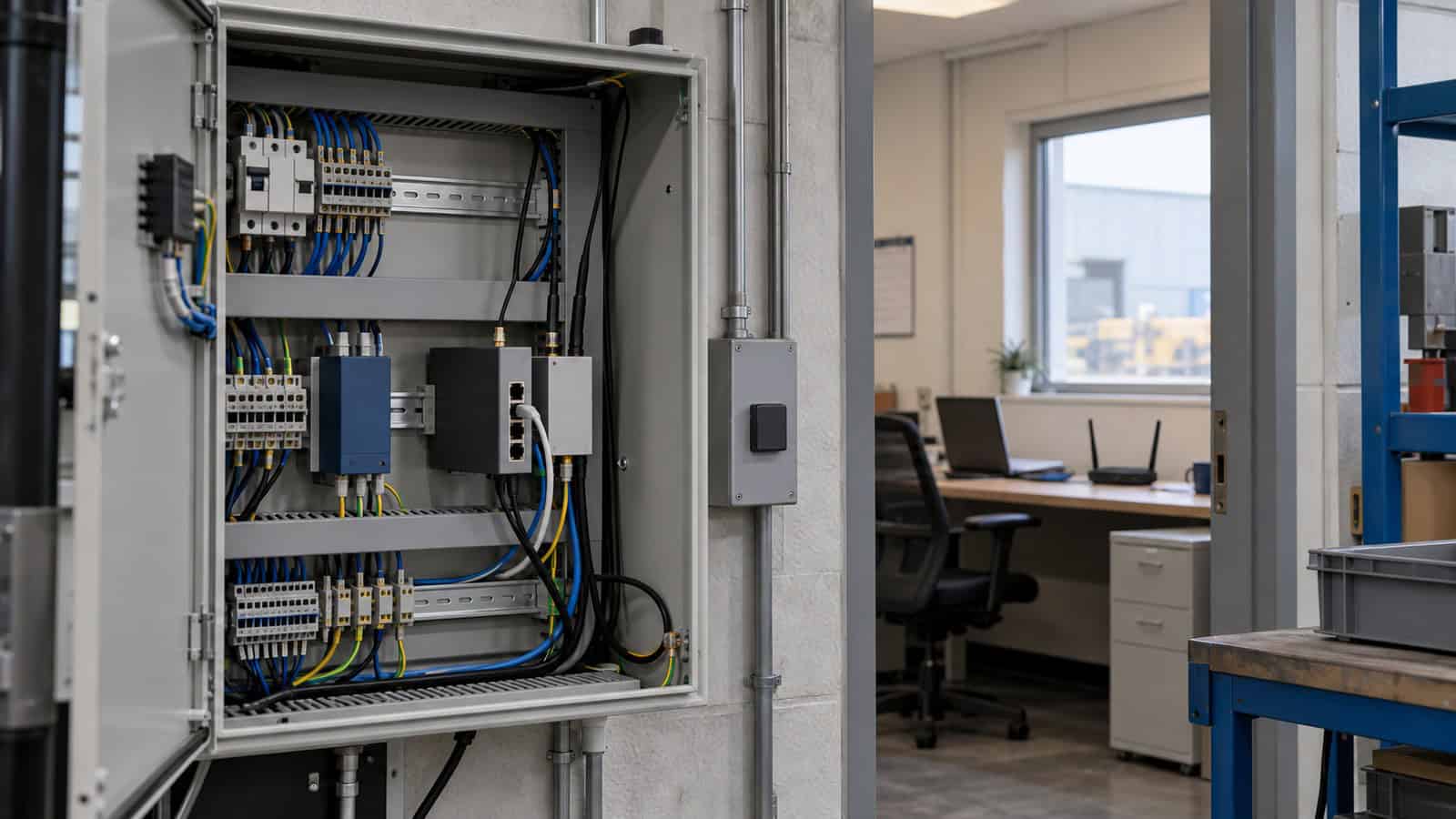
In practice, the release decision changes the evidence pack more than the cabinet layout. The network owner should supply operator and service confirmation, the integrator should retain the exact order code and firmware, and the application owner should define the traffic test. Robustel R5020-Lite is a proportionate choice when that Release 16 evidence closes the workload; it is not necessary to pay for an unneeded later-generation function simply to make the specification look newer.
Write an Acceptance Test Around Outcomes
Record the serving mode and bands, sustained and burst application behaviour, failover, remote access and recovery after a controlled interruption. If a feature is named in the requirement, add an observable test for that feature and state who supplies the supporting operator configuration.
A useful acceptance record also states what was not exercised. This prevents a pilot on one NSA network from being reused as evidence for an untested SA or private-network design.
Close the test with a signed list of the modes, bands and recovery conditions actually observed, plus the software and operator configuration used. If the planned deployment includes another operator, geography or private network, keep that item open rather than inheriting the pilot result. The owner of the outstanding network evidence should be named before purchase approval.
よくある質問
Q1. What is 3GPP Release 16?
It is a stage in the 3GPP specifications that develops 5G system and radio capabilities beyond the initial Release 15 baseline. Products implement selected functions through their modem, firmware and network support.
Q2. What changed in 5G Release 17?
Release 17 extended 5G into areas including RedCap and non-terrestrial networks, alongside other improvements. Availability still depends on product and operator implementation.
Q3. Is Release 17 required for RedCap?
RedCap was specified in Release 17. Buyers should look for an explicit RedCap product statement and supported network, not infer it from a general release label.
Q4. Does a newer 5G release make a router faster?
Not by itself. Throughput is influenced by modem category, bands, spectrum, signal, network loading, antennas, routing and the application path.
Q5. When is the Robustel R5020-Lite Industrial 5G Router the right Release 16 choice?
It fits when its documented Release 16 platform, bands, interfaces and regional variant meet the workload and pass a test on the intended operator network.
結論
The Robustel R5020-Lite Industrial 5G Router is a credible Release 16 choice for compact industrial and branch sites whose actual requirement is already supported by its documented radio and interface platform. Buying a higher release number without a named feature adds no usable acceptance criterion.
Put every release-driven requirement beside a product statement, operator confirmation and observable test. That makes the standard useful to procurement while keeping the deployment decision grounded in what the selected router and network can actually do.
Explore More Articles About Robustel 5G Routers



著者について
Robustel Editorial Team
The Robustel Editorial Team publishes practical articles on industrial connectivity, edge computing, LoRaWAN and device management, focusing on deployment considerations, technical limitations and long-term operation.