
How to Add Wireless Sensors to an Existing BMS Without Rewiring
Need more temperature, humidity, air quality, occupancy, leak or metering data from an existing building — but don’t want to start opening ceilings and running new cables?
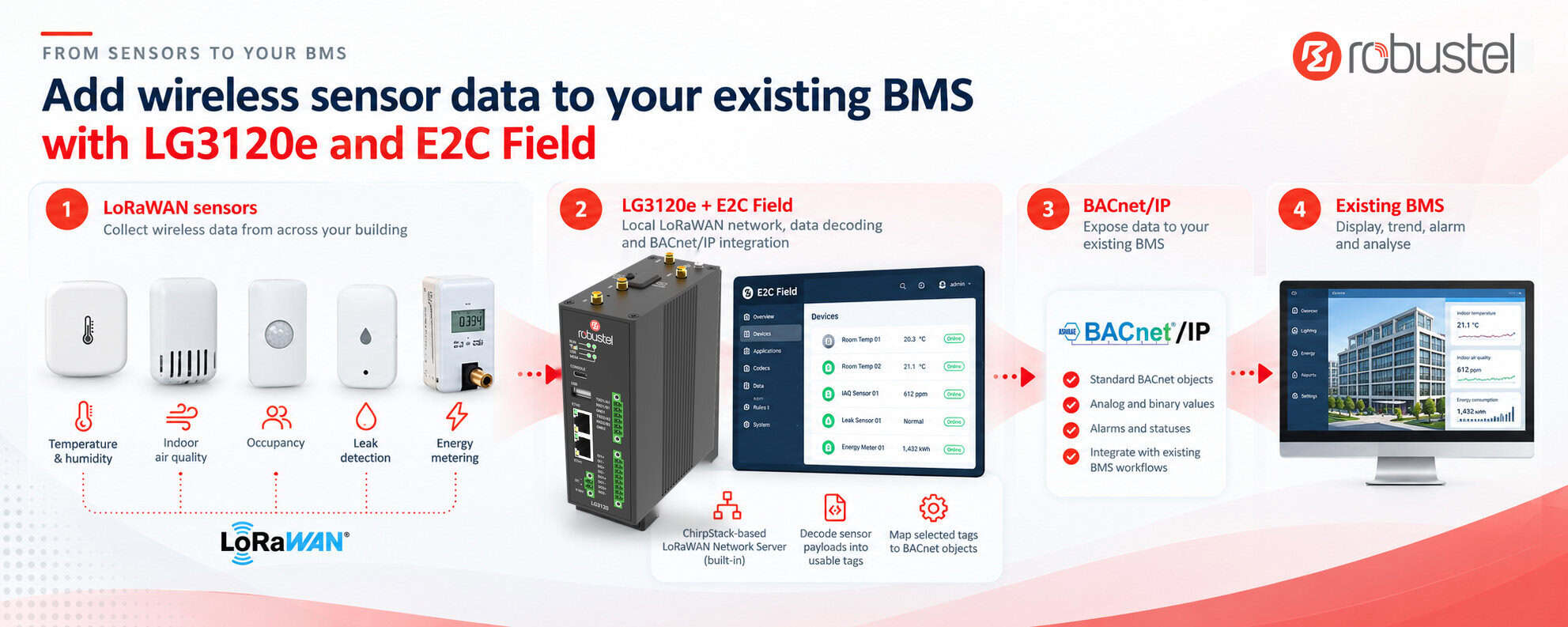
LoRaWAN® sensors can add new monitoring points while allowing the existing Building Management System (BMS) to remain in place. Using the Robustel LG3120e LoRaWAN Gateway with E2C Field, sensor data can be collected wirelessly, decoded locally and presented to an existing BMS through BACnet/IP.
For building owners, facilities teams and BMS integrators, this creates another option when useful data is missing but conventional rewiring would be difficult, disruptive or disproportionately expensive.
Why this may be useful for your building or project
- Add monitoring without replacing the existing BMS
- Reduce the amount of new sensor cabling required in retrofit projects
- Bring LoRaWAN sensor data into BACnet/IP environments
- Start with a small area or specific operational problem before expanding
- Create a repeatable integration model for additional rooms, floors or buildings
Why add wireless sensors to an existing BMS?
Buildings change over time, but their management systems often remain in service for many years.
A facilities team may later need better visibility of room temperature and humidity, indoor air quality, occupancy, leaks, additional metering or plant-room conditions that were never included in the original BMS design.
The problem is often not the BMS itself. It is simply that the required measurement does not exist.
Adding a conventional wired sensor can involve far more than the cost of the sensor. Cable routes, ceiling access, occupied spaces, containment, labour and commissioning all contribute to the installed cost.
Wireless sensing provides another route.
Battery-powered LoRaWAN sensors can communicate with a gateway without requiring a dedicated communications cable to every new measurement point. This can be particularly useful in retrofit projects where installing new wiring is difficult or disruptive.
Wireless does not eliminate engineering. Radio coverage, sensor placement, battery maintenance, gateway power and network connectivity still need to be considered.
The right comparison is therefore not simply wireless sensor versus wired sensor. It is the complete installed and lifecycle cost of both approaches.
Keep the BMS. Extend what it can see.
One of the most useful characteristics of this architecture is that the existing BMS can remain the environment operators already know.
The wireless layer adds new measurements rather than attempting to replace the existing building-control system.
The data path is straightforward:
LoRaWAN sensor → LG3120e → E2C Field → BACnet/IP → existing BMS
The LG3120e industrial LoRaWAN gateway combines LoRaWAN connectivity with local edge processing and can run E2C Field directly on the gateway.
E2C Field includes a ChirpStack-based LoRaWAN Network Server, allowing devices to be managed locally without requiring a separate external LNS for this architecture. Sensor payloads are decoded into usable values, or tags, which can then be mapped to BACnet objects.
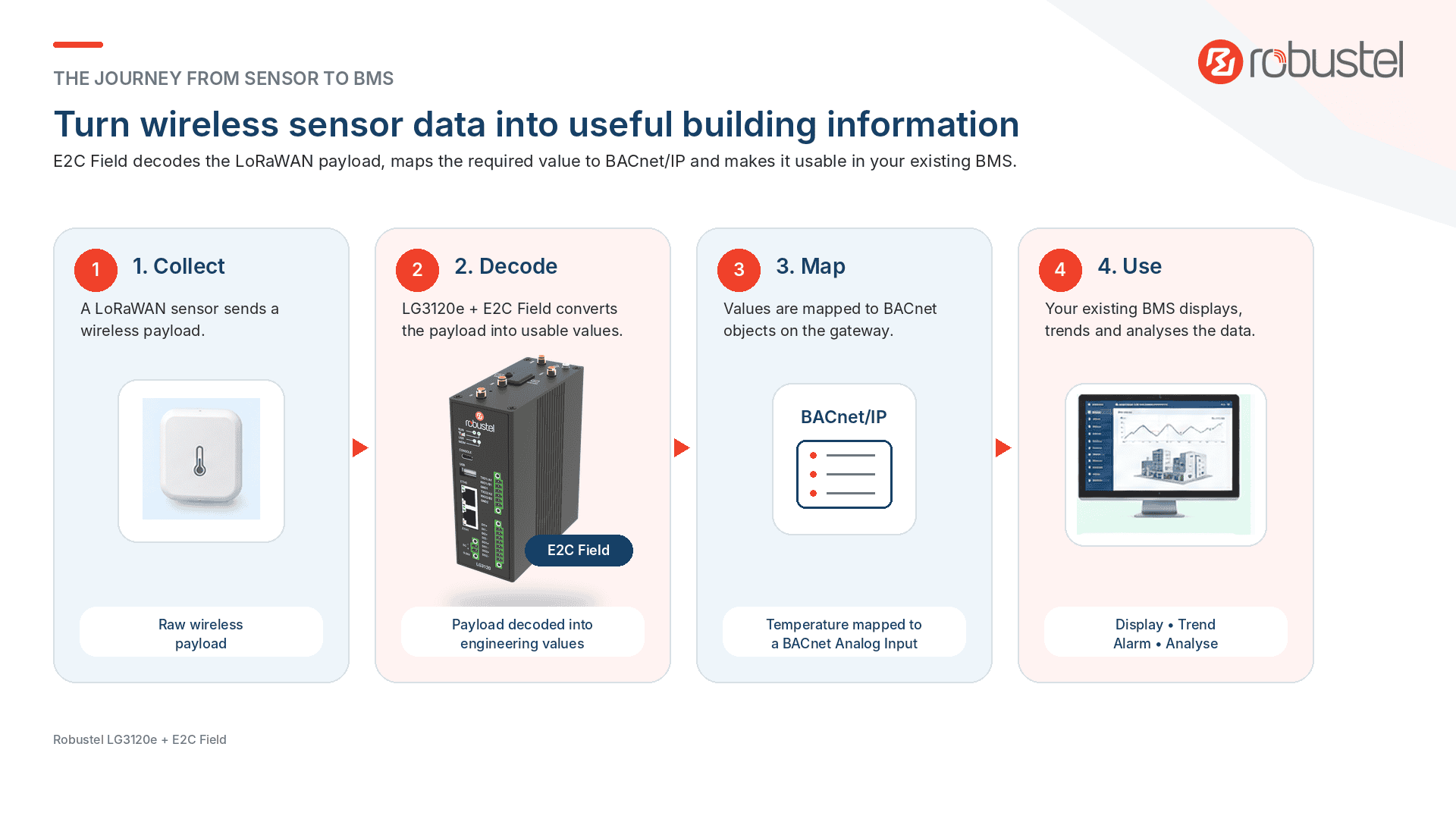
A wireless room-temperature reading, for example, can be presented to the BMS as a BACnet Analog Input and then used for visualisation, trending or other building-management functions.
Connecting a LoRaWAN sensor is only half the job
This is where wireless BMS projects can become more complicated than they first appear.
A LoRaWAN gateway can receive a message from a sensor, but that does not automatically mean the BMS understands the information inside it.
A sensor may transmit an encoded payload containing temperature, humidity, battery status or several other measurements. A payload codec is used to translate that message into usable engineering values.
E2C Field provides pre-integrated codecs for supported devices, reducing the amount of custom decoding required.
For other sensors, an appropriate codec may need to be obtained, converted or developed and then tested. The exact sensor model, firmware, radio region, device profile and payload format should therefore be confirmed rather than assuming that every LoRaWAN device will automatically produce usable application data.
That distinction matters for integrators planning a repeatable solution rather than simply proving that two devices can communicate.
BACnet integration still needs proper commissioning
Once sensor data has been decoded, selected values can be presented to the building system through the gateway’s BACnet/IP Server.
At that point, the normal disciplines of BMS integration still apply.
Object naming, engineering units, scaling, update intervals, alarm requirements and the treatment of stale or unavailable readings should all be agreed during commissioning.
BACnet provides a standard way for the systems to exchange information, but it does not remove the need to validate the behaviour of the complete integration.
Robustel provides a dedicated technical guide showing how LoRaWAN device data can be decoded by E2C Field and forwarded to a BACnet/IP system.
Where can wireless BMS monitoring make sense?
There is no universal rule that wireless is better than wired.
It becomes particularly interesting where obtaining the measurement conventionally creates disproportionate cost or disruption.
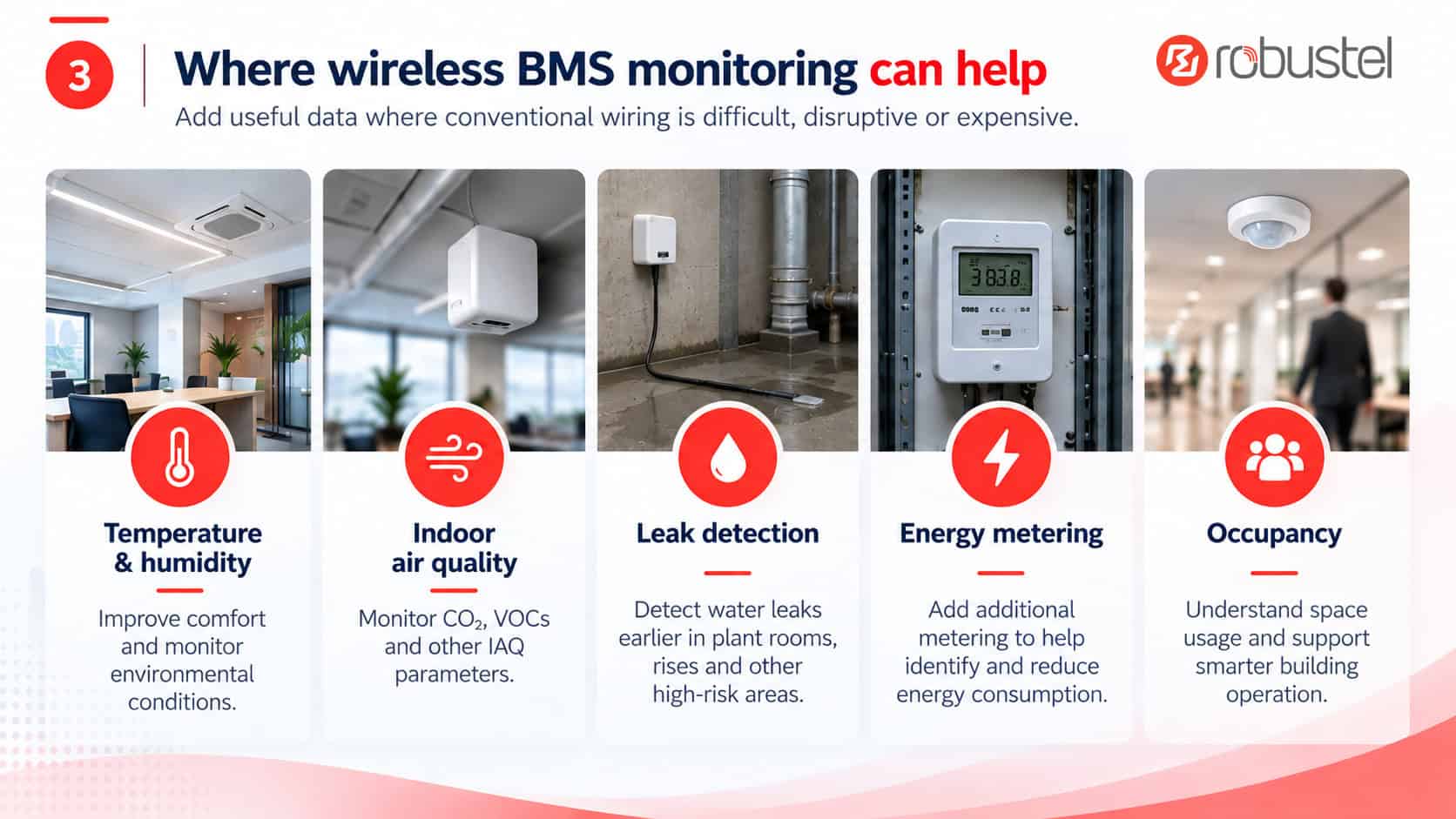
Typical examples include occupied offices, hotels, apartments, hospitals or commercial buildings where new cabling would require significant access work; plant rooms, risers and other difficult-to-reach areas; additional indoor-air-quality monitoring; energy and utility metering; and pilot projects where a facilities team wants to establish the value of additional data before committing to a larger deployment.
Design for repeatability, not just the first sensor
Connecting one wireless sensor is relatively straightforward.
The bigger commercial question for an integrator is what happens when the project becomes 50 sensors, 500 sensors or multiple buildings.
Once a combination of sensor profile, payload codec, naming convention and BACnet mapping has been validated, that engineering can become a reusable template for subsequent deployments.
E2C Field supports prepared device information and automated creation of devices and tags for supported sensors, helping reduce repetitive configuration during larger deployments.
The objective is not simply faster commissioning.
It is repeatable commissioning.
That can turn an individual integration project into a solution that can be deployed consistently across additional rooms, floors, properties or customer sites.
What happens if the internet connection fails?
For a local BMS integration, the sensor-to-building data path does not inherently need to depend on the public internet.
With the LG3120e powered and the local building network operating, the local path between LoRaWAN sensors, E2C Field and the BMS can continue even if the WAN connection is unavailable.
Where data is also being sent to a cloud platform, E2C Field supports local buffering and configured store-and-forward behaviour.
Cloud recovery and BMS history should, however, be treated separately. Storage capacity, reporting frequency, configuration and outage duration affect what can be retained, while historical recovery inside the BMS depends on the behaviour of the BMS or historian itself.
That should be tested during commissioning rather than assumed.
Start with the business problem, not the sensor
A useful BMS retrofit project should begin with a question.
Why are certain rooms uncomfortable after 3pm?
Where is unexplained overnight energy consumption coming from?
Can water leaks be detected earlier in areas the BMS does not currently monitor?
Do conditions in a plant room explain recurring equipment alarms?
The sensor is there to provide evidence.
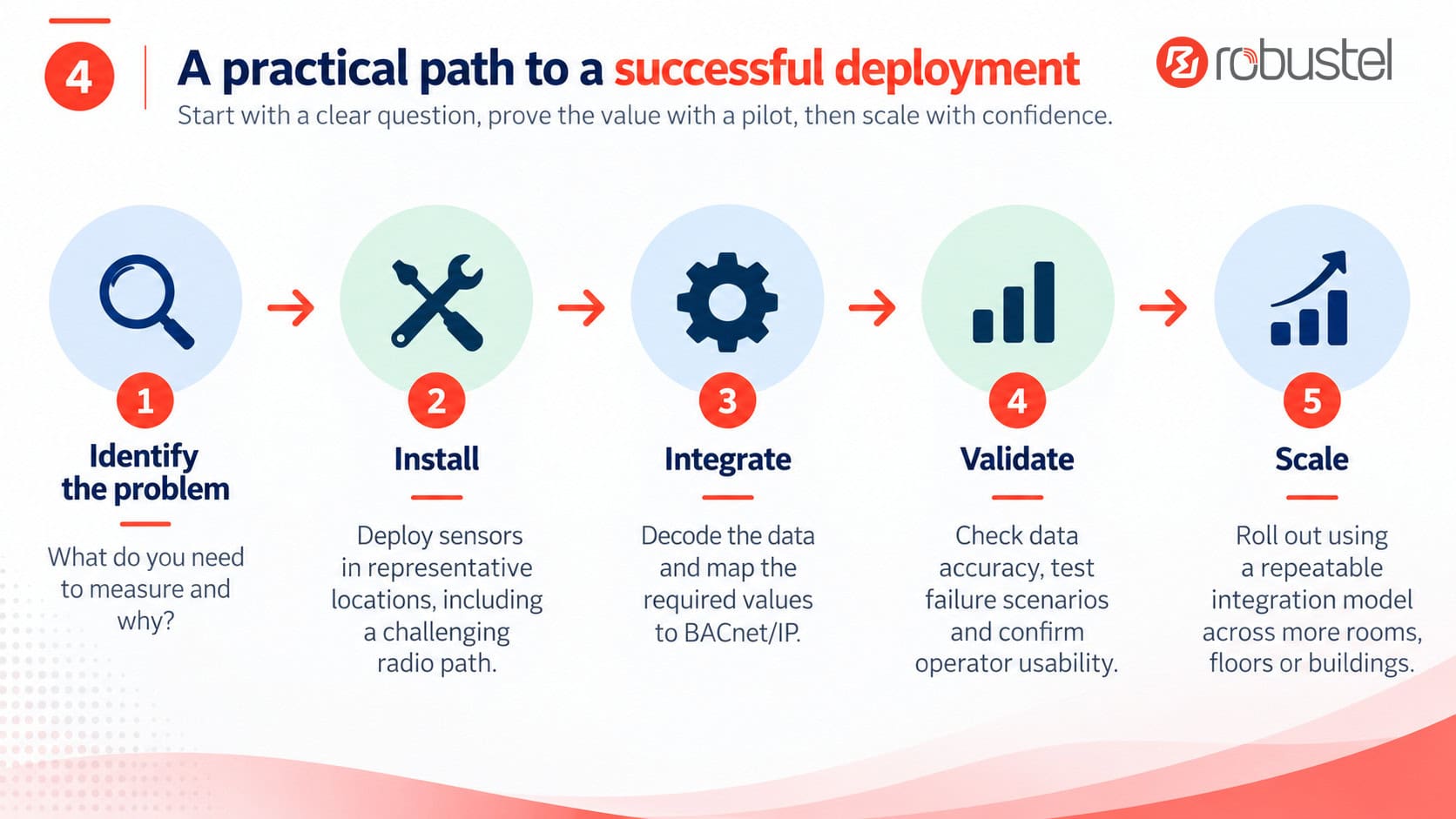
A sensible pilot might therefore cover one floor, one troublesome area or one operational problem rather than attempting to instrument an entire building immediately.
During the pilot, choose representative locations, including at least one challenging radio path. Validate the sensor readings against a trusted reference, confirm that the values are decoded correctly, map the required points into the BMS and make sure operators can actually identify and use the new information.
It is also worth deliberately testing sensor loss, gateway restart and WAN interruption so that stale-data and recovery behaviour are understood before the architecture is scaled.
If the pilot produces useful information at an acceptable lifecycle cost, the same integration model can then be expanded.
Can wireless devices also be controlled through the BMS?
Potentially, but monitoring and control should not be treated as the same problem.
Supported writable points can allow commands to be sent to compatible devices, but the device and its codec must support the required operation.
LoRaWAN device behaviour can also affect when a device is available to receive commands, so response time and fail-safe behaviour need to be validated carefully before wireless control is incorporated into an operational sequence.
For many retrofit projects, monitoring first and introducing control only where there is a clear requirement is the more practical approach.
Extending an existing BMS without starting again
A building does not necessarily need a new BMS simply because more data is required.
LoRaWAN sensors can add a wireless measurement layer, while the LG3120e and E2C Field provide the bridge between wireless devices and an existing BACnet/IP environment.
The real value is not simply avoiding cable.
It is being able to add useful measurements where obtaining them was previously difficult, integrate those measurements into existing operational workflows and create an architecture that can be repeated if the pilot proves worthwhile.
Planning a wireless BMS retrofit?
Start with three questions:
- What do you need to measure?
- Where do you need to measure it?
- What interface does the existing BMS provide?
From there, Robustel and our integration partners can help determine whether LoRaWAN, the LG3120e and E2C Field are appropriate for the project.