
SIP Registration vs VoLTE Fallback Troubleshooting for Lift Gateways
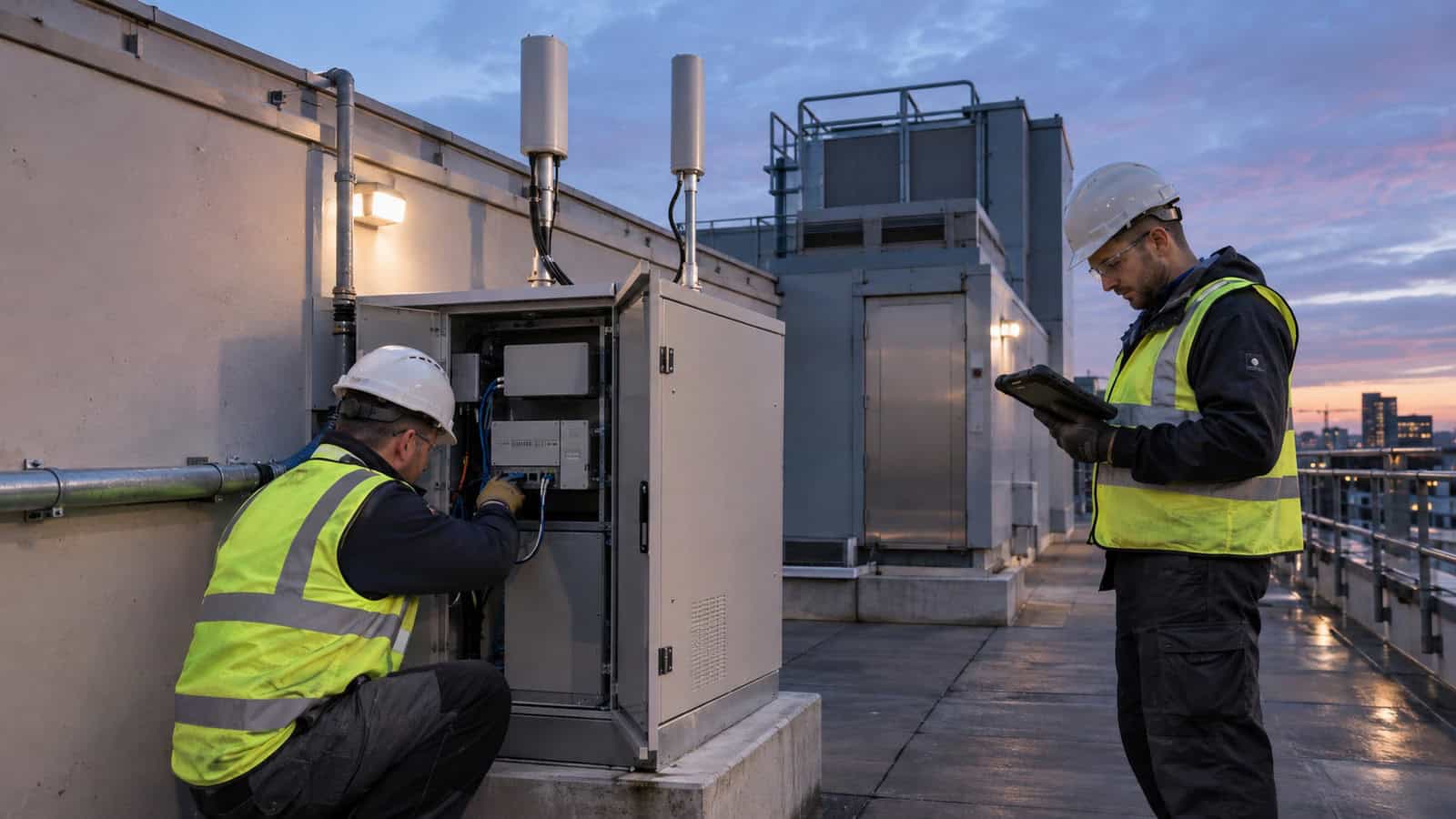
The Robustel EV8100 Elevator Voice Gateway supports SIP-based VoIP and VoLTE as a backup voice line, but troubleshooting must keep SIP registration, IP reachability, SIM attachment, VoLTE service and call routing as separate states. One green indicator cannot prove that a passenger call will reach the monitoring centre through the intended route.
Begin with a supervised test plan and a known-good baseline. Do not force a failure or alter call routing on an active emergency service without authorisation, a maintenance window and an alternative safety arrangement.
Draw the two call paths before diagnosing
The SIP path normally requires local phone seizure, gateway dial plan, IP service, DNS where used, reachability to the SIP platform, successful registration/authentication and routing to the monitoring centre. The VoLTE path requires mobile registration, IMS/VoLTE service, carrier voice routing and the configured gateway decision to use it.
The Robustel EV8100 Quick Pitch video helps stakeholders understand the gateway role. The project must then document its actual primary and fallback routing; the presence of both capabilities does not prove automatic behaviour.
Use a state matrix instead of one status light
| State | Evidence | What it proves | What it does not prove |
|---|---|---|---|
| cellular registered | operator/network/IMS status | modem attached to mobile service | SIP or VoLTE call routing |
| IP address and DNS | reachability tests | data path available | SIP credentials accepted |
| SIP registered | platform registration and expiry | account/session accepted | media or destination routing |
| VoLTE available | carrier/IMS and test-call evidence | voice service possible | gateway will select it when SIP fails |
| FXS off hook | line event/current | phone seized gateway | external call completed |
| call connected | monitoring-centre record and two-way audio | end-to-end service for that test | future automatic recovery |
Capture the matrix during normal operation so fault-state differences are visible.
Diagnose SIP registration independently
Check gateway clock, WAN route, DNS, server address/port/transport, credentials, registration expiry, certificate/time conditions for secure SIP and provider response codes. A successful ping to the internet is not proof that the SIP endpoint, port and policy are reachable.
If SIP registers but calls fail, inspect dial plan, called number, codec/media path, NAT/firewall, DTMF and monitoring-centre routing. Keep credential values out of screenshots and support tickets.
Robustel’s EV8100 and Tsaro case study demonstrates the value of daily end-to-end call records. Registration monitoring should be one input to that proof, not the final result.
Verify VoLTE as a distinct carrier service
Confirm the exact SIM, plan, carrier, device variant, firmware and VoLTE provisioning. Mobile data working does not establish IMS voice service. Make a supervised VoLTE test using the approved route before testing failure behaviour.
| Symptom | Possible domain | Discriminating check |
|---|---|---|
| data works, VoLTE call fails | SIM plan/IMS/carrier/route | carrier provisioning and supervised voice call |
| SIP fails, no fallback call | gateway routing/configuration or VoLTE unavailable | path-selection log plus manual path tests |
| fallback call connects, ID fails | DTMF/number/monitoring routing | end-to-end identification test |
| service does not return to SIP | failback policy/session recovery | registration and routing timeline |
Do not assume the gateway should fall back for every SIP failure. A DNS error, authentication rejection and media failure may be treated differently by the configured logic. Verify the intended trigger and timing with the exact firmware and provider design.
How Robustel EV8100 Elevator Voice Gateway supports supervised recovery
The Robustel EV8100 Elevator Voice Gateway supplies one FXS interface, SIP over UDP, SIPS/SRTP, VoLTE capability, dual SIM and RCMS-enabled monitoring. These capabilities allow primary and backup voice paths to be designed and observed while retaining an existing analogue phone.
| Site need | Verified Robustel EV8100 capability | Operational effect | Acceptance evidence |
|---|---|---|---|
| preserve analogue phone | FXS interface | separate car phone from external voice transport | seizure, audio and digit test |
| provide IP/cellular voice options | SIP/VoIP plus VoLTE backup capability | define route selection and recovery | witnessed primary/fallback calls |
| observe fleet condition | RCMS call/status functions where configured | centralise events and scheduled tests | timestamped call and fault logs |
Robustel’s IoT-enabled smart elevators application example illustrates a managed voice and data architecture. The project’s carrier and monitoring providers still control whether each route works end to end.
Run a supervised recovery sequence
Start with a normal SIP call. Introduce only the approved SIP-path failure while keeping cellular/VoLTE healthy, then observe failure detection, route selection, dialling, identification, audio and call clearance. Restore SIP and verify stable registration and the intended failback policy.
Repeat with a cellular impairment only if the safety plan, carrier and site procedure allow it. Record every timestamp and residual outage. A call that connects after several manual interventions is useful diagnostic evidence but not automatic fallback acceptance.
Häufig gestellte Fragen
Q1. What does SIP registration mean?
It means the SIP platform has accepted the endpoint’s registration for a period. It does not prove that call routing, media, DTMF or the monitoring destination work.
Q2. Can VoLTE work when mobile data is unavailable?
It depends on carrier provisioning, network conditions and device design. VoLTE uses the carrier’s IMS voice service and should be tested as a distinct path rather than inferred from general data status.
Q3. Why can a SIP account register but calls still fail?
Dial plan, destination routing, codec negotiation, NAT/firewall, media ports, DTMF or the monitoring centre can fail after registration succeeds.
Q4. How should voice fallback be tested?
Prove each path independently, then introduce one approved failure and measure route selection, call completion, identification, two-way audio and recovery. Restore the primary path and verify stable failback.
Q5. How does the Robustel EV8100 Elevator Voice Gateway separate SIP and VoLTE paths?
It supports SIP-based VoIP and VoLTE backup capability behind an FXS interface. The exact fallback triggers, timing, carrier service and monitoring-centre routing must be verified on the deployed configuration.
Schlussfolgerung
The Robustel EV8100 Elevator Voice Gateway is best suited to lift-phone designs that need an analogue FXS boundary with separately testable SIP and VoLTE-capable voice routes. Its status and management functions help observation, but only a supervised call proves the complete chain.
Diagnose registration, IP, IMS/VoLTE, routing, DTMF and audio as distinct states, then run one controlled failure at a time. Accept fallback only when the intended trigger and end-to-end recovery are recorded.
Explore More Articles About Robustel Lift Connectivity




Über den Autor
Robustel Editorial Team
The Robustel Editorial Team publishes practical articles on industrial connectivity, edge computing, LoRaWAN and device management, focusing on deployment considerations, technical limitations and long-term operation.