
PSTN Replacement Lift Phone Guide: 4G, VoLTE and SIP Migration Options
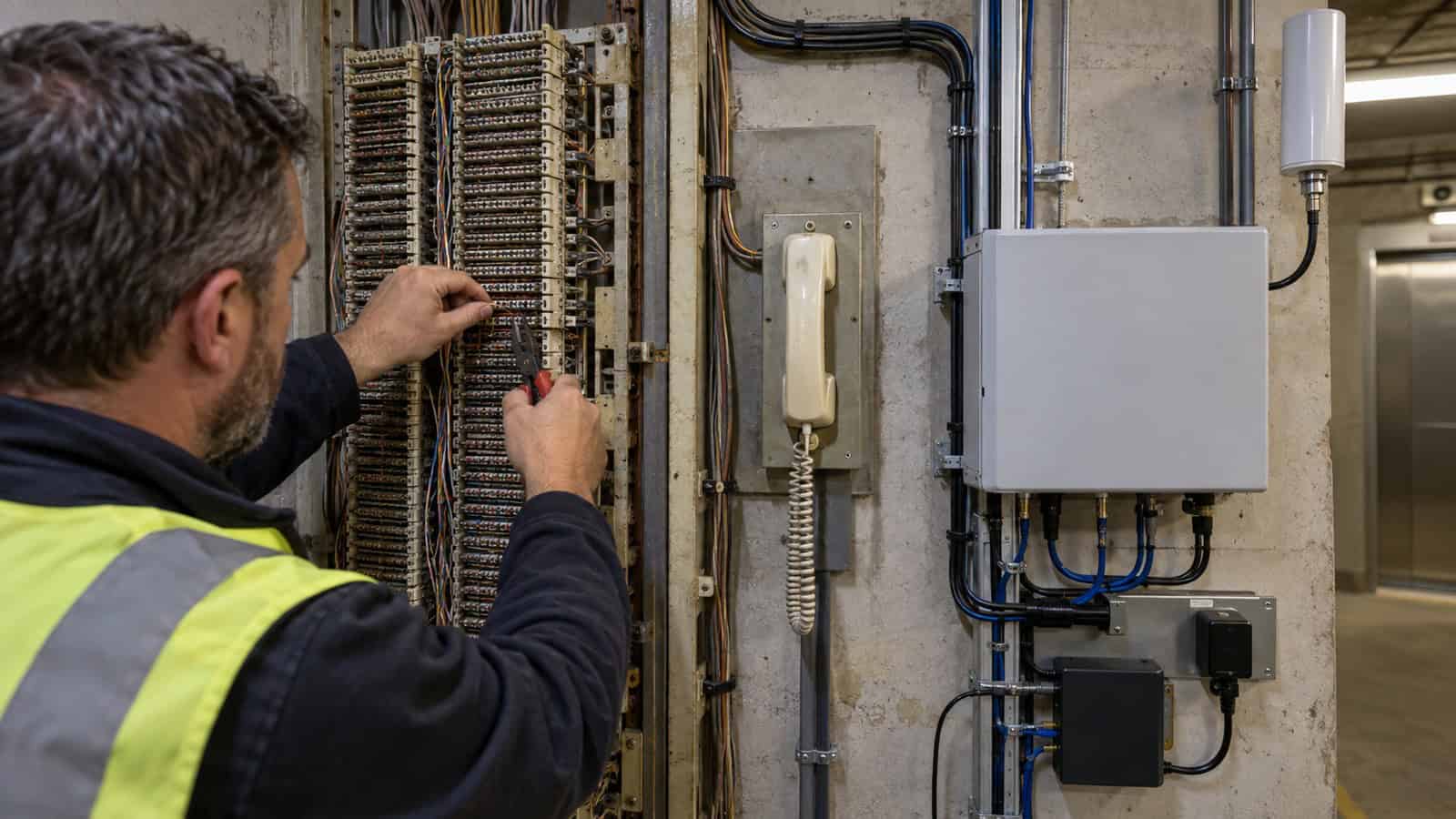
The Robustel EV8100 Elevator Voice Gateway can preserve a compatible analogue lift phone through its FXS port while moving the transmission path to SIP/VoIP or mobile voice. That makes it relevant to portfolios still carrying copper lines, NBN-era adapters or inconsistent retrofit arrangements. Migration should be positioned as a residual standardisation task—not as a new shutdown event—and every site still needs handset, DTMF, caller-ID, power and monitoring-centre checks.
Choose One of Three Migration Patterns
Preserve the Analogue Handset, Change the Transport
This is often the least disruptive pattern. The existing lift autodialler remains connected to an FXS port, while the gateway carries voice over the selected IP or mobile service. It can avoid replacing the car equipment, but only if loop conditions, dialling and identification remain compatible.
Move to a SIP-Centred Service
The gateway connects to a managed SIP platform, usually through cellular or Ethernet data. This can make service routing and central management more consistent. It also introduces dependencies on credentials, NAT, DNS, the SIP server and the data path. Those elements need monitoring and expiry management.
Use a Cellular Voice Path
VoLTE can provide a mobile-network voice route where the exact device, SIM, firmware and carrier profile support it. Generic 4G data registration is insufficient evidence. The building still needs usable RF and a defined response to loss of the preferred network.
Many projects use a primary and backup combination rather than choosing only one label. Document which path carries normal calls and how the alternate is selected.
Audit the Existing Portfolio Before Standardising
Create a site register covering handset/autodialler model, line type, DTMF, caller identification, monitoring-centre destination, signal environment, power, battery, machine-room access and current test process. Group sites by migration pattern rather than forcing one wiring assumption across the portfolio.
Use those groups to set deployment waves. Start with a representative but recoverable cohort, keep unusual autodiallers and difficult RF sites visible as exceptions, and do not let the easiest ten installations define the budget for the remaining estate. A portfolio programme needs an exception rate, a rework allowance and a named authority for approving a different migration pattern.
Old analogue equipment can behave differently behind an FXS gateway. Test answer supervision, call clearing and retries, not only the first connection. A false successful call that does not clear correctly can tie up the line or create repeat alarms.
Robustel’s EV8100 PSTN replacement application example gives exact-model architecture guidance for this transition. It explains the role of the FXS interface and modern voice transport. It does not promise drop-in compatibility with every legacy handset or building.
Keep the Monitoring Centre in the Design Loop
Confirm destination numbers, site identity, DTMF or data exchange, two-way speech, return calls and escalation. If the migration changes caller ID or SIP routing, update records before live cutover. Schedule test calls so operators recognise them.
The monitoring provider should help define evidence for acceptance and periodic operation. A gateway dashboard cannot replace the centre’s call record.
How the Robustel EV8100 Elevator Voice Gateway Supports PSTN Replacement
The Robustel EV8100 Elevator Voice Gateway provides one FXS port with documented loop characteristics, SIP/VoIP support, VoLTE as a backup voice line, dual physical SIMs, Ethernet and industrial monitoring interfaces. It supports RCMS and a Debian-based operating environment.
This allows one managed device to bridge a compatible analogue phone, voice transport and selected lift status signals. The ports do not prove a controller integration; RS-232, RS-485, CAN, DI and relay use must be documented for the exact lift system and application.
For Australian work, select the exact ANZ order code and verify current RCM and project evidence. Battery cells are not included by default, and the documented operating/charging ranges change when batteries are present. The integrator must own cell selection, runtime and replacement.
Plan Cutover and Rollback as One Job
Bench-test the representative handset and service. At site, survey RF, install the gateway, complete calls and record the result before removing or cancelling the former service. Keep a safe rollback path until the monitoring centre and responsible party accept the new route.
Another Robustel’s application example, the IoT-Enabled Smart Elevators application example, shows how EV8100 can support voice alongside managed lift data. That can create a stronger long-term service model, but it should not expand the migration scope before the emergency call itself is proven.
Standardise Operations After the Hardware
Use one naming convention, configuration baseline, SIM ownership model and evidence pack across the portfolio. Robustel RCMS platform can support gateway inventory, signal and configuration work. Maintain separate ownership for monitoring-centre records, battery maintenance and periodic call tests.
| Evidence | Gateway/RCMS can support | Separate service required |
|---|---|---|
| online state and signal | yes, at gateway level | correlate with application/call status |
| firmware and configuration | yes | organisational approval and rollback |
| successful two-way call | no assumption | monitoring-centre/test system record |
| battery condition/runtime | not implied | approved battery inspection and test |
| lift-system compliance | component evidence only | complete installed-system assessment |
The Robustel EV8100 Quick Pitch video beow is suitable for early stakeholder education. Site compatibility and test evidence decide the migration.
Häufig gestellte Fragen
Q1. What is PSTN replacement?
It is the migration of services that relied on traditional analogue telephone lines to modern IP or mobile networks, often using a gateway so compatible legacy equipment can remain in service.
Q2. Is PSTN being phased out?
Many markets have retired or transformed legacy copper voice services, but timing and residual arrangements vary. Treat each lift line as an asset to audit rather than relying on a general national headline.
Q3. What is PSTN for phones?
The public switched telephone network historically provided analogue line voltage, dialling and voice transport to fixed phones and autodiallers. Replacement designs must recreate the functions the connected equipment actually uses.
Q4. Can elevator phones be cellular?
Yes. A cellular voice gateway can connect an analogue lift phone or support an IP voice design. The building’s RF, power, carrier profile and monitoring workflow must be verified.
Q5. Can the Robustel EV8100 Elevator Voice Gateway be installed as a universal drop-in PSTN replacement?
No universal fit should be assumed. Its FXS, SIP/VoIP and VoLTE capabilities support migration, but every handset, wiring, DTMF, caller-ID, carrier and monitoring-centre combination needs validation.
Schlussfolgerung
The Robustel EV8100 Elevator Voice Gateway supports a repeatable path away from legacy lift-phone lines while preserving compatible analogue equipment and adding managed IP/mobile voice options. It is most useful when the portfolio is grouped by real handset and service conditions rather than treated as one identical retrofit.
Audit first, choose the migration pattern explicitly, involve the monitoring centre and keep rollback until calls are accepted. Once the emergency path is stable, central management and lift data can improve operations without confusing connectivity with proof of service.
The scalable outcome is not one universal wiring diagram; it is a small set of controlled patterns with known exceptions, evidence packs and owners. Track first-time acceptance, repeat visits, unresolved handset incompatibilities and ongoing line savings by pattern. Those measures show whether the migration is reducing portfolio risk rather than simply moving recurring cost from a PSTN invoice into support labour.
Explore More Articles About Robustel Lift Connectivity


Über den Autor
Robert Liao | Technical Support Engineer
Robert is an IoT Technical Support Engineer at Robustel, specializing in industrial networking and edge connectivity. A certified Networking Engineer, Robert focuses on the deployment and troubleshooting of large-scale IIoT infrastructures. His work centers on architecting reliable, scalable system performance for complex industrial applications, bridging the gap between field hardware and cloud-side data management.