
LoRaWAN Gateway Price and TCO Guide: Hardware, Backhaul and Fleet Management
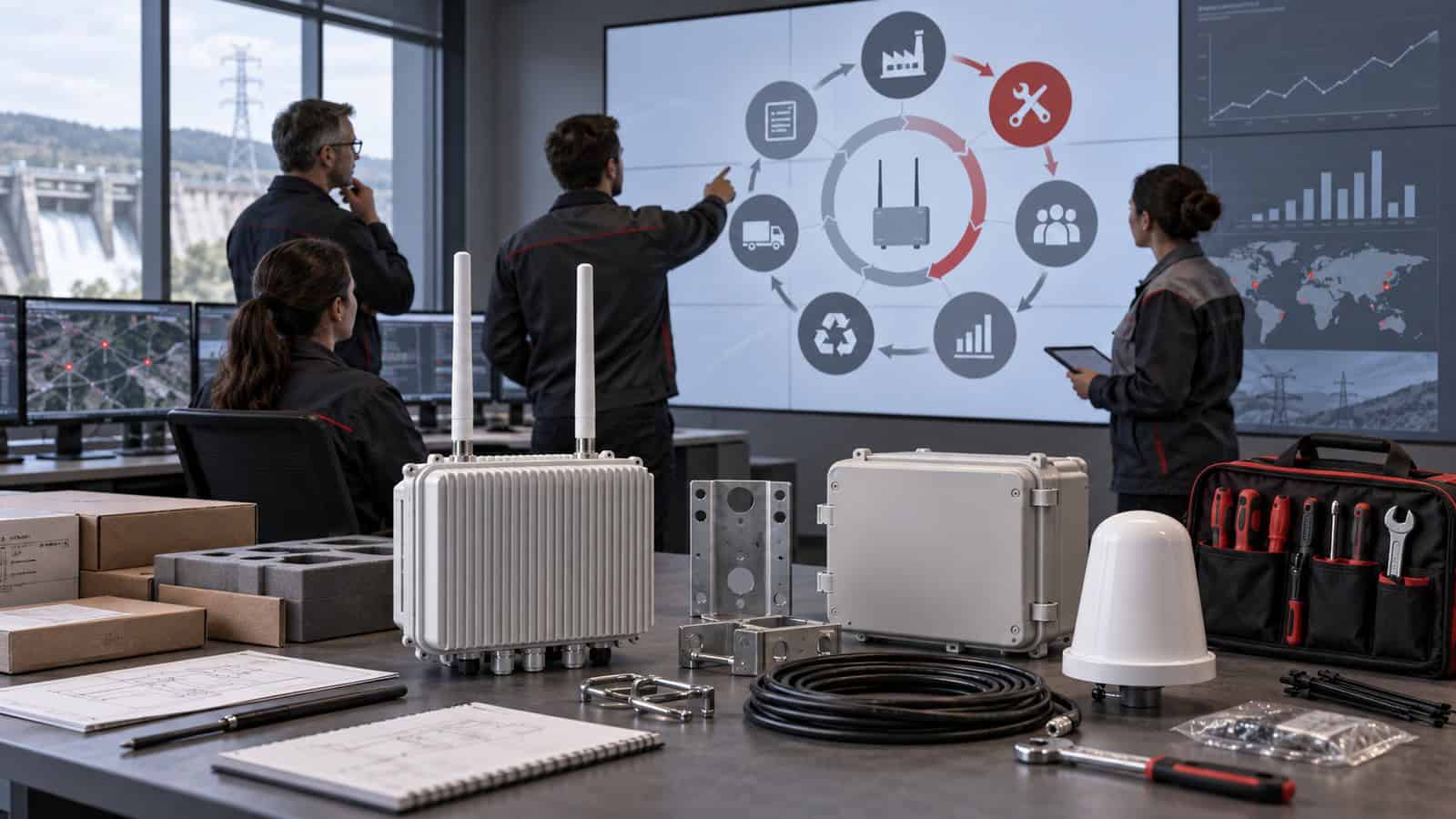
The Robustel LG3120e LoRaWAN Gateway combines LoRaWAN connectivity with local compute and mixed field interfaces. Its purchase price is only meaningful when compared with the software, installation and operating role the project expects it to perform.
A lower-cost packet forwarder can be the correct answer for a straightforward external-LNS design. It can become expensive when remote sites repeatedly need separate protocol tools, local computers or technician visits. TCO makes those responsibilities visible before product selection.
Start with a Lifecycle Ledger
| Cost owner | One-off items | Recurring or risk-based items |
|---|---|---|
| Hardware | Gateway, antennas, enclosure, power equipment | Spares and replacements |
| RF | Survey and placement design | Resurvey after site changes |
| Backhaul | Router/SIM installation or Ethernet work | Data plan, carrier and support |
| LNS | Deployment and integration | Hosting, backup, updates and administration |
| Field work | Mounting and commissioning | Travel, access permits and fault visits |
| Operations | Fleet onboarding and documentation | Monitoring, credentials, firmware and inventory |
| Anwendung | Payload and northbound integration | Changes, dashboards, alarms and data support |
Use credible labour rates and site-access costs. A remote substation, roof plant room and occupied office may use the same gateway but have very different cost consequences when someone must visit.
Backhaul Cost Is More Than the Data Plan
Cellular backhaul adds subscriptions, antenna work and carrier operations. Ethernet can appear free once available, but extending it to the gateway position may require cabling, switch capacity and coordination with another network owner. Wi-Fi can simplify a pilot while creating coverage and credential dependencies that are awkward at scale.
Robustel’s Cibicom nationwide LoRaWAN backhaul case study shows that backhaul architecture is an operating cost centre in its own right, not a footnote to gateway price. A TCO model should therefore include subscription administration, fault isolation, site access and the management path used when a gateway stops reporting. Those costs are paid across the estate and can outweigh a small hardware-price difference. The project’s LTE450 coverage and commercial result do not establish the cost of another network.
Model normal traffic and exceptional traffic. Device joins, retransmissions, downlinks, logs, software updates and queued-data replay can produce different demand from steady sensor payloads. A cheap data plan that requires regular intervention is not cheap in an unattended estate.
Server Ownership Changes the Operating Bill
An external LNS creates hosting, availability, security and administration work. An embedded option moves some responsibility onto the gateway. Neither cost disappears; it changes owner and failure domain.
The Robustel R1520LG LoRaWAN Gateway supports external UDP, LoRa Basics Station and LORIOT connections as well as embedded ChirpStack. It can reduce separate hardware in a local-server design, but backup and recovery still need funding.
A focused forwarder such as the Robustel R1320LGe LoRaWAN Gateway may be more proportionate when an existing ChirpStack architecture already owns the server layer. This is a change in server responsibility, not simply a cheaper line in the bill of materials.
How the Robustel LG3120e LoRaWAN Gateway Can Reduce Integration Work in Distributed Estates
The Robustel LG3120e LoRaWAN gateway belongs in the TCO comparison when a site needs more than forwarding packets. Its local compute, LoRaWAN role, cellular/eSIM, Ethernet, Wi-Fi, serial and I/O capabilities can consolidate functions that might otherwise require separate equipment and integration.
For deployments built on Robustel LG3120e, E2C Field provides a matched operational layer for documented LoRaWAN configuration, data collection, local processing, continuity, visualization, alarms, workflows and northbound integration. The pairing can make commissioning more repeatable and field data more transparent because the gateway and operating application share a defined boundary, reducing the amount of separate software that a project must assemble and maintain.
That is an engineering value proposition, not a blanket saving. Protocols, sensors, northbound systems and workflow requirements must be checked against the current product pages. Software should not be assumed to be bundled. If the project only needs a packet forwarder, the extra local role may be disproportionate.
| LG3120e and E2C Field cost question | Work the pairing may consolidate | Cost that remains external |
|---|---|---|
| Who commissions LoRaWAN and local data handling? | A defined gateway-and-application workflow on the compatible LG3120e | Sensor provisioning, RF survey and unsupported protocol work |
| Who observes local data and alarms? | Documented collection, visualization and alarm functions in E2C Field | Response staffing and upstream business-process ownership |
| Who maintains northbound delivery? | A specified integration boundary from the local application | The receiving platform, data contract and WAN service |
| What happens during disconnection? | Documented local continuity functions where configured | Site power, storage policy and application-level reconciliation |
Price each remaining external responsibility rather than counting every listed function as an automatic saving. The table becomes useful only when an owner and labour assumption are attached to every row.
Price the Cost of Uncertainty
Robustel’s Smart Buildings, Sensors and BMS Integration Application Example follows wireless sensing into a wider operational system. That makes it useful for finding costs omitted from a gateway quotation: payload ownership, alarm configuration, server hosting, backhaul, BMS handoff and the engineer who maintains each boundary. Put those owners and recurring tasks into the ledger before comparing hardware. The example maps the architecture; it does not promise a universal saving.
Run a pilot that includes the hardest installation and the real support process. Log technician time, access delays, configuration errors, failed joins and data-integration changes. Extrapolate from those observed tasks, not from an ideal bench setup.
The LoRaWAN Gateway Applications video is a useful way to align stakeholders on the breadth of use cases before building the ledger. It should not be used to estimate site count, range or capacity.
Häufig gestellte Fragen
Q1. How much does a LoRaWAN gateway cost?
Prices vary with radio design, backhaul, interfaces, compute, environmental protection and software role. Compare the purchase price only after defining the complete site architecture and support period.
Q2. Does LoRaWAN require a subscription?
LoRaWAN itself does not require a mobile-style subscription, but managed network services, cellular backhaul, hosting or software may create recurring costs depending on the architecture.
Q3. How many devices can connect to one LoRaWAN gateway?
There is no dependable universal number. Capacity depends on payload size, reporting interval, spreading factors, retransmissions, downlinks, RF conditions and application requirements.
Q4. Is LoRaWAN expensive to deploy?
It can be economical for low-power sensing, but installation, surveys, backhaul, server operations and integration often matter more than the radio hardware. A site-specific TCO model is the sensible comparison.
Q5. When does the Robustel LG3120e LoRaWAN Gateway improve TCO?
It can improve TCO when the project genuinely needs local compute, mixed field interfaces and a defined operational software layer alongside LoRaWAN. For simple forwarding into an existing LNS, a more focused gateway may cost less and be easier to own.
Schlussfolgerung
The Robustel LG3120e LoRaWAN Gateway belongs in the TCO comparison when local compute, mixed interfaces and a matched operational layer can replace separately engineered components or repeated site work. A simple packet-forwarding requirement sets a different baseline. In that design, the same resources may add cost without changing the outcome.
Build the ledger around labour and ownership as carefully as hardware: commissioning, payload work, hosting, backhaul, updates, alarm handling and failure visits. Price at least one realistic fault over the intended service life, then prefer the gateway whose defined role removes more lifecycle work than it creates.
Explore More Articles About Robustel LoRaWAN Gateways
Über den Autor
Robert Liao | Technical Support Engineer
Robert is an IoT Technical Support Engineer at Robustel, specializing in industrial networking and edge connectivity. A certified Networking Engineer, Robert focuses on the deployment and troubleshooting of large-scale IIoT infrastructures. His work centers on architecting reliable, scalable system performance for complex industrial applications, bridging the gap between field hardware and cloud-side data management.