
Lift Phone Remote Monitoring: Status, Signal, Power and Test Evidence
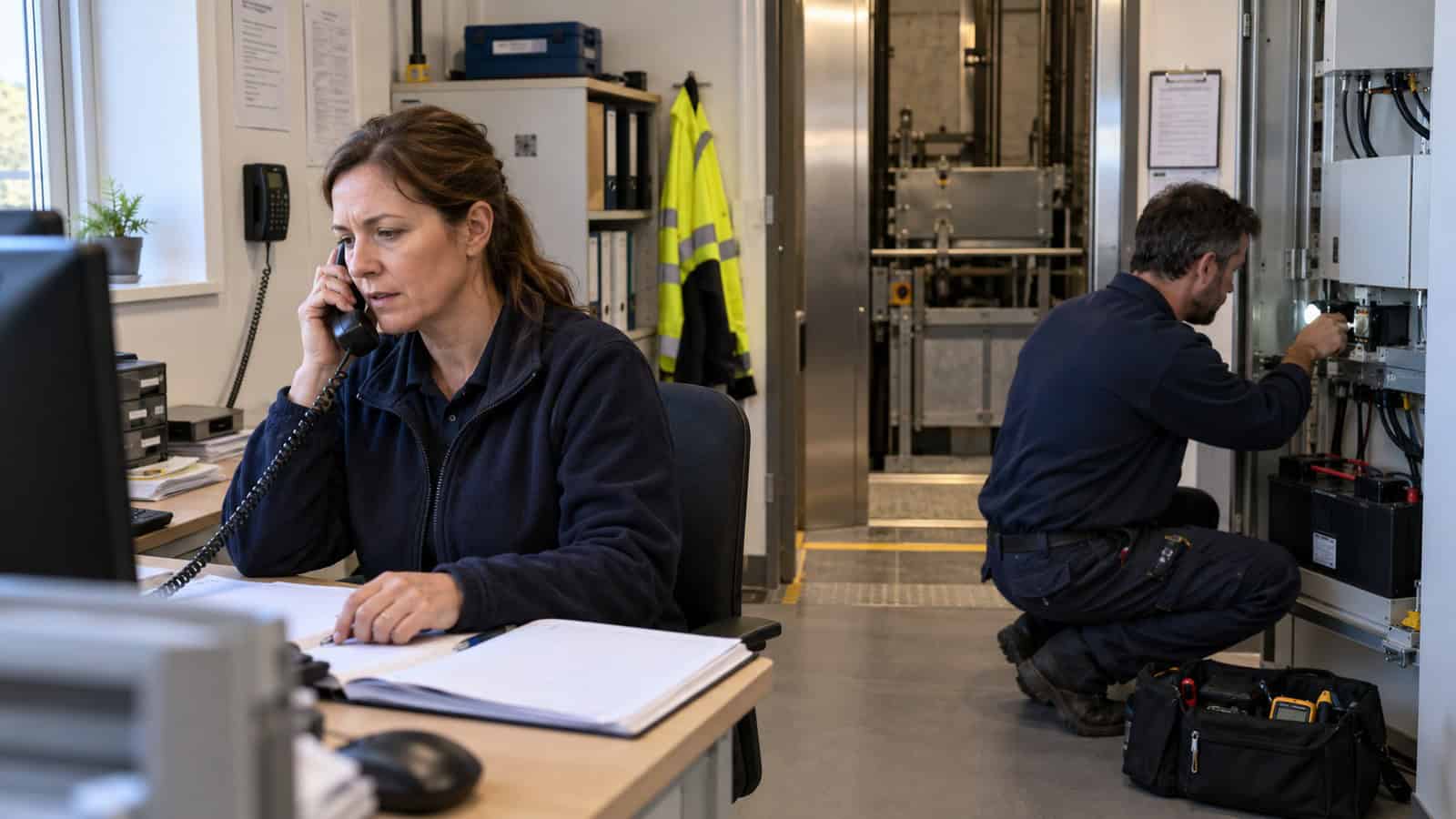
The Robustel EV8100 Elevator Voice Gateway can expose gateway and network information through RCMS while supporting lift voice and selected I/O connections. That visibility is valuable, but it must be labelled correctly. Online status, signal and configuration are gateway evidence; they are not automatic proof of battery condition, handset audio, successful test calls or monitoring-centre response.
Good remote monitoring answers two questions separately: “Can I see the gateway?” and “Can a passenger complete the required emergency communication?”
Build an Evidence Register
| Evidence | Source | What it proves | What it does not prove |
|---|---|---|---|
| gateway online/offline | RCMS/device | management contact and device reachability | successful voice call |
| cellular signal/network | modem/RCMS | current radio and registration indicators | continuous future coverage or VoLTE call success |
| firmware/configuration | RCMS/device | known software and settings | correct monitoring-centre record |
| power input alarm | wired integration where verified | selected local state | battery capacity or runtime unless separately measured |
| periodic call result | test service/monitoring centre | defined end-to-end call outcome | every future emergency call |
| battery inspection/runtime | maintenance/test system | condition under the approved test | unrelated carrier or handset state |
This prevents a green fleet dashboard from being interpreted as a compliance certificate.
Monitor Signal as a Trend, Not One Threshold
Record signal and network state over time. Building changes, antenna damage and operator adjustments can create gradual degradation. A single low reading may not justify a visit, while repeated transitions or failed calls deserve investigation.
Correlate signal with call and data events. The relevant question is whether the service can register, establish and sustain the required call path. Do not promise a universal minimum signal value without carrier and device evidence.
Keep Power and Battery Evidence Separate
The EV8100 documents a holder for specified 18650 flat-top batteries, with different operating and charging limits when batteries are installed. Remote online status during mains operation does not report usable backup runtime by itself.
Define inspection, replacement and load-test intervals under the lift maintenance plan. Where a verified input or integration reports mains state, label it as that signal—not as a direct measurement of remaining battery capacity.
Robustel’s TSARO EV8100 case study provides exact-model field evidence for a managed lift-phone replacement service. It supports the value of standardised gateways and remote operations; it does not claim that RCMS performs every call or battery test.
Treat Test Calls as a Service Workflow
An end-to-end test should prove the alarm initiation, call route, site identification, DTMF exchange where used, two-way speech, operator response and clearing. If automated testing is used, confirm what it actually exercises. Some systems can test connectivity without proving audio or human response.
Store results against the exact lift and gateway. Failed and missed tests need an escalation owner, response time and closure evidence. Avoid a reporting process that counts only successful tests and silently drops absent sites.
How the Robustel EV8100 Elevator Voice Gateway Supports Remote Lift-Phone Operations
The Robustel EV8100 Elevator Voice Gateway documents FXS, VoIP/VoLTE, dual SIM, Ethernet, RS-232, RS-485, CAN, four digital inputs, one relay and RCMS management. These features allow the gateway to serve as a voice migration point and a managed communications node around selected lift signals.
Robustel RCMS platform for the functions it documents: device visibility, network information, configuration and updates. Keep the monitoring centre as the authority for call records and keep battery evidence in the approved maintenance process. If a project integrates lift controller data through serial, CAN or I/O, verify the exact protocol and signal definitions rather than inferring compatibility from the connector.
Design Alarms for the People Who Respond
Online/offline alarms should avoid noise during planned maintenance and short network transitions. Set delay and escalation according to the service risk, and include context: site, lift, last contact, active SIM/network, recent change and the next diagnostic action.
Separate configuration drift from service outage. A gateway can be reachable but running an unapproved setting; conversely, an approved configuration may be offline because the building has lost power. The support queue should distinguish them.
The Robustel’s IoT-Enabled Smart Elevators application example shows how voice and lift monitoring can share an EV8100-based communications platform. The operational value is the shared site context: an alarm can identify the lift and communications node before a technician travels. It remains architecture guidance; the exact status points, controller protocol and northbound workflow must be commissioned for the individual lift system.
Prove the Monitoring Chain Quarterly
Select representative sites and simulate lost WAN, preferred SIM failure, mains loss and a failed test call. Confirm alarms reach the correct team and that closure records link back to the event. Review false positives and missing evidence.
When a test fails, diagnose from the outside in. Start with the monitoring-centre record, then check whether the call was presented, whether the gateway registered on the intended network and whether local power and wiring were healthy. This order avoids a common support mistake: rebooting a reachable gateway before preserving the evidence that would have separated a carrier problem, a voice-routing problem and a local handset fault.
The Robustel EV8100 Quick Pitch video below can train teams on the platform at a high level. The evidence register and witnessed tests define the actual service.
Häufig gestellte Fragen
Q1. Who monitors elevator phones?
They may be monitored by a lift service company, dedicated monitoring centre, building operator or another responsible service. The arrangement, response and escalation should be documented for each site.
Q2. Can someone remotely monitor your phone?
For a lift phone, authorised systems can monitor defined gateway, call or test status under the service design. That should not be confused with unrestricted listening; access, privacy and purpose need clear controls.
Q3. What is a remote monitoring device?
It is equipment that collects defined status or measurements and sends them to another location for observation, alarms or maintenance. Its evidence is limited to the signals and functions actually integrated.
Q4. Do mobile phones work in lifts?
Coverage inside a lift car or shaft can be poor because of metal and building structure. A lift emergency-phone gateway should use a surveyed, installed antenna position and should not rely on a passenger’s mobile phone.
Q5. What can RCMS show for the Robustel EV8100 Elevator Voice Gateway?
RCMS can support gateway-level visibility, network status, configuration and update operations. It should not be described as proof of battery health, successful mandatory test calls or complete lift compliance unless a separately verified integration supplies that evidence.
Schlussfolgerung
The Robustel EV8100 Elevator Voice Gateway can give lift service teams valuable remote evidence about the gateway and its network while supporting the voice migration path. The monitoring design is strongest when it states exactly what each signal proves and keeps call, battery and compliance records with their proper owners.
Use an evidence register, correlate signal trends with real calls and exercise the alarm workflow under controlled failures. That gives operators a transparent fleet view without turning gateway telemetry into claims it was never designed to support.
The maintenance team should be able to open one event and see the last known configuration, network state, test-call result, power evidence and responsible owner. If those records live in separate systems, link them through a stable site and lift identifier. Remote monitoring earns its value when it shortens diagnosis and produces a defensible service history, not when it merely adds another green status icon.
Explore More Articles About Robustel Lift Connectivity


Über den Autor
Robert Liao | Technical Support Engineer
Robert is an IoT Technical Support Engineer at Robustel, specializing in industrial networking and edge connectivity. A certified Networking Engineer, Robert focuses on the deployment and troubleshooting of large-scale IIoT infrastructures. His work centers on architecting reliable, scalable system performance for complex industrial applications, bridging the gap between field hardware and cloud-side data management.