
Lift Emergency Phone Fault-Isolation Guide: Power, Signal, Voice and Monitoring
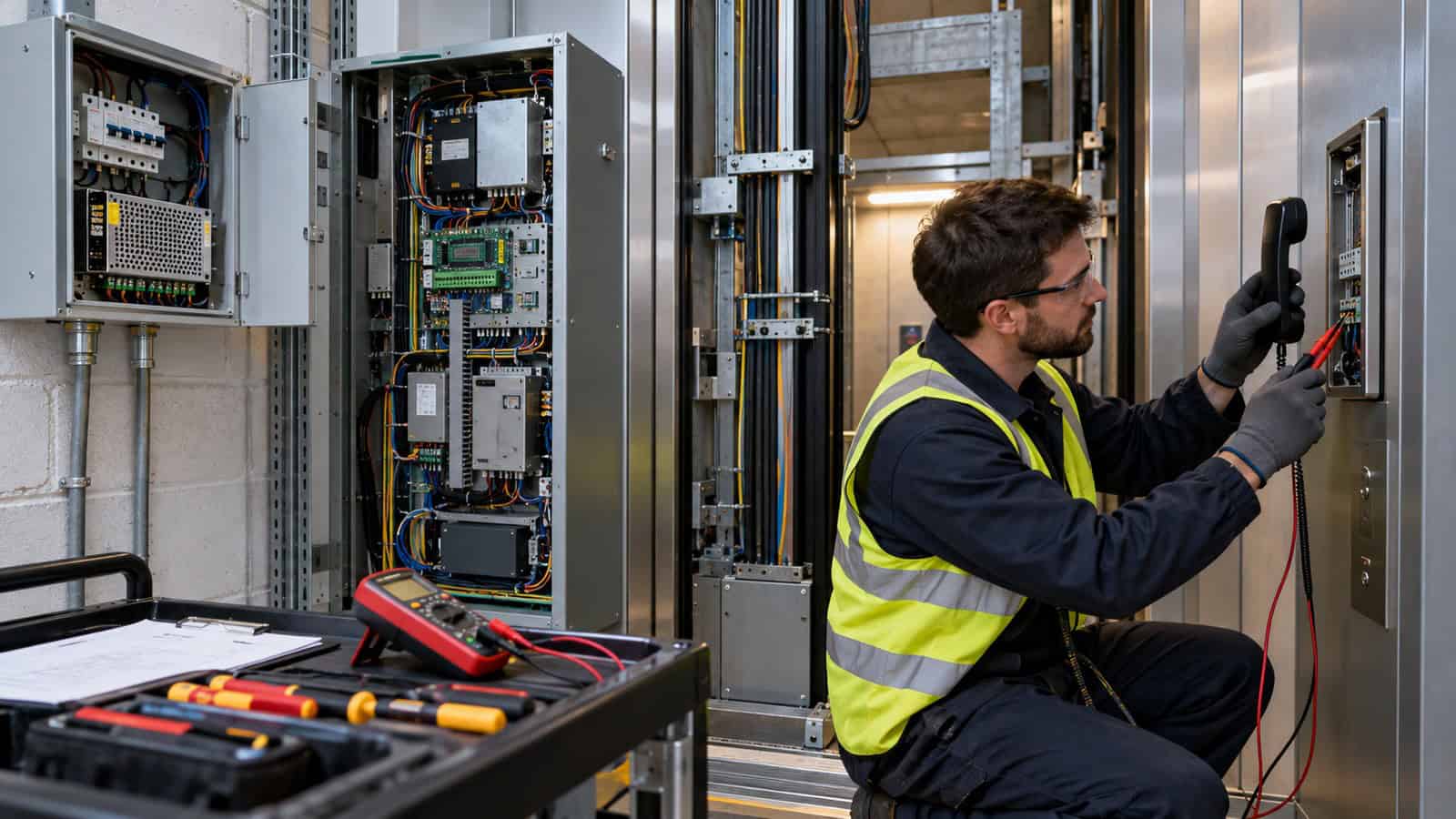
The Robustel EV8100 Elevator Voice Gateway exposes useful device and network states for lift-phone troubleshooting, but the quickest diagnosis still follows the call path in order: power, handset/FXS, mobile registration, voice service, audio/DTMF and monitoring-centre response. Do not change live emergency settings without the authorised lift contractor and service owner.
Start with the Symptom, Then Choose the Layer
| Symptom | First discriminating check | Likely owner if confirmed |
|---|---|---|
| no line activity | gateway power and FXS wiring | electrical/lift-phone maintainer |
| mobile registered, no call | VoLTE/SIP registration and service | mobile/voice provider |
| call connects, no audio | handset, codec/path and monitoring endpoint | voice service team |
| digits not recognised | DTMF mode and receiving system | installer/monitoring provider |
| intermittent failure | power, RF trend and event timestamps | site and connectivity owners |
A screenshot taken after recovery is weak evidence. Record timestamps and state while the symptom is present.
Check Power Before the Network
Confirm input power, battery condition and whether the fault followed a mains event. A short successful restart does not prove that backup cells can support a witnessed call. Inspect terminals and approved cells before replacing network settings.
The Robustel’s EV8100 Quick Pitch video below helps identify the product’s physical and service role. Use the site wiring diagram for terminal-level work.
Trace FXS and Handset Behaviour
Verify the analogue phone or autodialler type, loop behaviour, dial sequence and DTMF before changing voice-service settings. Start at the lift car: a successful test beside the gateway can bypass the travelling cable, handset and installation conditions that the passenger actually depends on.
Listen for the first change in the call sequence. No line activity points back towards power, FXS or local wiring; dialling without call setup moves the investigation towards digits, configuration or voice service; a connected call with failed identification or DTMF moves it downstream to the receiving path. Record the observation before disconnecting anything, because the original state is often lost as soon as a terminal is reseated or the gateway is restarted.
Robustel’s PSTN replacement application example illustrates how the analogue handset, FXS gateway, mobile voice service and monitoring centre form one chain. Use that chain to assign the next check to the party that owns the first failed boundary, then retest from the car after the repair rather than accepting a dial tone at the cabinet.
How the Robustel EV8100 Elevator Voice Gateway Supports Fault Isolation
Robustel EV8100 Elevator Voice Gateway combines the FXS boundary with 4G, VoLTE/VoIP capability, dual SIM, battery-related functions and RCMS. This allows authorised teams to compare local device state, mobile state and remote visibility without assuming that any one status proves a working call.
- Power present but no FXS behaviour points towards local wiring or handset investigation.
- Mobile registration without voice registration points towards service or configuration.
- A connected call with failed DTMF requires end-to-end voice-path checks.
- A secondary SIM test is useful only when carrier service and switching are configured for that role.
RCMS can narrow the investigation and preserve event context. The final repair is closed with a witnessed call and correct monitoring-centre identification.
Compare Remote and End-to-End Evidence
Robustel’s TSARO case study shows the operational value of consistent remote records across an estate. Those records help prioritise visits, while two-way audio and response still require an end-to-end test.
If remote state and field result disagree, preserve both. The disagreement often points to a downstream handset, audio or monitoring issue rather than a cellular fault.
Close the Incident with a Repeatable Test
After repair, repeat the original failure condition where safe, make the call on normal and approved backup power, confirm audio/DTMF and verify the correct site response. Record configuration and service changes so the next engineer does not repeat the same diagnostic work.
Do not close on “router online”. Close on the emergency communication outcome that failed.
For an intermittent or no-fault-found visit, retain the time window, signal and power observations, call destination and monitoring-centre evidence. That record gives the next investigation a starting condition and avoids replacing the gateway simply because it is the most visible component.
Häufig gestellte Fragen
Q1. Why is my lift phone not working?
Possible causes include power, handset/FXS wiring, mobile registration, VoLTE/SIP service, audio/DTMF or the monitoring destination. Check the path in layers rather than changing several settings at once.
Q2. What is a VoLTE call?
It is a voice call carried through an LTE network’s voice service. LTE data registration alone does not confirm that VoLTE is provisioned and working.
Q3. Does mobile registration mean voice calling works?
No. It confirms a radio/network state, while voice registration, call setup, media and receiving service remain separate checks.
Q4. How do you test an emergency phone line?
Use the approved procedure to place a witnessed call, verify identification, two-way audio, DTMF where used and monitoring-centre response under required power conditions.
Q5. How does the Robustel EV8100 Elevator Voice Gateway help fault isolation?
It brings FXS, cellular voice, dual-SIM and remotely visible device states into one gateway. Those observations help locate the failed layer before a witnessed retest confirms recovery.
Schlussfolgerung
The Robustel EV8100 Elevator Voice Gateway gives service teams a useful set of observations across the analogue and cellular boundary. The diagnostic advantage appears when those observations are read in call-path order and matched to the responsible owner.
Preserve the failed state, change one layer at a time and close only after the original end-to-end outcome has been restored. That method is slower than guessing for the first minute and much faster across the complete incident.
Explore More Articles About Robustel Lift Connectivity


Über den Autor
Robustel Editorial Team
The Robustel Editorial Team publishes practical articles on industrial connectivity, edge computing, LoRaWAN and device management, focusing on deployment considerations, technical limitations and long-term operation.