
Lift Emergency Communication Reliability Framework 2027: Failure Modes, Evidence and Ownership
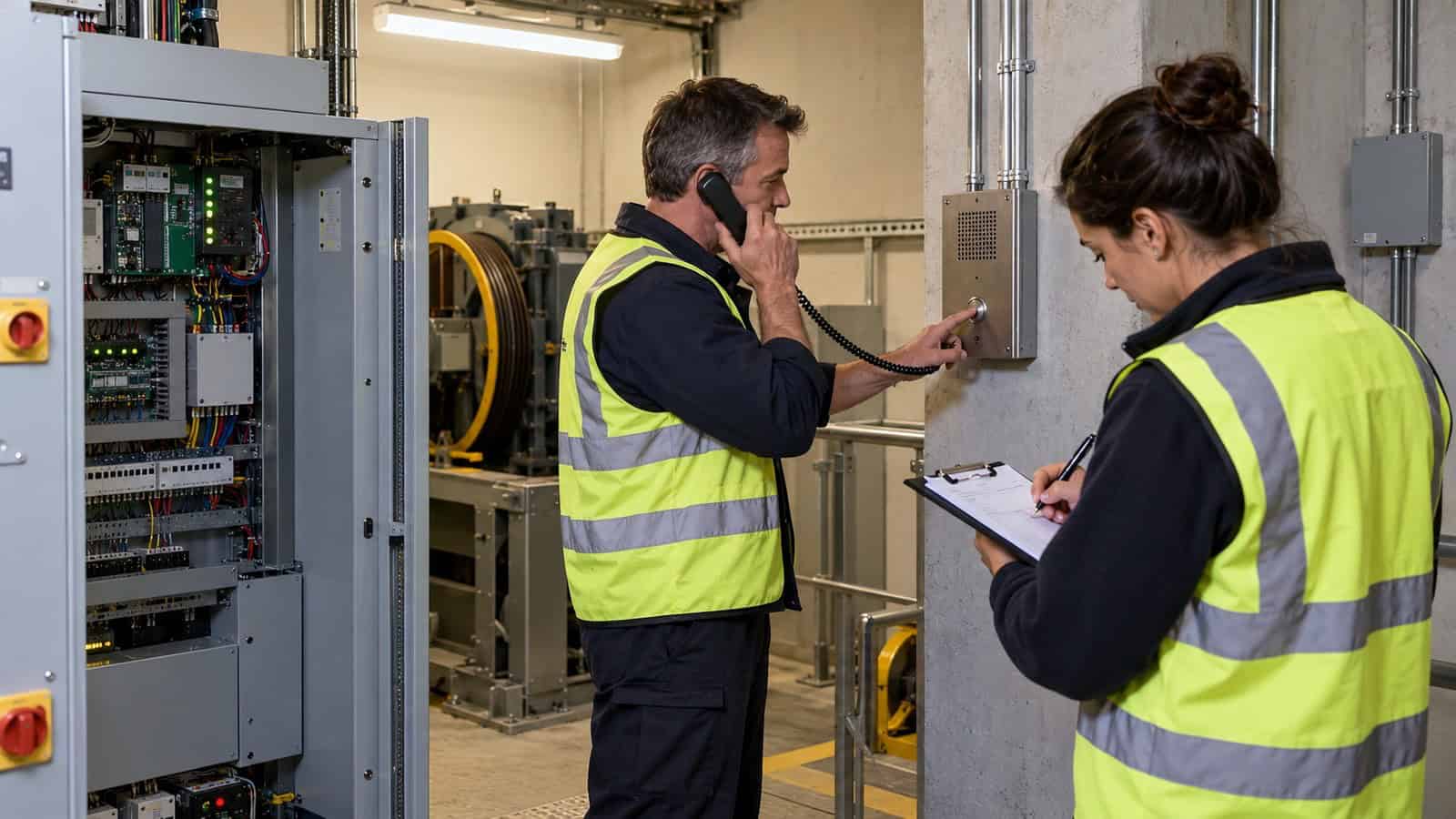
The Robustel EV8100 Elevator Voice Gateway supports lift emergency communication with an FXS interface, cellular voice options, dual SIM, battery-related operation and remote management, but reliability belongs to the complete call service. The handset, wiring, gateway, antenna, power, mobile service, SIP or VoLTE path and monitoring-centre response must all be assigned an owner and a test.
Build the Framework Around Failure Modes
| Failure mode | Observable evidence | Owner | Acceptance action |
|---|---|---|---|
| mains loss | gateway and battery state, call result | electrical/lift contractor | witnessed call on approved backup supply |
| mobile service loss | registration, signal and selected SIM | connectivity owner | prove planned secondary path behaviour |
| FXS/handset fault | line state, dial tone, DTMF and audio | lift-phone maintainer | end-to-end call from car handset |
| SIP/VoLTE fault | registration and call signalling | voice service owner | inbound/outbound test with monitoring centre |
| monitoring failure | no answer or wrong site identity | monitoring provider | correct identification and escalation |
This table prevents “gateway online” from becoming the only evidence. A device can be registered while voice service, DTMF or the receiving process is unavailable.
Make the Test Evidence Reproducible
Record date, site, lift identity, SIM/service, firmware/configuration, signal observations, power condition, destination, call result, two-way audio, DTMF where used and the monitoring-centre response. Include the person who witnessed the test and the next due action.
Robustel’s EV8100 TSARO case study shows the operating value of standardised connectivity and continuous records across lift estates. The relevant lesson is the repeatable service model; local requirements and witnessed acceptance still govern each installation.
Treat Power Loss as a Service Event
Backup runtime depends on the selected cells, their condition, temperature, charger behaviour, connected load and test method. Inspect trends and replacement criteria rather than relying on one short call immediately after charging.
Remove mains during commissioning under a controlled procedure and timestamp the transition. Observe whether the analogue phone remains available, whether mobile and voice registration survive or recover, and whether the monitoring centre receives the correct site identity. A restart that eventually restores service can still reveal an unacceptable gap in the emergency-call path.
Restore mains only after the witnessed call and record recharge behaviour against the approved maintenance plan. The gateway’s battery holder is one component of the power design; cell selection, wiring, ambient conditions and inspection ownership determine whether the complete installation remains serviceable between visits.
How the Robustel EV8100 Elevator Voice Gateway Supports Reliability Evidence
Robustel EV8100 Elevator Voice Gateway combines one FXS interface with 4G cellular connectivity, VoLTE/VoIP capability, dual SIM, internal battery support and RCMS. This gives the service team observable device and connectivity states while retaining the existing analogue lift phone where the full voice path is compatible.
| Reliability task | EV8100 contribution | Remaining project decision |
|---|---|---|
| analogue phone migration | FXS interface | handset/autodialler compatibility and wiring |
| mobile path | cellular voice and dual SIM | carrier acceptance, coverage and transition behaviour |
| power continuity | battery holder/status functions | approved cells, runtime and inspection programme |
| remote operations | RCMS visibility | alarm ownership and witnessed call schedule |
The Robustel EV8100 Quick Pitch video below is useful for installer and stakeholder orientation. Product orientation should be followed by the site’s wiring diagram, service configuration and witnessed call procedure.
Keep the accepted configuration with the call record. If a later firmware, SIM or voice-service change alters registration or call behaviour, the team can compare against a known baseline instead of treating the changed state as an unrelated fault.
Keep Remote Monitoring in Its Proper Role
RCMS can help teams see gateway, network and battery-related exceptions and manage supported device operations. It cannot hear the audio, verify DTMF, confirm the correct monitoring-centre script or replace a physical inspection.
Robustel’s PSTN replacement application example illustrates the full migration path from analogue lift equipment through cellular voice to the monitoring destination. Use that path to design the test, not as a substitute for site-specific compatibility and acceptance.
Set Ownership Before Handover
Name who maintains power, batteries, handset wiring, mobile subscription, SIP service, gateway configuration, monitoring-centre records and inspection evidence. Define how an alert becomes a work order and who closes it after a successful retest.
Test the escalation tree with one realistic exception before handover. A low-battery or registration alert should reach a named role, create an owned action and remain open until a witnessed service test confirms recovery. If the alert stops at an inbox shared by several suppliers, the technical monitoring exists but the reliability process does not.
The handover should contain the call path, accepted configuration, service contacts, test record, battery plan and escalation tree. Reliability improves when every boundary has one owner and the next maintainer can see which evidence closes the fault, rather than discovering the contract split during an outage.
Häufig gestellte Fragen
Q1. What is a lift emergency communication system?
It is the end-to-end arrangement that lets a trapped passenger call and communicate with an authorised response service. It includes equipment, networks, power and operating procedures.
Q2. Does a lift phone work during a power cut?
It should follow the approved backup-power design for the installation. Runtime and call performance must be witnessed with the actual batteries, load and network path.
Q3. Is mobile signal strength enough to prove a lift phone will work?
No. Signal is one input; voice registration, call setup, two-way audio, DTMF and monitoring-centre response need end-to-end testing.
Q4. How often should a lift emergency phone be tested?
Follow applicable local requirements, the maintenance plan and service-provider procedures. Use recurring witnessed tests and event-driven retests after relevant changes.
Q5. What does the Robustel EV8100 Elevator Voice Gateway contribute to reliability?
It provides the cellular/FXS voice boundary, dual-SIM options, battery-related functions and remote device visibility. The complete installation and response process still determine service reliability.
Schlussfolgerung
The Robustel EV8100 Elevator Voice Gateway gives lift service providers a practical platform for modernising the voice path and observing key device states. Reliability is demonstrated only when power, line, mobile service, voice path and monitoring-centre response are tested as one service.
Use the framework to assign every failure mode an owner, observation and recovery action. A complete witnessed record is the point at which a collection of components becomes an operable emergency communication system.
Explore More Articles About Robustel Lift Connectivity


Über den Autor
Robustel Editorial Team
The Robustel Editorial Team publishes practical articles on industrial connectivity, edge computing, LoRaWAN and device management, focusing on deployment considerations, technical limitations and long-term operation.