
Dual SIM Lift Gateway: Best-Fit Guide for Emergency Call Resilience
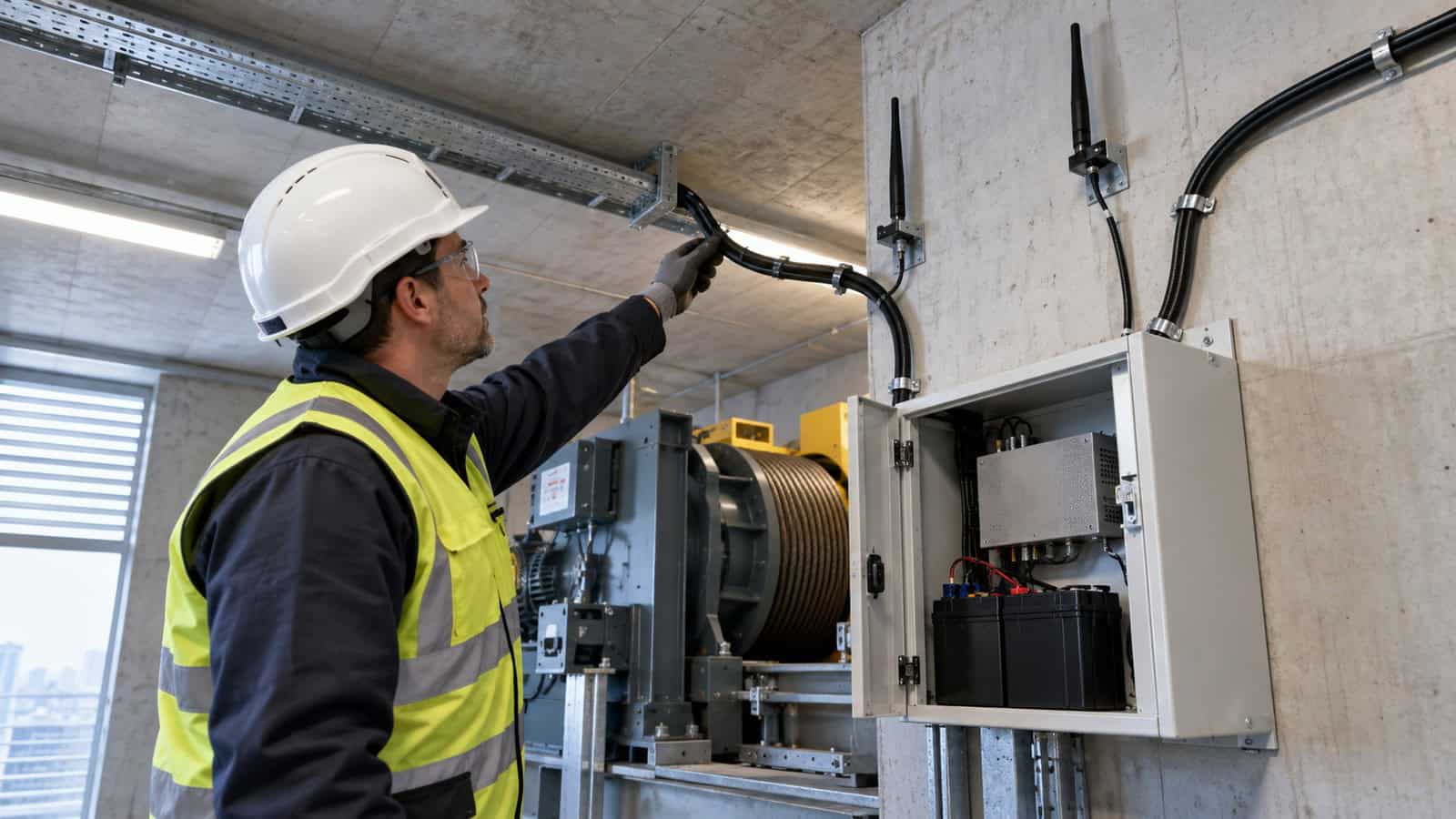
The Robustel EV8100 Elevator Voice Gateway has two physical SIM slots, allowing a lift communication design to reduce dependence on one subscription or mobile network. Dual SIM is useful only when the switching behaviour, voice registration, antenna system and operational response are verified. It does not provide active-active voice by implication and cannot protect shared power or equipment.
The practical question is not “does it have two SIM slots?” It is “which failure is the second SIM meant to cover, and can the emergency call path recover within the accepted operating model?”
Identify the Failure Domain First
| Failure | Can a second SIM help? | What else is required? |
|---|---|---|
| one subscription suspended | potentially | independent account control and tested switch |
| one carrier unavailable locally | potentially | genuinely different underlying network and usable RF |
| poor antenna position | usually not | survey, antenna relocation or installation change |
| gateway hardware fault | no | maintenance response and spare strategy |
| mains and battery failure | no | compliant power and battery maintenance |
| monitoring-centre or SIP outage | not necessarily | alternate service path or provider recovery plan |
This table prevents dual SIM from becoming a generic resilience claim. It addresses only failures above the shared radio hardware and below the selected voice service, depending on implementation.
Verify Carrier Diversity Rather Than SIM Branding
Two commercial SIM products may roam onto the same local network. They may also share a wholesale provider or provisioning platform. Obtain written service information and test network selection at the actual building.
Use the lift machine room or gateway location, not a phone at street level. Lift shafts, basements and reinforced structures can create very different RF conditions. Record signal and registration on both profiles, then complete real calls through the monitoring centre.
Understand the Switch and Return Policy
Ask what triggers a SIM change and whether the criterion measures registration, data reachability or voice-service availability. A fast switch on a false alarm can be worse than a measured response, especially if the second service is weaker.
Test return behaviour as well. Some operations teams prefer the gateway to remain on the recovered secondary until a maintenance window; others want automatic reversion. The chosen policy should be visible in logs and support procedures.
Robustel’s TSARO EV8100 case study provides exact-model deployment evidence for modernising lift emergency communications. It supports the wider value of a managed cellular gateway but does not prove that any pair of SIMs will deliver the same diversity.
Keep Power Resilience in the Same Test
Robustel EV8100 elevator voice gateway provides a battery holder for specified 18650 flat-top batteries, which are not included by default. Battery operating and charging temperature limits are documented separately from operation without batteries. Select cells, protection and maintenance under the project’s requirements.
Run a mains-failure call, not just an idle runtime test. Include the analogue handset, voice path and any monitoring interfaces. Then restore power and verify charging, device state and remote visibility. A dual-SIM design on an untested battery is not resilient.
How the Robustel EV8100 Elevator Voice Gateway Uses Dual SIM in a Lift Call Architecture
The Robustel EV8100 Elevator Voice Gateway documents two Mini SIM slots, VoIP with VoLTE as a backup voice line, one FXS port for analogue equipment, Ethernet, serial/CAN, digital inputs and a relay. RCMS provides gateway-level management and visibility.
This allows an integrator to keep a compatible analogue lift phone while moving transmission to managed IP/mobile voice and adding another SIM option. The exact failover and roaming behaviour, carrier profile and call route must be confirmed for the selected firmware and service. Do not assume simultaneous active-active calling.
Robustel’s IoT-Enabled Smart Elevators application example shows the EV8100 used as a platform for voice and lift data connectivity. It helps explain why signal, device state and operational telemetry can share a managed gateway. It does not prove native battery-health measurement or mandatory test-call completion.
Create a Quarterly Failure Exercise
Periodic live testing should include the normal path, selected secondary path, mains failure and monitoring-centre handling. Record SIM used, registration, call setup, speech, DTMF/identification, power state and operator response. Coordinate tests so they are not mistaken for emergencies.
If the secondary call fails, preserve the sequence before forcing another switch. Note the registered network, voice-registration state, dialled number, time to failure and monitoring-centre observation. A second SIM can attach for data while the intended voice service remains unavailable, so a green network indicator is not enough to close the fault. Diagnose subscription, RF and voice routing as separate layers.
Robustel RCMS platform is designed to support device and network diagnosis, while the monitoring centre retains call and response evidence. The Robustel EV8100 Quick Pitch video below can orient service teams; the test record is the resilience proof.
When Dual SIM Is Not the Best Investment
If both SIMs have poor service at the gateway, improve antenna position or choose a different physical location. If the dominant risk is power, invest in the battery and maintenance design. If failures occur in the analogue handset or monitoring centre, adding another SIM will not solve them.
Dual SIM earns its place when it addresses a documented carrier or subscription failure and the organisation is prepared to maintain two services.
Häufig gestellte Fragen
Q1. What is a lift phone?
It is the emergency communication equipment that lets a trapped passenger contact a responsible service. Its reliability depends on the handset, transmission, power and monitoring response together.
Q2. What is a dual SIM phone?
It is a device that can hold two subscriber identities. Behaviour varies: some devices use one at a time, while others support different standby or active modes. The lift gateway’s documented behaviour must be checked directly.
Q3. Where can I buy a SIM card for a lift phone?
Use a telecommunications or managed-service provider that can confirm the required voice profile, network, tariff, lifecycle and support. A generic data SIM may not support the intended VoLTE or emergency-call workflow.
Q4. Can elevator phones be cellular?
Yes. A cellular gateway can carry lift emergency calls, often while retaining an existing analogue handset through FXS. The complete installation must meet current local requirements and pass end-to-end testing.
Q5. Does the Robustel EV8100 Elevator Voice Gateway guarantee resilience with two SIMs?
In fact, its two SIM slots provide an option for subscription or carrier diversity. Resilience still depends on service independence, RF conditions, switching logic, power, voice registration and monitoring-centre operation.
Schlussfolgerung
The Robustel EV8100 Elevator Voice Gateway supports a more resilient lift communication design when its two SIMs are tied to a specific, tested carrier or subscription failure. The second SIM is valuable evidence only after the team proves the switch, call path and return policy.
Build resilience across the full chain: antenna, service, voice profile, gateway, battery, handset and monitoring centre. When quarterly tests show which path carried the call and how it was answered, dual SIM has become an operating capability rather than a procurement checkbox.
The maintenance record should also show when each SIM was last proven, who owns renewal and what happens if one provider changes its voice profile. That lifecycle detail is easy to omit at commissioning and is often the difference between nominal redundancy and a secondary path that still works several years later.
Explore More Articles About Robustel Lift Connectivity


Über den Autor
Robert Liao | Technical Support Engineer
Robert is an IoT Technical Support Engineer at Robustel, specializing in industrial networking and edge connectivity. A certified Networking Engineer, Robert focuses on the deployment and troubleshooting of large-scale IIoT infrastructures. His work centers on architecting reliable, scalable system performance for complex industrial applications, bridging the gap between field hardware and cloud-side data management.