
5G Router with Satellite Backup: Architecture Guide for Remote Sites
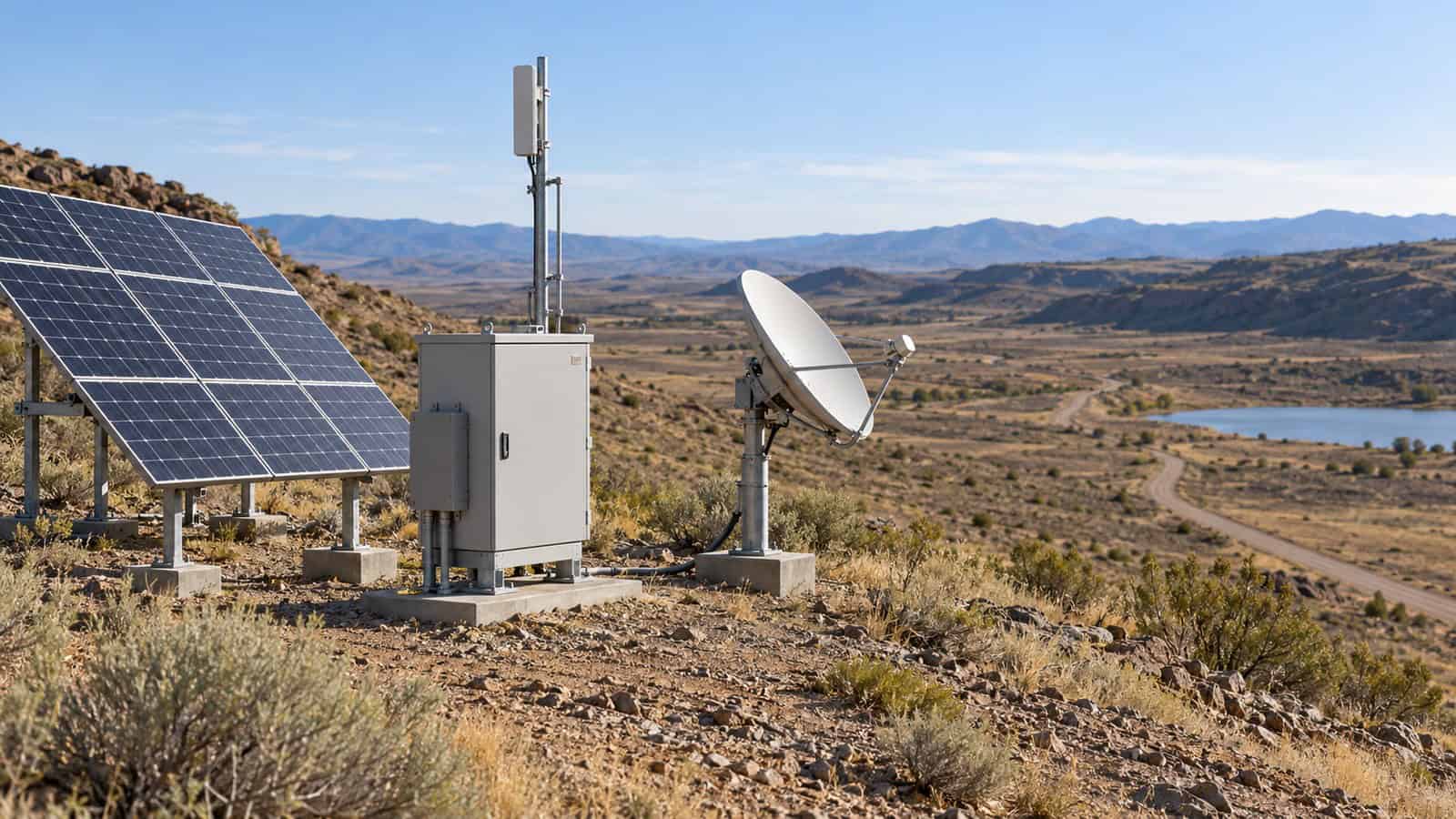
The Robustel R5020-Lite Industrial 5G Router can anchor a remote-site design in which an external satellite terminal connects through Ethernet WAN, provided the two paths are given independent power, health checks and routing policy rather than being called redundant because two subscriptions exist.
Draw the Failure Domains Before the Network Diagram
Start with what can fail together. Cellular and satellite may share the same DC supply, enclosure, Ethernet switch, firewall tunnel endpoint or roof cable route. If one event removes both, the design has two bearers but one failure domain.
| Shared item | What a failure removes | Design question |
|---|---|---|
| AC feed or DC converter | router and satellite terminal | Is backup runtime sized for both loads? |
| intermediate switch | both WAN handoffs | Can each terminal reach the router without it? |
| antenna zone | RF paths | Can damage, snow or access affect both? |
| VPN/concentrator | application reachability | Is upstream service health tested separately? |
Robustel’s 5G internet for farms application example uses an R5020-Lite with Starlink or another satellite service as a separate WAN. It is a useful architecture reference for remote buildings: the satellite terminal remains its own system, while the router owns Ethernet-WAN policy and site-side connectivity.
Follow the Site Through an Outage
Under normal operation, record which path carries telemetry, remote access, video and bulk updates. When cellular health fails, the router must detect a condition that matters to the application, not merely loss of radio registration. A reachable modem with an unreachable VPN endpoint is still an outage for the operator.
During satellite operation, decide which traffic is allowed across the backup link. Metered or higher-latency service may justify preserving alarms and support access while postponing firmware or video transfers. When cellular returns, use a stability period before failback so a fluctuating link does not move sessions repeatedly.
The Robustel video of “Where Are Industrial 5G Routers Used in Real IoT Deployments?” helps teams identify which remote-site flows actually need the cellular path. Put that traffic list beside the failover policy; otherwise a technically successful change of route can still leave the important application unusable.
How the Robustel R5020-Lite Industrial 5G Router Supports Satellite Backup at Remote Sites
Robustel R5020-Lite Industrial 5G Router provides configurable Ethernet roles, dual SIM cellular connectivity and RobustOS routing functions in a compact industrial platform. In this design, cellular is native to the router and satellite arrives from an external terminal over Ethernet. The router can then apply routing and failover policy between those interfaces.
That combination reduces the number of policy points, but it does not merge the two services into one radio. The satellite provider, terminal power, dish view, subscription and upstream routing remain separate dependencies. Robustel RCMS platform can support device visibility and remote operations for the Robustel router; the satellite terminal needs its own monitoring and support path.
Robustel’s fixed-line backup application example uses a different primary medium, yet it exposes the same operational lesson: failover must preserve addressing, segmentation and remote support, not simply produce internet connectivity. Apply that lesson to the satellite transition and test the applications that survive it.
Prove Recovery, Not Only Switchover
Commissioning should include a controlled loss of cellular service, loss of the satellite Ethernet handoff, loss of the shared upstream VPN and a restart on approved backup power. For each event, record detection time, route selection, surviving services, queued work and the operator notification.
After the preferred link returns, confirm that routes, VPN sessions, DNS and management visibility settle into the intended state. A site that switches to satellite but never returns cleanly can consume an expensive plan for weeks. A site that fails back too early can flap through a marginal cellular period.
Häufig gestellte Fragen
Q1. Can satellite internet be used as a backup connection?
Yes. A satellite terminal can present an Ethernet WAN to a suitable router. The design still needs tested health checks, routing, power and subscription ownership.
Q2. What is WAN failover?
WAN failover moves selected traffic to an alternate path when the preferred path fails a defined health test. The health target should represent the service users need, not only the local cable state.
Q3. What is the difference between failover and load balancing?
Failover keeps a secondary link for an outage or policy condition. Load balancing uses more than one link during normal service; it introduces different session and path-control requirements.
Q4. Does satellite internet work during a power outage?
Only if the terminal, router, associated network equipment and any required heaters or auxiliaries have an adequate approved backup supply.
Q5. When is the Robustel R5020-Lite Industrial 5G Router suitable for satellite backup?
It suits remote sites where the satellite terminal provides a documented Ethernet handoff and the router can own the tested cellular/satellite routing policy without hiding shared power or upstream dependencies.
Schlussfolgerung
The Robustel R5020-Lite Industrial 5G Router is a practical site anchor when 5G and an external satellite terminal must serve different failure and cost conditions. The architecture works best when the router owns route selection while each bearer retains a visible service and power boundary.
Approve the design only after the site has switched away, operated on the restricted backup policy and returned to the preferred path under observation. That full cycle is the evidence that two WANs have become an operable recovery system.
Explore More Articles About Robustel 5G Routers

Über den Autor
Robustel Editorial Team
The Robustel Editorial Team publishes practical articles on industrial connectivity, edge computing, LoRaWAN and device management, focusing on deployment considerations, technical limitations and long-term operation.