
4G Lift Gateway Post-Installation Health Checklist for Australian Buildings
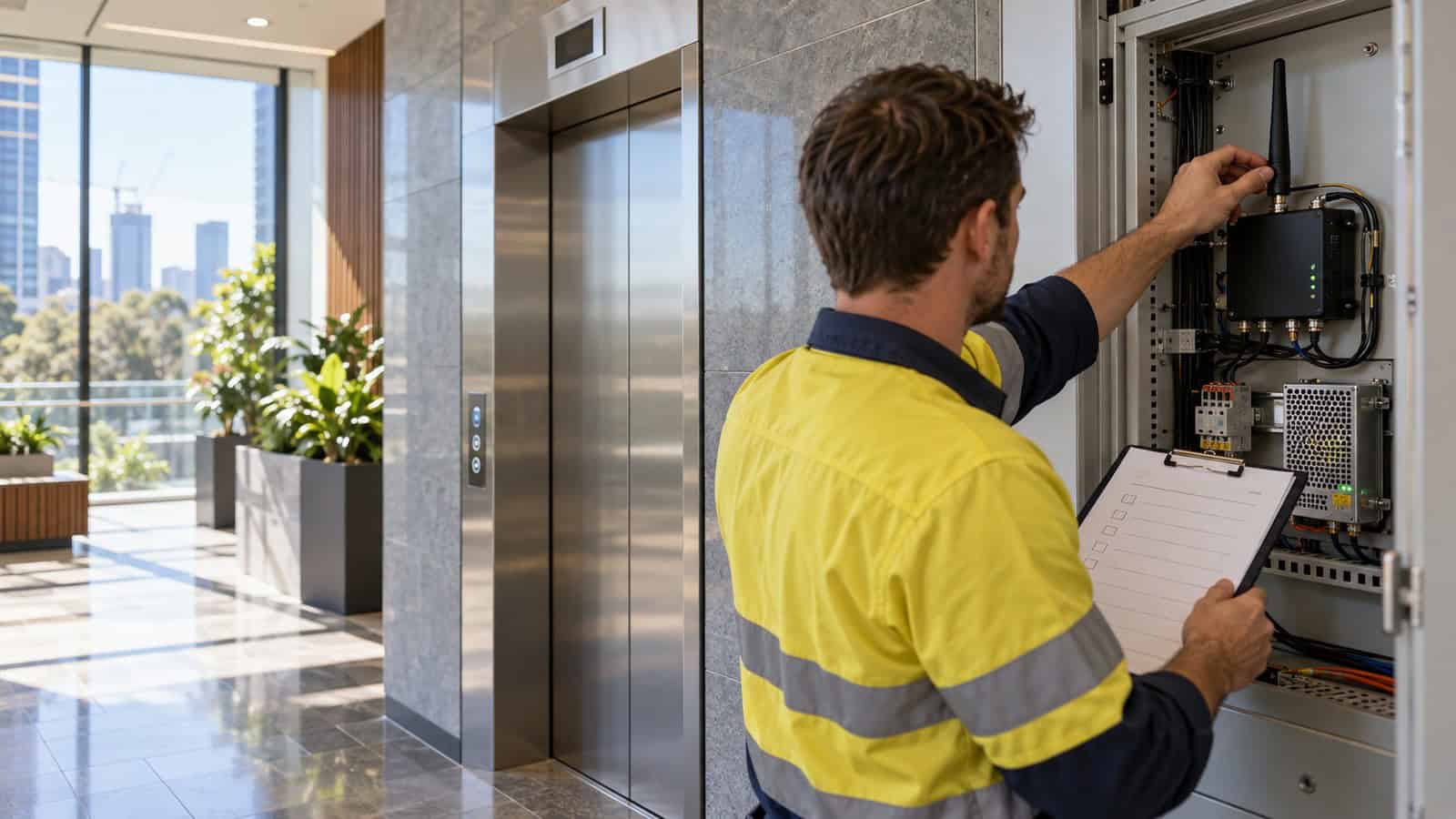
The Robustel EV8100 Elevator Voice Gateway gives Australian lift projects a 4G, FXS and remotely manageable gateway platform, but post-installation health is proved by the complete emergency call and its records. The checklist below supports commissioning and maintenance; it is not an AS 1735 certificate or a replacement for the responsible contractor’s compliance process.
Record the Installation Baseline
Capture site and lift identity, exact gateway variant, firmware/configuration, antenna position, power source, battery details, SIMs, voice service and monitoring destination. Photograph the cabinet and labelled wiring so later remote observations can be related to the physical installation.
Robustel’s TSARO case study demonstrates why standardised records matter across an estate. The local acceptance record remains specific to the installed lift, service and Australian maintenance process.
Check Power and Battery Behaviour
- Verify normal input voltage and secure terminals.
- Confirm the approved cells, polarity and charger state.
- Remove mains under the authorised procedure.
- Place a witnessed call on backup power.
- Restore mains and confirm recharge/status behaviour.
Record voltage/status and timing rather than a simple pass tick. A short call immediately after charge does not establish future runtime.
Verify RF, Registration and Voice Separately
| Check | Evidence | Pass condition |
|---|---|---|
| antenna/RF | final placement and signal observations | stable enough for the tested service |
| network | selected SIM and mobile registration | expected operator/service reached |
| voice | VoLTE or SIP registration | approved voice path available |
| call | setup, two-way audio and DTMF | monitoring centre receives correct lift identity |
Record the mobile network, signal observations and registration state before placing the call. Signal bars are only one radio indicator: they cannot show whether the voice service is provisioned, whether call setup succeeds or whether the monitoring centre receives usable audio and identification.
Place a witnessed call from the lift car and timestamp call setup, connection, two-way audio and clear-down. If the call fails while the gateway remains registered, preserve that state for the mobile or voice provider instead of moving the antenna immediately. If registration itself is unstable, compare power, antenna position and carrier behaviour before changing voice settings.
Repeat the same sequence at a representative time and after any antenna, SIM, carrier or voice-service change. The result should make clear whether the fault followed the radio path, the subscription or the end-to-end voice chain, giving the correct owner evidence they can act on.
How the Robustel EV8100 Elevator Voice Gateway Supports Post-Installation Health Checks
Robustel EV8100 Elevator Voice Gateway combines one FXS interface, 4G voice capability, dual SIM, internal battery support and RCMS. That lets the checklist connect physical wiring, mobile service and remote status around one device.
Use RCMS to identify device, network and battery-related exceptions before sending a technician, then compare that record with the installed handset and witnessed call. A remote change in registration or battery status can focus the visit, but it cannot confirm the travelling cable, audio path or monitoring-centre response.
The Robustel’s EV8100 Quick Pitch video below is useful before installer training, while the exact wiring diagram and service configuration control the field procedure. Close the health check only when the remote record and the witnessed call describe the same working state.
Test the Lift-Car Experience
Place the call from the installed lift phone. Verify call initiation, destination, site identification, two-way audio, volume, DTMF or autodialler behaviour and the monitoring-centre script. Test any required callback process using the approved procedure.
Run the call with doors and machinery in representative states. A quiet machine-room call can miss audio, travelling-cable or handset problems that appear in the car. Record which party heard each direction clearly and whether identification arrived, rather than relying on a general “call passed” entry.
Robustel’s PSTN replacement application example maps the analogue-to-cellular call chain. Use it to organise the observations, then keep site acceptance tied to the actual handset, travelling cable, mobile service and monitoring-centre procedure.
Complete Remote Monitoring and Handover
Confirm device naming, site/lift identifiers, alert recipients, access roles and escalation. Create a test exception and verify that it becomes an owned action rather than an unread notification.
Follow the exception through acknowledgement, work allocation and closure. If the alert reaches the correct dashboard but no party owns the response, monitoring has added visibility without reducing service risk. Record the expected response time and the evidence required before the incident can be closed.
Hand over the baseline, witnessed call record, battery plan, service contacts, configuration backup and next test date. Record which party owns the lift phone, gateway, mobile service and monitoring-centre relationship so that a later fault does not begin with suppliers debating the boundary.
Häufig gestellte Fragen
Q1. How do you test a lift emergency phone?
Place a witnessed call from the lift car and verify destination, identification, two-way audio, DTMF where used and the receiving party’s response under required power conditions.
Q2. What should be checked after installing a 4G gateway?
Check power, antenna, mobile and voice registration, application or call outcome, remote access, alerts and the handover record.
Q3. Does signal strength prove call quality?
No. It is useful diagnostic evidence, but call setup, media quality and the receiving service need end-to-end testing.
Q4. How often should battery backup be tested?
Follow applicable local requirements and the approved maintenance programme. Retest after battery, power or configuration changes that may affect the service.
Q5. What should be verified after installing the Robustel EV8100 Elevator Voice Gateway?
Verify its FXS connection, cellular and voice service, approved battery arrangement, RCMS visibility and a witnessed emergency call from the lift car.
Schlussfolgerung
The Robustel EV8100 Elevator Voice Gateway can provide a consistent 4G voice boundary for Australian lift estates, while the post-installation record proves how the particular lift behaves. A complete check combines physical inspection, remote state and the passenger call experience.
Do not hand over a green dashboard alone. Hand over the exact baseline, a witnessed call on normal and backup power, clear service ownership and the date and trigger for the next test.
Explore More Articles About Robustel Lift Connectivity


Über den Autor
Robustel Editorial Team
The Robustel Editorial Team publishes practical articles on industrial connectivity, edge computing, LoRaWAN and device management, focusing on deployment considerations, technical limitations and long-term operation.