
PoE LoRaWAN Gateway Selection Guide for Building Retrofits
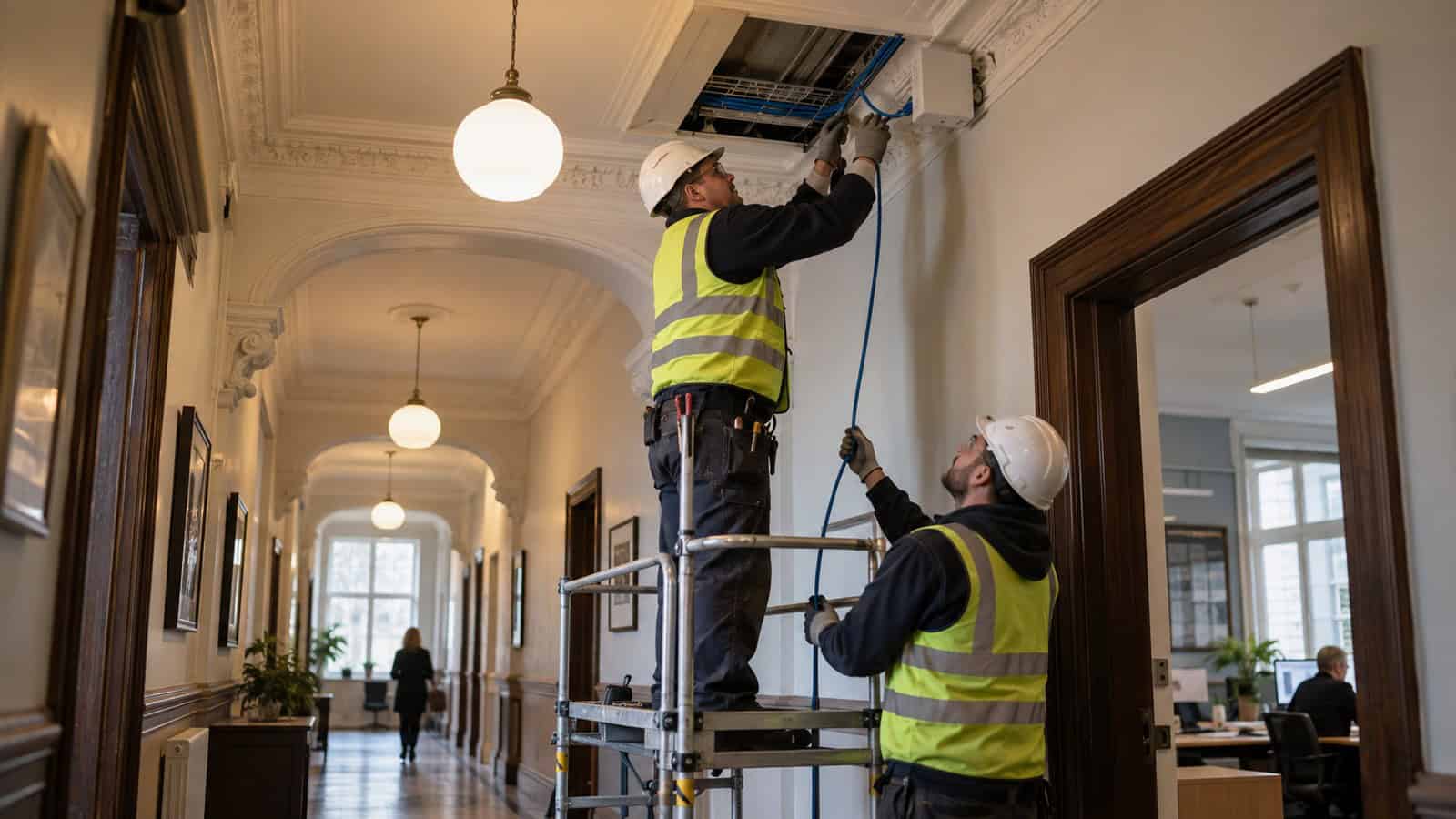
The Robustel R1520LG LoRaWAN Gateway offers an optional 802.3at PoE-PD input on ETH0, which can help a building retrofit place the gateway where LoRaWAN reception is better without adding a local mains outlet. PoE is useful because it changes the cabling problem, not because it fixes radio coverage. The installation still needs a survey, a complete power budget and a handover that facilities staff can understand.
I would rather move a gateway three metres to a known-good position than try to recover a poor path with assumptions about antenna gain. In occupied buildings, that placement decision can save far more time than the hardware specification suggests.
Walk the Building Before Counting Gateways
Mark risers, plant rooms, basements, lift cores, reinforced walls, metal services and tenant boundaries. Identify the hardest sensors rather than standing in the easiest corridor. A gateway location that hears an open-plan office may miss a meter in a concrete basement.
Run a representative radio survey with the intended regional frequency plan, antenna and sensor settings. Do not quote a universal LoRaWAN range or device count. Airtime, spreading factors, payloads, duty-cycle rules, interference and building materials all shape the usable design.
The Robustel’s Voytech Systems case study provides exact-series deployment evidence for using R1520-LG gateways in building monitoring. Its value is the retrofit context and the reduction of sensor cabling. It does not turn one gateway placement into a coverage template for every building.
Decide Whether PoE Removes or Moves the Risk
PoE can combine power and data on one cable and move the power source to a managed cabinet. That is helpful only if the switch or injector, cable route and backup supply are themselves controlled. A ceiling-mounted gateway powered from an unlabelled office switch may be harder to support than a locally powered gateway in a known panel.
Check these points during the survey:
- which Ethernet port accepts PoE and which standard it requires;
- switch or injector capacity and the per-port allocation;
- cable category, length, patching and fire-stopping requirements;
- earthing, surge and separation from building services;
- whether the PoE source is on the intended UPS;
- who can cycle the port during support;
- how the gateway remains physically accessible.
Keep Radio and Backhaul Placement in the Same Drawing
The best LoRaWAN position may be away from the existing LAN. PoE extends Ethernet, but it still has distance and pathway constraints. Cellular backhaul can remove the tenant-network dependency, while Ethernet may provide a lower-cost primary path. Wi-Fi can be useful in some sites but should not be assumed available in secure plant areas.
Draw LoRaWAN coverage, Ethernet/PoE, cellular antennas and cabinet ownership on one plan. This prevents an RF improvement from accidentally creating a maintenance or security problem.
How the Robustel R1520LG LoRaWAN Gateway Fits PoE Building Retrofits
The Robustel R1520LG LoRaWAN Gateway documents optional 802.3at PoE-PD on ETH0, two Fast Ethernet ports, dual-SIM LTE, Wi-Fi, RS-232 and RS-485 and support for external or embedded LNS architectures. That combination suits a retrofit where sensor radio placement, independent cellular backhaul and existing BMS/SCADA interfaces all matter.
The Robustel R1320LGe is a more focused packet-forwarding alternative with PoE-PD and a physical SIM plus eSIM. Choose it when an external LNS is already established and local edge applications are not part of the requirement. Meanwhile, LG3120e serves a different role with an integrated LNS, more compute and E2C Field support. (Tips: E2C Field compatibility applies to LG3120e, not R1520LG)
The Robustel’s LoRaWAN connectivity for smart buildings application example describes an R1520-LG architecture that separates the sensor network from tenant IT through cellular backhaul. That is a useful operating pattern for retrofits; the final gateway count and radio result still belong to the survey.
Use a PoE Loss Budget, Not a Checkbox
| Item | Record at design | Verify at handover |
|---|---|---|
| source | switch/injector model and standard | negotiated power and port state |
| cable | length, category, patch points | continuity, labelling and measured condition |
| load | gateway maximum and accessories | stable operation under normal and restart load |
| resilience | UPS and switch failure domain | runtime and controlled recovery |
| access | port-control owner | remote cycle process and audit trail |
Do not attach unrelated devices to the same small power design without recalculating it. If an external antenna amplifier, converter or switch is added later, the original PoE assumption may no longer describe the installation.
Commission From the Hardest Sensor Location
Bring representative sensors online, verify joins, uplinks and downlinks, then close doors and restore plant operation. Machinery, occupancy and services can change the radio environment. Test cellular or Ethernet loss, PoE port cycling and recovery of the LNS/application path.
Inspect what remains after a gateway restart: device sessions, buffered data, clock, alarm state and management visibility. The Robustel R1520LG product overview video can help installers understand the platform, but the survey and electrical handover are the evidence for the building.
If the gateway later goes offline, diagnose the PoE chain before replacing radio hardware. Check switch port state and negotiated power, then patching, cable continuity and gateway input; only after power is stable should the team investigate Ethernet, cellular or LoRaWAN service. This sequence avoids a familiar retrofit failure in which a marginal cable or unprotected switch is reported as intermittent RF because the gateway restarts without a clear power alarm.
FAQs
Q1. Does LoRaWAN need a gateway?
Yes. End devices send LoRaWAN radio traffic to one or more gateways, which connect it to the network-server architecture.
Q2. What is a LoRaWAN gateway used for?
It receives uplinks from LoRaWAN sensors and forwards them to an LNS. Some gateways also host the LNS, provide cellular backhaul or run edge applications.
Q3. Is LoRaWAN better than Wi-Fi?
They solve different problems. LoRaWAN suits small, low-power messages over wider areas, while Wi-Fi supports higher data rates and usually needs more device power.
Q4. What are the best LoRaWAN gateways?
The best fit depends on frequency plan, LNS ownership, backhaul, interfaces, environment and fleet operations. A packet forwarder, integrated-LNS gateway and edge-computing gateway are different categories, not a simple quality ranking.
Q5. When is the Robustel R1520LG LoRaWAN Gateway a good PoE retrofit choice?
It is a good candidate when optional PoE-PD helps place the gateway for better RF, while dual-SIM LTE and flexible LNS options support the building’s backhaul design. Confirm the exact variant and complete PoE path before installation.
Conclusion
The Robustel R1520LG LoRaWAN Gateway fits building retrofits where PoE can move the gateway to a better radio position and cellular or Ethernet can keep the monitoring network independent of tenant infrastructure. The installation succeeds when RF, power and ownership are designed together.
Survey the hardest spaces, document the PoE source and recovery path, and test the finished building rather than an open-plan approximation. That turns a convenient cable feature into a supportable monitoring service.
The handover should let a facilities engineer identify the gateway, PoE source, switch owner, UPS dependency and antenna location without opening the design team’s drawings. When those details are labelled at both ends of the cable, a remote port cycle becomes a controlled diagnostic action rather than a guess that might disconnect another tenant service.
Explore More Articles About Robustel LoRaWAN Gateways


About the Author
Robert Liao | Technical Support Engineer
Robert is an IoT Technical Support Engineer at Robustel, specializing in industrial networking and edge connectivity. A certified Networking Engineer, Robert focuses on the deployment and troubleshooting of large-scale IIoT infrastructures. His work centers on architecting reliable, scalable system performance for complex industrial applications, bridging the gap between field hardware and cloud-side data management.