
LoRaWAN vs NB-IoT: Best Fit for Long-Range Industrial Sensors
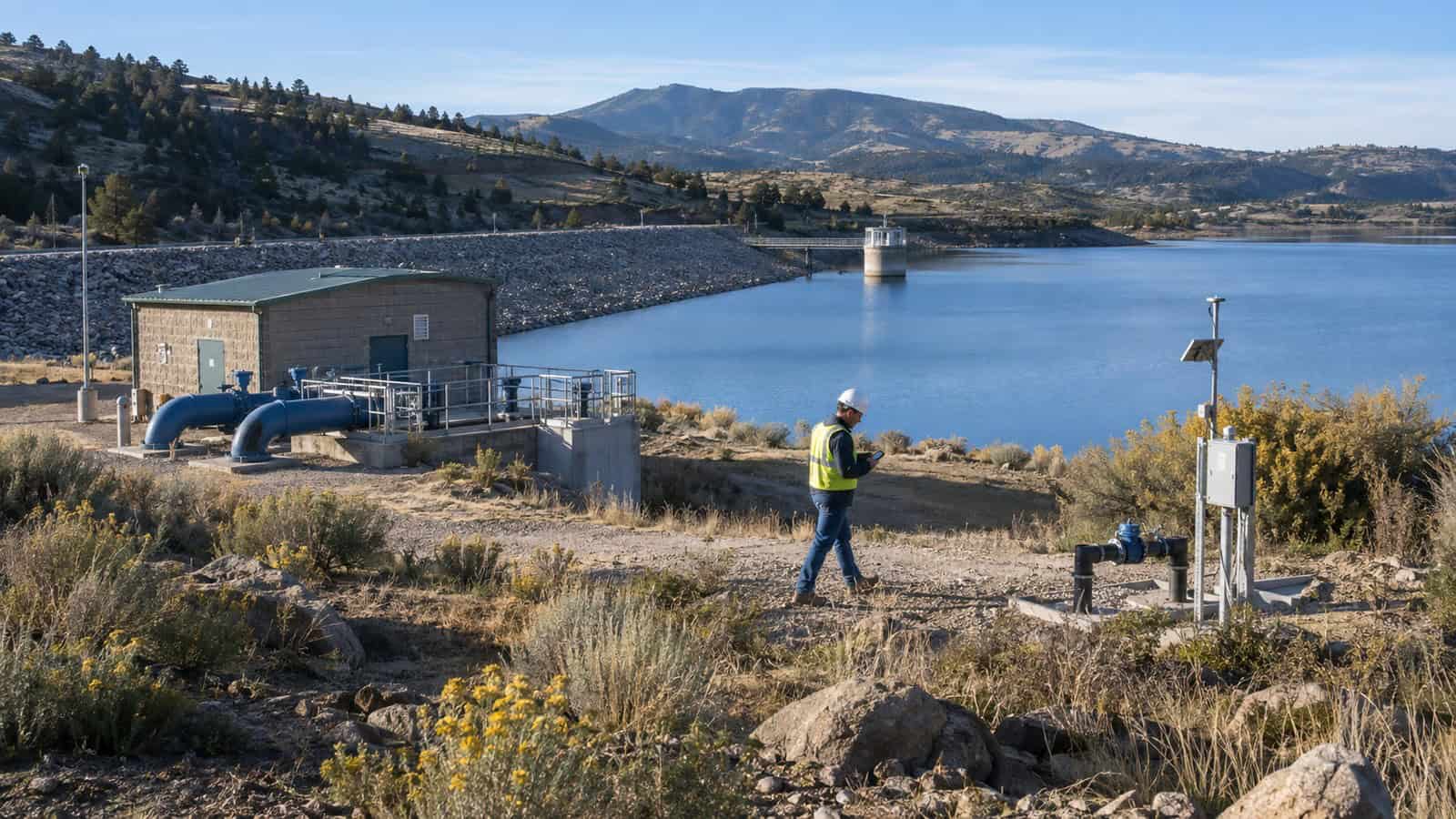
The Robustel LG3120e LoRaWAN Gateway with 4G, eSIM, Wi-Fi, Serial and I/O fits projects that want to own a local LoRaWAN access layer and combine wireless field sensors with selected edge operations. NB-IoT takes a different route: each device normally connects through a mobile operator’s licensed network. The better fit follows from ownership, coverage, traffic and lifecycle, not from a universal range claim.
The Network Boundary Is the Main Difference
With LoRaWAN, the project can deploy gateways, choose where the network server runs and design backhaul to suit the site. That control is useful in factories, estates, farms and distributed infrastructure where private radio coverage or local processing matters. It also makes RF planning and gateway maintenance the project owner’s responsibility.
NB-IoT typically places radio access with the mobile operator. Endpoint provisioning, subscriptions, roaming conditions and operator coverage become central. This can reduce private gateway infrastructure where service is available, but the organization has less control over the access network.
| Decision | LoRaWAN direction | NB-IoT direction |
|---|---|---|
| Radio-network ownership | Private or managed gateway estate | Operator network |
| Endpoint relationship | LoRaWAN device joins chosen network | Device uses operator subscription |
| Local coverage work | Gateway and antenna design owned by project | Validate operator service at each device |
| Backhaul | Gateway needs IP path to external services where used | Embedded in operator service path |
| Local processing | Can be placed at capable gateway | Usually requires separate edge/application layer |
| Recurring commercial model | Gateway, server and operations choices | Per-device/operator terms commonly matter |
Range Is a Site Result in Both Architectures
LoRaWAN range changes with antenna height, terrain, walls, metal, regional plan, spreading factor, endpoint antenna and traffic. NB-IoT coverage also depends on operator deployment, supported bands, building penetration and device conditions. Neither technology should be purchased from a single distance figure.
Survey the difficult locations first: basements, plant rooms, pits, metal enclosures and the far side of terrain. A LoRaWAN design can add or reposition gateways. An NB-IoT design may need another operator, antenna arrangement or technology if the required service is unavailable.
Power and Traffic Behaviour Need Real Payloads
Both technologies can support low-power sensing, but battery life comes from the complete endpoint behaviour. Message interval, payload, retries, receive windows, network conditions, firmware and sensor duty cycle all matter. A device that reports a few bytes twice per day has a different energy budget from one that sends frequent alarms and expects downlinks.
LoRaWAN capacity also cannot be inferred from channel count. Airtime rises with longer packets, slower data rates and retransmissions. For NB-IoT, subscription and operator network behaviour remain part of the service design. Model the application for its busiest credible interval, not its average day.
How Robustel LG3120e and E2C Field Fit a Private LoRaWAN Architecture
The LG3120e provides an integrated LoRaWAN Network Server, up to eight simultaneous receive channels, 4G and Wi-Fi backhaul, two Fast Ethernet ports, serial interfaces and a Debian-based RobustOS Pro environment. It supports the published regional frequency plans and LoRaWAN V1.0.4 Class A and Class C. Projects that require Class B need a gateway architecture with explicit Class B support.
At a distributed site, Robustel LG3120e brings LoRaWAN radio, backhaul, field interfaces and local compute into one node. Running E2C Field on that supported gateway adds LoRaWAN configuration, data collection, local processing, alarms, workflows and northbound delivery. The pairing gives operations a clearer path from sensor onboarding to usable data and alerts, reducing the number of separate tools the project must integrate and maintain. Sensor compatibility and commissioning still depend on the selected field devices.
The Voytech Systems LoRaWAN BMS case study documents a real R1520-LG deployment across building environments. It demonstrates the practical value of private LoRaWAN where cabling is difficult, but its building results are not a range guarantee.
The KoolZone cold-chain case study provides another deployment reference in refrigeration and laboratory monitoring. It supports the separation between local LoRaWAN sensing and the wider backhaul/service architecture rather than proving a result for every cold store.
Choose the Robustel Gateway by the Application Layer
| Requirement | Robustel direction | Boundary |
|---|---|---|
| Forward packets to existing ChirpStack | Robustel R1320LGe | Focused forwarding role |
| Choose external or embedded LNS | Robustel R1520LG | Flexible server placement |
| LoRaWAN plus local field workflows | Robustel LG3120e | Gateway-and-software pairing with E2C Field |
| Building-oriented multi-protocol integration | Robustel LG5120 | Select for its separate building-integration role |
The Robustel LoRaWAN Gateway Portfolio webinar explains these different gateway roles. Use it to orient the architecture discussion, then match the chosen model and regional variant to the site’s frequency plan and interface requirements.
Commission the Technology Choice
Pilot representative endpoints at difficult sites. Measure join behaviour, uplink delivery, retry patterns, battery assumptions and recovery after backhaul or server interruption. For LoRaWAN, include gateway placement and LNS ownership. For NB-IoT, include subscription activation, coverage and operator support processes.
The commercial comparison should use the same period and responsibility boundary. Private LoRaWAN costs include gateways, backhaul, server and operations; NB-IoT costs include modules, subscriptions and operator conditions. Avoid declaring a winner before those boundaries are comparable.
FAQs
Q1. What are the key differences between NB-IoT and LoRaWAN?
The main difference is who owns and operates the access network. LoRaWAN can be deployed as a private gateway network with local architectural control, while NB-IoT uses a mobile operator’s licensed network; coverage, device power, payload, downlink needs and commercial ownership then decide the better fit.
Q2. What are the disadvantages of LoRaWAN?
Private LoRaWAN gives the project control, but it also makes gateway placement, RF planning, network-server operation and maintenance part of the project. Its low-data-rate design also means it should be reserved for suitable sensor traffic rather than treated as general-purpose wireless connectivity.
Q3. What is replacing LoRaWAN?
There is no single replacement because the available technologies solve different operational problems. A better question is whether the next deployment needs a private network, operator-managed coverage, greater payload capacity or a different power profile; that requirement may lead to LoRaWAN, NB-IoT or another LPWAN option.
Q4. What are the limitations of NB-IoT?
NB-IoT depends on suitable operator coverage, supported bands, subscriptions and the operator’s service lifecycle. It can be a good fit for low-data-rate devices, but projects should verify roaming, latency tolerance, power behaviour and commercial terms in every intended market.
Q5. When do the Robustel LG3120e Industrial Edge Computing LoRaWAN Gateway and E2C Field make sense together?
They suit a private LoRaWAN site that needs more than packet forwarding. The gateway supplies LoRaWAN connectivity, local compute and backhaul, while E2C Field adds supported configuration, data collection, alarms, workflows and northbound integration on that compatible model—giving the team a clearer route from field devices to usable operational data.
Conclusion
The Robustel LG3120e Industrial Edge Computing LoRaWAN Gateway with 4G, eSIM, Wi-Fi, Serial and I/O is a strong fit when the organization wants private LoRaWAN coverage and an operational edge layer at distributed sites.
Choose between LoRaWAN and NB-IoT by deciding who should own radio access, how difficult locations will be covered, what endpoints actually transmit and where field data must be processed.
Explore more articles about Robustel’s LoRaWAN gateways in industrial IoT:
About the Author
Robert Liao | Technical Support Engineer
Robert is an IoT Technical Support Engineer at Robustel, specializing in industrial networking and edge connectivity. A certified Networking Engineer, Robert focuses on the deployment and troubleshooting of large-scale IIoT infrastructures. His work centers on architecting reliable, scalable system performance for complex industrial applications, bridging the gap between field hardware and cloud-side data management.