
When Does an IoT Project Need an Edge Gateway? A Practical Selection Checklist

An IoT project does not need an edge gateway simply because it connects equipment to the cloud. Robustel EG5100 edge computing gateway becomes relevant when the site needs local protocol integration, application execution, data handling, secure WAN connectivity, or management responsibilities that a basic router or device-native connection cannot fulfil.
In a simpler architecture, one IP device may already support the required cloud protocol and security method. A Robustel router or the device’s own connection may then be sufficient, particularly when no local data transformation, buffering, or downstream network integration is required.
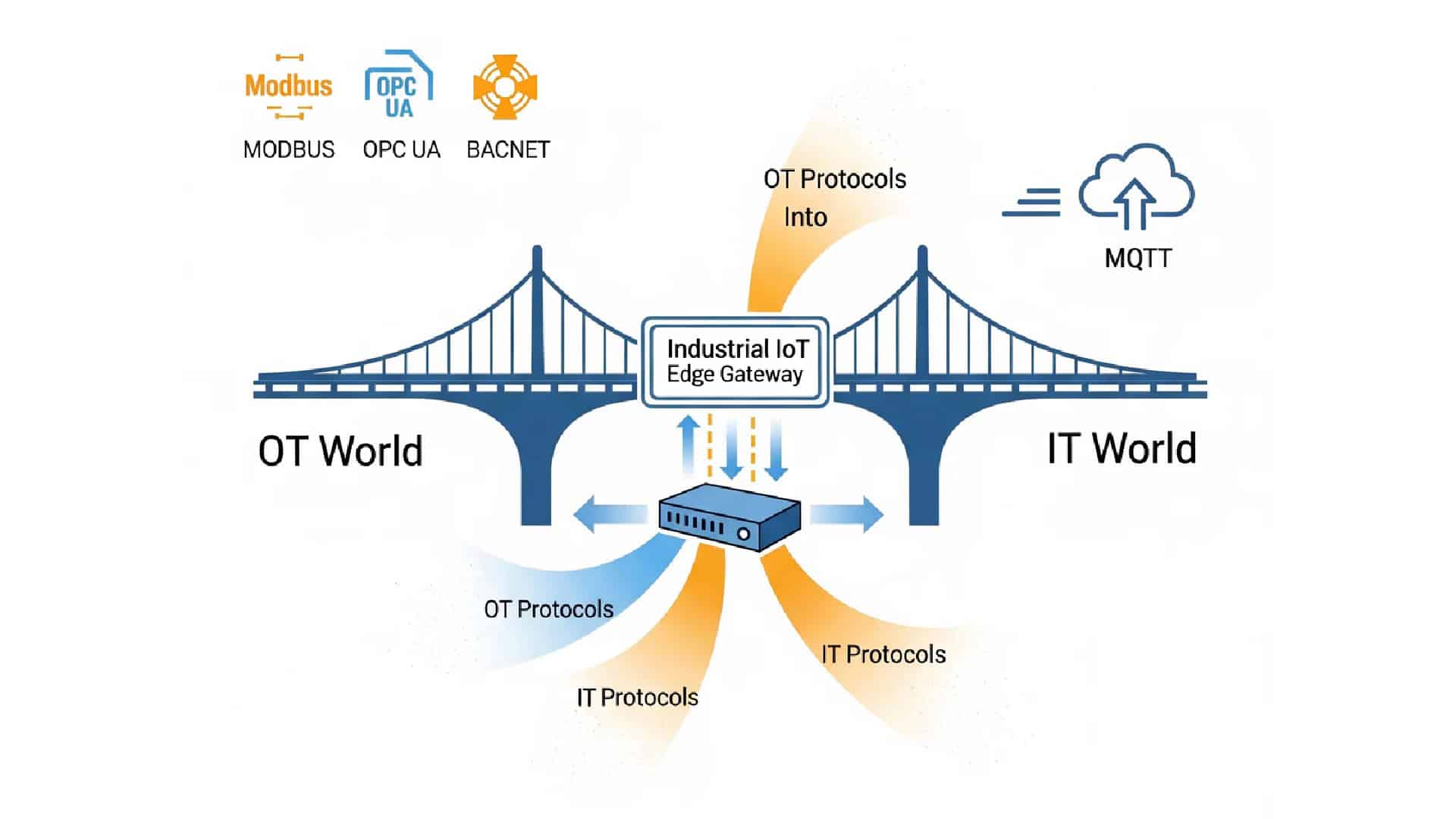
The decision should therefore start by identifying the responsibility that must remain at the site. Robustel edge computing gateways are designed to connect OT equipment, run Debian-based applications, bridge industrial protocols, prepare selected data, and provide secure upstream connectivity, but a project should only adopt those capabilities when it can explain why they are necessary.
First Identify Projects That Do Not Need an Edge Gateway
Robustel does not need to position an edge gateway in every connected-device architecture. A simpler design is often easier to deploy, secure, and maintain when the field device already provides the required upstream connection.
An edge gateway may be unnecessary when one Ethernet or cellular device sends complete, correctly structured data directly to the approved platform. The device must already provide stable identity, authentication, encryption, outage recovery, and remote-management functions that satisfy the project.
A standard industrial router may also be enough when the only requirement is to provide cellular backhaul, VPN access, routing, firewall protection, or Ethernet failover. Local compute resources add little value when no field protocol needs interpretation and no application must continue at the site.
| Project Situation | More Proportionate Starting Point |
| One cloud-ready IP device | Device-native connection |
| Several IP devices needing only WAN access | Industrial router |
| Remote PLC access without local data processing | Router with secure VPN |
| One application already running on an industrial PC | Router plus existing computer |
| Serial devices requiring protocol and data integration | Edge gateway candidate |
| Local application required during WAN loss | Edge gateway candidate |
The presence of MQTT, Modbus, cellular service, or a cloud dashboard alone does not prove that an edge gateway is needed. The missing local responsibility must be identified first.
Check Whether Different Device Systems Must Be Integrated
A Robustel edge computing gateway becomes easier to justify when the site contains equipment that cannot connect to the upstream system in one consistent way.
A brownfield installation may combine RS-485 meters, an Ethernet PLC, digital status signals, and a legacy serial controller. Each source may use different addresses, data types, units, polling behaviour, and failure states. A router can carry IP packets, but it does not automatically interpret serial registers or create a common asset model.
The gateway requirement becomes stronger when one platform must collect from several device types, preserve their engineering definitions, and produce a consistent northbound output. Robustel EG5100 supports two configurable RS-232/RS-485 interfaces, two Fast Ethernet ports, digital I/O, RobustOS Pro, and Docker-compatible applications for focused protocol bridging and preprocessing.
The key qualification question is not how many devices exist. It is whether those devices require a shared integration layer that would otherwise be implemented separately in a PLC, industrial computer, protocol converter, and router.
| Integration Condition | Gateway Justification |
| All devices already use one approved IP protocol | Weak |
| One serial device needs simple transparent access | Project-dependent |
| Several serial and Ethernet sources need one data model | Strong |
| Vendor-specific values require normalization | Strong |
| Multiple independent applications need local access | Strong |
| Device replacement must not change the cloud schema | Strong |
Robustel EG5100 is most proportionate where this integration remains focused. A substantially larger application stack or high-volume workload may require a higher-capacity gateway rather than forcing the EG5100 beyond its resource boundary.
Check Whether the Site Must Operate Through a WAN Outage
Robustel edge computing is justified when selected site functions must continue despite temporary loss of cellular service, Ethernet WAN, VPN access, or the cloud endpoint.
The requirement must be stated precisely. “Offline operation” can mean continued device polling, local message exchange, event generation, buffering, a local dashboard, or process control. These functions have different technical and safety implications.
An edge gateway can continue approved data collection and application processing when the local equipment and gateway remain powered. It may retain selected records and replay them after the connection returns. It cannot guarantee cloud visibility during the outage, and it should not take over deterministic PLC or safety-controller responsibilities without a separately validated control architecture.
Robustel EG5100 provides 8 GB eMMC for its operating system, applications, logs, and selected local data. Reliable buffering still requires an application-defined retention period, queue limit, timestamp policy, acknowledgement method, replay order, and storage-full response. Available flash capacity alone does not create store-and-forward behaviour.
A useful qualification test asks what business or operational result would be lost if all processing stopped until the cloud connection returned. When the answer is limited to a temporarily unavailable dashboard, a router may still be enough. When the site must retain records, evaluate conditions, or maintain local application services, an edge gateway has a clearer role.
Check Whether Data Must Change Before Upload
Robustel EG5100 becomes more relevant when device data cannot be sent upstream in its original form.
Raw industrial values may require scaling, units, timestamps, asset identities, quality states, or mapping versions. Repetitive measurements may need controlled aggregation, while equipment states may be more useful as transitions or events. This processing reduces ambiguity rather than merely reducing message volume.
The project should document the difference between the source and the required upstream record.
| Source Data | Required Upstream Result | Local Function |
| Raw meter register | Named value with unit and timestamp | Normalization |
| Repeated unchanged status | Message after state transition | Filtering |
| One-second measurements | Five-minute summary | Aggregation |
| Device communication timeout | Explicit quality event | Validation |
| Records created during WAN loss | Ordered historical replay | Buffering |
The presence of one minor transformation does not always justify a separate edge platform. A cloud connector may handle simple formatting when the WAN is reliable and the device protocol is already supported.
The gateway case becomes stronger when several transformations must be performed consistently across multiple local sources, or when they must continue independently of the cloud. Robustel’s Debian-based RobustOS Pro environment supports containerized and package-based applications for these workflows, but the selected connector, mapping, and data policy remain project responsibilities.
Check Whether the Site Must Host a Maintained Application
An edge gateway is not only hardware. A Robustel deployment that runs protocol connectors, databases, Node-RED flows, custom code, or containerized services also creates a software lifecycle.
The project should identify who owns the application, which versions are approved, how configuration is backed up, and what happens when an update fails. Resource use, security patches, logs, dependencies, and rollback cannot be left undefined after the pilot.
Robustel EG5100 runs RobustOS Pro based on Debian 11 and supports Docker containers and Debian-compatible packages. Its Cortex-A7 processor, 1 GB DDR3, and 8 GB eMMC make it suitable for focused connectors, buffering, and lightweight preprocessing rather than large databases or a wide collection of heavy concurrent services.
This creates a clear Go/No-Go boundary. An edge gateway is justified when the local application has a defined operational value and a realistic maintenance owner. It is not justified when a team wants “future flexibility” but has not defined the application, required resources, security process, or support responsibility.
The Robustel EG5100 product specification should be used to validate the real application workload rather than treating Linux or Docker support as proof that every package will run.
Check Whether One Platform Must Own the Site Boundary
A Robustel edge computing gateway can be valuable when the project needs one managed boundary between field equipment and external systems.
That boundary may combine local interfaces, LAN/WAN separation, routing, firewall rules, VPN connectivity, cellular backhaul, application hosting, and controlled access to downstream equipment. Consolidating these roles can simplify distributed sites, provided that the gateway does not become an untested single point of failure.
Robustel EG5100 supports dual-SIM 4G/LTE, supported 3G/2G fallback, Ethernet WAN options, firewall features, and several VPN technologies alongside its local application environment.
The value increases when the deployment must be repeated across many sites. RCMS can monitor Robustel routers and gateways, apply templates, distribute signed firmware, applications, and configurations, provide remote CLI and diagnostics, and support controlled remote access.
RCMS manages the gateway estate rather than the full industrial process. It does not replace the PLC, SCADA system, cloud broker, historian, or custom application validation.
The Robustel RCMS platform supports repeatable provisioning, monitoring, updates, diagnostics, and configuration control once an edge-gateway architecture moves beyond a single site.
Use an Edge Gateway Go/No-Go Worksheet
The final decision should be evidence-based rather than driven by a product label.
| Qualification Question | Evidence Required | Decision Effect |
| Must different field protocols be integrated? | Device and interface list | Supports gateway |
| Must data change before upload? | Mapping or processing specification | Supports gateway |
| Must local functions continue during WAN loss? | Outage and recovery requirement | Strongly supports gateway |
| Must the site host a maintained application? | Software ownership and lifecycle plan | Supports gateway |
| Must one device own LAN, WAN, and security boundaries? | Network diagram | Supports gateway |
| Is fleet-wide deployment expected? | Provisioning and management plan | Strengthens gateway case |
| Can the device or router already meet all requirements? | Verified simpler architecture | Gateway not required |
A “yes” should be supported by a concrete responsibility. The project should not apply an arbitrary score such as “three checks mean buy a gateway.” One critical requirement—such as serial integration with mandatory local buffering—may be sufficient. Several weak preferences may not be.
Robustel EG5100 edge computing gateway fits the qualified project when the local workload is focused, two Fast Ethernet ports and two configurable serial interfaces are sufficient, 4G backhaul meets the WAN requirement, and the application fits within its compute and storage resources.
よくある質問
Q1. Does every industrial IoT project need an edge gateway?
No. A device can connect directly to the cloud when it already provides the required protocol, security, identity, and recovery behaviour. An industrial router may also be enough when the project only needs WAN, VPN, firewall, or routing. An edge gateway becomes justified when local protocol integration, data processing, buffering, application hosting, or multi-device coordination creates a responsibility that simpler equipment cannot fulfil.
Q2. When is an industrial router enough for an IoT project?
An industrial router is usually enough when local devices already communicate over IP and only require secure Ethernet or cellular connectivity. It can provide routing, firewall protection, VPN access, and WAN failover without hosting an industrial data application. The project should consider an edge gateway when serial equipment, protocol translation, local buffering, normalized cloud data, or WAN-independent application behaviour becomes necessary.
Q3. Is temporary WAN loss a reason to deploy an edge gateway?
It can be, but only when something useful must continue locally. The project may require device polling, message exchange, buffering, event generation, or a local interface during the outage. A gateway does not keep the cloud platform available and cannot recreate data that the source device failed to produce. Retention, timestamps, storage limits, replay, and duplicate handling must be explicitly designed.
Q4. Can one industrial device connect directly to the cloud without a gateway?
Yes. Direct connection can be the simpler architecture when one device already supports the approved cloud protocol, authentication, encryption, payload format, remote management, and outage recovery. A gateway becomes more relevant when several devices must share connectivity, legacy protocols require integration, data must be transformed locally, or the site needs a separate security and application boundary between operational equipment and the cloud.
Q5. When is Robustel EG5100 a suitable edge gateway?
Robustel EG5100 edge computing gateway is suitable when a project needs focused serial and Ethernet integration, lightweight local applications, selected buffering or normalization, dual-SIM 4G connectivity, VPN functions, and RCMS management. Its 1 GB RAM and 8 GB eMMC define a practical workload boundary. Larger databases, high-volume analytics, or several heavy applications may require a higher-capacity edge platform.
Conclusion: Edge Gateway Qualification Takeaway
Robustel EG5100 edge computing gateway should be selected because the project assigns it a clear local responsibility—not simply because the architecture contains IoT devices, cloud software, or cellular connectivity.
A router or direct device connection remains the better design when connectivity is the only missing function. A Robustel edge gateway becomes justified when the site must integrate different equipment, transform data, retain records through WAN interruptions, host a maintained application, or own a managed network and security boundary.
The practical decision is therefore a Go/No-Go qualification. Define the responsibility, provide the supporting evidence, test the failure boundary, and then confirm that the EG5100 has the interfaces and resources to fulfil that role without unnecessary architectural complexity.
Related Reading on Edge Computing in Industrial IoT:

著者について
Robert Liao | Technical Support Engineer
Robert is an IoT Technical Support Engineer at Robustel, specializing in industrial networking and edge connectivity. A certified Networking Engineer, Robert focuses on the deployment and troubleshooting of large-scale IIoT infrastructures. His work centers on architecting reliable, scalable system performance for complex industrial applications, bridging the gap between field hardware and cloud-side data management.