
Lift Phone Testing Guide: Commissioning, Periodic Checks and Audit Records
The Robustel EV8100 Elevator Voice Gateway can connect a suitable analogue lift phone to VoLTE or SIP/VoIP and expose gateway status through RCMS, but a compliant service is demonstrated by supervised calls, power-loss behaviour and defensible records across the complete path. No online status can hear distorted audio or confirm that the monitoring centre sees the correct car identity.
Assign the Test Owners Before the Test Steps
The lift contractor owns safe access and lift-side work; the communications provider owns the SIM or SIP service; the monitoring centre owns call receipt, identity and response procedure; the building owner holds service and audit obligations. Name these parties in the test plan and nominate who signs the final result.
Confirm the applicable AS 1735 provisions, local authority requirements and service contract. Do not copy an interval from another portfolio. Commissioning, periodic checks and post-change testing may have different triggers.
Use the Robustel’s EV8100 Quick Pitch video to align lift, communications and monitoring teams on the device’s role before hands-on commissioning. It is orientation rather than a test method, so the signed plan must still name each owner, test condition and acceptance record.
Commission the Voice Path From the Passenger’s Side
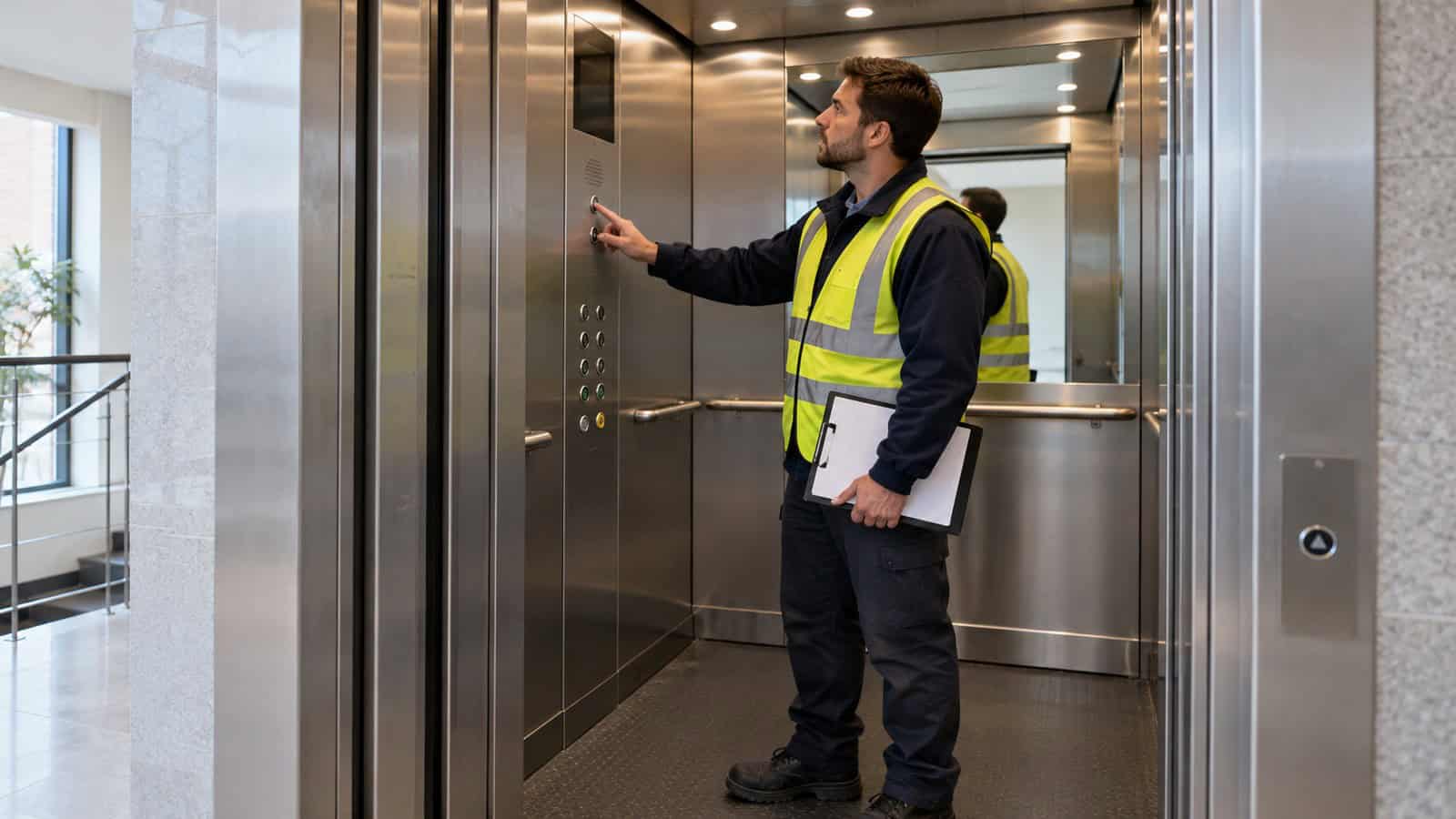
Start with the lift in normal service and the car at representative positions. Operate the alarm interface according to the approved safe procedure. Confirm call initiation, ring/answer, intelligible two-way audio, correct site and car identity, operator response and call clearing. Where a return-call function is required, test it through the monitoring centre’s actual process.
Repeat from difficult RF positions and with the machine-room or communications-cabinet doors in their normal state. Record mobile registration and signal indicators, but treat them as diagnostic context rather than a pass result.
Robustel’sPSTN replacement application example illustrates this complete path: analogue handset, FXS gateway, mobile or IP voice and monitoring centre. Each installed handset and service still needs its own witnessed acceptance.
Test Power and Network Failures Separately
Remove mains using the approved isolation method and confirm that the EV8100 and phone remain capable of the required supervised call. Record battery identity, temperature and elapsed time. Then restore power and confirm charging and normal registration.
Test the alternate SIM or voice path only if it is part of the approved design. Dual SIM does not protect against a failed gateway, antenna or battery. A data connection also does not prove VoLTE or SIP call delivery.
Minimum commissioning record
- building, lift/car and gateway serial identity;
- EV8100 firmware and regional variant;
- handset/autodialler model and relevant settings;
- SIM/service and monitoring-centre destination;
- antenna position and RF observations;
- normal and mains-failure call results;
- caller identity and audio confirmation; and
- names, date, corrective actions and sign-off.
How the Robustel EV8100 Elevator Voice Gateway Supports Testable Operations
The Robustel EV8100 elevator voice gateway provides one FXS port, dual SIM, VoIP/VoLTE functions, two Ethernet ports, RS-232, RS-485, CAN, four digital inputs and one relay output. Its FXS and voice capabilities support the migration architecture, while Robustel RCMS platform can add central status and device-management evidence.
Use remote status to prioritise and prepare service work. It may show a gateway or network exception before a scheduled visit, but it cannot certify two-way audio, passenger operation or monitoring-centre response. Keep the authoritative call record with the party responsible under the maintenance and compliance process.
Periodic Checks Should Detect Drift
Compare each test with the previous record. Look for longer registration, weaker RF, reduced battery performance, altered caller identity, audio change or repeated remote alarms. After a SIM, carrier, monitoring-centre, handset, antenna, power or firmware change, run the affected part of the acceptance test again.
Do not normalise retries. If a call succeeds on the third attempt, record the first two failures, their timestamps and the conditions in the car. A simple pass/fail sheet would erase the trend that may later explain an intermittent passenger complaint or a network transition problem.
An audit record should show failures and closure, not only successful calls. A recurring fault marked “passed after retry” is a trend that deserves engineering review.
Robustel’s Tsaro case study records standardised EV8100 operations and recurring call-readiness records. That makes it a useful example of repeatable evidence; Australian projects should map the same discipline to their own authority, monitoring-centre procedure, service contract and post-change test triggers.
よくある質問
Q1. How do you test a lift emergency phone?
Follow the approved safe procedure and complete a supervised two-way call from the lift to the monitoring centre. Confirm identity, audio, response and call clearing, then record the result.
Q2. Do elevator phones call 000 directly?
The call destination depends on the installed service and applicable requirements. Many systems call a staffed monitoring centre that identifies the lift and coordinates response; verify the actual programmed route.
Q3. Who monitors lift phone lines?
Usually an appointed monitoring centre or service provider under the building’s emergency communication arrangement. Ownership of testing, escalation and records should be written into the contract.
Q4. How often should a lift phone be tested?
Use the interval required by the applicable standard, authority, service contract and risk assessment. Retest after changes that affect power, RF, voice routing or the handset.
Q5. Can RCMS test the Robustel EV8100 Elevator Voice Gateway remotely?
RCMS can provide supported device and network status that helps operations identify exceptions. A witnessed call remains necessary where the procedure requires proof of audio, identity and monitoring-centre response.
結論
The Robustel EV8100 Elevator Voice Gateway makes the modernised voice path observable, while commissioning and periodic checks prove what matters to a trapped passenger: a completed, intelligible and correctly identified call. Remote evidence and supervised calls should reinforce each other rather than compete as alternative records.
Use one repeatable test sheet, preserve failed attempts and retest after material change. That record gives building owners, service teams and auditors a shared account of the installed service.
Explore More Articles About Robustel Lift Connectivity


著者について
Robustel Editorial Team
The Robustel Editorial Team publishes practical articles on industrial connectivity, edge computing, LoRaWAN and device management, focusing on deployment considerations, technical limitations and long-term operation.