
Lift Phone Battery Backup Guide: Runtime, Charging and Inspection Criteria
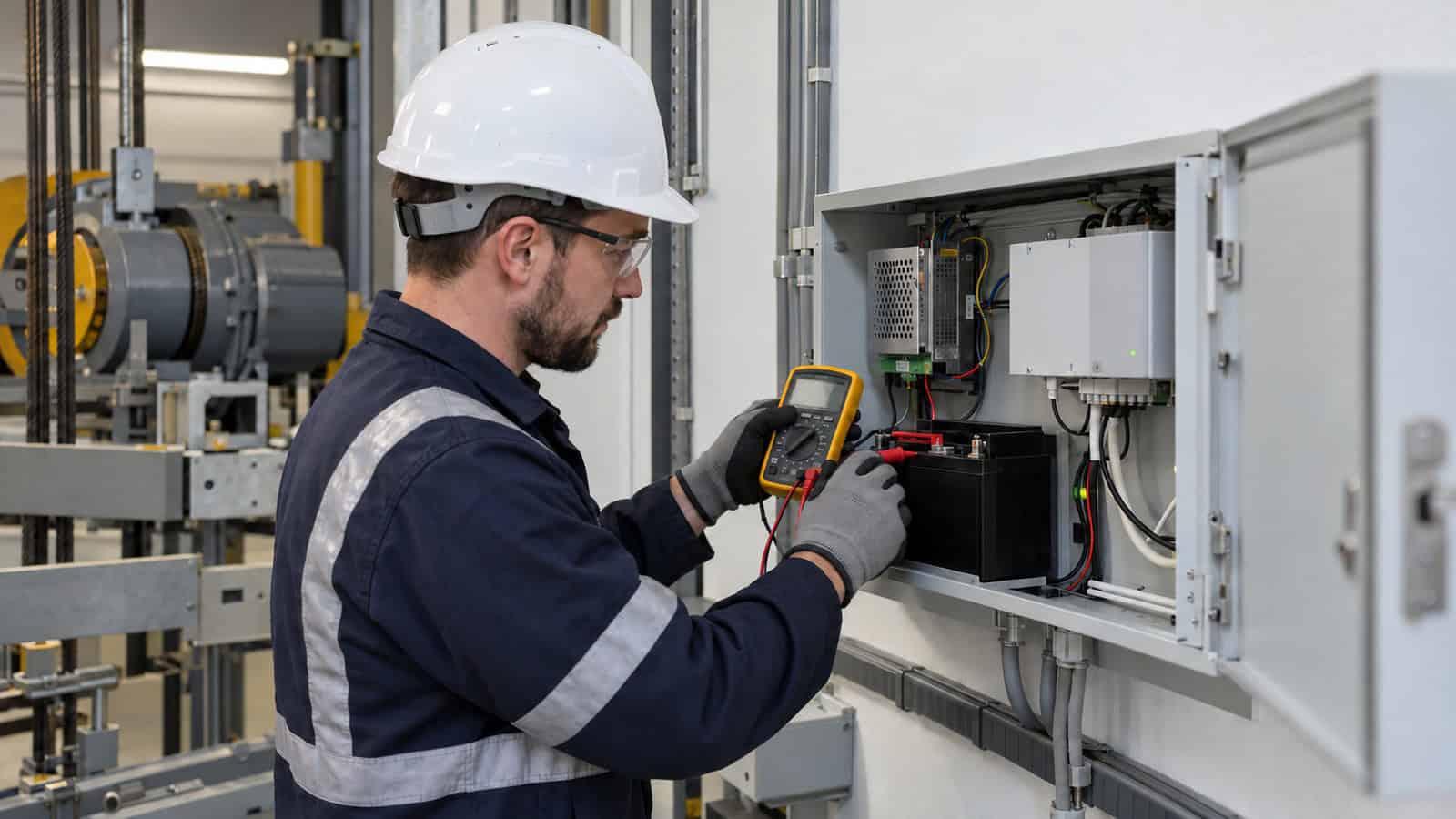
The Robustel EV8100 Elevator Voice Gateway includes a holder for two flat-top 18650 lithium batteries, giving an integrator a defined place to build power-loss resilience into a lift emergency-phone system, but it does not create a universal runtime. Battery specification, age, temperature, call activity, network conditions and configuration must be tested as one installed service.
Define the Service That Must Continue
Write the outage requirement in operational terms: the gateway remains registered, the existing analogue phone can seize the FXS line, the call reaches the approved monitoring centre, two-way audio works, the site/car identity is recognised and a return or repeat call follows the agreed procedure. A battery percentage or green LED does not prove that chain.
Review the applicable AS 1735 obligations, authority requirements, building emergency plan, service contract and monitoring-centre procedure with the responsible lift professionals. This guide supports engineering decisions; it does not set a statutory runtime or inspection interval.
The Robustel’s EV8100 Quick Pitch video is a useful pre-brief for service teams because it establishes the gateway’s role before the practical battery and call-path training begins. The method statement should then name the approved cells, outage profile and witnessed-call procedure for the actual site.
Temperature Changes Both Charging and Available Energy
The EV8100’s documented operating range is -20 to +60 °C without batteries and 0 to +45 °C with batteries. Charging is specified from 0 to +35 °C, and long-term storage with batteries is -20 to +35 °C. Those ranges are not interchangeable.
A machine room can be within the gateway’s no-battery operating range while being unsuitable for charging the installed cells. Record the temperature at the actual enclosure through representative seasons and check the selected battery manufacturer’s limits. Heat also accelerates ageing, so a capacity test that passes when new may not represent later service.
Runtime Must Be Measured Under a Named Profile
Document battery manufacturer, model, capacity, chemistry, protection features, installation date and initial condition. Batteries are not included with the EV8100 by default. If one battery is used, the datasheet directs it to position 1; fleet standards should avoid informal variations.
Create a test profile with standby time, registration activity, supervised calls and any connected interfaces that remain active. Disconnect mains, record voltage and reported status over time, place calls at the defined points and confirm graceful behaviour near the low-energy boundary. Do not deep-discharge cells outside their approved procedure merely to produce a larger number.
Robustel’s PSTN replacement application example shows how the EV8100 sits between an existing analogue emergency phone and mobile or IP voice. That call path defines what the battery test has to keep working; runtime is then measured with the selected cells, site temperature and final configuration.
Robustel’s Tsaro case study records standardised EV8100 installations and an operating model built around continuous records. An Australian maintenance plan can take that repeatability as a useful reference, while setting battery acceptance, inspection intervals and record ownership against the applicable local requirements and installed cells.
| Inspection item | Evidence | Escalate when |
|---|---|---|
| Battery identity | Model, lot/date, position | Unapproved or unmatched cells |
| Environment | Logged cabinet temperature | Charging range exceeded |
| Charge state | Trend after mains restoration | Capacity does not recover |
| Call service | Supervised two-way call | Registration or audio fails |
| Physical condition | Visual inspection | Swelling, leakage, heat or damage |
How the Robustel EV8100 Elevator Voice Gateway Supports Power-Loss Resilience
The Robustel EV8100 elevator voice gateway accepts 9–30 VDC and provides one FXS interface, dual SIM, VoIP/VoLTE capability and RCMS support alongside the internal battery holder. It exposes battery-related status for supported remote operations, while the site power supply, selected cells and inspection programme remain part of the installation.
Use Robustel RCMS platform to help identify gateway, network and battery-status exceptions; it does not replace a witnessed emergency call or a required inspection record.
During a mains-failure test, record the state in the order an operator would see it: loss of site power, battery takeover, mobile registration, FXS line seizure, monitoring-centre answer and recovery after mains returns. That sequence separates a weak cell from a network, call-routing or charging fault and gives the correct owner a useful incident record.
Inspect Trends, Not Only Pass/Fail Results
A battery can pass a short call and still be losing useful capacity. Compare charge recovery, voltage behaviour and witnessed-call results across inspections. Set a replacement rule based on the approved battery and maintenance plan, not on waiting for a complete failure.
When a test fails, preserve the conditions: temperature, mains state, registration, SIM/network, battery age and call result. Replacing cells without recording that evidence can leave a charger, power supply or coverage fault untouched.
The Robustel’s RCMS EV8100 data-usage guide shows battery information among the data that can be reported and explains how collection and keepalive settings affect mobile usage. Use that visibility to compare changes between inspections, then confirm any exception with the physical and witnessed-call checks defined in the maintenance plan.
よくある質問
Q1. Do lift phones need battery backup?
Lift emergency communication must have an approved power-loss strategy under the applicable rules and service design. The required arrangement and duration should be confirmed with the responsible lift and compliance parties.
Q2. How long should a lift phone battery last?
There is no safe universal answer. Required standby and call service, battery capacity and age, temperature, network activity and gateway configuration all affect the result. Use a witnessed project test.
Q3. How often should lift phone batteries be replaced?
Follow the approved battery specification, maintenance plan, condition trends and applicable inspection requirements. Calendar age alone is not enough, but waiting for failure is too late.
Q4. Can a lift phone work during a power cut?
It can when the complete emergency-call system has a working backup supply and the voice path remains registered and reachable. Prove it by isolating mains and completing a supervised call.
Q5. What battery provision does the Robustel EV8100 Elevator Voice Gateway have?
It has an internal holder for two flat-top 18650 lithium batteries, which are not included by default. Cell selection, runtime and inspection remain project responsibilities within the documented temperature limits.
結論
The Robustel EV8100 Elevator Voice Gateway provides a clear battery location and remote status boundary for a lift emergency-phone retrofit, but resilience is proved only when the selected cells support the complete call service after mains is removed. A runtime claim without temperature, load and test method is not useful maintenance evidence.
Keep the battery identity, environmental record, discharge profile and supervised-call result together. That history lets the service team replace a weakening component before a passenger discovers it.
Explore More Articles About Robustel Lift Connectivity


著者について
Robustel Editorial Team
The Robustel Editorial Team publishes practical articles on industrial connectivity, edge computing, LoRaWAN and device management, focusing on deployment considerations, technical limitations and long-term operation.