
Lift Gateway Coverage Survey Guide: Machine Room, Shaft and Antenna Placement
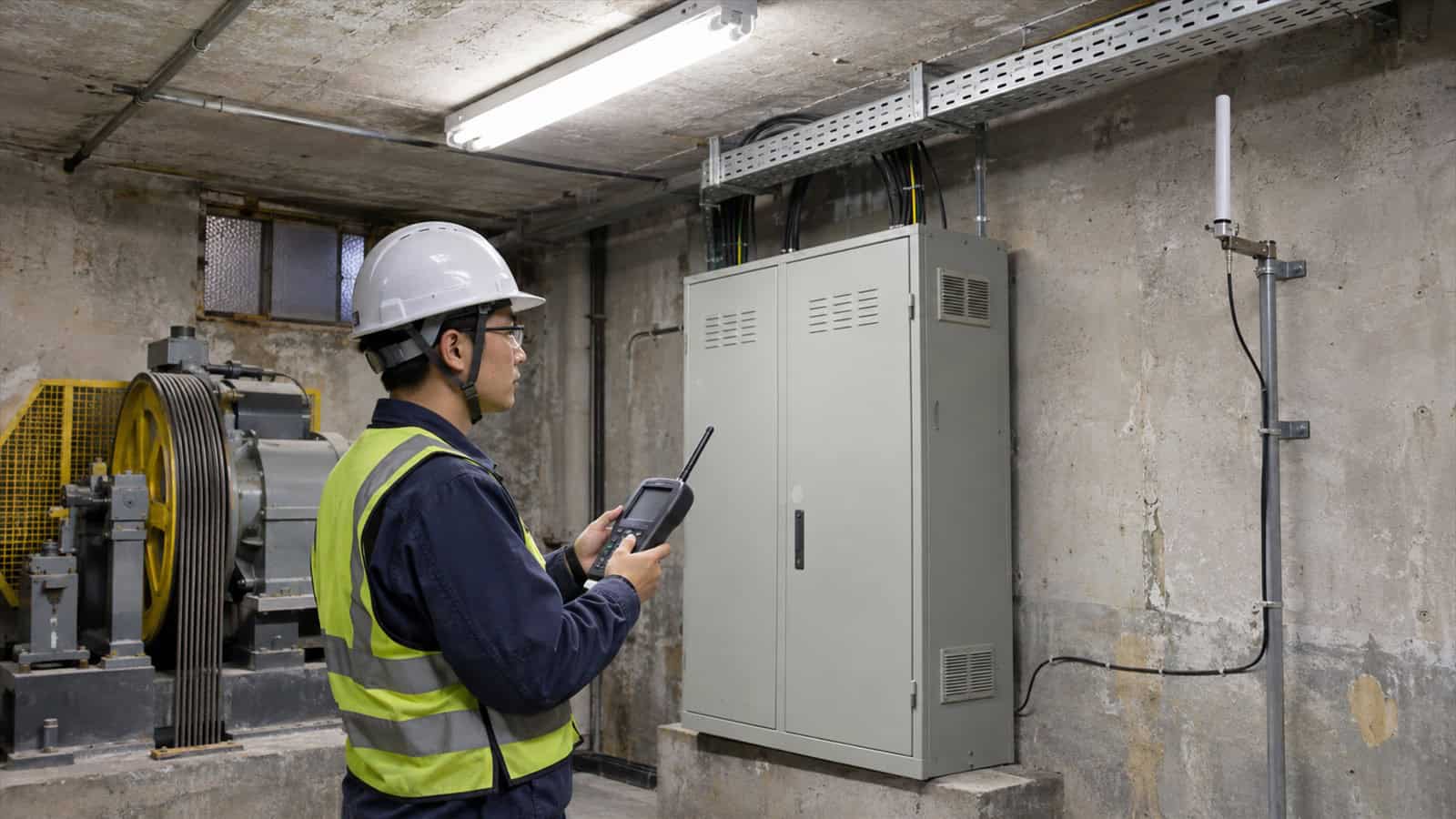
The Robustel EV8100 Elevator Voice Gateway uses external cellular antennas and dual SIM, giving lift service teams more flexibility when planning cellular coverage in machine rooms, shafts and other difficult installation areas. A signal reading taken at an open machine-room door or another convenient spot, however, does not prove that the final installed voice path will remain reliable once the gateway, antenna, cabinet doors and surrounding equipment are in their normal operating positions.
For installers and maintenance teams, a lift coverage survey should therefore test the final RF path rather than simply record the strongest available signal. This guide uses the Robustel EV8100 to show how to compare suitable cellular services, evaluate practical antenna locations and cable routes, and repeat call and signal checks under realistic site conditions before permanent installation.
Survey the Final RF Path, Not the Convenient Spot
Lift shafts, metal cabinets, basements and plant rooms create reflections and attenuation. Measure where the antenna will actually remain, with doors and equipment in normal states.
Record serving cell, signal metrics, registration, voice service and call outcome at representative times. A strong number without voice registration or stable audio is not acceptance.
| Location/state | Record | Decision |
|---|---|---|
| cabinet closed | metrics and call | baseline |
| lift moving | audio/registration | dynamic effect |
| busy period | repeated calls | capacity variability |
| mains loss | call on backup power | combined failure |
Design the Antenna Route as Part of the System
Account for connector type, cable length, bend radius, separation from power conductors and protected mounting. Extra cable can consume the gain expected from moving the antenna.
Avoid arbitrary shaft placement where access, moving equipment or regulation makes maintenance unsafe. Agree the route with the lift contractor and building owner.
- final antenna and cable model
- protected mounting and access
- two approved service options
- repeated witnessed calls
- survey date and cell identity
How the Robustel EV8100 Elevator Voice Gateway Supports Coverage Planning
| Coverage pain | Verified EV8100 capability | Survey consequence | Acceptance evidence |
|---|---|---|---|
| metal/underground machine room | two external cellular antenna connections | move the antenna to a safe, maintainable RF position instead of relocating the gateway blindly | repeat calls with the final cable and cabinet closed |
| provider variability | dual Mini SIM 4G/3G/2G support | compare approved services at the same installed position | record cell, registration, setup time, audio and DTMF |
| mains-loss scenario | internal holder for approved 18650 cells and battery-status functions | include backup-power state in the same installed-path survey | complete the authorized call test after mains removal |
Robustel EV8100 Elevator Voice Gateway provides dual-SIM cellular, VoLTE/VoIP capability and two external cellular antenna connections. The gateway can expose useful device and network states during qualification.
Use those states to compare locations and services, not to replace the call result. Signal, registration, audio, DTMF and monitoring-centre identity must all be accepted together.
Keep the final antenna position and cable in the installation record. A later cabinet move or cable replacement should trigger a targeted resurvey.
Challenge the Survey with Time and Failure
Repeat at busy periods and after the installation is complete. Remove the preferred service where approved and observe registration, call setup and return behaviour.
If results are marginal, change placement or service before relying on a threshold that passes only under ideal conditions. Preserve raw survey readings and call records for future comparison.
Evidence from Related Deployments
Robustel’s PSTN replacement application example shows the complete chain from analogue handset through FXS and mobile voice service to the receiving endpoint.
Robustel’s TSARO case study demonstrates the operational value of standardised EV8100 deployments and retained fleet records.
The Robustel EV8100 Quick Pitch video is useful for stakeholder orientation; terminal wiring, carrier acceptance and witnessed calls still require the current product documents and site procedure.
よくある質問
Q1. Where should a lift gateway antenna be installed?
At a safe, maintainable position that provides verified service with the final cable route and building state.
Q2. Can a cellular signal bar prove call reliability?
No. Registration, voice path, audio, DTMF and receiver acceptance also need testing.
Q3. Does antenna cable length matter?
Yes. Cable loss and installation quality can reduce the benefit of remote placement.
Q4. When should a lift coverage survey be repeated?
After relevant building, antenna, carrier or equipment changes and when performance trends degrade.
Q5. How does the Robustel EV8100 Elevator Voice Gateway support coverage surveys?
Its dual-SIM and network states support comparison, while the installed call remains the acceptance result.
結論
The Robustel EV8100 Elevator Voice Gateway provides the FXS, cellular voice and management functions for this lift-phone workflow, while the accepted result comes from an authorised end-to-end test in the installed building.
Keep the observed evidence, responsible people and recovery steps together. That record gives the next technician a starting point and prevents a changed network or handset from being treated as the same proven system.
Explore More Articles About Robustel Lift Connectivity



著者について
Robustel Editorial Team
The Robustel Editorial Team publishes practical articles on industrial connectivity, edge computing, LoRaWAN and device management, focusing on deployment considerations, technical limitations and long-term operation.